

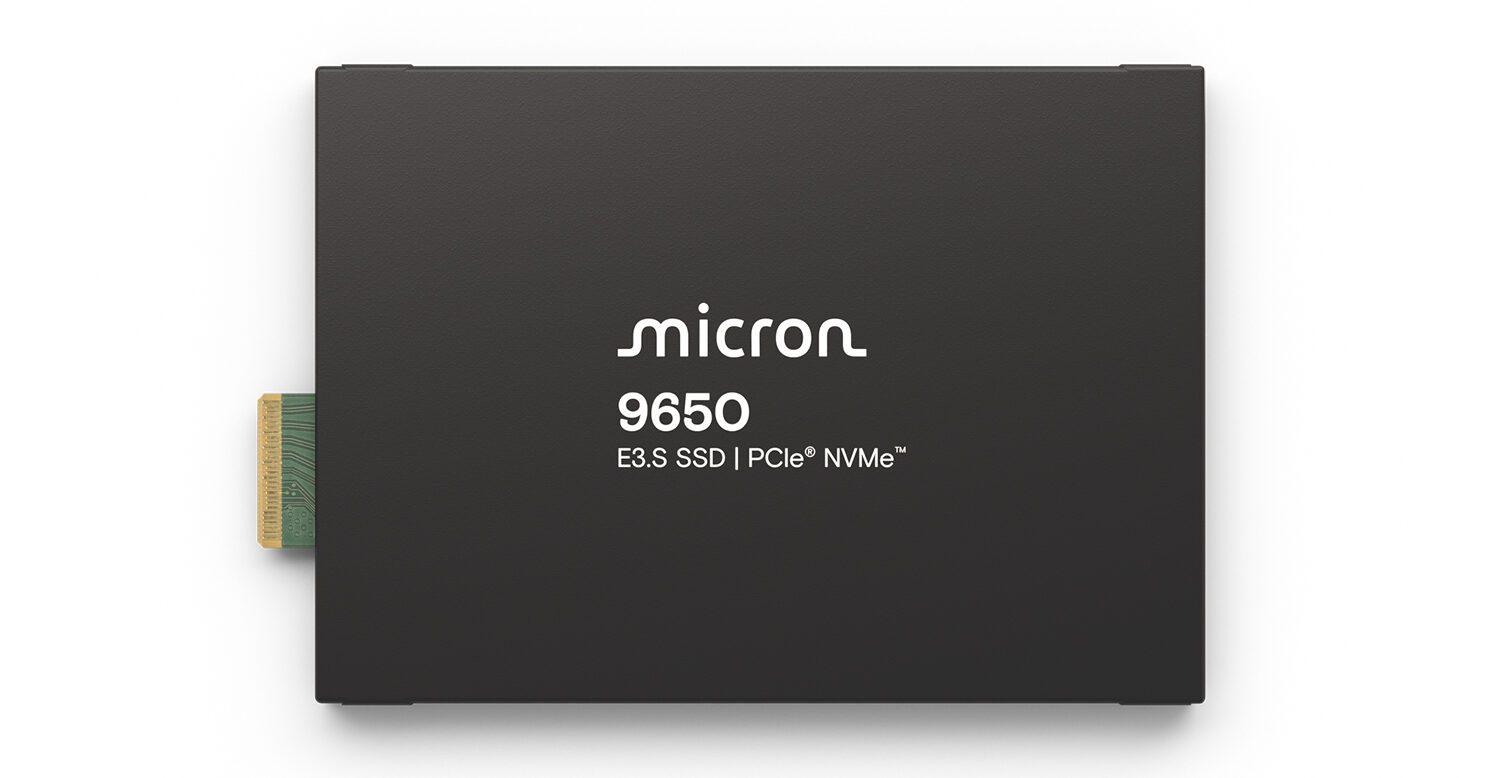
The transition to PCIe Gen6 storage has reached a commercial milestone: the Micron 9650 NVMe SSD has entered mass production, becoming the first data center SSD built on the PCIe Gen6 interface to ship at scale. The development marks a shift in storage architecture, as higher data throughput and improved energy efficiency become increasingly important to overall system performance in modern data centers.
For years, storage devices were designed primarily to avoid becoming bottlenecks in compute-heavy environments. As processors, accelerators, and network fabrics advanced, storage performance scaled incrementally to keep pace. That balance is changing. In AI-driven data centers, where massive datasets move continuously between storage and accelerators, input/output performance has become a primary architectural constraint rather than a background consideration.
PCIe Gen6 Doubles Bandwidth Ceiling
The PCIe Gen6 standard effectively doubles available bandwidth compared with PCIe Gen5, removing a key limitation in data movement between storage and compute resources. The Micron 9650 leverages a PCIe Gen6 x4 interface and NVMe 2.0 protocol to deliver up to 28,000MB/s sequential read speeds and 14,000MB/s sequential writes.
Compared with typical PCIe Gen5 enterprise SSDs, the Micron 9650 posts:
- 100% higher sequential read performance (28,000MB/s vs. 14,000MB/s)
- 40% higher sequential write performance (14,000MB/s vs. 10,000MB/s)
- 67% higher random read throughput (up to 5.5 million IOPS)
- 22% higher random write performance (up to 900,000 IOPS)
These performance gains are particularly relevant for AI model training and inference workloads. Large language models and retrieval-augmented generation pipelines require sustained high-throughput access to massive datasets. During inference, extended context windows increase real-time data access demands, making storage latency and bandwidth critical factors in maintaining responsiveness.
The drive is also designed to support evolving architectures in which data moves directly between accelerators and storage devices, reducing CPU mediation. The additional bandwidth provided by PCIe Gen6 enables more efficient peer-to-peer data transfers within next-generation AI systems.
Two Variants: PRO and MAX
The Micron 9650 is offered in two configurations: PRO and MAX. Both models use G9 TLC NAND and are available in E1.S and E3.S form factors, supporting modern data center deployment standards.
Micron 9650 PRO
- Capacities: 7.68 TB to 30.72 TB
- Sequential read/write: 28,000 / 14,000 MB/s
- Random read: 5.4–5.5 million IOPS
- Random write: 500,000–570,000 IOPS
- Endurance: 1 drive write per day (DWPD) for five years
Micron 9650 MAX
- Capacities: 6.4 TB to 25.6 TB
- Sequential read/write: 28,000 / 14,000 MB/s
- Random read: 5.4–5.5 million IOPS
- Random write: up to 900,000 IOPS
- Endurance: 3 DWPD for five years
Both models operate at a maximum of 25 watts, offer a mean time to failure rating of 2.5 million hours at 50°C, and support advanced security and compliance features. The drives are also designed to be compatible with GPU-direct technologies and liquid-cooled environments.
Efficiency Gains Amid Energy Constraints
Performance improvements in data centers are increasingly scrutinized for energy consumption. AI infrastructure already accounts for a growing share of global electricity use, and power availability is becoming a limiting factor in facility expansion.
At the same 25-watt power envelope, the Micron 9650 delivers significantly higher performance per watt than PCIe Gen5 drives. According to company specifications:
- Sequential read efficiency reaches 1,120 MB/s per watt, roughly double that of Gen5 equivalents.
- Sequential write efficiency improves by approximately 1.4×.
- Random read efficiency increases by 1.7×.
- Random write efficiency improves by 1.2×.
By delivering higher throughput without increasing power consumption, the drive helps operators extract more usable performance within fixed energy budgets. Faster task completion at the same power level can also reduce overall energy consumption for data-intensive workloads.
Thermal Demands Drive Cooling Changes
As I/O density rises alongside compute density, thermal management has become a broader system challenge. While GPUs have already transitioned to liquid cooling in many high-performance environments, storage devices are beginning to follow suit.
The Micron 9650 supports both air-cooled and liquid-cooled configurations, acknowledging that high-performance PCIe Gen6 SSDs may operate in environments where traditional airflow alone is insufficient. Integrating storage into platform-level thermal strategies reflects the increasing performance density of modern AI servers.
Ecosystem Validation and Deployment
Over the past 18 months, Micron conducted interoperability testing across the PCIe Gen6 ecosystem to prepare the drive for broader deployment. With mass production underway, the 9650 is currently being qualified by OEM partners and AI-focused data center operators.


 Amazon