

At COMPUTEX 2026, MSI showcased a broad range of AI and data center infrastructure platforms, with a clear emphasis on liquid cooling as rack power density continues to climb. The company’s exhibit featured OCP ORv3 rack-scale architectures, NVIDIA MGX-based GPU servers for training and inference, an NVIDIA DGX Station-derived desktop system for local AI work, and DC-MHS multi-node and enterprise platforms for modular cloud and enterprise deployments.
MSI Enterprise Platform Solutions General Manager Danny Hsu framed the portfolio around a practical challenge many operators face. “Scaling AI infrastructure now requires a balance between compute performance, thermal efficiency, and deployment flexibility,” Hsu said. MSI positioned its lineup to span everything from high-density rack-scale rollouts to deskside AI development environments.
Liquid-cooled ORv3 and air-cooled EIA rack architectures
MSI expanded its rack infrastructure options to include both OCP ORv3 liquid-cooled designs and standard 19-inch EIA air-cooled racks. The ORv3 approach targets high-density AI and cloud deployments. At the same time, the EIA option is intended to fit within existing enterprise data center standards without requiring a shift to new rack dimensions.
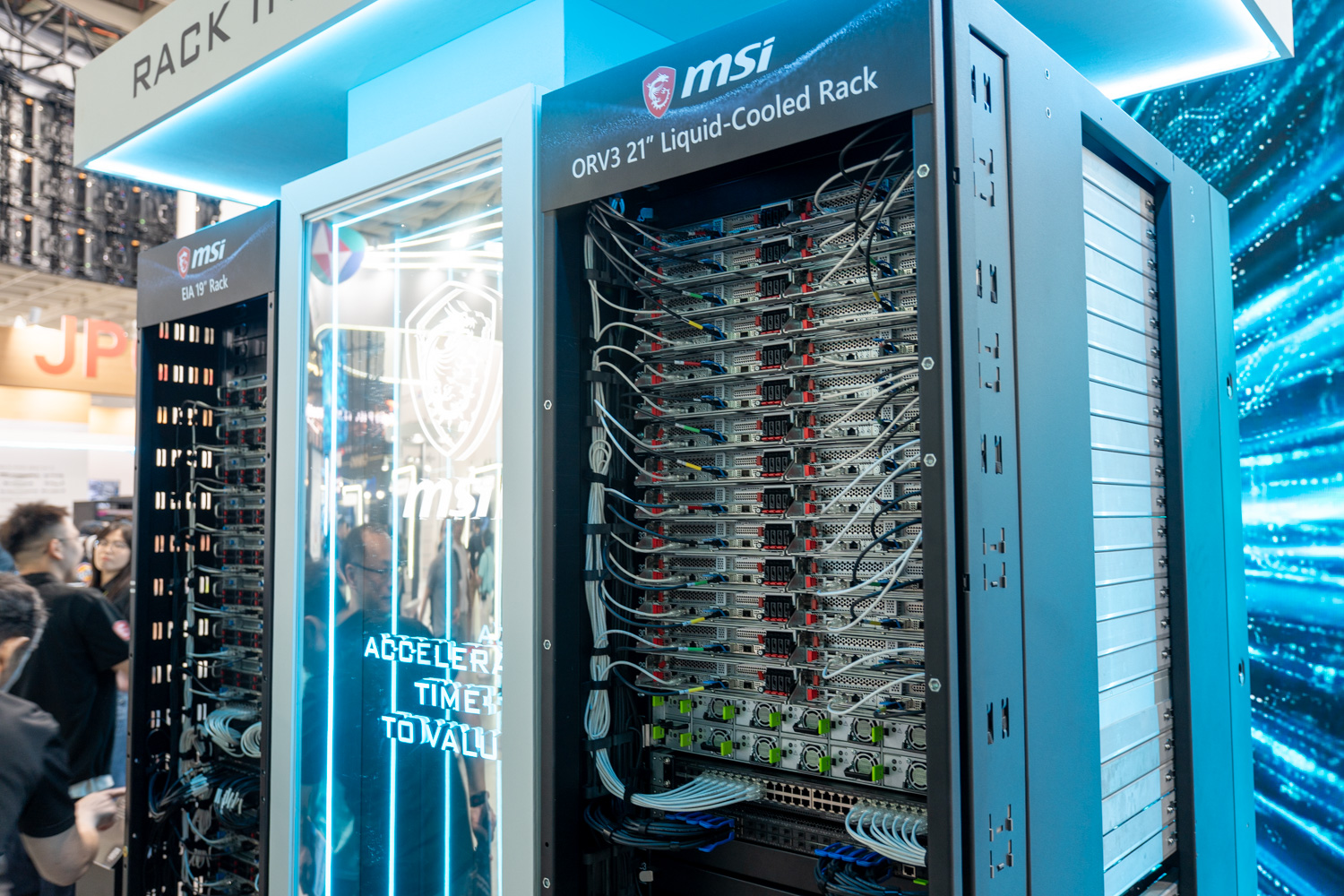
The 21-inch 44OU ORv3 liquid-cooled rack architecture is designed for deployments up to 100kW and includes an integrated liquid-to-liquid coolant distribution unit (L2L CDU). MSI demonstrated it configured with 28 of its 1OU2N Open Compute multi-node systems. MSI also emphasized the ORv3 rack’s use of 48V busbar power distribution as part of an overall design aimed at higher compute density with liquid cooling.
For environments that remain standardized on traditional racks, MSI also showcased a 19-inch, 48RU EIA air-cooled rack architecture. In this configuration, the rack supports 16 2U2N multi-node systems and offers both AMD EPYC 9005 and Intel Xeon 6 platform options, aligning the design with mixed enterprise and cloud deployment needs.
NVIDIA MGX GPU servers and a DGX Station-class desktop platform
On the GPU side, MSI’s portfolio centers on NVIDIA MGX, which it is using as the basis for a family of 2U, 4U, and 6U servers targeting AI training, inference, HPC, and data-intensive workloads across air-cooled and liquid-cooled configurations. MSI stated support for NVIDIA H200 NVL, NVIDIA RTX PRO 6000, and NVIDIA RTX PRO 4500 Blackwell Server Edition GPUs, and indicated ongoing work within the MGX ecosystem toward next-generation NVIDIA Vera Rubin rack-scale platforms.
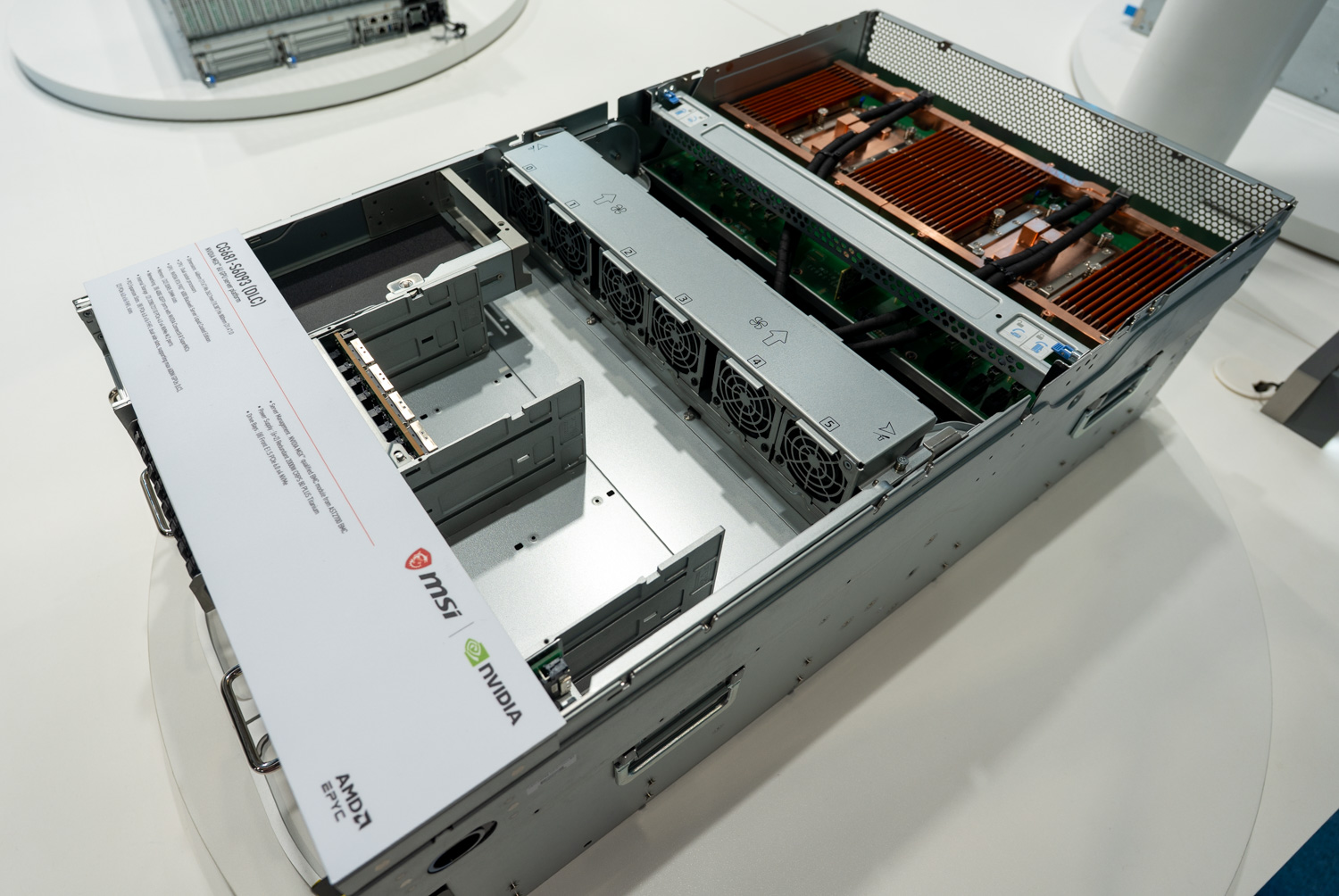
MSI highlighted several specific MGX server models. The CG681-S6093 is a liquid-cooled 6U dual-socket AMD EPYC system designed to scale to eight NVIDIA RTX PRO 6000 Blackwell Server Liquid Cooled Edition GPUs, with 32 DDR5 DIMMs and NVIDIA ConnectX-8 SuperNIC connectivity supporting up to 8x 400Gbps networking. The CG480-S5063 is a 4U dual-socket Intel Xeon 6 platform that supports up to eight double-wide GPUs, 32 DDR5 DIMMs, up to 20 E1.S NVMe drives, and five additional PCIe 5.0 expansion slots for storage-intensive AI and HPC configurations.
MSI also detailed two 4U dual-socket AMD EPYC 9005 options, the CG481-S6053 and CG480-S6053, each designed to support up to eight double-wide GPUs, 24 DDR5 DIMMs, and eight U.2 NVMe drives. MSI differentiated the two by highlighting high-bandwidth networking on the CG481-S6053, including up to 8x400G QSFP112 via NVIDIA ConnectX-8 SuperNICs, while positioning the CG480-S6053 with five additional PCIe 5.0 expansion slots for added flexibility.
Rounding out the MGX server highlights, MSI described the CG290-S3063 as a 2U, single-socket Intel Xeon 6 system that supports up to four double-wide GPUs, 16 DDR5 DIMMs, and rear U.2 NVMe storage, targeting inference, edge AI, and space-constrained data center deployments.
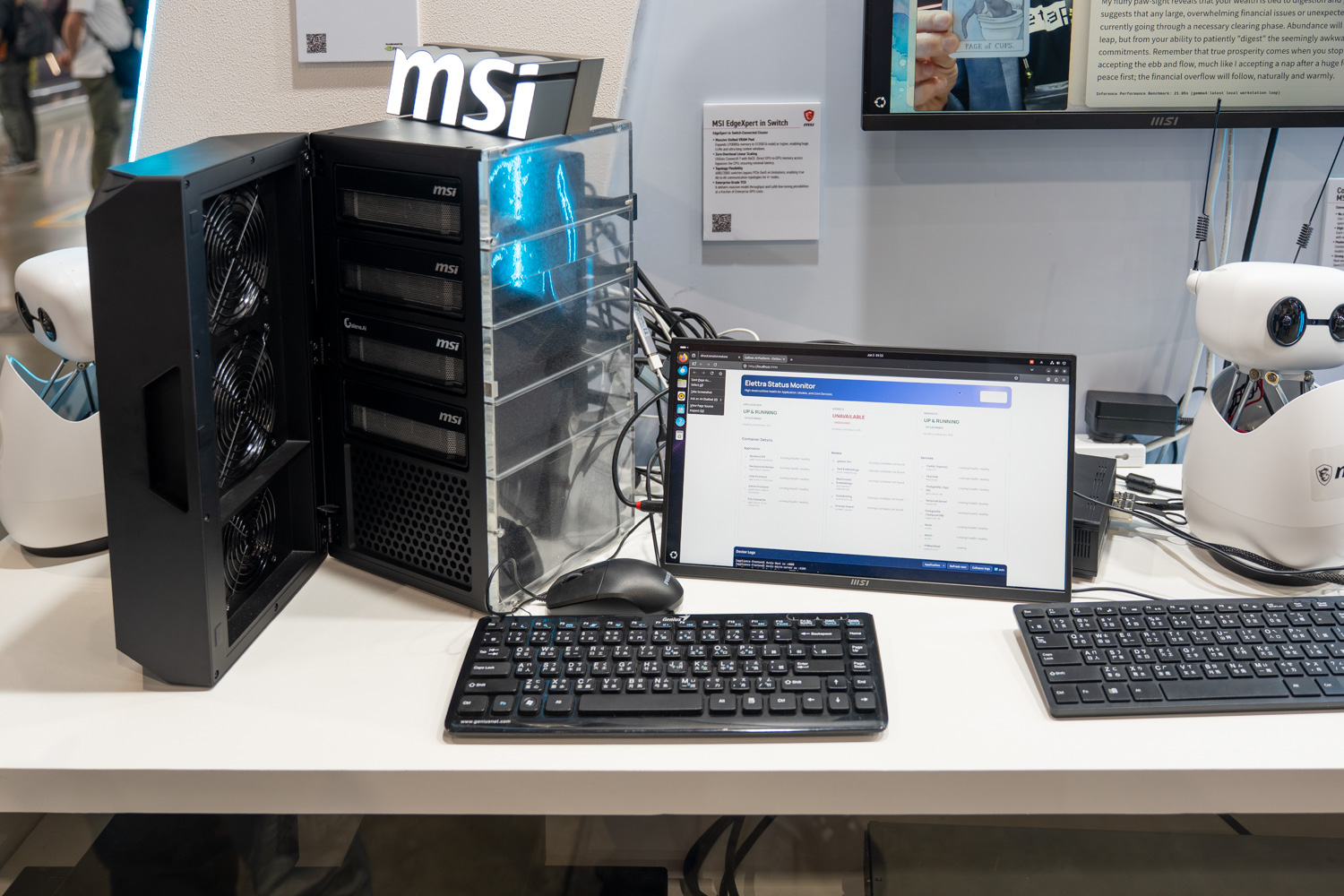
For local AI development and fine-tuning, MSI showcased its XpertStation WS300, a desktop platform based on the NVIDIA DGX Station architecture. MSI said the system is powered by the NVIDIA GB300 Grace Blackwell Ultra Desktop Superchip and supports up to 748GB of coherent memory and 7.1TB/s of HBM3e bandwidth, targeting high-throughput CPU-GPU communication and larger model workflows on-prem. MSI also specified dual 400GbE networking via NVIDIA ConnectX-8 SuperNICs and a liquid-cooled thermal design to sustain higher performance in a deskside form factor, with Windows support positioned for local AI application and agent development.
DC-MHS multi-node platforms for Open Compute and 19-inch environments
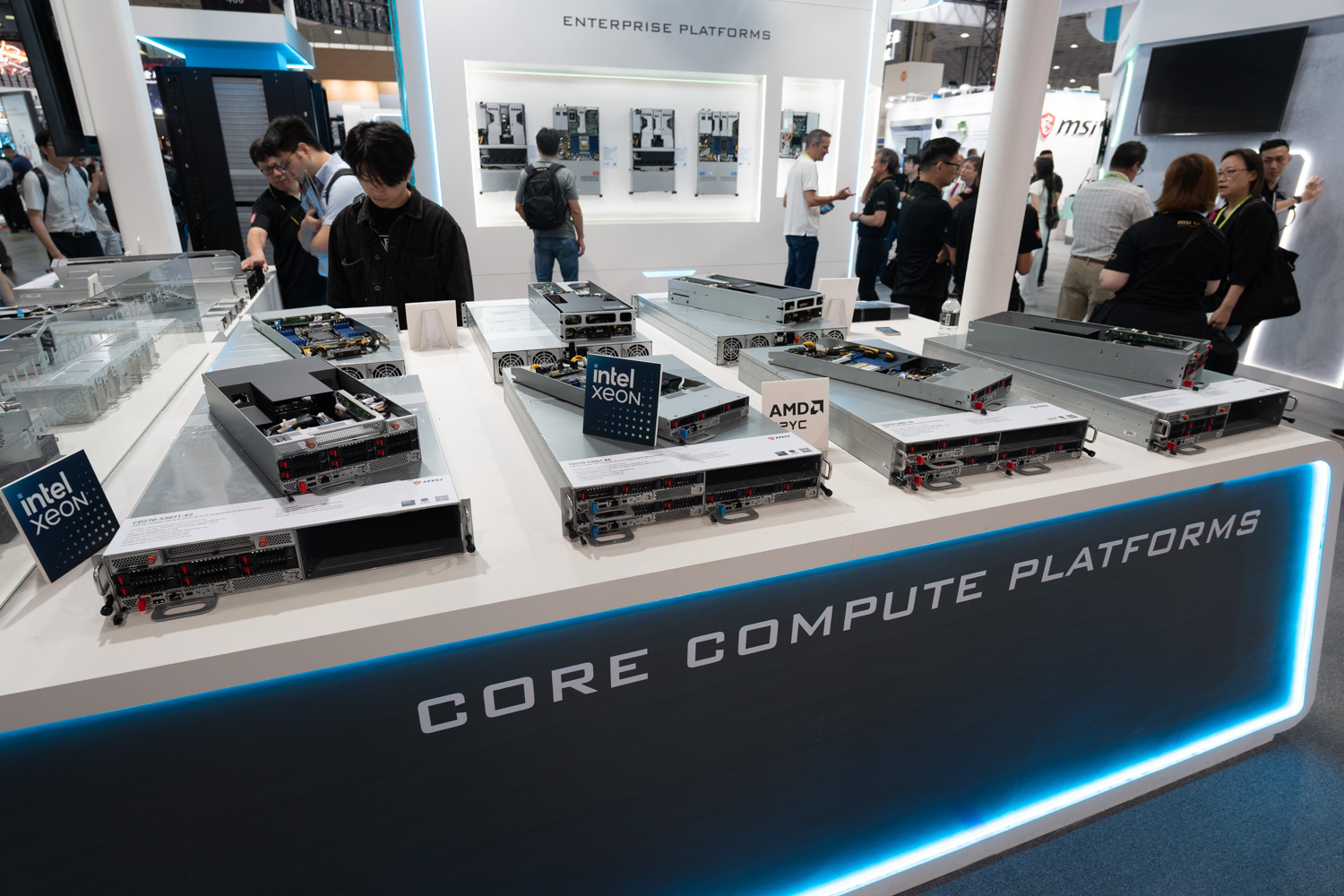
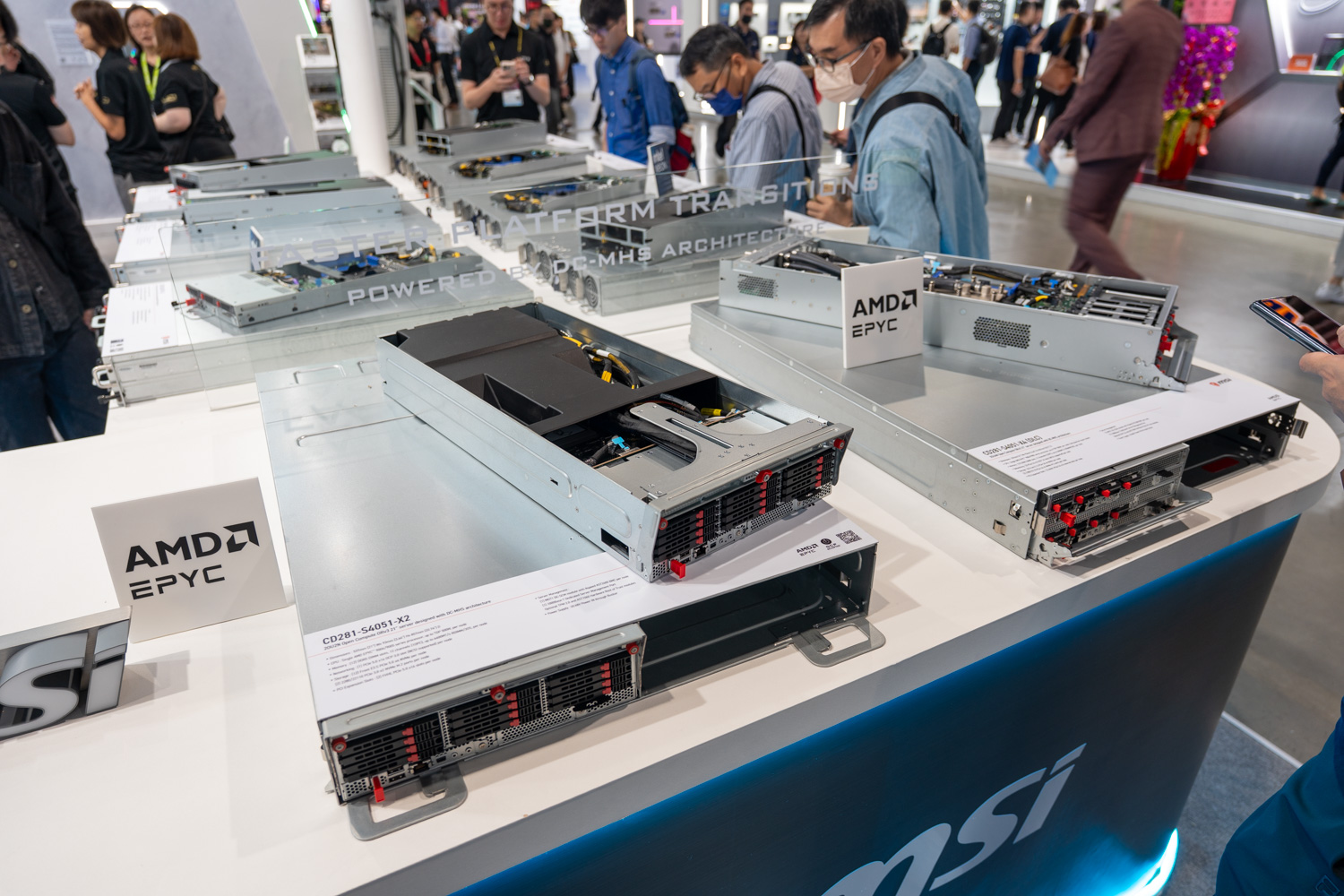
MSI also embraced modularity with 21-inch Open Compute and 19-inch Core Compute multi-node platforms based on the DC-MHS architecture, targeting hyperscale and cloud operators seeking simpler platform transitions and consistent building blocks across deployments.
Within the 21-inch Open Compute lineup, MSI described air- and liquid-cooled 1OU2N, 2OU2N, and 2OU4N designs optimized for density and 48Vdc busbar power distribution. Two examples were highlighted. The CD281-S4051-X4 is a liquid-cooled 2OU 4-node platform, with each node supporting a single AMD EPYC 9005 processor, 12 DDR5 DIMMs, and four E1.S NVMe bays, aimed at inference and cloud-native infrastructure. The CD281-S4051-X2 is a 2OU 2-node platform, also based on AMD EPYC 9005, with each node configured with 12 DDR5 DIMMs, 12 E3.S NVMe bays, and dual full-height, half-length PCIe 5.0 slots, positioning it for storage-rich scale-out designs.
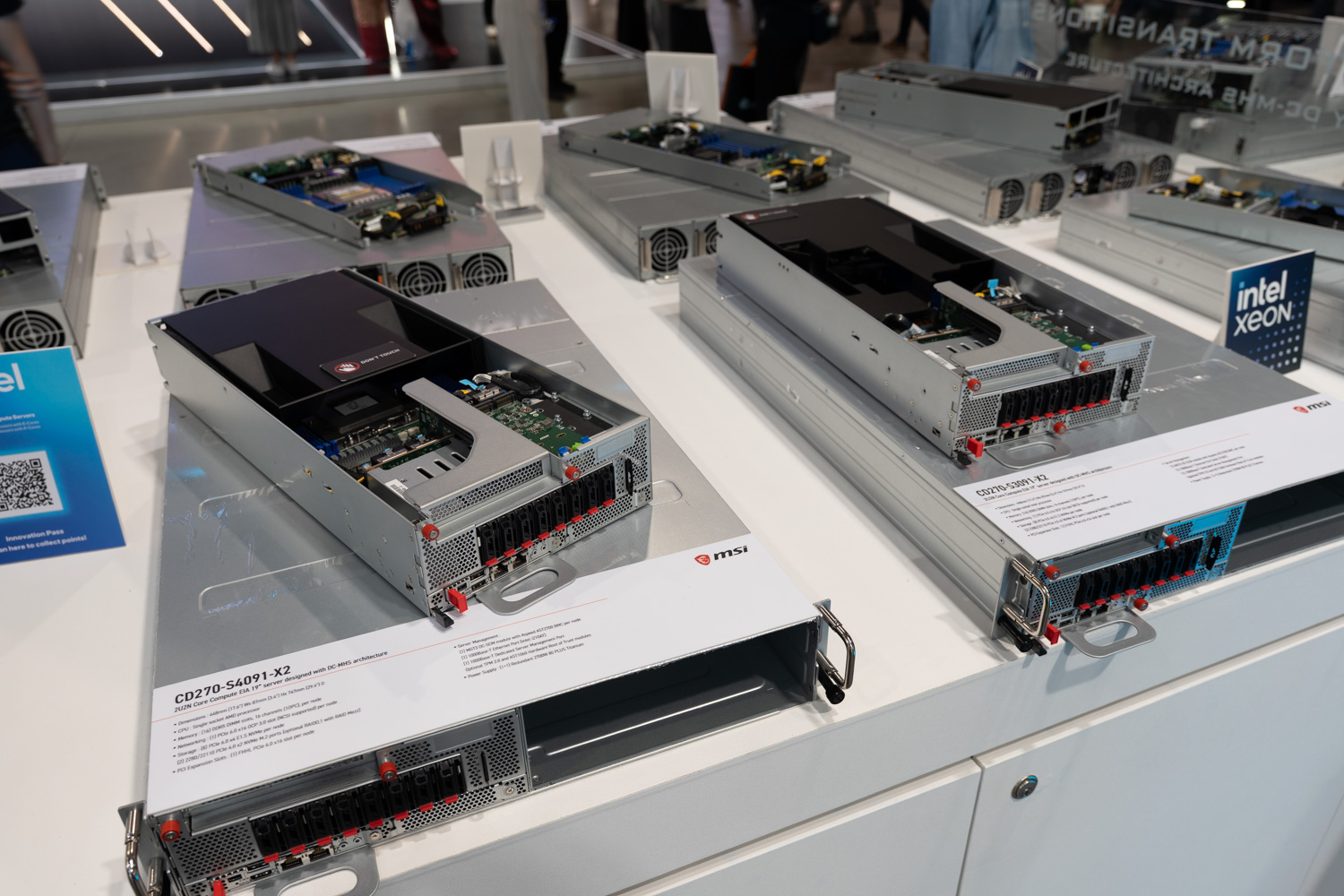
For 19-inch rack deployments, MSI’s Core Compute portfolio includes 2U2N and 2U4N systems spanning Intel Xeon 6 and AMD EPYC 9005 options. MSI cited the CD270-S3071-X4 and CD270-S3071-X2 as Intel Xeon 6 or 6+ platforms with 12 DDR5 DIMMs per node, supporting Xeon 6+ configurations up to 288 E-cores. The X4 variant carries three U.2 NVMe bays per node for compute-focused deployments, while the X2 doubles that to six bays per node for virtualization and data-centric services. MSI also listed the CD270-S3061-X4 as a 2U 4-node Intel Xeon 6 platform with 16 DDR5 DIMMs and three U.2 NVMe bays per node for mainstream scale-out and containerized use. On the AMD side, MSI described the CD270-S4051-X4 and CD270-S4051-X2 as EPYC 9005-based multi-node systems with 12 DDR5 DIMMs per node, with the X2 again shifting toward mixed compute and storage at six U.2 NVMe bays per node versus three on the X4.
Enterprise servers, modular HPMs, and motherboards
Beyond multi-node, MSI detailed a set of DC-MHS enterprise servers and modular HPMs intended to bridge modular cloud infrastructure and traditional enterprise requirements, including GPU-ready configurations.
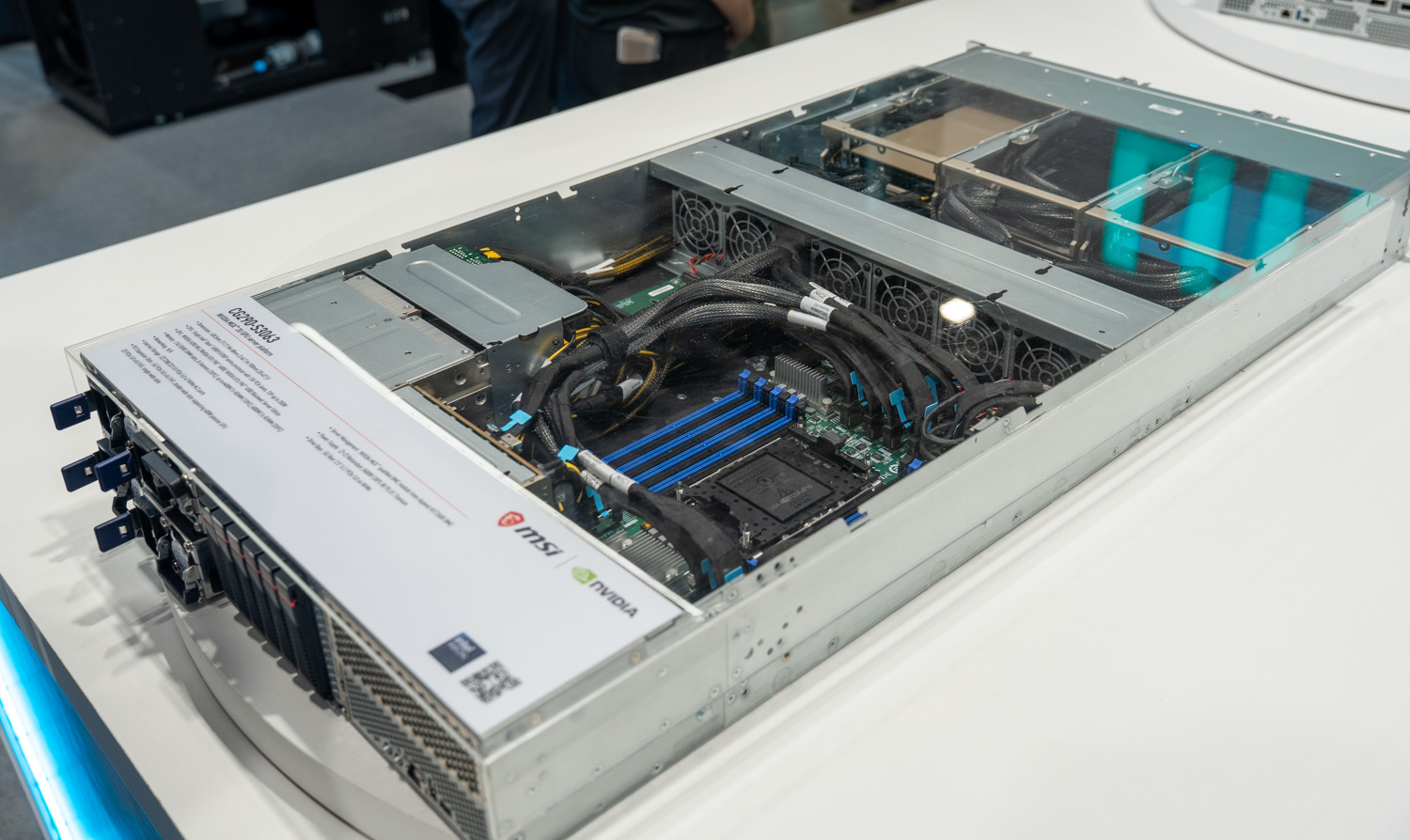
On DC-MHS enterprise servers, MSI listed dual-socket Intel Xeon 6 options, including the CX270-S5062 (2U) and CX170-S5062 (1U), each supporting 32 DDR5 DIMMs. The 2U system pairs eight U.2 NVMe drives with support for up to two double-wide 600W GPUs, while the 1U model steps up to 12 U.2 NVMe drives for high-density cloud infrastructure. MSI also outlined single-socket AMD EPYC 9005 systems, the CX271-S4056 (2U) and CX171-S4056 (1U), with up to 24 DDR5 DIMMs, and a separate single-socket Intel Xeon 6 pair, the CX271-S3066 (2U) and CX171-S3066 (1U), supporting up to 16 DDR5 DIMMs. Across both single-socket families, the pattern holds: the 2U models support up to two double-wide 600W GPUs and eight U.2 drives, while the 1U models carry 12 U.2 drives for scale-out deployments.
On the modular side, MSI referenced DC-MHS HPM support across the M-DNO Type-2, M-DNO Type-4, and M-FLW form factors, listing specific modules for Intel Xeon 6 and AMD EPYC 9005 platforms. MSI also cited standard enterprise motherboards for Intel Xeon 6 (D3060) and AMD EPYC 9005 (D4050), indicating continued coverage for mainstream enterprise and workstation server builds outside DC-MHS deployments.


 Amazon