

At CES 2026, NVIDIA will introduce G-SYNC Pulsar, a new display technology designed to improve motion clarity in fast-paced games. The technology debuts alongside a new wave of 27-inch, 1440p, 360Hz monitors from multiple manufacturers, all scheduled to become available starting at CES.
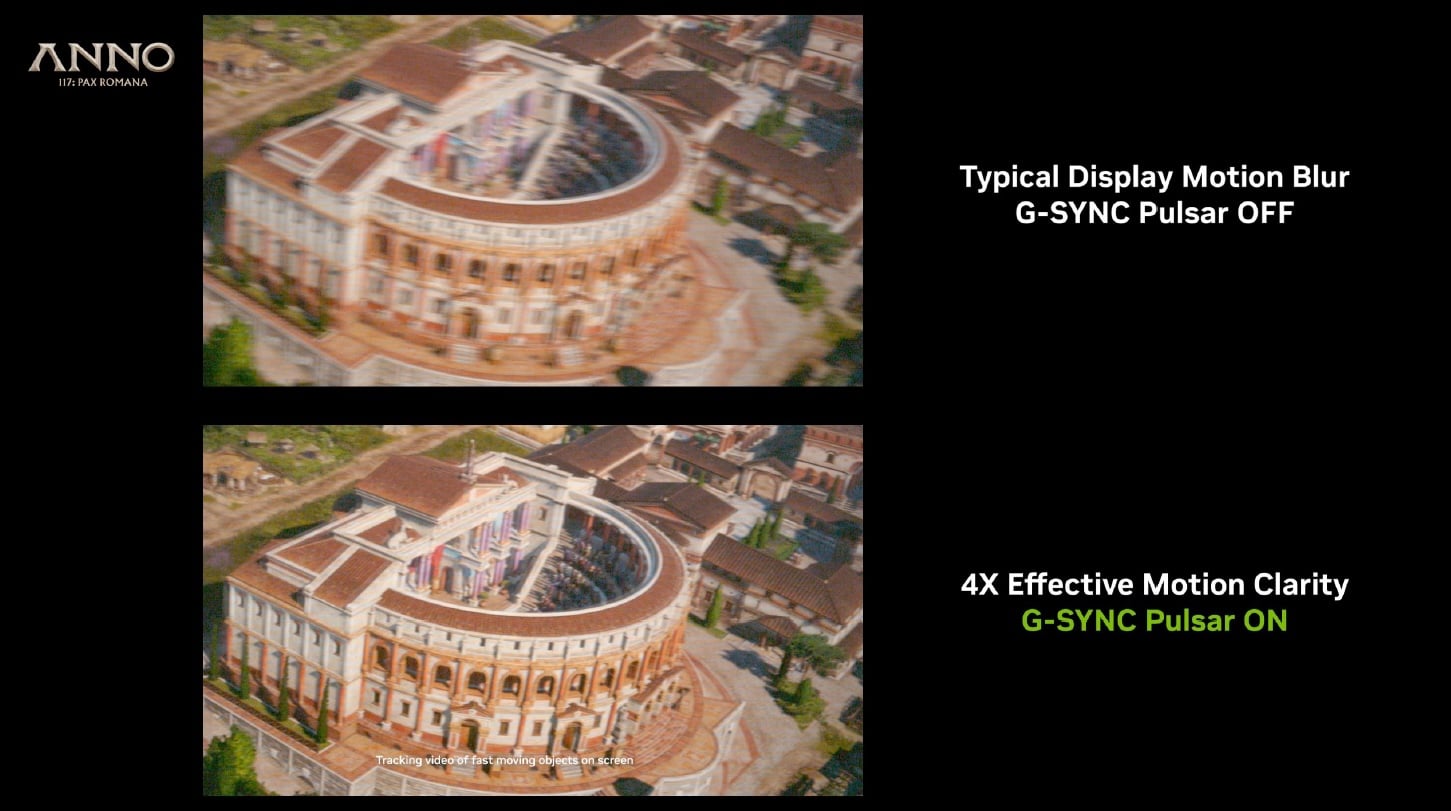
Rather than focusing on higher refresh rates, Pulsar addresses how motion is displayed on LCD panels during gameplay. The goal is to reduce motion blur while maintaining variable refresh rate behavior, a capability that has traditionally required compromises with backlight strobing techniques.
Even at refresh rates up to 360Hz, LCDs still exhibit motion blur. NVIDIA explains that this occurs because each frame remains visible on the screen for its full duration. When a player’s eyes track a moving object, the image does not move with the eye, which results in perceived blur.
Traditional displays keep the backlight fully illuminated while the image is scanned onto the panel from top to bottom. Although the pixels update quickly, the continuous illumination causes the image to linger long enough for blur to become visible during fast motion. Conventional backlight strobing can reduce this effect, but it typically requires fixed refresh rates and often conflicts with variable refresh rate operation.
How G-SYNC Pulsar Alters Backlight Behavior
G-SYNC Pulsar changes this behavior by introducing a rolling, region-based backlight pulsing system that operates in sync with the panel’s scanout. Instead of keeping the entire backlight on continuously, the display briefly illuminates small sections of the screen as the scan progresses.
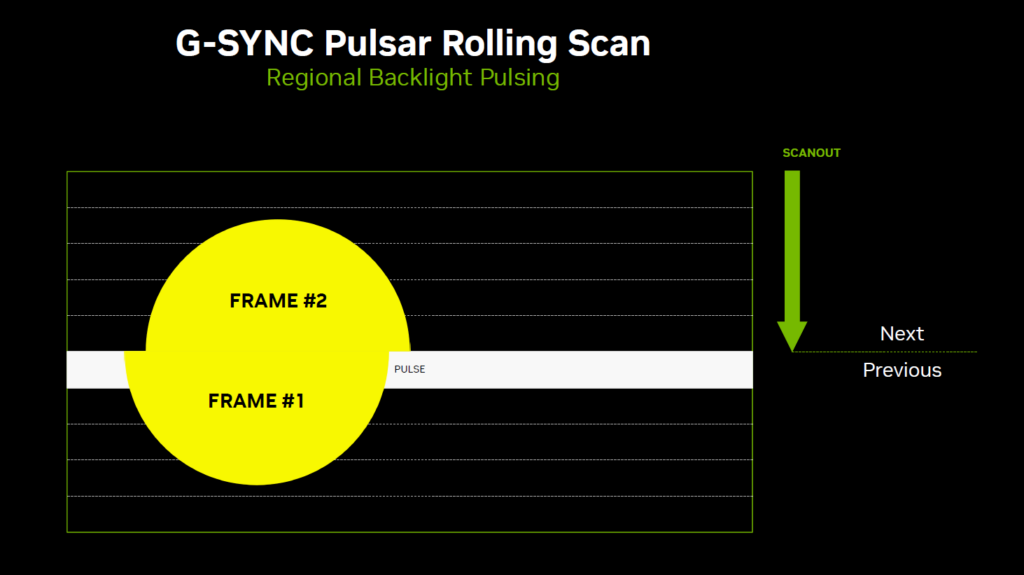
Each region of pixels is given time to stabilize before the backlight pulses on, then turns off again as the scan advances. By shortening the duration each image remains visible, NVIDIA says Pulsar reduces object hold time, improving motion clarity during fast movement.
The backlight pulse occupies roughly 25% of each frame’s duration, resulting in a four-times reduction in object hold time compared to a traditional display. NVIDIA refers to this as delivering more than 1000Hz of perceived motion clarity, even though the panel operates at 360Hz. This process remains active alongside variable refresh rate operation, allowing the display to adapt dynamically as frame rates change.
Displays, Features, and What This Signals
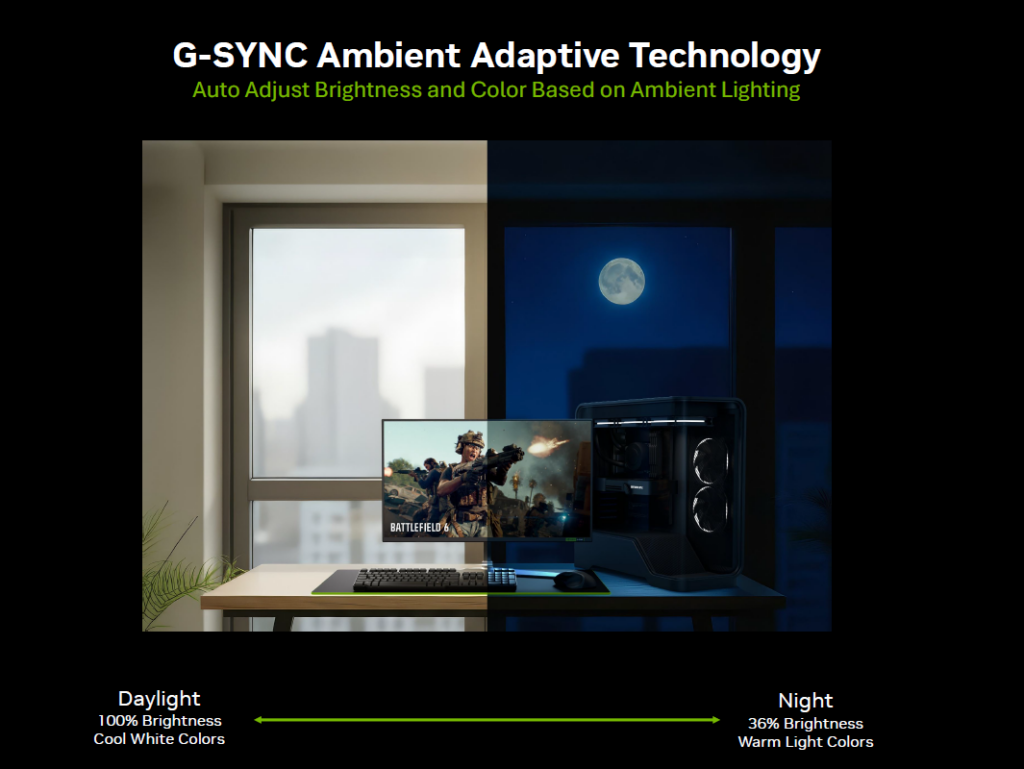
Pulsar-equipped monitors also include G-SYNC Ambient Adaptive Technology, which automatically adjusts brightness and color temperature based on ambient lighting conditions. Brighter environments increase brightness and shift toward cooler tones, while darker environments reduce brightness and shift toward warmer tones.
Control over Pulsar and other G-SYNC features will be available through Project G-Assist, a feature within the NVIDIA App for RTX-based systems. This allows users to adjust monitor settings such as refresh rate, G-SYNC status, and Pulsar activation without relying on traditional on-screen menus.
Acer, AOC, ASUS, and MSI will offer initial G-SYNC Pulsar displays. All announced models share the exact core specifications, including a 27-inch IPS panel, 2560×1440 resolution, 360Hz refresh rate, Pulsar support, and Ambient Adaptive Technology.
With Pulsar, NVIDIA is placing less emphasis on increasing refresh rates and more on how long images remain visible on screen. Motion persistence is still a limiting factor for LCD gaming displays, even at very high refresh rates. By pairing variable refresh rate support with region-based backlight pulsing, Pulsar takes a different approach to improving motion clarity, focusing on display behavior rather than raw panel speed.


 Amazon