

Qualcomm Technologies had a full plate during its 2026 Investor Day, laying out an aggressive data center strategy built around three major announcements: the acquisition of AI software company Modular Inc., the introduction of the Dragonfly C1000 CPU and expanded inference accelerator portfolio, and deepened partnerships with Hugging Face and Meta. Together, the moves signal Qualcomm’s intent to compete across the full stack of AI infrastructure, from silicon to software to ecosystem.
Qualcomm to Acquire Modular Inc.
Qualcomm has entered into a definitive agreement to acquire Modular Inc., an AI software company whose platform is designed to enable efficient AI execution across heterogeneous hardware architectures. The transaction is expected to close in the second half of 2026, subject to regulatory approvals and customary closing conditions.
Modular was founded by engineers who contributed to foundational AI infrastructure projects and has built an open, AI-native software stack that runs across CPU, GPU, NPU, and custom ASIC architectures without requiring developers to rewrite code for each target. The platform’s portability is a key differentiator, allowing organizations to build once and deploy across any environment while reducing the total cost of ownership.
The acquisition addresses a growing constraint in AI deployment. As Qualcomm frames it, efficiency, not raw capability, is becoming the limiting factor: performance per watt drives the cost of inference, and software efficiency is becoming a primary lever for scaling it economically. Modular’s stack is aimed squarely at that lever, turning silicon performance into efficient inference across heterogeneous, disaggregated compute.
For Qualcomm’s data center strategy, the deal deepens its ability to deliver optimized inference, orchestration, and deployment across a range of platforms, from edge devices to hyperscalers that require consistent performance across diverse hardware environments. Modular’s developer community, which Qualcomm describes as open, industry-friendly, and vendor-neutral, adds further reach into the AI developer ecosystem.
Dragonfly C1000 CPU and Data Center Platform
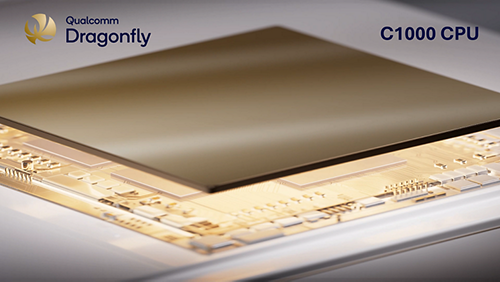
Qualcomm introduced the Dragonfly C1000, a purpose-built data center CPU designed around its custom Oryon cores, targeting agentic AI orchestration, general-purpose server workloads, and AI head node applications. The processor is built on a multi-chiplet architecture with more than 250 cores, operates at frequencies above 5 GHz, and is engineered to deliver more than 2x better performance per watt than current competitive server CPU offerings, based on published specifications.
The C1000 supports PCIe Gen 7 connectivity at over 2 TB/s, along with CXL support for memory disaggregation and high-speed storage and networking integration. Its memory subsystem is designed for high bandwidth, capacity, and power efficiency using leading-edge low-power memory technology. The platform supports both air and liquid cooling and is compliant with OCP ORv3 rack and server standards. Reliability features include ECC, fault isolation, and error recovery for resilient operation at scale. Commercial availability is targeted for 2028.
The C1000 is offered in three configurations: an agentic CPU optimized for high-throughput orchestration and low-latency interactive AI; a general-purpose CPU targeting performance-per-TCO for first-party workloads and vCPU elasticity for third-party usage; and an AI head node CPU designed to maximize XPU utilization through low-overhead host processing over high-speed interconnects.
Qualcomm High Bandwidth Compute (HBC)
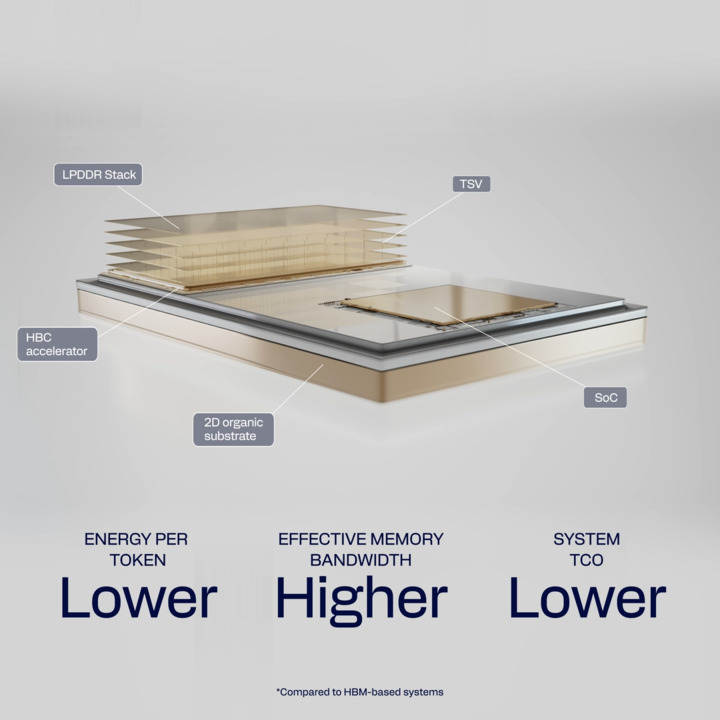
Central to Qualcomm’s inference accelerator roadmap is its High Bandwidth Compute architecture, a near-memory computing design that bonds compute with accelerated memory bandwidth in a 3D-stacked silicon solution. HBC is positioned as a direct alternative to HBM, with Qualcomm claiming 6x higher bandwidth per watt than HBM and 200x higher capacity per watt than SRAM, based on normalized card- and rack-level comparisons against published competitor specifications.
HBC Gen 1, integrated into the Dragonfly AI250, delivers 133 TB/s of effective memory bandwidth per card, representing an 18x increase over the AI200 with LPDDR5X. HBC Gen 2, integrated into the newly announced AI300, delivers a 54x increase over the AI200. Commercial sampling of HBC Gen 1 with the AI250 is expected in mid-2027.
Dragonfly AI300
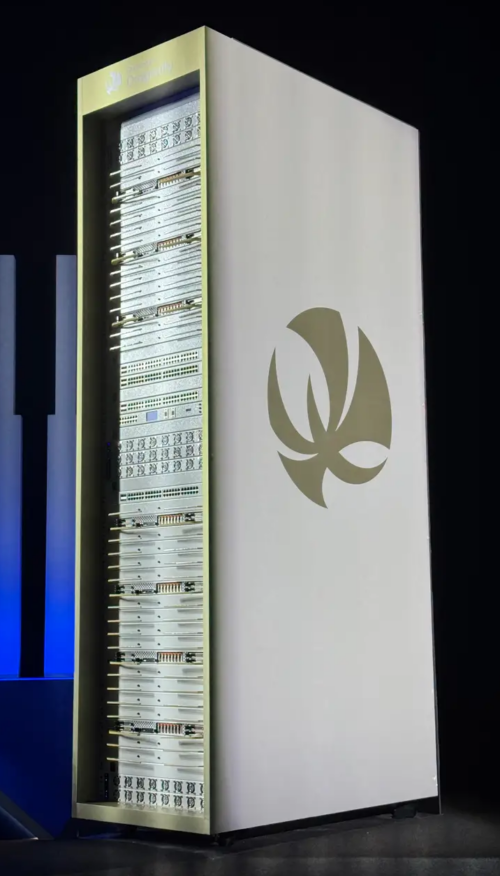
The AI300 is the third generation of Qualcomm’s rack-scale AI inference platform, following the AI200 and AI250, which were announced in October 2025. It integrates HBC Gen 2 for compute acceleration with increased effective memory bandwidth and capacity, targeting large language model and multimodal model inference as well as agentic AI workloads. Qualcomm projects 4x to 8x higher memory bandwidth per watt per card compared to existing GPU-based architectures. The AI300 supports scale-up via UALink and ESUN, and scale-out via copper and optical interconnects. Commercial sampling is expected in 2028.
Connectivity
Qualcomm’s data center connectivity portfolio spans die-to-die, copper, optical, and campus-reach interconnects, supporting 800G and 1.6T bandwidth across optical, AOC, and AEC applications, with reach up to 20 km. The portfolio draws on Qualcomm’s SerDes, PAM4, coherent-lite DSP, and signal-integrity capabilities to address data movement bottlenecks that increasingly define performance in distributed, disaggregated AI infrastructure.
Custom Silicon
Qualcomm also outlined a custom silicon offering targeting hyperscalers and cloud providers with bespoke designs for agentic AI and specialized workloads. The program covers end-to-end co-design across silicon, system, and software, with advanced packaging and modular architectures designed to reduce time-to-market and execution risk through high-volume manufacturing support.
Partnerships: Hugging Face and Meta
Hugging Face
Qualcomm announced an expansion of its strategic relationship with Hugging Face, structured around three pillars spanning its Snapdragon, Dragonwing, and Dragonfly product families. The collaboration is designed to connect Qualcomm’s device-to-data-center platforms with Hugging Face’s 16 million-strong developer community and its library of over 3 million open models.

The first pillar maps Hugging Face’s storage and inference services to Qualcomm Dragonfly-powered data center infrastructure, creating a direct path from model experimentation to production deployment of applications and agents. The second pillar focuses on model deployment automation: AI models from the Hugging Face ecosystem are planned to be onboarded onto Qualcomm platforms via an agent-based workflow that handles setup, optimization, and deployment with no manual integration required. This is intended to simplify deployment across smartphones, PCs, wearables, industrial systems, automotive platforms, and data center infrastructure from a single workflow.
The third pillar targets agentic AI orchestration across hybrid environments. Qualcomm and Hugging Face plan to support a distributed AI framework in which agents operate across on-device and cloud systems, dynamically routing models and workflows based on performance, cost, privacy, and latency requirements. As part of the collaboration, Hugging Face will offer customers using Qualcomm-powered devices or cloud systems access to Hugging Face PRO. Developers will also be able to access Modular’s AI software components and tools through the Hugging Face ecosystem, directly connecting the Modular acquisition to this partnership.
Meta
Qualcomm and Meta announced a strategic multi-generation collaboration in which Qualcomm will supply data center CPUs to Meta. The Dragonfly C1000 is planned to power Meta’s next-generation server fleet, representing a significant design win for Qualcomm’s data center CPU ambitions and validating the platform’s positioning for large-scale, scale-out deployments in terms of performance and efficiency.

In addition to Meta, more than 35 ecosystem partners across the technology and AI supply chain have expressed support for Qualcomm’s data center vision, including Arista, Lenovo, Micron Technology, Samsung SDS, SK hynix America, Supermicro, VAST Data, and others spanning ODMs, memory suppliers, networking vendors, and AI infrastructure providers.
Qualcomm has committed to a multi-generation data center roadmap with an annual cadence, with the Dragonfly AI300 joining the AI200 and AI250 in an inference accelerator lineup that will continue to evolve alongside the C1000 CPU platform and Modular’s software stack.


 Amazon