

Dell Technologies has introduced the PowerEdge XE8812, a new liquid-cooled server platform designed for large-scale inference and high-performance computing workloads. The system joins the Dell AI Factory with the NVIDIA portfolio. It is built around the NVIDIA Vera Rubin NVL4 architecture, offering up to 144 GPUs per rack in a dense rack-scale configuration.
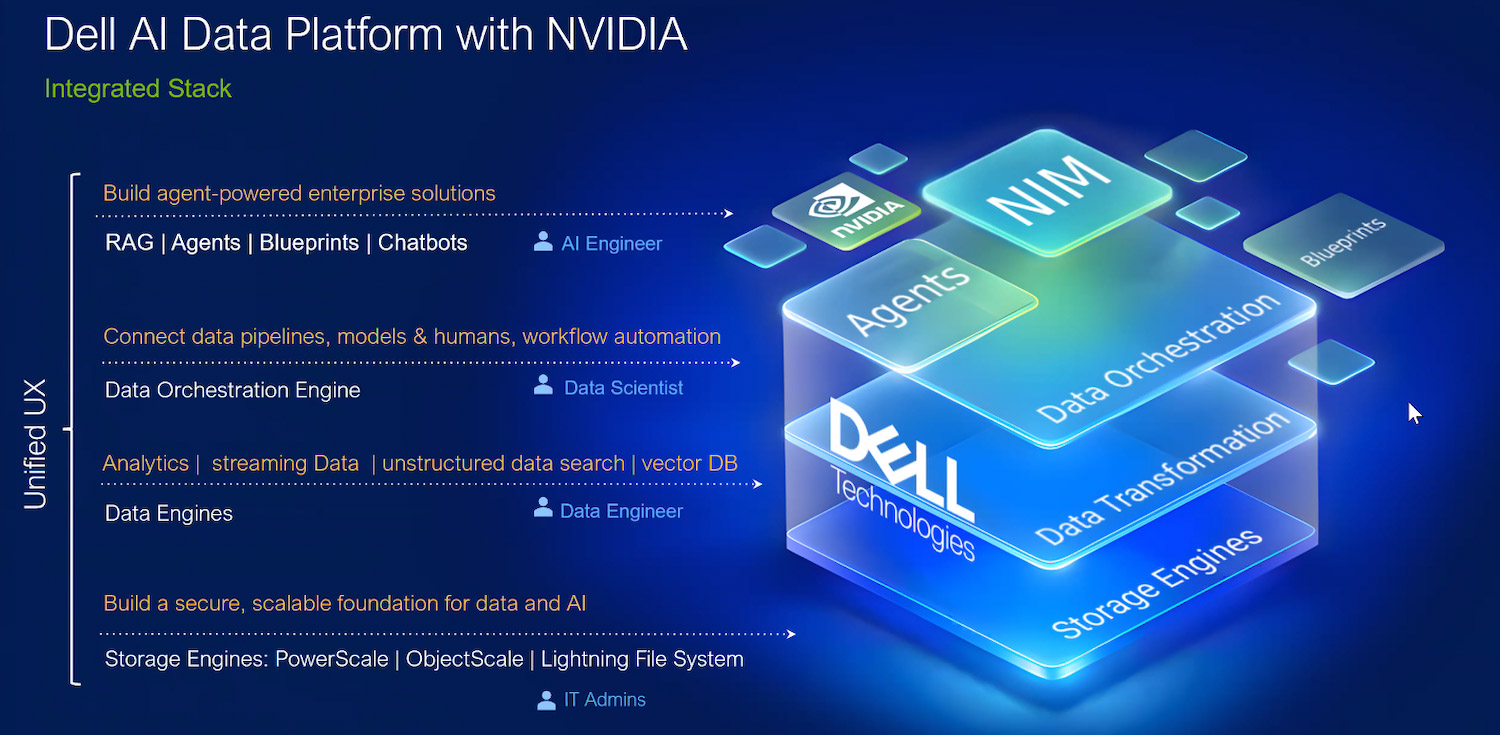
Screenshot
The announcement reflects growing demand for infrastructure capable of supporting increasingly complex AI and simulation workloads. Organizations across scientific research, engineering, sovereign AI initiatives, and genomics are requiring greater compute density, memory capacity, and power efficiency than previous-generation systems can provide.
Designed for AI and HPC Convergence
The Dell PowerEdge XE8812 is a fanless, direct liquid-cooled platform targeting environments running large-scale simulations and data-intensive workloads. Dell positions the system for applications such as molecular modeling, multiphysics simulation, and foundation model development.
Based on NVIDIA Vera Rubin NVL4, the platform increases host memory capacity, CPU core counts, GPU memory, and overall compute resources compared to systems built on NVIDIA GB200 NVL4. Dell notes that CPU core counts increase from 144 to 176, and that the platform carries 50% more memory per socket and GPU memory than the prior generation, enough to keep larger AI models and simulations resident in memory.
Keeping datasets and models resident in memory reduces reliance on staging and swapping operations, both of which introduce microsecond to millisecond latency and sharply cut effective bandwidth. That penalty matters most in HPC and AI environments, where data movement increasingly governs overall application performance.
The platform also leverages NVIDIA CUDA-X libraries to accelerate scientific computing and AI workloads, enabling organizations to run larger simulations and models without distributing workloads across additional infrastructure.
Rack-Scale Density and Liquid Cooling
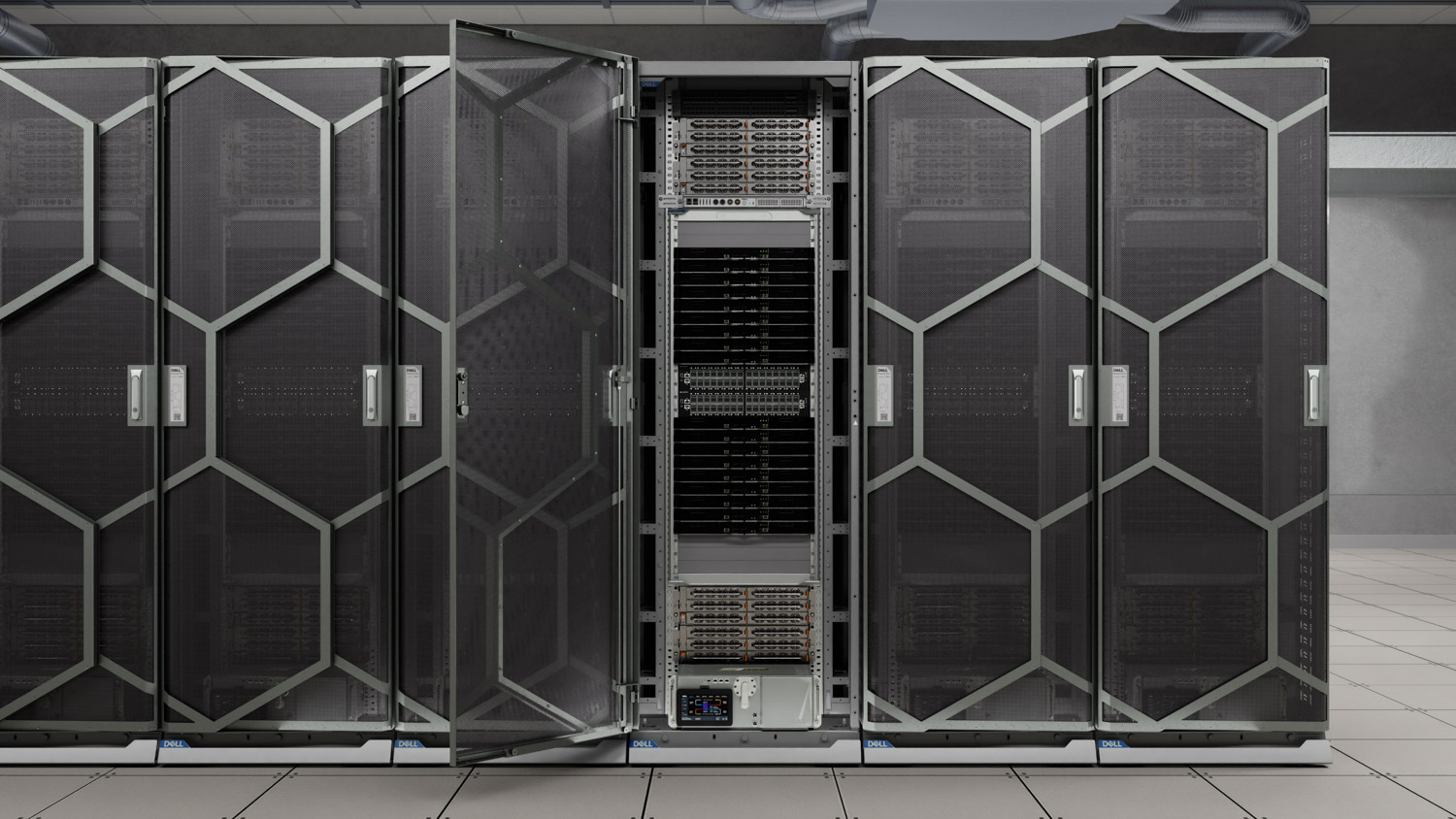
Dell plans to deliver the XE8812 in an Open Rack v3 (ORv3)-based rack architecture supporting up to 144 GPUs per rack and power delivery exceeding 300kW. The system employs direct liquid cooling for both CPUs and GPUs, enabling higher component density and improved thermal efficiency.
The ORv3-based design provides a modular architecture intended to simplify deployment and integration into large-scale data center environments. Dell also emphasizes operational management capabilities through its infrastructure management portfolio.
Integrated Dell Remote Access Controller (iDRAC) provides remote deployment, monitoring, and update capabilities for PowerEdge systems. At the rack level, Dell Integrated Rack Controller and OpenManage Enterprise provide telemetry, monitoring, and automated leak detection designed to improve operational visibility and reduce infrastructure risk.
Factory-Integrated Deployment Model
The company is pairing the new platform with Dell PowerRack, a factory-integrated rack-scale deployment model designed to reduce implementation complexity for large AI and HPC clusters.
Dell says PowerRack systems are delivered as pre-validated configurations, allowing organizations to move more quickly from installation to production workloads. Combined with Dell ProDeploy white-glove services, the approach replaces manual rack integration with production-ready racks that Dell says can be up and running with live workloads in just over six hours.
Dell AI Factory Expands Global Footprint
Dell reported continued growth for its Dell AI Factory initiative, with more than 5,000 customers deploying AI infrastructure globally.
Several high-profile deployments highlight the range of supported workloads.
In the United States, Dell, NVIDIA, and the National Energy Research Scientific Computing Center (NERSC) are building the Doudna supercomputer at Lawrence Berkeley National Laboratory. The system will use Dell PowerEdge XE8812 servers equipped with NVIDIA Vera Rubin NVL4 technology and NVIDIA Quantum-X800 InfiniBand networking to support large-scale scientific computing and data-intensive research.
In France, AI company InstaDeep is scaling its Kyber supercomputing cluster using Dell AI Factory infrastructure. The system delivers approximately 0.5 exaFLOPs of FP16 performance and supports industrial design applications, including automated printed circuit board design.
In the UK, the Wellcome Sanger Institute uses Dell PowerEdge XE-Series servers with NVIDIA GPUs to support genomic research. The institute now produces a fully assembled genome every 7 hours and manages more than 100 PB of curated genomic data on-premises, work that has contributed more than 70% of the genomes in the global Earth BioGenome Project.
In Australia, Monash University has deployed the MAVERIC supercomputer in partnership with Dell, NVIDIA, and CDC Data Centres. The system uses liquid-cooled Dell PowerRack infrastructure and PowerEdge XE9712 servers based on NVIDIA GB200 NVL72 technology to support AI and data-intensive research spanning cancer detection, climate action, and genomics.
Availability
Dell said the PowerEdge XE8812 will be available globally in early 2027.


 Amazon