

TrueNAS has launched the R60, a storage platform created to address traditional capacity limits. The R60 features a high-density NVMe design built for AI, HPC, and analytics I/O profiles. Packaged in a 1U platform, the R60 is designed to deliver consistent throughput and operational reliability in compute-intensive environments without compromising data control, cost, or long-term portability.
Performance Built for Density and Throughput
The R60 platform is rated for up to 60GB/s of throughput, which TrueNAS claims is about three times that of the earlier R30. The system uses PCIe Gen5 NVMe and a fifth-generation controller, targeting mixed read/write and parallel access patterns common in model training, inference tasks, and large-scale analytic scans.
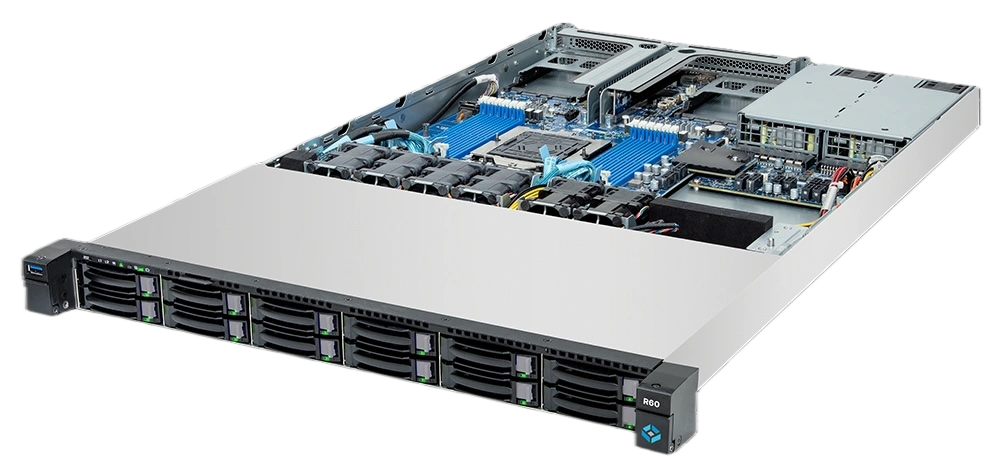
Capacity density sets the R60 apart: it supports up to 1.4PB of NVMe in a 1U chassis, delivering high-performance local datasets without consuming excessive rack space. For growth, expansion shelves increase capacity up to 7PB while maintaining the same basic architecture, reducing the need for disruptive replatforming as datasets grow.
TrueNAS R60 Specifications
| TrueNAS R60 | ||
|---|---|---|
| All-Flash Storage | Yes | |
| Hardware | ||
| Processor | 16 – 32 Cores (32-64 Threads) | |
| Controller Memory | 192 – 384 GB DDR5 at 6400 MT/s | |
| RAM (Max) | 64 – 256 GB | |
| Write Cache | Distributed Write Log | |
| Networking | 1x or 2x 400GbE 2x or 4x 200/100/25GbE |
|
| Management IO | 1x IPMI Out-of-Band Management Port, 1x WebUI Port | |
| Capacity & Expansion | ||
| Max All-Flash Capacity | 736 TB – 3.6 PB | |
| Max Capacity | 7 PB | |
| Max NVMe Expansion Shelves | Up to 2 | |
| Max SAS Expansion Shelves | 4 | |
| Power | ||
| Typical Power Draw (HA) | 350 – 600 Watts | |
To keep up with storage needs, optional 400GbE connectivity is designed for setups that use high-bandwidth fabrics, preventing the network from becoming a bottleneck between compute and storage. For organizations running RAG pipelines, continuous training, MLOps workflows, and large analytics clusters, increased GPU and CPU utilization reduces data wait times across the system.
TrueNAS 25.10 “Goldeye” Focuses the Software Stack on NVMe Era Systems
High throughput is irrelevant if the software can’t deliver under real-world workloads. The TrueNAS 25.10 “Goldeye” release is optimized for multi-core systems with dense NVMe, with a focus on concurrency, fabric access, and automation.
For caching, Parallel ARC eviction aims to improve OpenZFS cache management under multithreaded demands. TrueNAS reports 20-25% throughput gains in mixed environments, primarily when many jobs compete for hot datasets and metadata access.
On the fabric side, NVMe over Fabrics support for TCP and RDMA extends NVMe capabilities beyond the chassis, with TrueNAS targeting microsecond-level latency. This feature is crucial for latency-sensitive services such as vector search and real-time inference, where delays can degrade user experience and system performance.
The platform emphasizes operational automation. JSON-RPC 2.0 WebSockets are configured for API-driven provisioning and integration with GitOps and CI/CD pipelines. In Kubernetes environments, the TrueNAS CSI driver enables dynamic provisioning of NVMe-backed persistent volumes, streamlining storage workflows and helping infrastructure teams keep up with rapid application development.
Control, Portability, and Predictable Costs
TrueNAS also emphasizes control alongside performance. The R60 is designed for organizations that want high-end NVMe throughput without sacrificing data ownership or mobility.
Data portability relies on OpenZFS. By keeping datasets in an open, well-defined format, the platform aims to avoid situations where data becomes difficult to move without proprietary tools. This is especially important for proprietary AI datasets, feature stores, and curated training sets that provide a competitive edge.
Cost predictability is linked to efficiency features rather than usage-based pricing. Inline deduplication and compression are expected to deliver typical data reduction ratios of 2.5:1 or higher, increasing effective NVMe capacity. Importantly for many buyers, this value proposition highlights the elimination of per-query fees and unexpected costs that can complicate long-term budgeting for AI and analytics.
Data integrity remains a key focus for OpenZFS. TrueNAS emphasizes ongoing block-level verification and self-healing to detect and fix silent corruption and bit rot. For long-term datasets and regulated environments, this feature is a practical advantage because integrity issues often arise late, are costly to fix, and can undermine trust in analytics results.
Enterprise Support and Evaluation Path
TrueNAS is banking on the enterprise relationship as a partnership model covering architecture, deployment, and operations, with direct access to engineers instead of relying on ticket-only systems. For teams building and running data platforms, this support model can be as valuable as raw performance, especially during integration with fabrics, Kubernetes, and application pipelines.
For evaluation, TrueNAS recommends hands-on testing with TrueNAS Community Edition. This edition uses the same OpenZFS foundation and core software as enterprise systems, allowing organizations to test behavior, workflows, and integration on their own terms before investing in enterprise hardware and support.


 Amazon