

VDURA has introduced a new “Flash Relief Program” for organizations facing sharp NAND-driven price volatility and constrained SSD supply. The company positions the offer as a direct response to escalating all-flash platform costs and extended lead times, particularly for high-capacity SSDs used in AI and high-performance file system deployments.
Market context: NAND pricing shock and stalled procurements
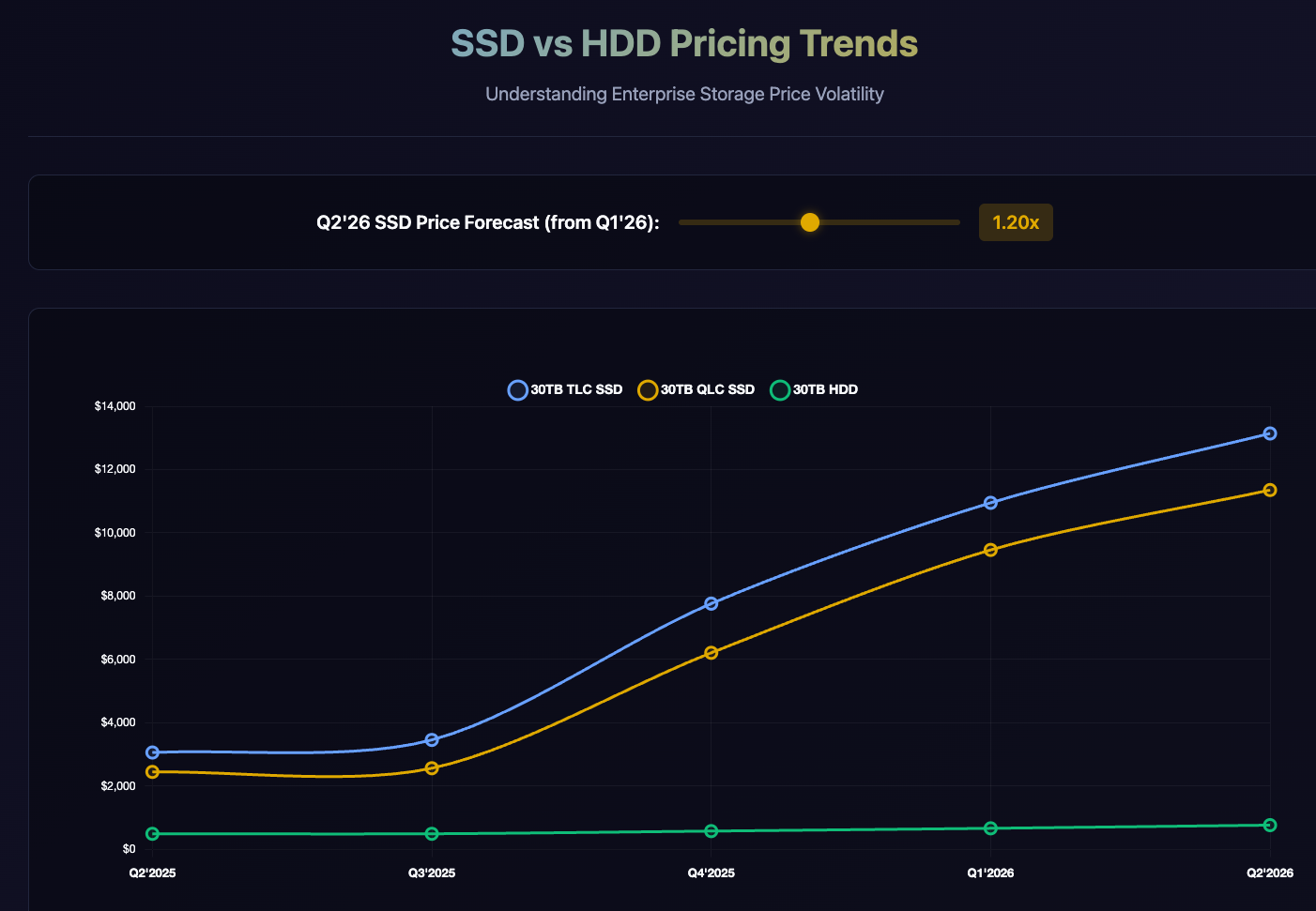
VDURA points to a rapid price surge in high-capacity flash over the past year as the catalyst for the program. The company cites a 257% increase in 30TB SSD pricing between Q2 2025 and Q1 2026, rising from $3,062 to $10,950, while HDD pricing increased 35% over the same period. VDURA also cites CES 2026 commentary from Vast Data describing severe market pressure, including a significant flash supply deficit, extended lead times of roughly a year, and broad-based price increases.
In practical terms, VDURA claims the market disruption is manifesting as stalled storage projects and widespread re-quotes, with all-flash configurations being repriced at 2 to 3 times prior estimates. The company argues that architectures dependent on a single storage commodity are most exposed, as allocation constraints and supplier dynamics translate directly into higher delivered system costs and longer delivery windows.
Program overview: 50% undercut with spec parity or better
Under the Flash Relief Program, VDURA invites customers and partners to submit a valid configuration for Vast, Weka, or another all-flash, high-performance file system alternative. VDURA commits to providing a competing proposal within 24 hours that is intended to:
- Match or exceed performance targets, including throughput, IOPS, and latency requirements.
- Match or exceed capacity requirements, including raw, usable, and effective capacity.
- Reduce total cost by 50% relative to the submitted configuration.
VDURA notes that submissions must include performance requirements, capacity requirements (raw, usable, effective), and configuration details. The company accepts submissions via its Flash Relief Program page or by email to sales@vdura.com. Program terms are published at the VDURA Flash Relief Program.
Why VDURA is betting on mixed-fleet: HYDRA architecture positioning
VDURA is anchoring its offering around HYDRA, a modern, software-defined parallel file system designed for high sustained throughput and linear scaling while supporting native mixed-fleet SSD and HDD configurations. The company’s core claim is that mixed-fleet is no longer a compromise architecture, but a way to preserve “flash-velocity” performance where it matters while shifting bulk capacity economics to HDD when flash pricing is unstable.
To illustrate the impact of flash price movement, VDURA provides a 25PB example targeting 1,000 GB/s of performance. In that scenario, the company reports that an all-flash architecture grew from $8.50M in Q2 2025 to $24.54M in Q1 2026, while a VDURA mixed-fleet approach using 20% SSD and 80% HDD was $6.56M in Q1 2026.
VDURA also emphasizes operational flexibility, noting that the flash-to-HDD ratio can shift over time through online dynamic cluster expansion. This means customers can start with a more HDD-forward build for near-term supply chain and cost relief, then increase flash density later as workload requirements or component economics change.
| Quarter | 30TB TLC SSD | TLC vs HDD | 30TB QLC SSD | QLC vs HDD | 30TB HDD |
|---|---|---|---|---|---|
| Q2’2025 | $3,062 | 6.2x | $2,450 | 4.9x | $495 |
| Q3’2025 | $3,460 | 7.0x | $2,566 | 5.2x | $495 |
| Q4’2025 | $7,765 | 13.4x | $6,212 | 10.7x | $580 |
| Q1’2026 | $10,950 | 16.4x | $9,461 | 14.2x | $668 |
| Q2’2026 | $13,140 | 17.1x | $11,353 | 14.8x | $768 |
Ken Claffey, CEO of VDURA, highlights the current flash crisis as a challenge for ‘flash-only’ vendors, who are forcing customers to make tough choices. He emphasizes VDURA’s pioneering approach with a high-performance, mixed-fleet data storage infrastructure that avoids reliance on a single commodity. Claffey noted that this system combines various storage media to eliminate performance bottlenecks and reduce operational complexity, proving resilient amid market volatility. He added that the Flash Relief Program, offering to beat all-flash prices by 50% while delivering comparable or better specs, demonstrates that mixed-fleet storage is a smarter, more accessible solution.
Technical claims and differentiators highlighted by VDURA
VDURA positions HYDRA as a fit for AI infrastructure where storage is expected to keep accelerators busy rather than queue-bound. The company’s stated technical advantages include:
- Alignment with NVIDIA and AMD storage performance guidance for GPU-centric environments, with an emphasis on sustained throughput to reduce idle accelerator time.
- Per flash-node performance claims reaching up to 60 GB/s reads and 40 GB/s writes.
- Software-defined architecture not tied to proprietary appliances, with support for a multi-vendor hardware ecosystem to improve sourcing flexibility and reduce lock-in.
- File-level network erasure coding combined with inline data reduction to improve effective capacity and mixed-fleet efficiency.
- Unified namespace with a single data and control plane to reduce management complexity.
- Online software upgrades to minimize operational disruption.
- Linear scalability positioning without performance degradation as clusters expand.
Storage Economics tool: Flash Volatility Index
Alongside the program, VDURA is promoting a free interactive calculator that tracks quarterly flash pricing and models architectural trade-offs across performance, capacity, and cost. The tool quantifies how all-flash economics compare with mixed-fleet designs across SSD percentages, using market pricing inputs. The calculator is available at Flash Volatility Index and Storage Economics Optimizer Tool.
VDURA is using the Flash Relief Program to turn flash market volatility into a competitive advantage over all-flash file system deployments. The pitch is straightforward: bring a Vast or Weka configuration, receive a fast-turnaround proposal, maintain or improve performance and capacity requirements, and cut total cost in half by shifting to a software-defined mixed-fleet architecture.


 Amazon