

The ORICO X50 is a Thunderbolt 5 portable SSD line for those who want external storage with much more bandwidth than a standard USB drive. ORICO is offering it in a few different forms, including a diskless version and preconfigured 512GB, 1TB, 2TB, and 4TB models, so it can work either as a ready-to-use portable SSD or as an enclosure for a user-supplied drive. That gives it a fairly diverse audience, from video editors and photographers moving large project files to workstation users who need fast storage, high-speed external backups, or a portable drive that can keep up with heavier file workloads. The size is still compact enough for bag carry at 110 × 60 × 18.7mm, but this is very much a performance-focused external SSD.
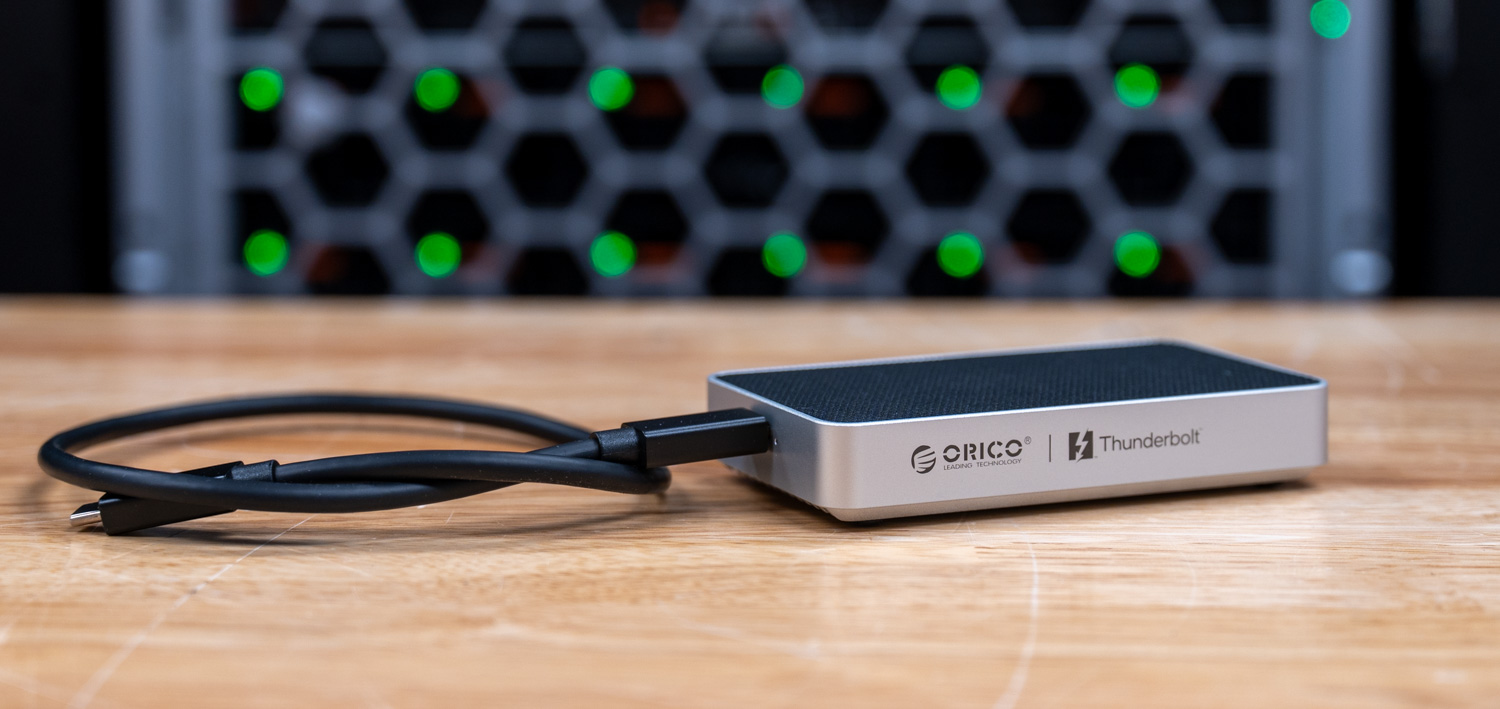
ORICO rates it for up to 6000 MB/s read and 5800 MB/s write speeds, with actual speeds depending on the Thunderbolt 5 host, the included 80 Gbps cable, and a fast enough NVMe SSD inside. On older Thunderbolt 4, Thunderbolt 3, or USB4 systems, it still works, but the available bandwidth is limited by that host connection. ORICO also equips the enclosure with a fanless four-layer passive cooling setup, a CNC aluminum shell, and support for M.2 NVMe 2280 SSDs, which gives the X50 a more serious role than the average portable SSD. For large media transfers, active project storage, heavier backup jobs, and external work files that stay in regular use, the X50 is built for a much more intensive workload than a standard USB portable drive.
Backed by a limited 3-year warranty, the ORICO X50 goes for roughly $199.99 (affiliatelinnk) for the diskless model.
ORICO X50 – Specifications
| Label | Value |
|---|---|
| Overview | |
| Product Name | ORICO X50 |
| Product Type | Thunderbolt 5 Portable SSD |
| Product Model | ORICO-X50 |
| Color | Silver |
| Material | Aluminum Alloy |
| Size | 110*60*18.7mm |
| Interface and Performance | |
| Input Interface | Thunderbolt 5 |
| Theoretical Transfer Rate | 6000MB/s Read 5800MB/s Write |
| Data Cable | C To C 0.5M 80G Data Cable |
| Capacity Options | |
| Diskless | No built-in SSD |
| Built-in Capacity Options | 512GB, 1TB, 2TB, 4TB |
| Compatibility and Box Contents | |
| Support system | Window / Mac / Linux |
| Packing list | Data cable x1 instruction manual x1 thermal conductive silicone x2 screwdriver *1 |
ORICO X50 – Design and Build
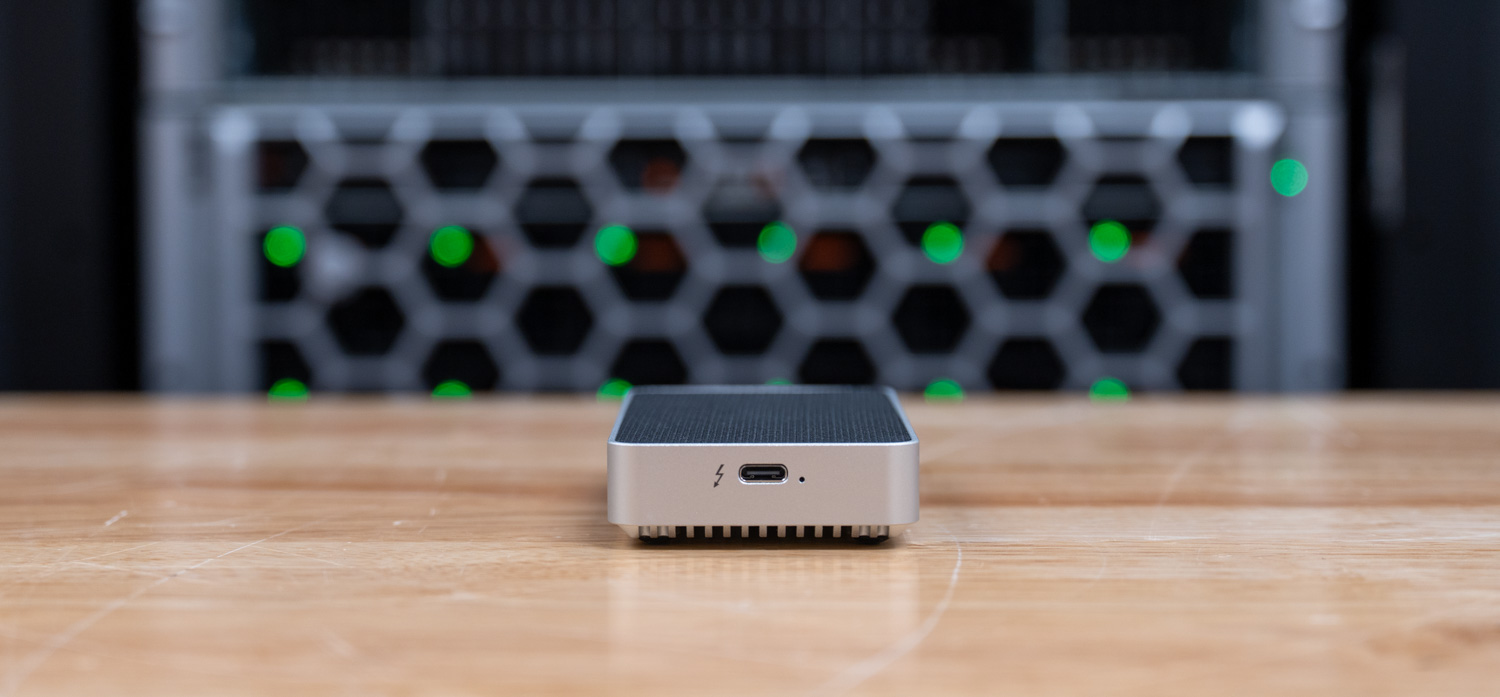
The X50 has a slightly larger enclosure than most slim portable SSDs. At 110mm long, 60mm wide, and 18.7mm thick, it is still portable, but it is thicker than the slim card-style drives that are designed to slip easily into a pocket. ORICO uses an aluminum alloy body with rounded corners, a silver finish, and a top panel covered with a dark perforated surface, which promotes thermal control. It feels very sturdy when handled.
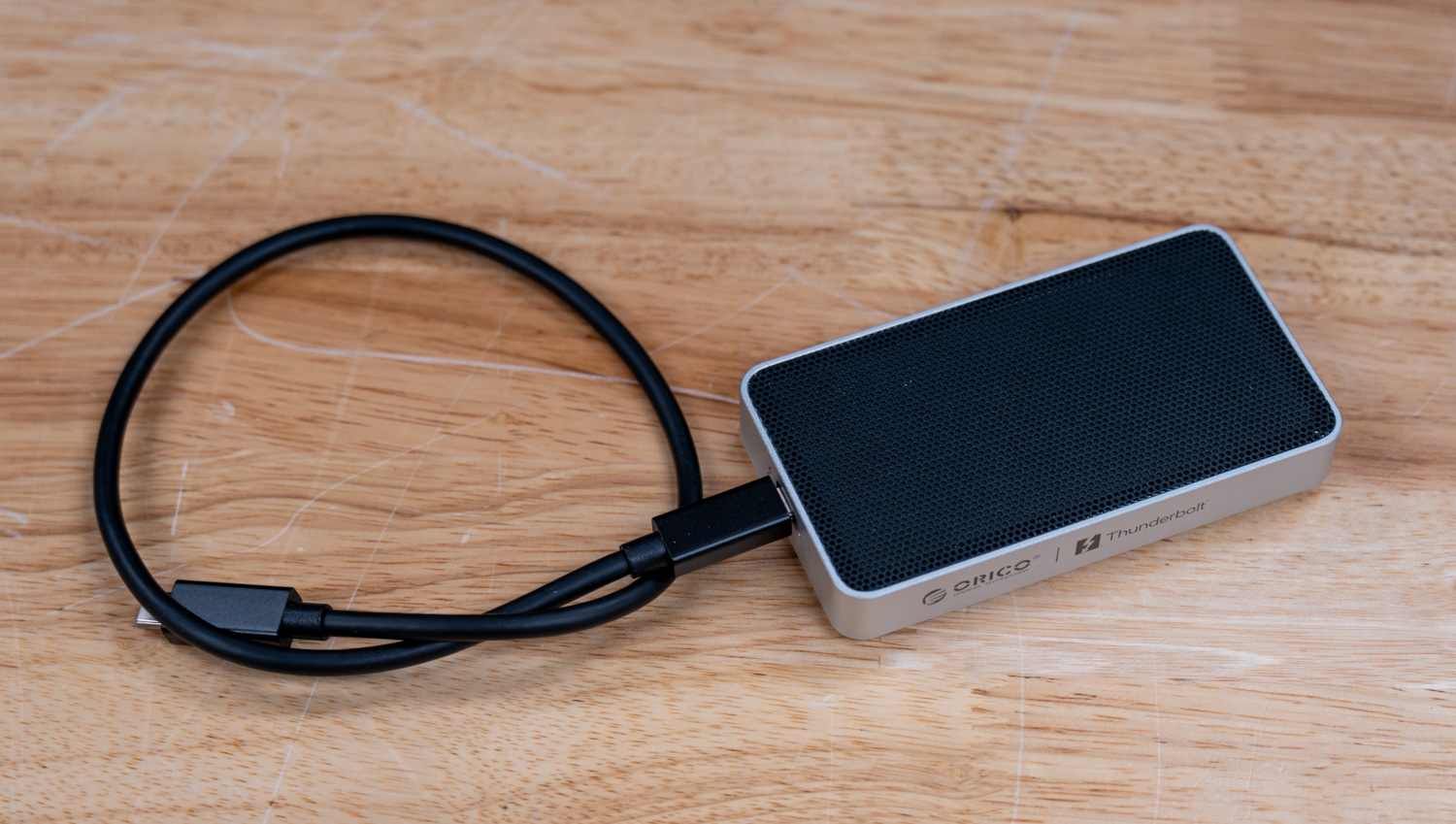
The port layout includes a single front-mounted Thunderbolt 5 port, with a small LED status light next to it for quick activity visibility. Besides that, the enclosure is kept clean and minimal, with branding along the side.
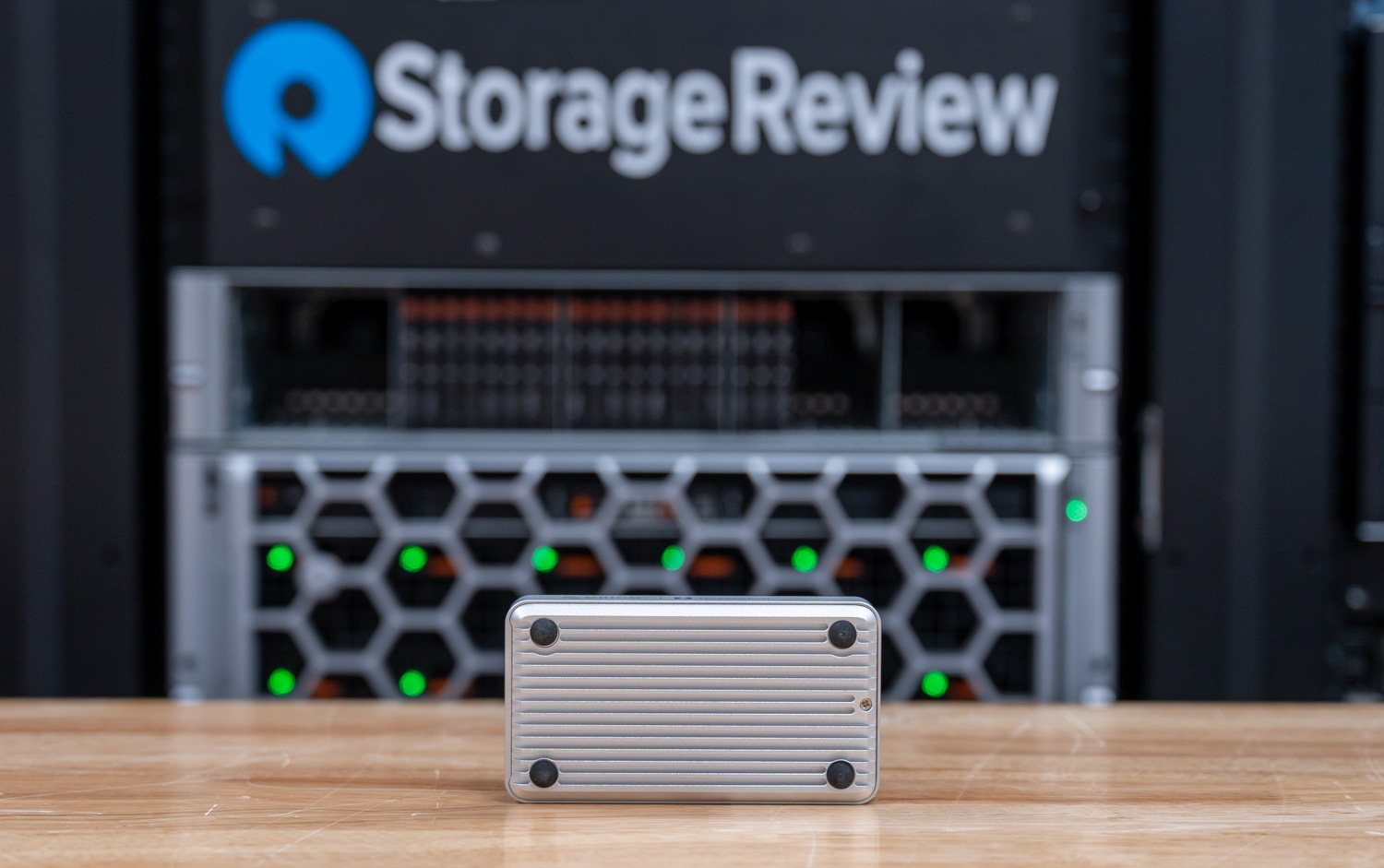
ORICO has also built the X50 with a ribbed underside, thermal conductive silicone pads, and a cooling film. That is important for an SSD of this class because the interface speed is high enough that thermal limits can become a real, sustained performance limitation. It also comes bundled with a screwdriver for those who want to mount their own drive.
With the top panel off, the X50 is very easy to work with, which is important for a diskless enclosure like this. The SSD (the Samsung in our case) is mounted on a compact internal board and secured with a single screw, as usual, while the underside of the cover has a thermal pad that presses down onto the drive once everything is closed.
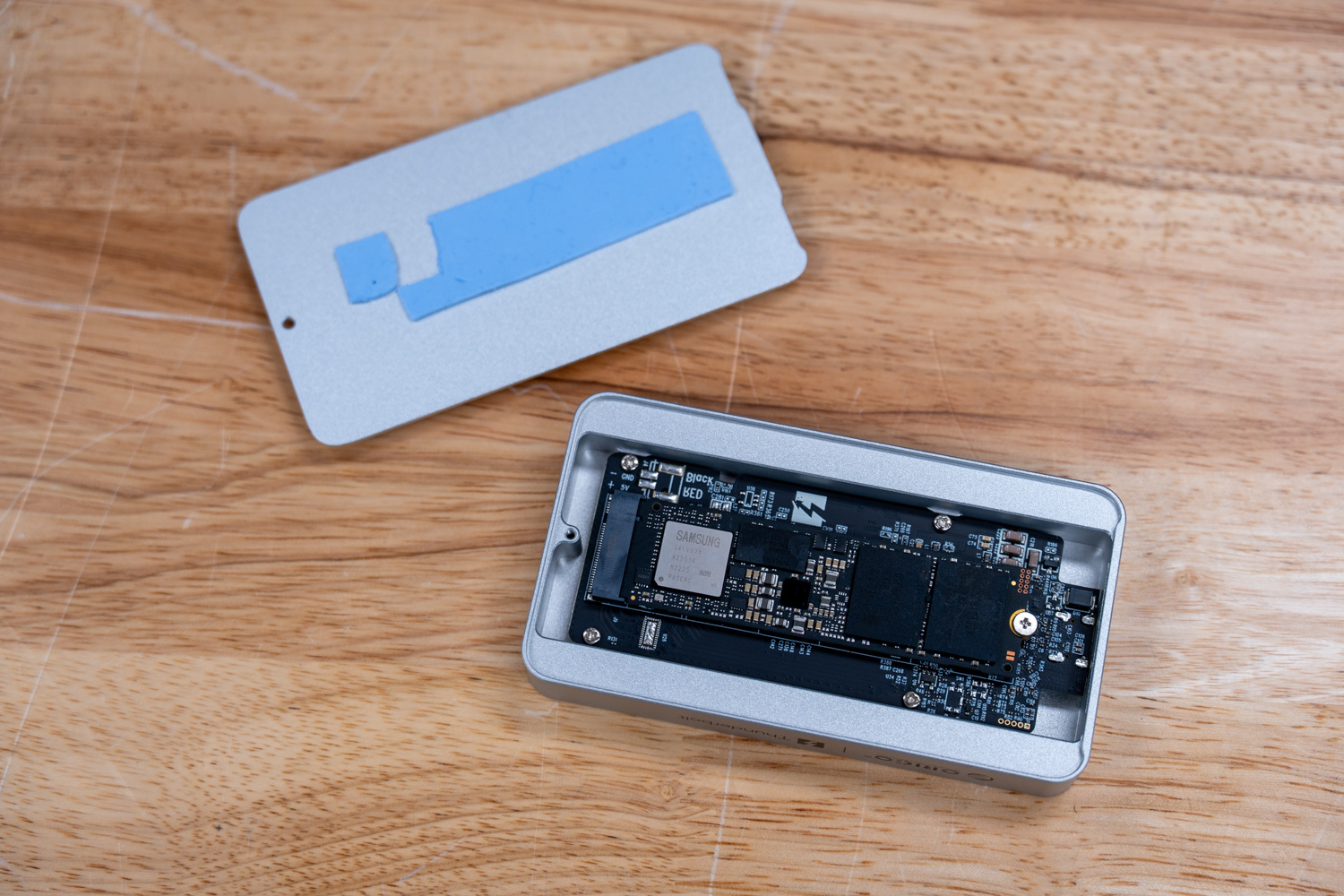
Overall, it’s a very unique design, and it certainly looks more like a premium enclosure than a mass-market portable SSD. The trade-off is that it’s a bit bigger than some external SSDs, but that is normal for a device designed to handle far more bandwidth and heat than a basic portable USB drive.
ORICO X50 – Performance
For testing, we used a Dell Pro Max 14 and installed a 2TB Samsung 990 Pro SSD.
Blackmagic Diskspeed Test
The Blackmagic Disk Speed Test benchmarks a drive’s read and write speeds to estimate its performance, especially for video editing tasks. It helps users ensure their storage is fast enough for high-resolution content, such as 4K or 8K video. The Blackmagic results show clear, real-world performance.
In this run, the ORICO X50 posted 3,824.6 MB/s write and 2,568.1 MB/s read speeds, which put it well beyond the range of a typical USB portable SSD and into territory much more relevant for heavier professional usage.
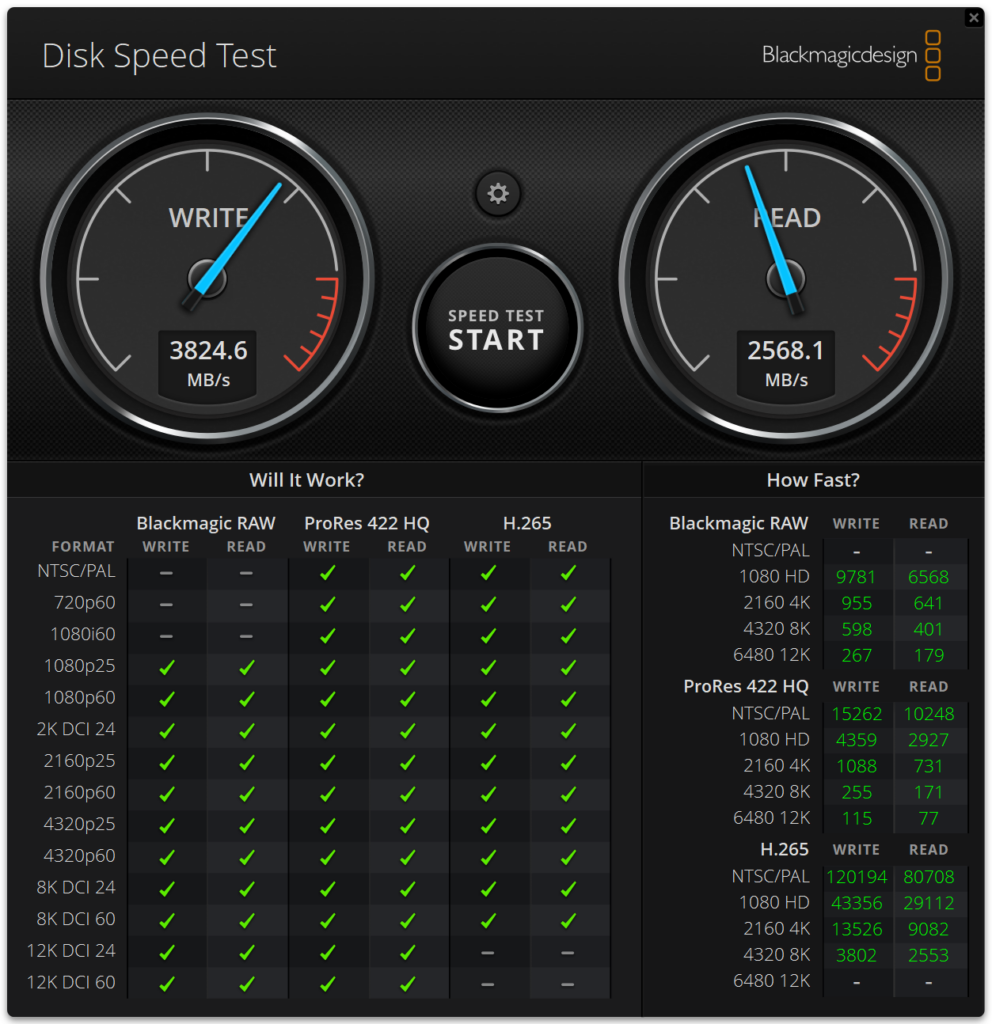
The read speed is below the quoted theoretical ceiling, but it is still very fast for an external drive, and the write speed, in particular, is impressive.
IOMeter
We also ran the ORICO X50 through IOMeter to better understand its behavior under both sequential and random workloads. For this round, we tested the drive at 1 queue for lighter access patterns and at 2 queue to see how it scales once the workload becomes more demanding.
At 1 queue, the X50 posted 1550.1 MB/s read and 1513.0 MB/s write in the sequential 2 MB test. Random 2MB performance came in at 1803.4 MB/s read and 1394.0 MB/s write, while 4K random performance reached 3522 IOPS read and 12344 IOPS write. That is a strong opening result, with especially good large-block random read speed for an external drive.
| IOMeter (1 queue) | ORICO X50 |
|---|---|
| Seq 2MB Read | 1,550.1 MB/s |
| Seq 2MB Write | 1,513.0 MB/s |
| Random 2MB Read | 1,803.4 MB/s |
| Random 2MB Write | 1,394.0 MB/s |
| Random 4K Read | 3,522 IOPS |
| Random 4K Write | 12,344 IOPS |
Moving up to 2 queue, the X50 scales sharply in sequential work, climbing to 5934.9MB/s read and 5354.8MB/s write. Random 2MB reads also jump to 5464.5 MB/s, while writes jump to 1577.2 MB/s. In 4K random activity, reads reach 15,908 IOPS and writes reach 87,279 IOPS. The read scaling here is very strong, and the sequential numbers are very close to ORICO’s rated ceiling, which is a good sign for the enclosure and host combination used in this test.
| IOMeter (2 queue) | ORICO X50 |
|---|---|
| Seq 2MB Read | 5,934.9MB/s |
| Seq 2MB Write | 5,354.8MB/s |
| Random 2MB Read | 5,464.5MB/s |
| Random 2MB Write | 1,577.2MB/s |
| Random 4K Read | 15,908IOPS |
| Random 4K Write | 87,279IOPS |
PCMark 10
PCMark 10’s Data Drive Benchmark goes beyond simple peak transfer rates and examines how a drive performs across a broader range of storage activity. Instead of focusing only on large sequential reads and writes, it is meant to reflect workloads closer to day-to-day use, including more varied file access patterns than a raw throughput test. That makes it a helpful benchmark for external SSDs such as the X50, as it gives a better idea of how a drive may perform when used for active project files, application data, game storage, and general file movement, not just large copy jobs.
In this run, the ORICO X50 posted a PCMark 10 Data Drive Benchmark score of 3,503, with a bandwidth of 514.94 MB/s and an average access time of 44ms. That is a strong result for an external drive.
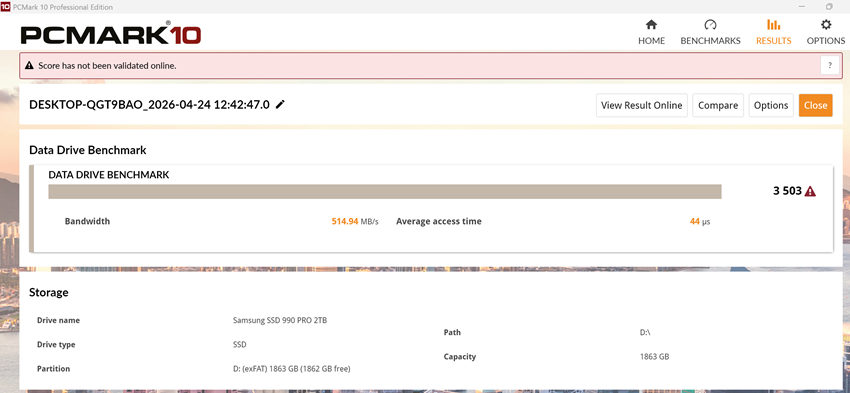
It is not going to match a flagship internal Gen5 SSD result, but for an external drive, this is still a strong PCMark 10 score and shows that the X50 is great for heavier everyday work like active project storage, large file transfers, media editing, application files, and game libraries, not just cold storage.
Conclusion
The ORICO X50 is a high-speed external SSD for people who have more demanding storage needs than a typical USB portable drive can handle. Between the Thunderbolt 5 connection, the option to buy it diskless so you can use your own drive, and the larger aluminum enclosure, this is much more than a small carry-around SSD for casual file transfers. The X50 is still easy enough to carry around, but the thicker enclosure and thermal-focused design make it feel closer to a high-speed external work drive than a basic portable SSD.
Paired with a 2TB Samsung 990 Pro, Blackmagic posted an impressive 3,824.6 MB/s write speed, and IOMeter showed better performance as workload depth increased, with sequential read throughput climbing to 5,934.9 MB/s. PCMark 10 also showed how the X50 performs outside large sequential transfers, yielding a score of 3,503. Looking at the overall results, the X50 is definitely best used as active external storage for project files, large media transfers, and heavier day-to-day file work rather than as a simple backup drive. That said, exact performance will still depend on the SSD and the host system’s specs.
Priced at $199.99, the diskless X50 is easy to justify for anyone who already has a fast NVMe drive on hand, since the enclosure itself is not priced out of line for early Thunderbolt 5 hardware. The 1TB model at roughly $329.99 is harder to judge next to ordinary USB portable SSDs. However, the performance results here do a lot to justify that premium, especially when the drive delivers almost 6GB/s in read transfer speeds, which standard USB options cannot match.
Leaderboard: This drive is ranked on our Best Portable SSDs leaderboard.


 Amazon