

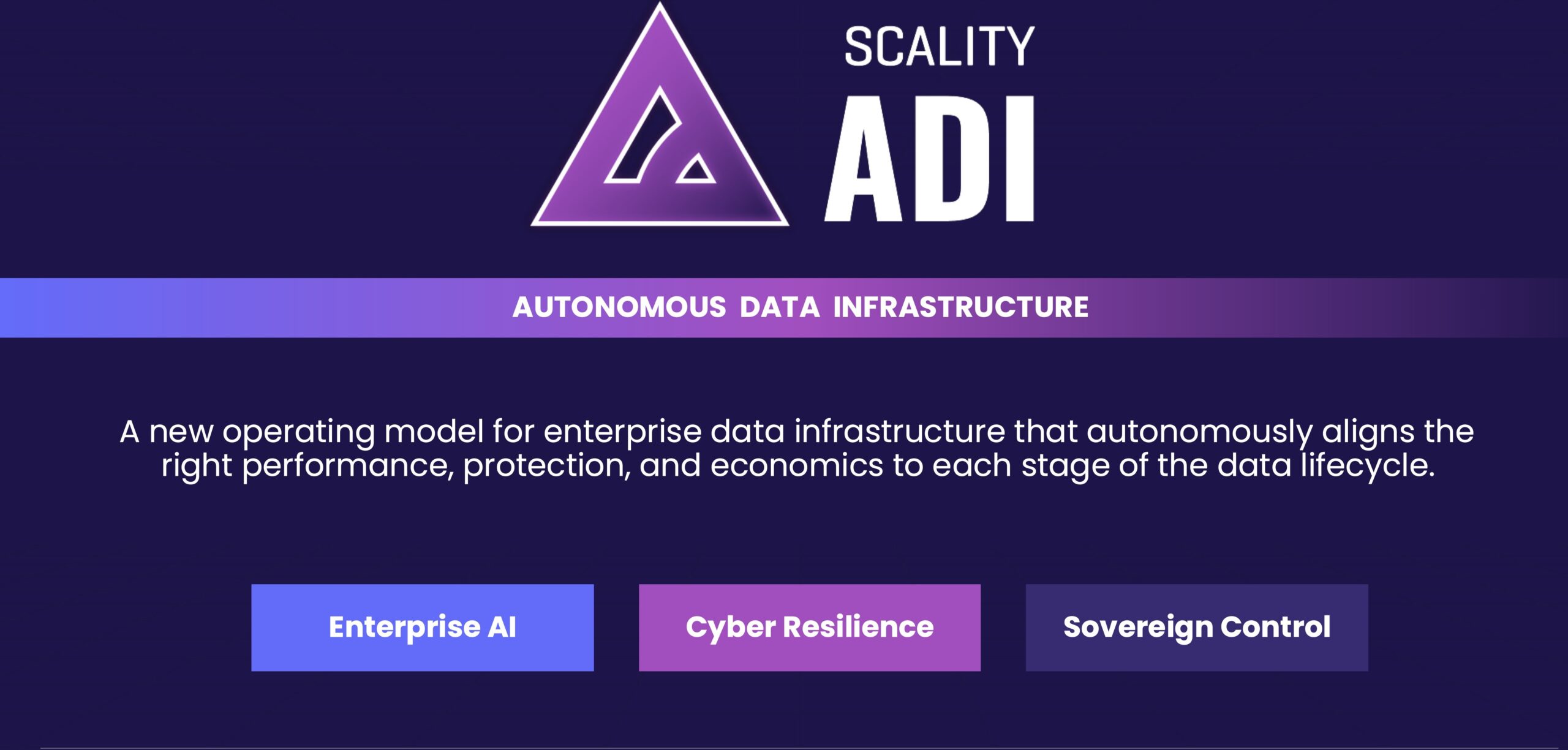
Scality has announced Scality Autonomous Data Infrastructure (ADI), a platform aimed at enterprises facing increasing pressure to support diverse AI workloads, strengthen cyber resilience, and maintain sovereign control over data. The offering combines Scality’s distributed object storage foundation with a new autonomous operations layer designed to reduce operational complexity while maintaining human oversight.
The release reflects a broader shift in enterprise storage requirements. AI workloads now span training, inference, retrieval-augmented generation, multimodal pipelines, video analytics, and distributed inference caching. These workloads introduce conflicting demands across throughput, latency, and governance. At the same time, organizations are contending with stricter regulatory requirements, more sophisticated cyber threats, and growing power constraints in data centers. Traditional tiered storage architectures are increasingly unable to balance these competing factors without introducing operational overhead.
Extending RING and ARTESCA
Scality ADI is an evolution of its existing portfolio rather than a replacement. RING continues to serve as the company’s large-scale distributed object storage platform, with established deployments operating at multi-petabyte and exabyte scale.
Scality RING has established a significant footprint in the service provider and telecommunications markets, initially gaining traction among organizations seeking to build private cloud environments that can compete with hyperscale offerings from Amazon, Google, and Microsoft. The platform architecture was designed to scale horizontally into the multi-petabyte range, attracting long-term enterprise clients such as Comcast and Orange. These organizations have successfully scaled their environments over several years, demonstrating the platform’s ability to maintain data availability and performance across massive, growing datasets.
Technical longevity is demonstrated through the platform’s ability to navigate hardware refresh cycles without service interruption. Comcast currently operates a single RING environment that has successfully migrated across three hardware generations and now manages over 300 billion unique objects within a unified infrastructure. Other global deployments illustrate the platform’s capacity for extreme density, with single failure domains reaching nearly half an exabyte. These implementations highlight a focus on sustained scalability and on managing massive object counts across consolidated storage namespaces.
ARTESCA remains focused on immutable backup storage, incorporating its CORE5 cyber resilience framework and associated ransomware-recovery guarantees.
ADI builds on these foundations by introducing a unified platform designed to address emerging workload patterns and operational requirements associated with AI and data sovereignty.
Autonomous Operations with Human Oversight
At the core of ADI is Guardian, an AI-driven operations engine that automates routine infrastructure tasks, including capacity expansion, data rebalancing, system healing, upgrades, and lifecycle management. The system is designed to reduce administrative burden while preserving operator control. Guardian generates recommendations and executes workflows only with human approval, maintaining a human-in-the-loop model for all decisions.
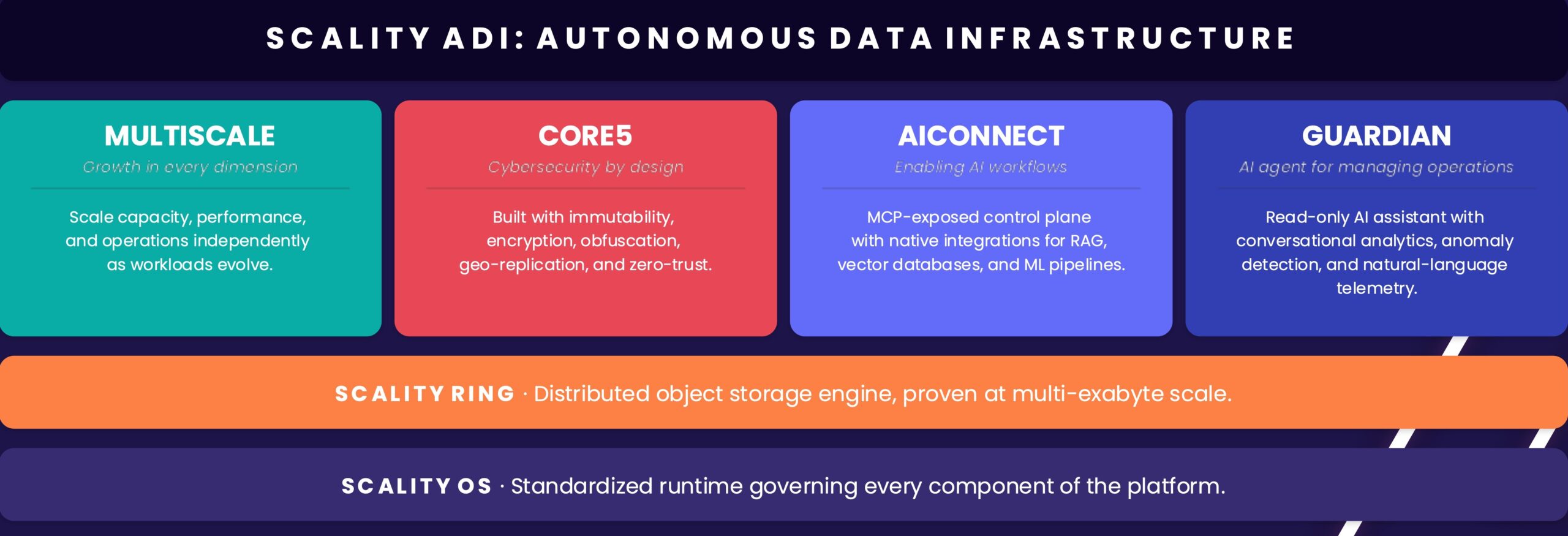
The platform also supports extensibility through MCP-enabled integration, allowing organizations to incorporate their own AI tools and automation frameworks into ADI operations. This approach enables enterprises to align the platform with internal AI strategies rather than relying solely on vendor-provided intelligence.
Unified Namespace Across Storage Media
Scality ADI adopts a software-defined, disaggregated architecture that spans multiple storage media within a single namespace. Supported tiers include NVMe SSDs with TLC and QLC flash, HDDs, tape, and cloud-based cold storage. Policy-driven lifecycle management allows administrators to map workloads to the appropriate storage class based on performance, cost, and retention requirements.
This architecture is designed to address the wide performance envelope of AI workloads. High-performance tiers can support GPU-intensive pipelines with multi-terabyte-per-second throughput and low latency, enabled in part by a new RDMA-accelerated key-value cache connector. Capacity-oriented tiers such as QLC flash and HDD provide cost-efficient storage for less performance-sensitive data. At the same time, long-term archives can be offloaded to tape or cloud cold storage to minimize power consumption.
Cyber Resilience and Power Visibility
Security and resilience remain central to the platform. ADI incorporates Scality’s CORE5 cyber resilience framework, ensuring immutability, recoverability, and auditability across stored data. These capabilities are intended to address both ransomware threats and regulatory compliance requirements.
The platform also introduces real-time power telemetry, giving operators visibility into energy consumption at the system, node, and workload levels. This data enables infrastructure teams to align storage decisions with data center power budgets, an increasingly important constraint in AI-heavy environments.
Open Source Model and SLA Framework
Scality is delivering ADI as open-source software, with source code available for inspection and governed contributions. This model is intended to support transparency and long-term viability in environments where control and auditability are critical, including government and regulated industries.
The platform is backed by outcome-based service level agreements that cover availability, performance, data protection posture, power consumption, and operational efficiency. Scality also offers its Scale Care Services to provide enterprise support for mission-critical deployments.
Jérôme Lecat, Scality CEO, highlighted that the AI era has revealed flaws in traditional storage systems. He noted that Scality ADI offers a dynamic operating model that autonomously adjusts performance, protection, and cost-efficiency for each workload throughout the data lifecycle. Lecat added that this approach maintains GPU productivity, meets regulatory requirements, ensures sovereignty, and handles exabyte-scale data without replacing existing solutions, representing the next generation of data management.


 Amazon