

Supermicro has introduced a new Data Center Building Block Solutions (DCBBS) Blueprint for HPC based on the NVIDIA Vera Rubin NVL4 platform. The announcement extends the company’s DCBBS architecture strategy beyond enterprise AI deployments to scientific computing environments, providing a reference framework for deploying large-scale HPC and AI infrastructure.
The new blueprint follows the NVIDIA Vera Rubin NVL72 and NVIDIA HGX Rubin NVL8 DCBBS designs unveiled earlier this year and applies the same integrated approach to research institutions, national laboratories, and supercomputing centers. Supermicro’s DCBBS framework combines compute, networking, liquid cooling, power distribution, and facility infrastructure into a pre-engineered deployment model that reduces implementation complexity and accelerates cluster deployment.
Supermicro President and CEO Charles Liang said AI is becoming a fundamental component of modern scientific research. He noted that organizations capable of rapidly deploying advanced infrastructure will be positioned to drive future discoveries. He highlighted the company’s experience building large-scale liquid-cooled GPU clusters as a key factor behind the new blueprint.
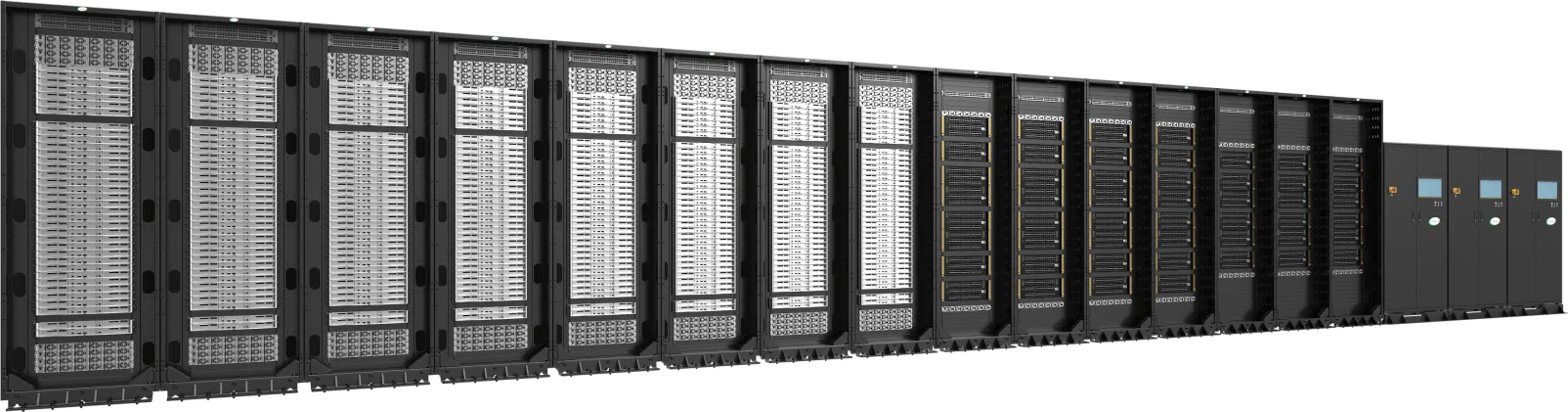
Designed for Converged HPC and AI Workloads
The blueprint is built around the growing convergence of traditional HPC simulation and AI-accelerated computing. Research organizations increasingly combine double-precision simulation workloads with machine learning and AI models to shorten development cycles and accelerate scientific discovery across fields such as climate modeling, drug discovery, materials science, and energy research.
Supermicro positions the NVIDIA Vera Rubin NVL4 platform as a foundation for these hybrid workloads, combining large-scale GPU acceleration with CPU resources and high-performance networking. The company notes that its deployment methodology is based on experience gained from building liquid-cooled supercomputing clusters containing more than 100,000 GPUs.
End-to-End Deployment Methodology
The DCBBS Blueprint outlines the deployment process Supermicro uses for large-scale liquid-cooled infrastructure projects.
Projects begin with on-site facility assessments that evaluate loading dock access, data hall dimensions, floor loading capabilities, and existing power and cooling infrastructure. The resulting data is used to develop a site-specific deployment plan.
System integration is performed in Supermicro manufacturing facilities before shipment, including rack assembly, cabling, and both system-level (L10) and cluster-level (L11) validation testing. Once delivered, deployment services include rack installation, network integration, power and cooling connections, commissioning, and operational validation.
Supermicro also offers ongoing support services, including on-site response options intended for mission-critical research and production environments.
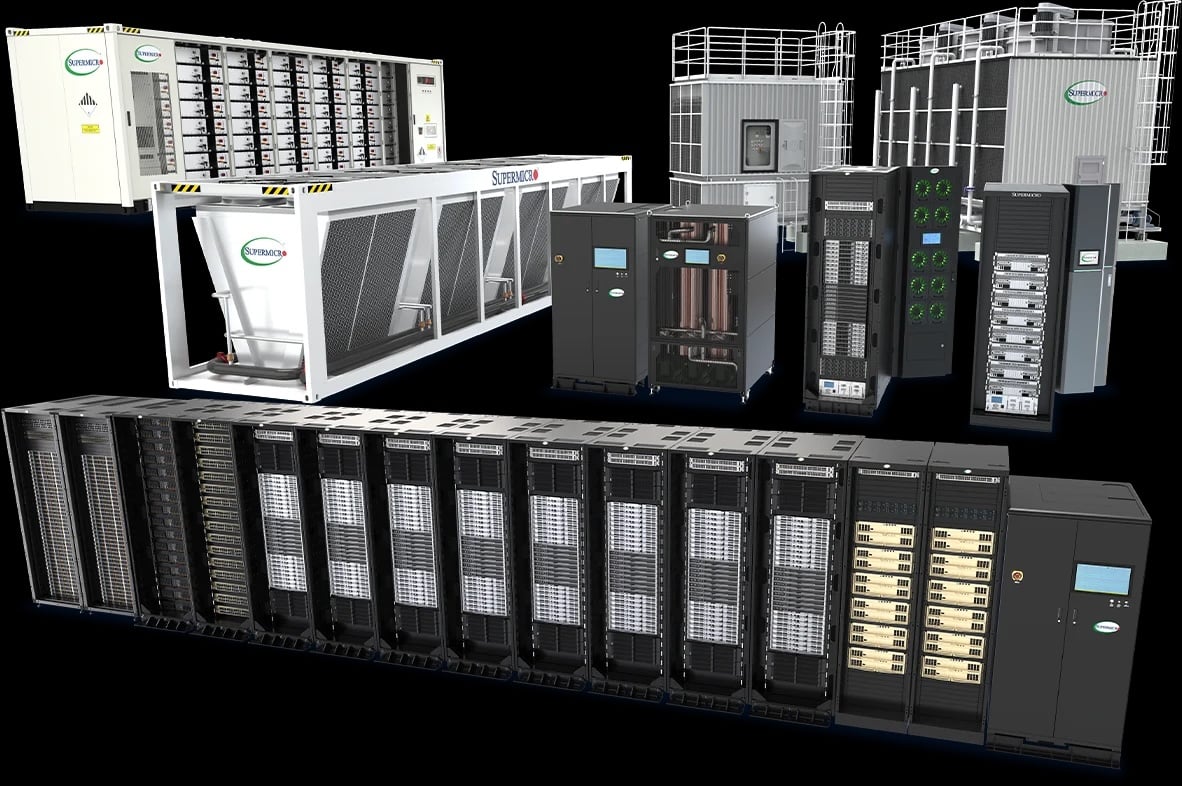
Vera Rubin NVL4 Scalable Unit Architecture
The blueprint is organized around a repeatable NVIDIA Vera Rubin NVL4 Scalable Unit that can be replicated to create clusters ranging from approximately 3.2MW deployments to facilities approaching gigawatt scale.
Each scalable unit consists of eight liquid-cooled compute racks using custom 52U enclosures. The configuration supports 288 NVIDIA Vera Rubin NVL4 nodes, incorporating up to 1,152 NVIDIA Rubin GPUs and 576 NVIDIA Vera CPUs. Individual racks operate within a 362kW power envelope.
Cooling is provided through Supermicro’s DLC-2 direct liquid cooling architecture. Each scalable unit includes three in-row cooling distribution units, each rated at up to 1.8MW, in a 2+1 redundant configuration. The cooling design incorporates direct-to-chip cold plates, vertical coolant distribution manifolds, and Supermicro’s PG25-A coolant formulation.
Networking is based on NVIDIA Quantum-X800 InfiniBand infrastructure, providing the low-latency, high-bandwidth interconnect required for distributed HPC and AI workloads. Liquid-cooled networking configurations are also available.
Power delivery is handled by eight 72kW power shelves per compute rack, while dual top-of-rack management switches provide out-of-band monitoring and control.
Immediate Availability for GB200 NVL4 Deployments
In addition to the Vera Rubin-based architecture, Supermicro said configurations based on NVIDIA GB200 NVL4 are available immediately for organizations seeking near-term deployment options.
The announcement reflects the continued industry shift toward integrated rack-scale infrastructure designs that combine compute, networking, power, cooling, and management into pre-validated deployment models. As AI and HPC workloads continue to converge, vendors are increasingly focusing on reducing deployment complexity while supporting higher rack densities and liquid-cooled environments.


 Amazon