

Although Dell’s PowerEdge R4715 and R5715 are two separate products, they should be viewed as a configurable matrix. The matrix includes two chassis, four AMD EPYC 9005 Series CPU options, a wide range of storage configurations, and the full Dell management and support ecosystem. The combination is purpose-built for SMB organizations that need to match infrastructure investment to actual workload requirements, and for the channel partners who help them get there.
Both platforms launched in March 2026. We covered each one individually in our R4715 and R5715 reviews. This piece is different. Rather than evaluating either server in isolation, we examine how the two platforms and the four CPU options perform across the workloads SMB buyers actually run and where configuration choices make the most difference.
Hypervisor flexibility is a key reason these platforms make sense right now. The virtualization market is evolving, and organizations of all sizes are reevaluating the assumptions underlying their infrastructure. Some are sticking with their established stack; others are migrating, and many are running two or more hypervisors in parallel for the foreseeable future. The R4715 and R5715 support the full range of common options, including VMware ESXi, Microsoft Hyper-V, Proxmox VE, and the major Linux KVM distributions, with consistent management and provisioning regardless of choice. For SMB customers who do not have the luxury of standardizing on a single platform, that flexibility is part of the value and one of the reasons we tested across multiple hypervisors for this piece.
The Dell Ecosystem Advantage for SMB and the Channel
The conversation around server platforms often centers on silicon, which makes sense at the spec sheet level. But for SMB buyers and the VARs and system integrators who support them, the operational experience with the silicon is often the deciding factor. Dell’s PowerEdge ecosystem is mature and well understood, and it manifests in ways that disproportionately benefit organizations with lean IT teams.
iDRAC10 and OpenManage Enterprise are the most visible components. The same management plane spans the entire 17th Generation PowerEdge family, so an SMB that buys an R4715 today can later add an R7725 or any other PowerEdge model without needing to learn a new toolset. For VARs and SIs supporting scores of customers, that consistency is even more valuable. A technician who knows iDRAC understands every PowerEdge customer’s infrastructure. The platform supports remote console access, firmware management, hardware health monitoring, and full Redfish API access for automation. For customers without dedicated infrastructure staff, that capability often means the difference between a phone call to a partner and a site visit.
Beneath the management layer, Dell brings a security and supply chain story that is hard to match. Silicon root of trust, cryptographically signed firmware, secured component verification, and TPM 2.0 with FIPS certification are all standard. ProSupport and ProDeploy services are available with global coverage, which matters for distributed SMBs and for partners selling into multiple geographies. Dell’s supply chain is one of the few in the industry that can deliver predictable lead times at scale. For VARs trying to close deals against backorder uncertainty, that is a competitive asset in itself.
For an SMB IT team of two or three people, or for a channel partner supporting dozens of customers with limited bench depth, the Dell ecosystem significantly reduces the operational surface area. The R4715 and R5715 inherit all of that.
R4715 and R5715 at a Glance
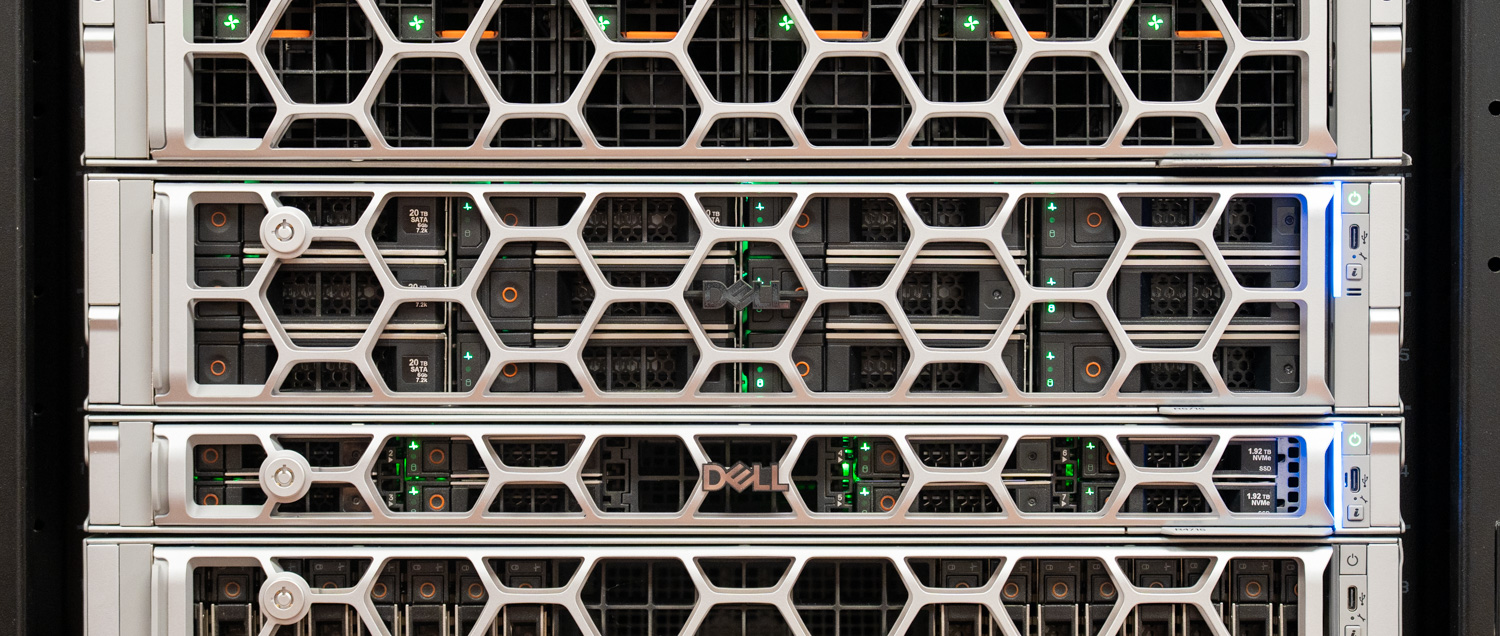
Here’s a brief recap for readers who have not seen our individual reviews. The R4715 is a 1U single-socket server optimized for compute density. It supports up to 24 DDR5 RDIMMs, three PCIe Gen5 slots, and a range of storage options, including 2.5-inch and 3.5-inch SAS/SATA configurations and an 8-bay 2.5-inch U.2 NVMe configuration. This is the right choice when rack density and per-rack-unit compute matter more than drive count.
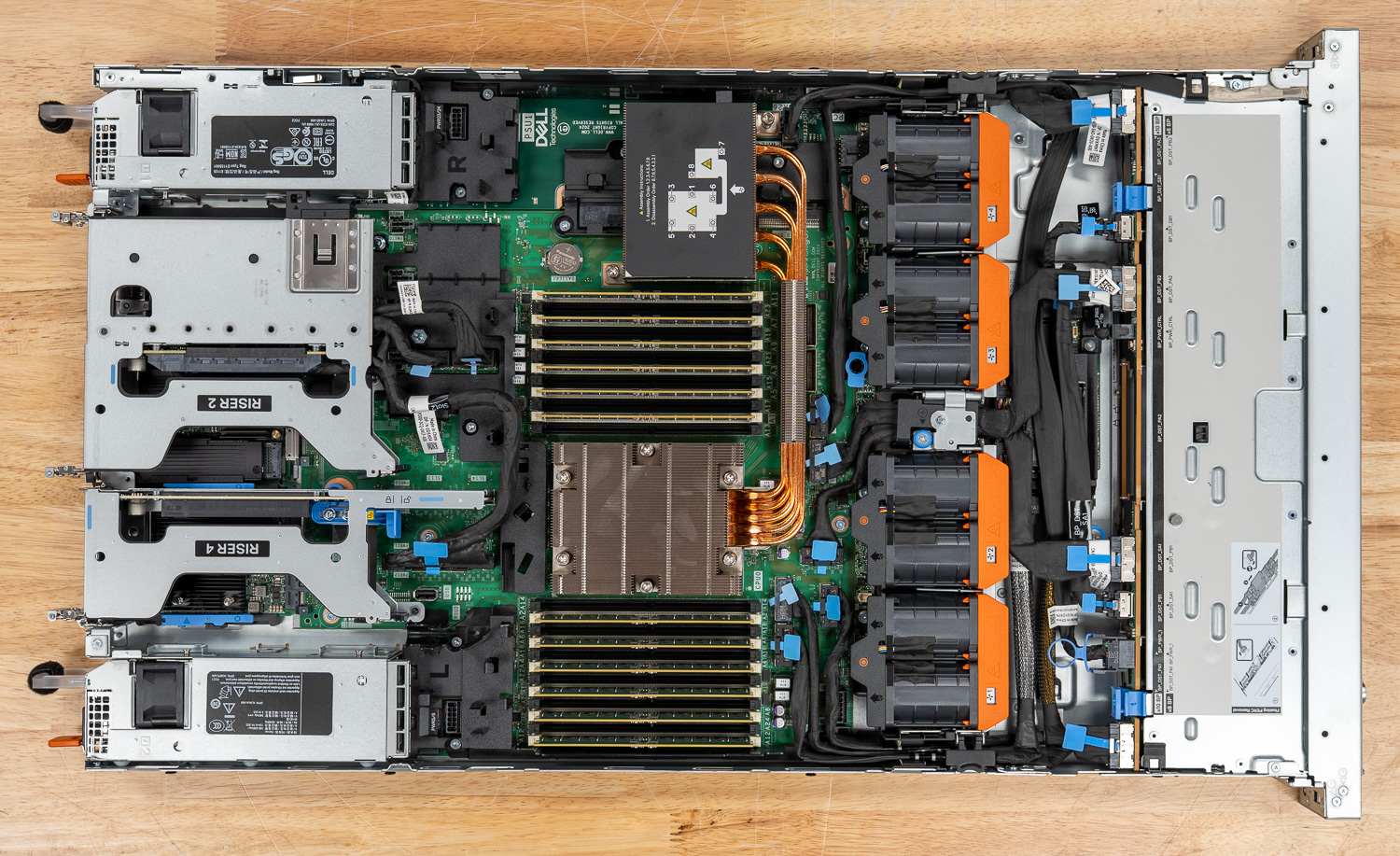
Dell PowerEdge R4715 Chassis View
The R5715 is a 2U single-socket server optimized for storage capacity and I/O expandability. It supports the same 24 DDR5 RDIMMs and the four CPU options. However, the R5715 adds a fourth PCIe Gen5 slot and steps up to either 12 bays of 3.5-inch SAS/SATA drives or 16 bays of 2.5-inch SAS/SATA drives. The 3.5-inch configuration can reach 288TB of raw capacity in a single node, which is the configuration we built our R5715 around for this article.
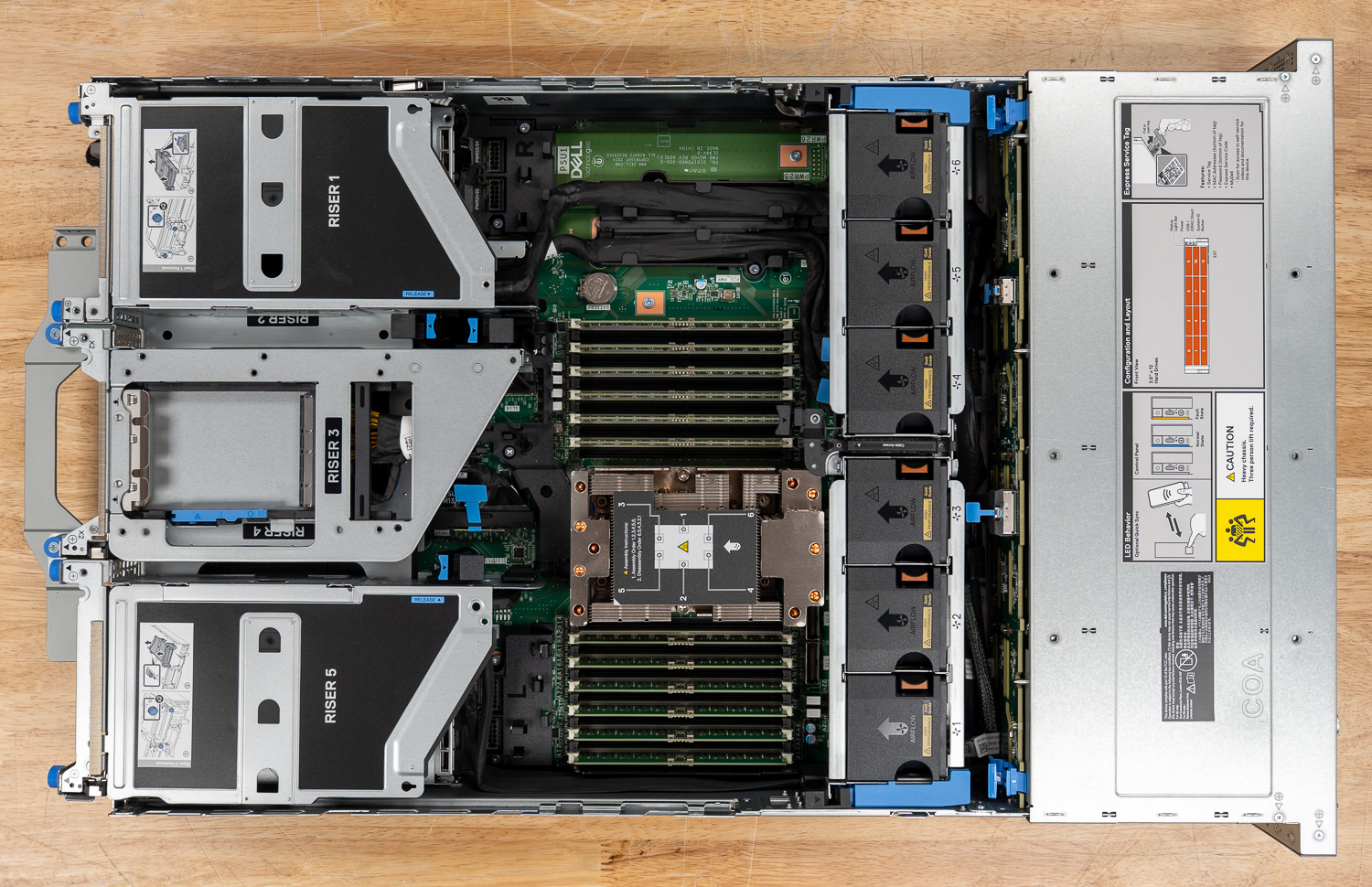
Dell PowerEdge R5715 Chassis View
Both platforms are air-cooled, ship with iDRAC10, and support 800W and 1100W power supplies in Platinum or Titanium efficiency grades. These PowerEdge servers do not support GPUs, DPUs, or Fibre Channel, which aligns with Dell’s positioning of these servers as right-sized platforms with a specific target rather than maximum-flexibility platforms.
It is worth understanding where these two servers sit within Dell’s broader AMD-based PowerEdge lineup. The R4715 and R5715 are the value-optimized entry points, purpose-built for the SMB workloads covered in this article. Customers who need accelerators, higher core counts, or greater expansion have a clear path up the stack to the R6715 and R7715, which add GPU and DPU support, processors scaling well beyond 32 cores, and additional PCIe capacity for accelerator-driven and performance-intensive workloads. This tiering is an advantage for the channel; a VAR can place an R4715 or R5715 with a customer today and scale that customer up to the R6715 or R7715 as requirements grow, all within the same management plane, deployment workflow, and support model.
Platform Specifications
| Specification | Dell PowerEdge R4715 | Dell PowerEdge R5715 |
|---|---|---|
| Processor | ||
| Processor | One 5th Generation AMD EPYC 9005 Series processor, up to 32 cores | |
| Form Factor | 1U rack server | 2U rack server |
| Memory | ||
| DIMM Slots | 24 DDR5 DIMM slots | |
| Maximum Memory | 1.5 TB (up to 64 GB per DIMM) | |
| Memory Speed | Up to 5200 MT/s | |
| Memory Type | Registered ECC DDR5 RDIMMs only | |
| Storage | ||
| Internal Controllers (RAID) | PERC H365i, H965i | |
| Internal Boot | BOSS-N1 DC-MHS | |
| External HBAs | N/A | |
| Front Drive Bays | 4x 3.5-inch SAS 8x 2.5-inch SAS/SATA 8x U.2 NVMe Gen4 |
12x 3.5-inch SAS/SATA 16x 2.5-inch SAS/SATA |
| Power | ||
| Power Supplies | Platinum 800W, 1100W Titanium 800W, 1100W FTR supported |
|
| Cooling & Fans | ||
| Cooling Options | Air cooling | |
| Fans | Up to four sets (dual fan module) hot-plug fans | Up to six hot-plug fans |
| Dimensions | ||
| Height | 42.8 mm (1.68 inches) | 86.8 mm (3.41 inches) |
| Width | 482.0 mm (18.97 inches) | |
| Depth (with bezel) | 816.921 mm (32.16 inches) | 802.4 mm (31.59 inches) |
| Depth (without bezel) | 815.141 mm (32.09 inches) | 801.51 mm (31.55 inches) |
| Bezel | Optional metal bezel | |
Four AMD EPYC 9005 Series CPU Options
Dell offers four specific CPU SKUs across both servers. The selection is deliberate, covering the range of SMB workloads without overlap or unnecessary complexity. Each CPU is built on AMD’s Zen 5 microarchitecture and shares the same platform-level memory and PCIe characteristics.
| CPU | Cores | Default TDP | cTDP Range | Base Clock | Max Boost | L3 Cache |
|---|---|---|---|---|---|---|
| EPYC 9335 | 32 | 210W | 200-240W | 3.0 GHz | 4.4 GHz | 128 MB |
| EPYC 9255 | 24 | 200W | 200-240W | 3.2 GHz | 4.3 GHz | 128 MB |
| EPYC 9135 | 16 | 200W | 200-240W | 3.65 GHz | 4.3 GHz | 64 MB |
| EPYC 9015 | 8 | 125W | 120-155W | 3.6 GHz | 4.1 GHz | 64 MB |
The 32-core 9335 is the top of the stack and the most flexible for compute-bound workloads. The 24-core 9255 is the closest match to the price-performance sweet spot we observed in our testing, particularly for database workloads, where marginal gains in core count slow after 24 cores. The 16-core 9135 and 8-core 9015 are where the value story is strongest. Because much of the software SMBs run is licensed per core, including Windows Server, many relational databases, and some hypervisor and backup platforms, the core count chosen at purchase carries forward as a recurring cost for the life of the deployment.
Selecting an 8-core or 16-core SKU that comfortably covers the workload, rather than over-provisioning cores that sit idle, reduces both acquisition cost and ongoing licensing exposure. The 16-core 9135 is especially relevant here, as it aligns with the minimum core count for Windows Server licensing, making it a natural starting point for Windows-centric environments that want to right-size the CPU to the license floor without leaving performance on the table. The 8-core 9015 is the lowest-power and lowest-cost option, ideal for storage-forward workloads or roles where the CPU is not the constraint. Each CPU runs at the same memory speeds and supports the same PCIe Gen5 lane count, so configuration decisions higher up the stack are not constrained by SKU choice.
Performance Testing
| Testing Configurations | Dell PowerEdge R4715 | Dell PowerEdge R5715 |
|---|---|---|
| Tested CPU’s | AMD EPYC 9335, 9255, 9135, 9015 | AMD EPYC 9015 |
| Memory | 384GB DDR5 | 384GB DDR5 |
| Boot Storage | BOSS RAID1 | BOSS RAID1 |
| Front Storage Configuration | 8x Samsung PM9D3a RI U.2 Gen5 NVMe SSDs (1.92TB) Raid 10 x 6 | 12x 20TB HDDs in RAID6 |
Database Performance: HammerDB MariaDB TPC-C
The headline workload for this evaluation is HammerDB running TPC-C against MariaDB 12.3.1. TPC-C is a long-established OLTP benchmark that produces measurable, comparable results across CPU and storage configurations and represents the kind of transactional database workload at the core of most SMB application stacks. We tested two distinct profiles: a CPU-intensive profile that stresses transaction processing and an I/O-intensive profile that places greater load on the storage subsystem. Both profiles were run across all four CPU options on the R4715 flash configuration to produce a clean CPU scaling curve, and then on the R5715 HDD configuration to show what changes when the storage substrate shifts.
Dell PowerEdge R4715
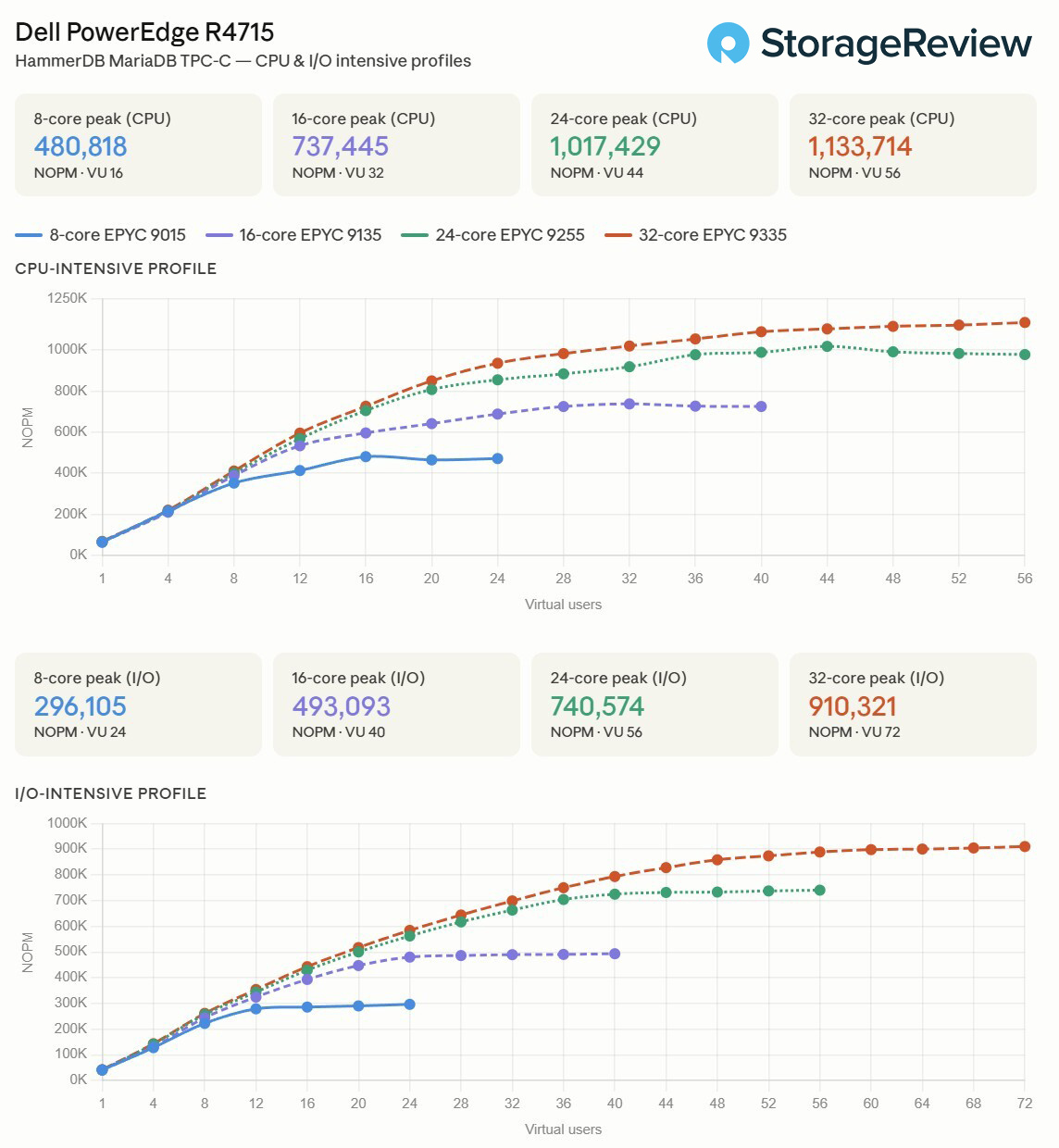
The HammerDB results show a clear scaling trend as core counts increase across the R4715 platform. Starting with the 8-core EPYC 9015, the system reached 480,818 NOPM in the CPU-intensive profile and 296,105 NOPM in the I/O-intensive profile before leveling off as the number of virtual users increased. Moving to the 16-core EPYC 9135 brought a substantial jump in throughput, pushing CPU-intensive performance to 737,445 NOPM and I/O-intensive performance to 493,093 NOPM, while also allowing the system to sustain higher virtual user counts before saturation.
The jump to the 24-core EPYC 9255 pushed the platform past the one million NOPM mark in the CPU-intensive profile, peaking at 1,017,429 NOPM, while the I/O-intensive profile climbed to 740,574 NOPM. At this point, the additional cores continued to translate directly into usable transactional throughput, while the NVMe storage subsystem kept pace with the growing database load.
At the top end, the 32-core EPYC 9335 delivered the highest results across both profiles, reaching 1,133,714 NOPM in the CPU-intensive workload and 910,321 NOPM in the I/O-intensive workload. The scaling curve remained relatively smooth even at high virtual user counts, indicating that the R4715 flash configuration effectively utilized the larger CPU configurations without storage bottlenecks prematurely limiting performance.
 Dell PowerEdge R5715
 Dell PowerEdge R5715
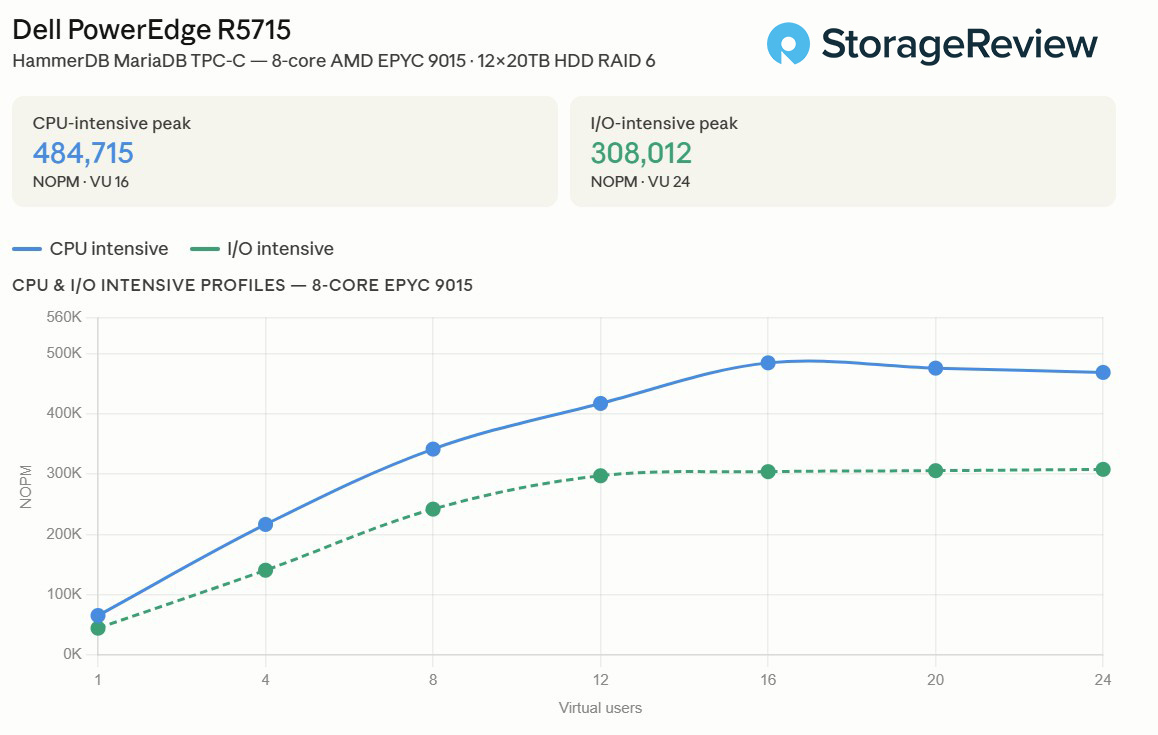
Then we tested the Dell PowerEdge R5715, configured with 12×20TB HDDs in RAID 6, alongside the 8-core AMD EPYC 9015. In the CPU-intensive profile, the platform reached a peak of 484,715 NOPM at 16 virtual users, with throughput scaling cleanly as additional users were introduced before leveling off near saturation.
The I/O-intensive profile peaked at 308,012 NOPM with 24 virtual users, indicating solid transactional performance of the high-capacity HDD array under moderate concurrency. As the workload ramped, the scaling curve flattened as the spinning-disk subsystem approached its practical performance ceiling under sustained concurrent database activity.
Windows Server Shared Storage
The second practical use case targets a different SMB workload pattern: Windows-based shared storage. For organizations running file shares, departmental applications, or general-purpose Windows Server roles, these platforms can meet modern SMB performance expectations. We ran FIO on Windows Server to characterize sequential and random performance across two storage configurations: a RAID 6 HDD array on the R5715 as a baseline, and an 8-drive SSD JBOD array on the R4715 representing a high-performance storage configuration. The comparison illustrates the operational gap between the two storage tiers in this platform class.
The gap between the two storage configurations becomes immediately apparent in the FIO results. While the RAID6 HDD array in the R5715 delivered respectable sequential throughput for a high-capacity spinning-disk platform, the SSD-equipped R4715 operated in a completely different performance class, particularly in random workloads, where SMB environments tend to feel storage latency most.
Sequential performance on the HDD array reached up to 3.7GB/s writes and 2.2GB/s reads in the 4-thread tests, which is more than adequate for traditional file serving, backups, and bulk storage tasks. However, the SSD configuration pushed sequential throughput into the tens of gigabytes per second, exceeding 56GB/s reads and 26GB/s writes while maintaining dramatically lower latency.
The separation widened even further in 4K random workloads. The HDD array peaked at under 1,300 IOPS in random-write testing, with latency climbing above 100ms, whereas the SSD configuration delivered over 4 million IOPS with sub-millisecond latency. In practical terms, this translates directly into application responsiveness, multi-user file share performance, VM storage behavior, and the ability to sustain concurrent SMB workloads without the storage layer becoming a bottleneck.
| FIO Workload | R5715 RAID6 HDD 1T | R5715 RAID6 HDD 4T | R4715 8x SSD 1T | R4715 8x SSD 4T |
|---|---|---|---|---|
|
Sequential Read (128K) |
||||
| Bandwidth | 1,475.89 MB/s | 2,198.89 MB/s | 56,861.09 MB/s | 56,866.76 MB/s |
| IOPS | 11,807 | 17,589 | 454,885 | 454,918 |
| Latency | 2.70ms | 7.28ms | 0.56ms | 2.25ms |
|
Sequential Write (128K) |
||||
| Bandwidth | 2,665.31 MB/s | 3,726.63 MB/s | 26,739.52 MB/s | 26,753.48 MB/s |
| IOPS | 21,322 | 29,811 | 213,912 | 214,011 |
| Latency | 1.49ms | 4.39ms | 1.20ms | 4.78ms |
|
Random Read (4K) |
||||
| Bandwidth | 1.00 MB/s | 3.60 MB/s | 7,268.78 MB/s | 16,143.19 MB/s |
| IOPS | 256 | 919 | 1,860,803 | 4,132,645 |
| Latency | 125.11ms | 139.00ms | 0.13ms | 0.17ms |
|
Random Write (4K) |
||||
| Bandwidth | 4.88 MB/s | 4.67 MB/s | 7,555.53 MB/s | 16,010.24 MB/s |
| IOPS | 1,248 | 1,195 | 1,934,214 | 4,098,613 |
| Latency | 25.63ms | 106.98ms | 0.07ms | 0.13ms |
Proxmox Backup Server
Beyond raw benchmarks, the R5715 with HDD storage is exactly the kind of platform that suits a virtualized backup target workload. To validate that fit, we deployed Proxmox Backup Server on the R5715 configured with the 8-core EPYC 9015 and the same 12-bay 3.5-inch HDD array. Proxmox is a representative example of the broader open-source hypervisor and infrastructure ecosystem that has gained significant traction in SMB environments, and Proxmox Backup Server, in particular, is well-suited to this server’s storage profile.
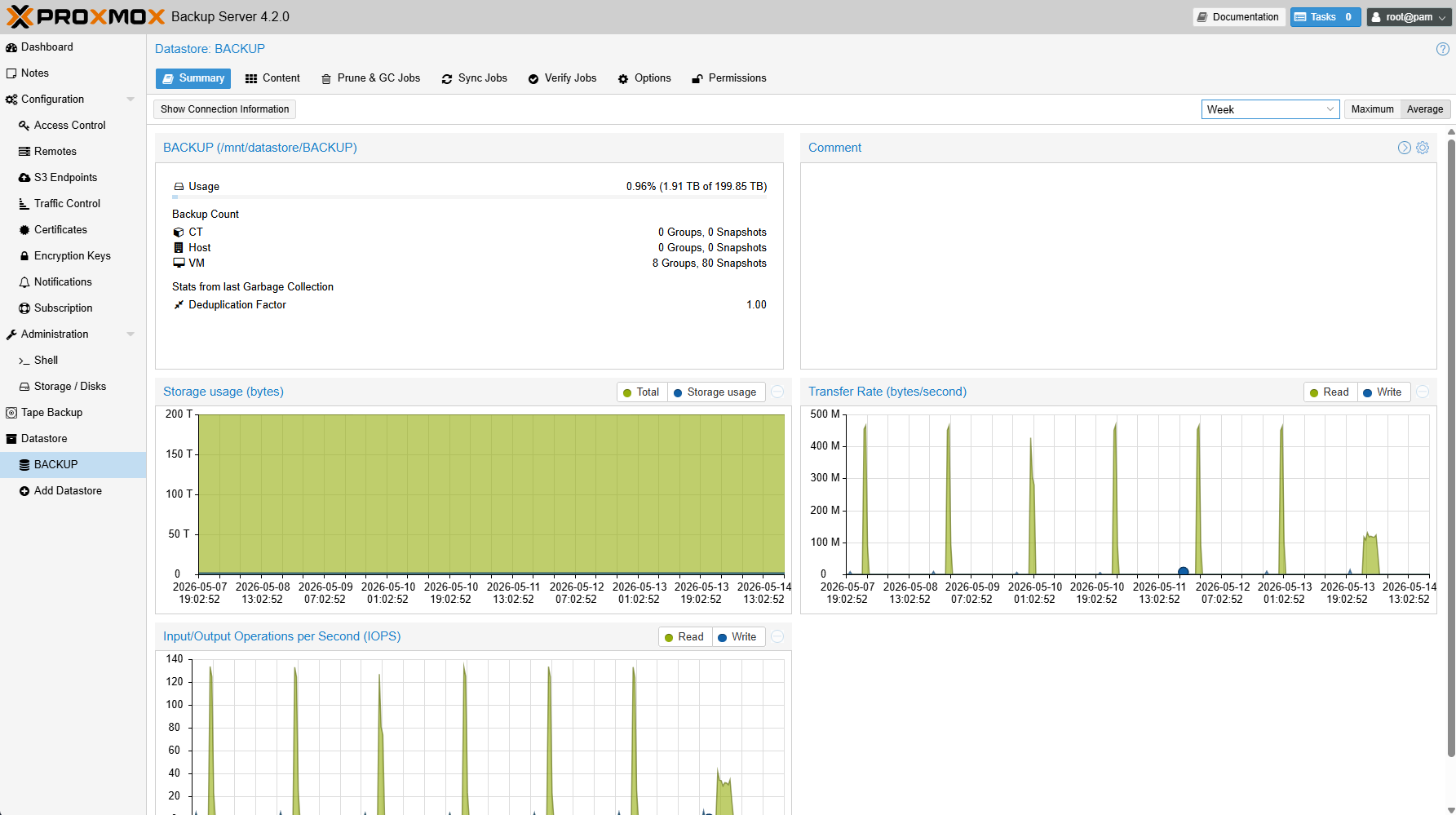
We deployed Proxmox Backup Server 4.2.0 and used it to back up the virtual machines that power our Proxmox community Discord server environment.
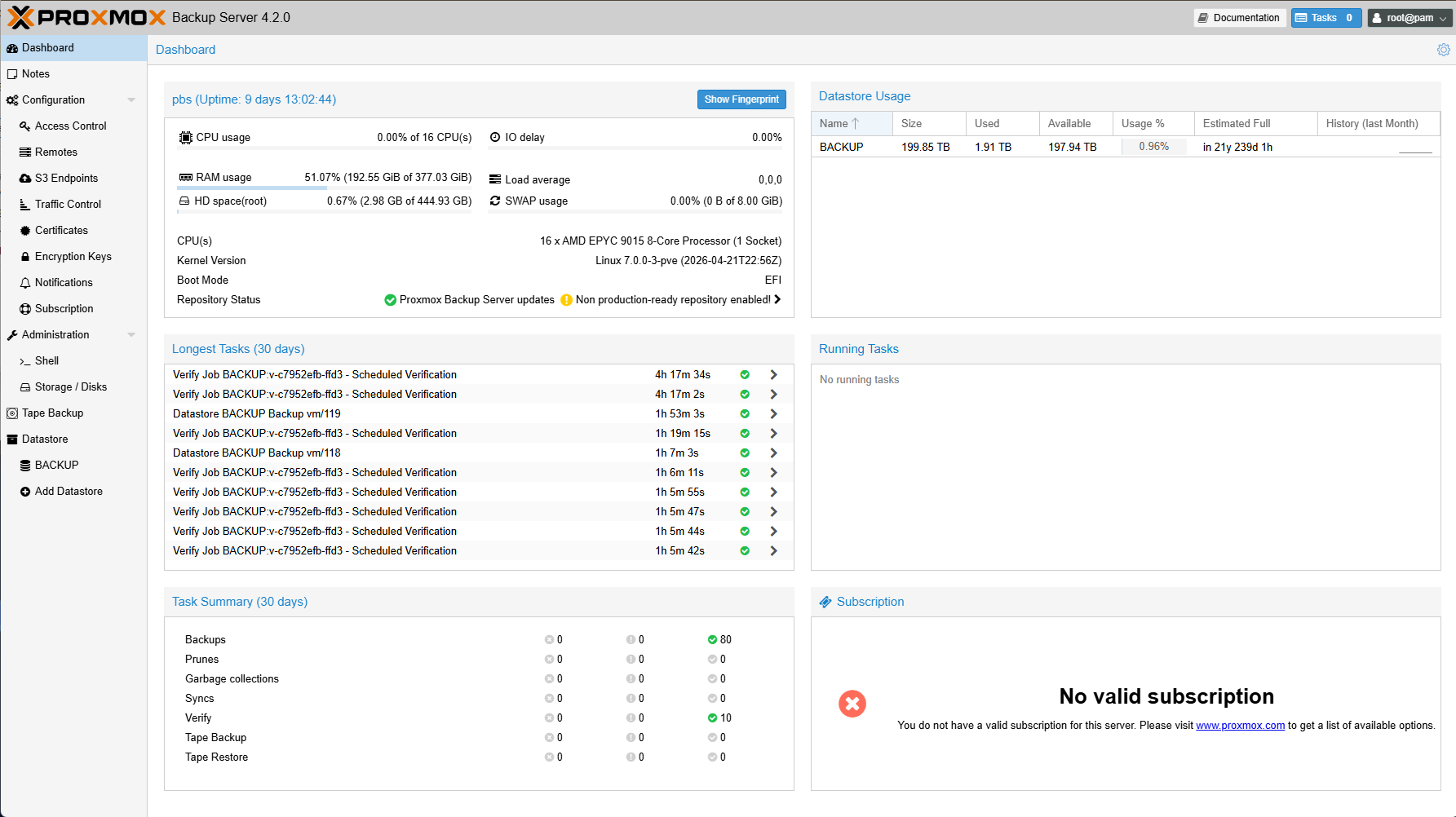
In our specific configuration, backup and restore operations were somewhat limited by the system’s 1GbE networking connection, which became the primary bottleneck during larger transfers. However, the platform supports straightforward networking upgrades via OCP expansion cards, making it easy to migrate to 10GbE or even 25GbE connectivity. With faster networking in place, the R5715 would be able to handle significantly higher backup throughput and restore performance, especially in environments with larger VM datasets or more demanding backup windows.
Conclusion
The Dell PowerEdge R4715 and R5715 succeed by getting the configuration matrix right. Two chassis with clearly differentiated form factors, four CPU options that cover the practical range of SMB workloads without overlap, and a storage menu broad enough to support everything from low-cost bulk capacity to all-flash performance. The configuration flexibility is not theoretical. Across the workloads we tested, the right answer changed with each one. The 24-core 9255 hit the sweet spot for transactional database performance on flash. The 8-core 9015 provided exactly enough CPU for a Proxmox Backup Server deployment with bulk HDDs. The R4715 with flash storage was the appropriate choice for Windows shared storage, while the R5715 with HDDs was the appropriate choice for capacity-focused workloads where peak I/O is not the constraint.
For SMB customers and the partners who serve them, the value of these platforms lies in the ability to match the build to the workload, rather than buying more capacity than the workload requires. The Dell ecosystem, including iDRAC10 management, ProSupport, the security stack, and supply chain predictability, amplifies that value at the operational level. Lean IT teams and channel partners both benefit when the platform behind the customer’s workload is a known quantity.
Dell’s positioning of these servers as a way to consolidate legacy infrastructure and reduce per-socket and per-core licensing exposure holds up against the data we collected. With four CPU options spanning 8 to 32 cores at the same platform level, customers and partners have the flexibility to right-size acquisition, licensing, and operational costs to match actual requirements. That is the value proposition, and the R4715 and R5715 deliver against it.



 Amazon