

Updated October 13, 2026: Copy pass for house style, with long entries split and dashes removed; picks and data unchanged.
Every system ranked on this page has been through the StorageReview lab. We benchmark local AI performance directly: vLLM online serving throughput, time-to-first-token, and time-per-output-token across models including GPT-OSS-120B, Llama 3.1 8B, Mistral Small 3.1 24B, and Qwen3 Coder 30B, plus MAMF compute efficiency and GDSIO storage testing. No system is ranked from a spec sheet.
The defining question for a local AI desktop in 2026 is unified memory versus discrete VRAM. Deskside appliances such as NVIDIA’s GB10-based DGX Spark and AMD’s Ryzen AI Max (Strix Halo) systems put 128GB of unified memory behind a single chip at appliance prices, holding models that would otherwise require multiple discrete GPUs.
Workstation towers answer with raw throughput: RTX PRO 6000 Blackwell cards deliver far higher tokens per second, at several times the cost and power draw. This page ranks both, in separate tiers, from one consistent test suite, because the right answer depends on the largest model you intend to run and how fast you need it to respond.
At a Glance
| Category | System | Memory | GPUs (Tested / Max) | Full Review |
|---|---|---|---|---|
| Best Overall Deskside AI System | NVIDIA DGX Spark | 128GB unified LPDDR5X | GB10 integrated (fixed) | DGX Spark Review |
| Best GB10 Implementation | Acer Veriton GN100 | 128GB unified LPDDR5X | GB10 integrated (fixed) | Veriton GN100 Review |
| Best x86 Alternative | AMD Ryzen AI Halo (Strix Halo) | Up to 128GB unified LPDDR5X | Radeon 8060S integrated (fixed) | Ryzen AI Halo Review |
| Best Without a Discrete GPU | HP Z2 Mini G1a | Unified LPDDR5X (ran GPT-OSS 120B) | Integrated, no dGPU (fixed) | Z2 Mini G1a Review |
| Best GB300 System | MSI XpertStation WS300 (alternative: ASUS ET900N G3) | 748GB coherent (252GB HBM3e + 496GB LPDDR5X) | GB300 integrated (fixed) | XpertStation WS300 Review |
| Best Tower for Local AI | Dell Precision 7875 | 192GB GDDR7 (2× 96GB) | 2× RTX PRO 6000 / 2 max | Precision 7875 Review |
| Best Multi-GPU Platform | HP Z8 Fury G6i | 192GB GDDR7 as tested / up to 384GB | 2× RTX PRO 6000 tested / 4 max | Z8 Fury G6i Review |
| The Extreme Pick | Comino Grando RTX PRO 6000 | 768GB GDDR7 (8× 96GB) | 8× RTX PRO 6000 / 8 max | Comino Grando Review |
Deskside AI Appliances
The appliance tier, what Dell calls deskside AI and NVIDIA calls the personal AI supercomputer, trades peak throughput for model capacity, power efficiency, and price. With 128GB of unified memory, these systems comfortably hold 70B-class models at high quantization and can stretch to 120B-class, workloads that would demand multiple discrete GPUs in a tower.
Essential lab reading for this tier: our DGX Spark thermal test compares OEM cooling designs across the GB10 systems below and applies to every unit in this class until these platforms see a revision.
Best Overall Deskside AI System: NVIDIA DGX Spark
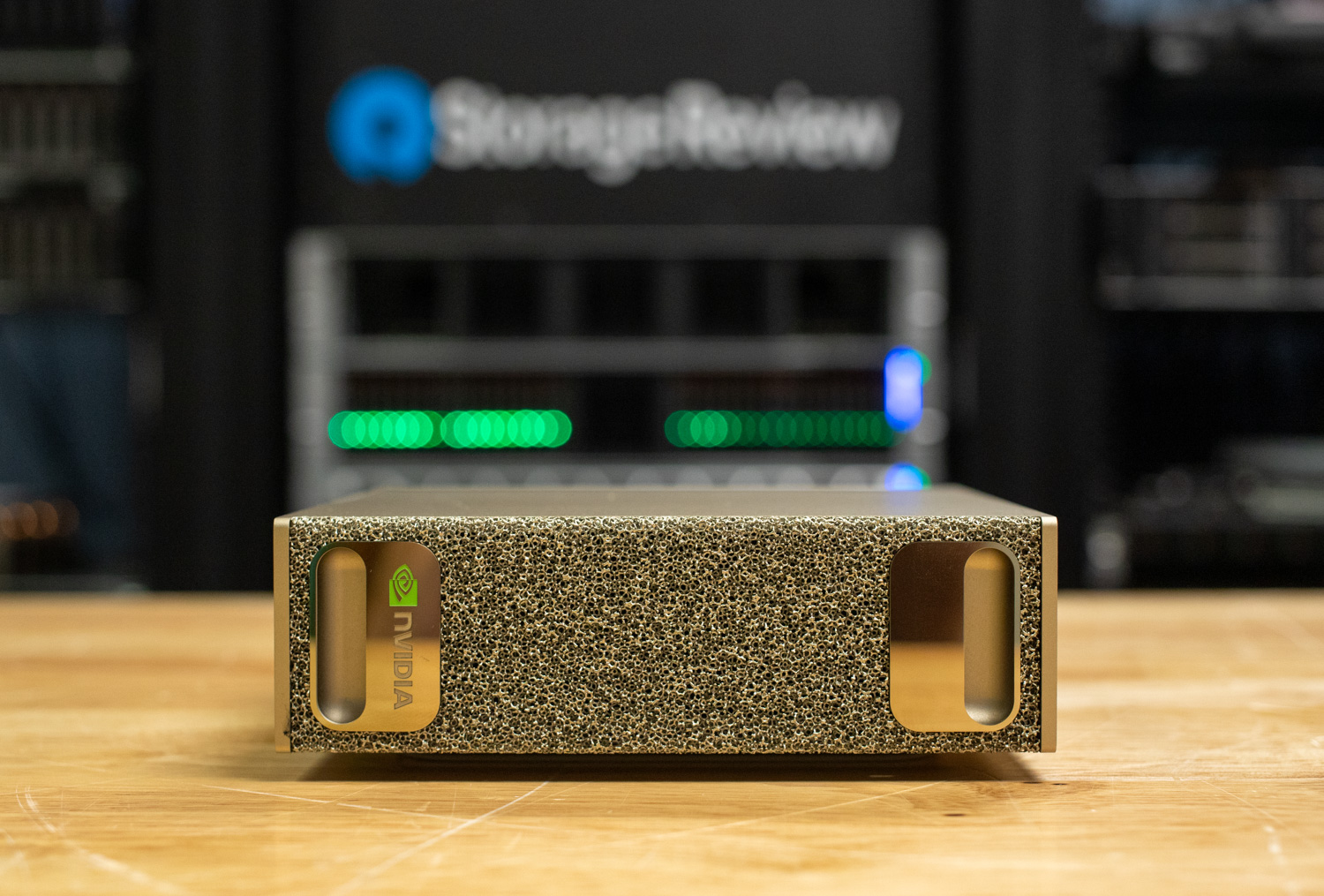
The DGX Spark is the reference point every other deskside AI box is measured against. The GB10 Grace Blackwell superchip pairs a 20-core Arm CPU with 128GB of unified LPDDR5X, and dual ConnectX-7 200GbE ports make it the only appliance class we have tested that clusters out of the box: our two-node distributed inference testing ran pipeline-parallel workloads across Dell, GIGABYTE, and HP nodes over 200GbE.
That clustering story now has a cheaper on-ramp: NVIDIA is adding a 64GB DGX Spark SKU on October 23 at $4,999, sold through the same six OEMs, and two of them pair over one 200GbE cable to pool 128GB; NVIDIA puts the clustered pair at up to 1.7x a single 128GB unit on Qwen3.8 27B, a claim we have not yet tested. The CUDA software stack remains the deepest in the segment.
The platform’s one hard limit is storage: every GB10 system tops out around 4TB on a single short M.2 slot. Our eight-Spark shared storage build is the fleet answer: a single governed QLC array served over the 100GbE ports every Spark already carries, where one client read at 10.8GiB/s, matching the fastest internal M.2 we have measured in a GB10 system, and a 78GB model hosted centrally loaded within 13% of local NVMe.
Read the full DGX Spark review
Best GB10 Implementation: Acer Veriton GN100
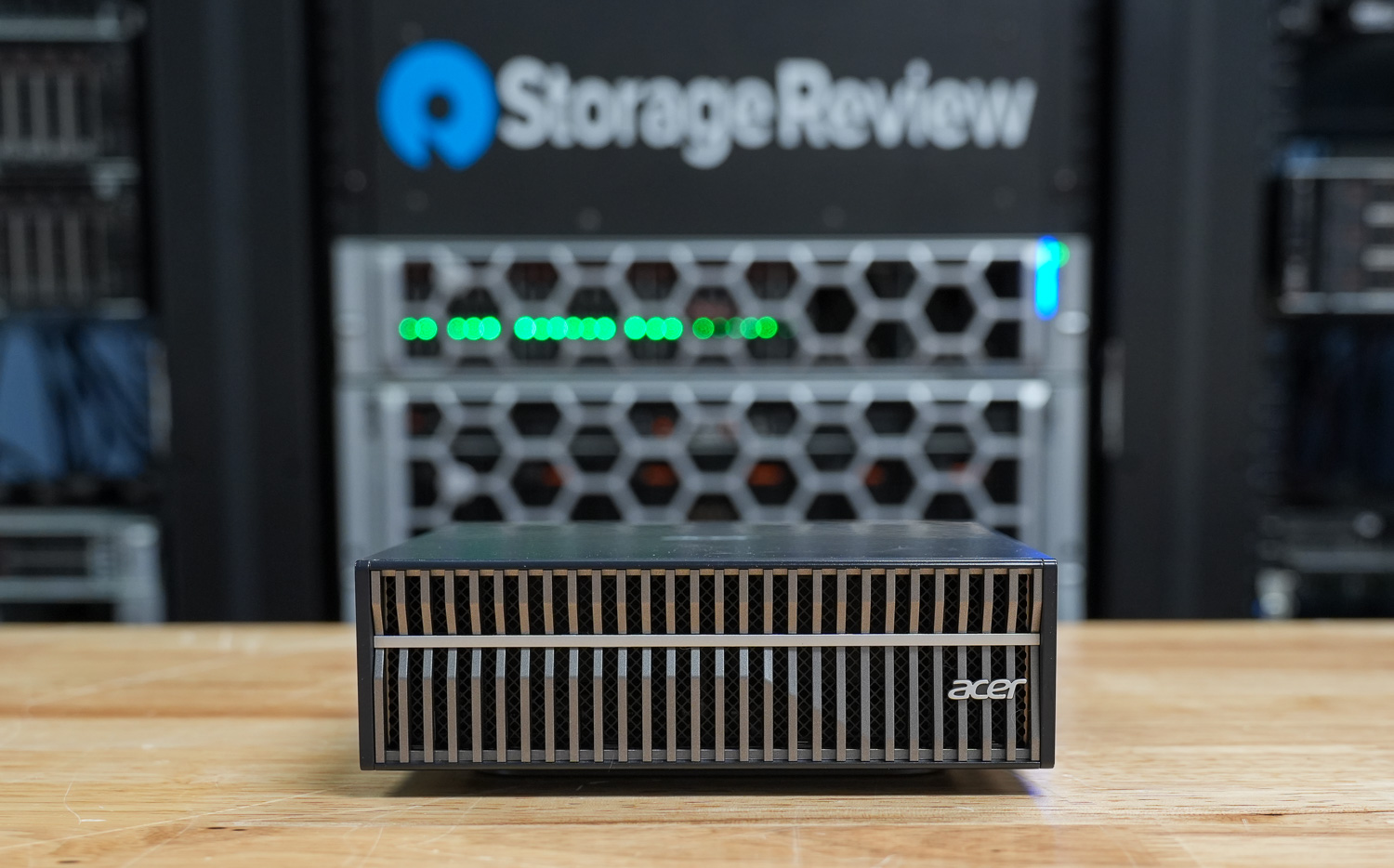
Among the GB10 OEM systems, thermal design is the real differentiator, and the Veriton GN100 stood out in our testing. All GB10 boxes share the same silicon and memory configuration, so sustained performance comes down to cooling. Our multi-OEM thermal comparison is, to our knowledge, the only one of its kind published.
Read the full Veriton GN100 review
Best x86 Alternative: AMD Ryzen AI Halo
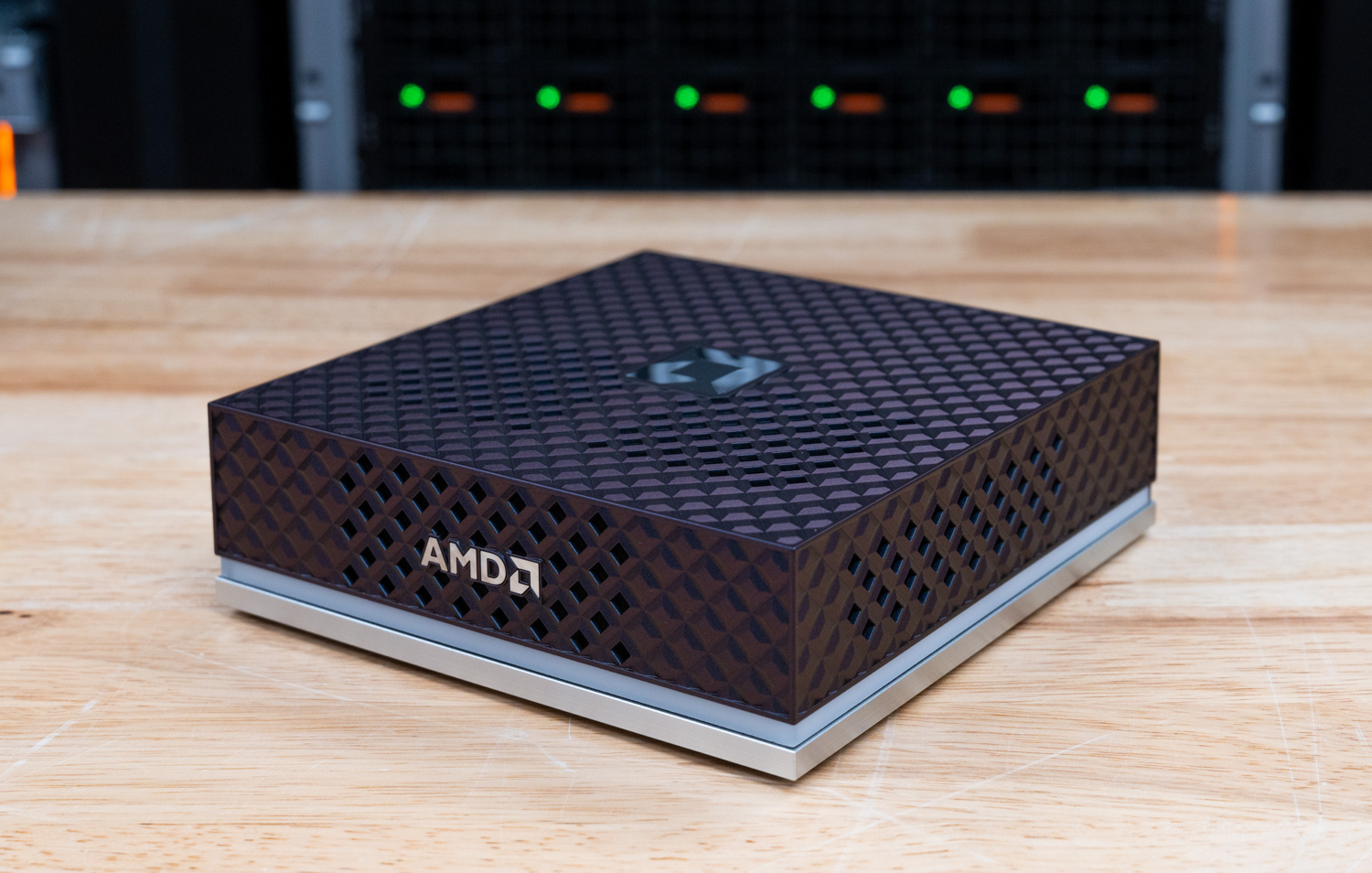
If you need Windows or a standard x86 software stack, Strix Halo is the deskside answer. AMD’s Ryzen AI Max+ 395 platform pairs 128GB of unified memory with a dual-OS setup, and in our testing it handled 200B-parameter-class models, a direct shot at the DGX Spark without the Arm/DGX OS commitment.
Read the full Ryzen AI Halo review
Best Without a Discrete GPU: HP Z2 Mini G1a
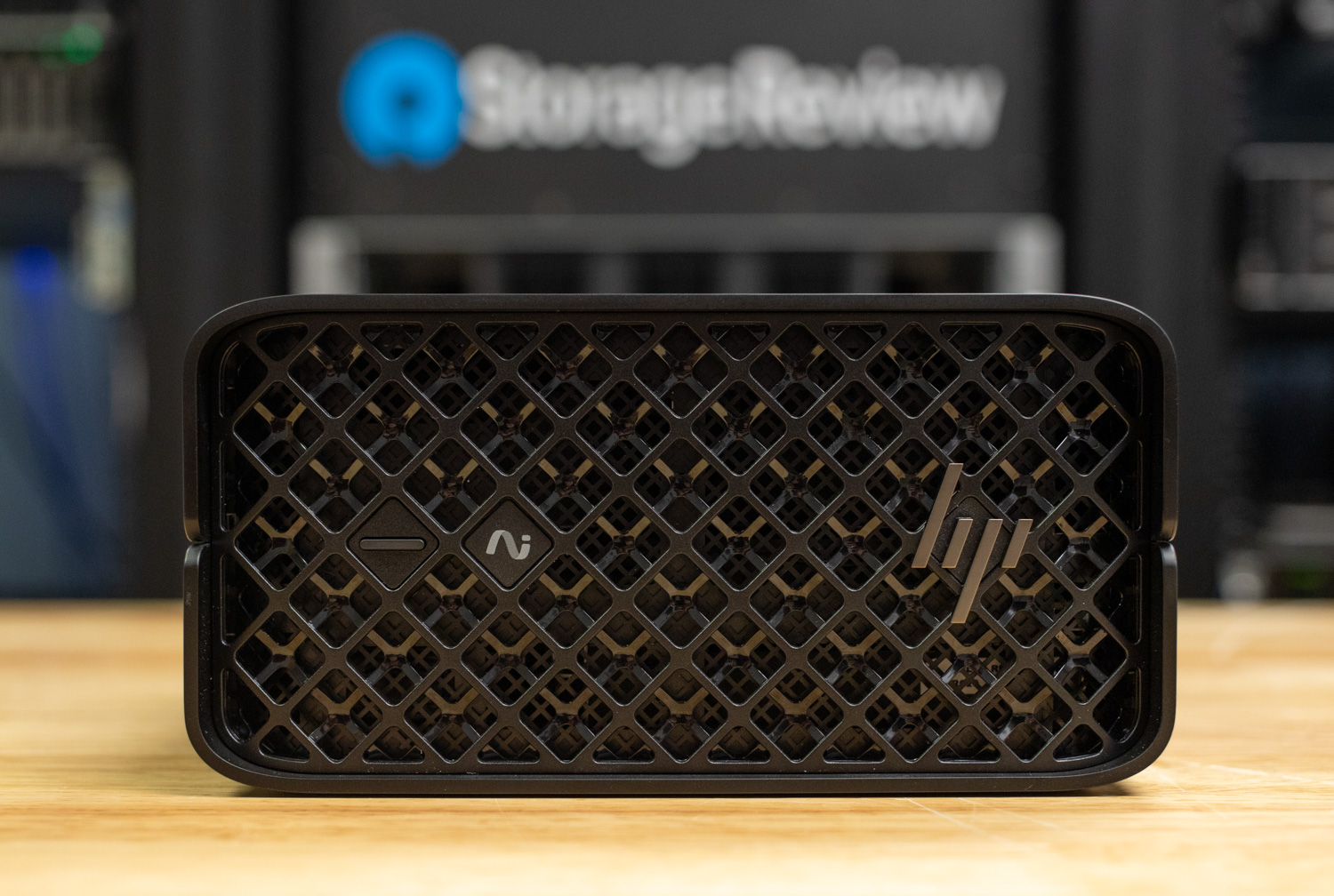
The Z2 Mini G1a ran GPT-OSS 120B with no discrete GPU at all. HP’s mini workstation puts AMD’s Ryzen AI Max+ PRO silicon in a compact, quiet, IT-friendly chassis, and it remains the clearest demonstration that unified-memory x86 systems have changed what a small office box can do with large models.
Read the full Z2 Mini G1a review
Best GB300 System: MSI XpertStation WS300
The WS300 is the first GB300 DGX Station through our lab, and it resets the ceiling for the appliance tier. The Grace Blackwell Ultra superchip pools 748GB of coherent memory, 252GB of HBM3e plus 496GB of LPDDR5X, behind 20 petaFLOPS of FP4 compute, and in our testing it served a 433GB GLM-5.2 checkpoint with 216GB of expert weights held in Grace memory, a model that has no business running beside a desk. Like every DGX-class system it runs DGX OS rather than Windows; that is the commitment this much memory asks for.
Price and power put it closer to the extremes of the tower tier than to the GB10 boxes above, but nothing else in the appliance class holds a model this large. The obvious question, whether a 1,300W part throttles in a tower, now has a measured answer: our WS300 thermals deep dive logged a 2.8-hour sustained run with the Blackwell Ultra die held at 60C, a flat 2.07GHz clock with no dips, and roughly 20C of thermal margin left at full load.
GB300 alternative: the ASUS ExpertCenter Pro ET900N G3 is the second GB300 DGX Station through our testing, and it confirms the platform: across 14 models and two workloads, 24 of 28 peak-throughput comparisons landed within 2% of the WS300, and the coherent-pool models ran at parity or better. ASUS adds carry handles on the 27kg tower, a dedicated fan over the 400G optics cages, and an 80 PLUS Titanium supply. Either tower delivers the platform; read our ET900N G3 review for the two-tower comparison.
Cluster scaling: two of these towers cabled together over their own 400G ports are now measured, not promised: our GB300 cluster test paired the ASUS and HP Stations with two DACs, reached 98% of line rate on the NCCL collectives, and turned GLM-5.2, a 433GB model a single Station can only serve by spilling 215GB of weights into Grace memory, from 139 output tokens per second at 32 streams into 1,525, on the way to 3,141 at 256.
Models that fit on one Station scale differently: prefill/decode disaggregation tripled GLM-5.3 Flash short-prompt throughput, and DeepSeek V4.1 Flash posted 5,248 tokens per second, the highest output in the set.
Read the full XpertStation WS300 review
In the Lab: HP ZGX Fury AI Station
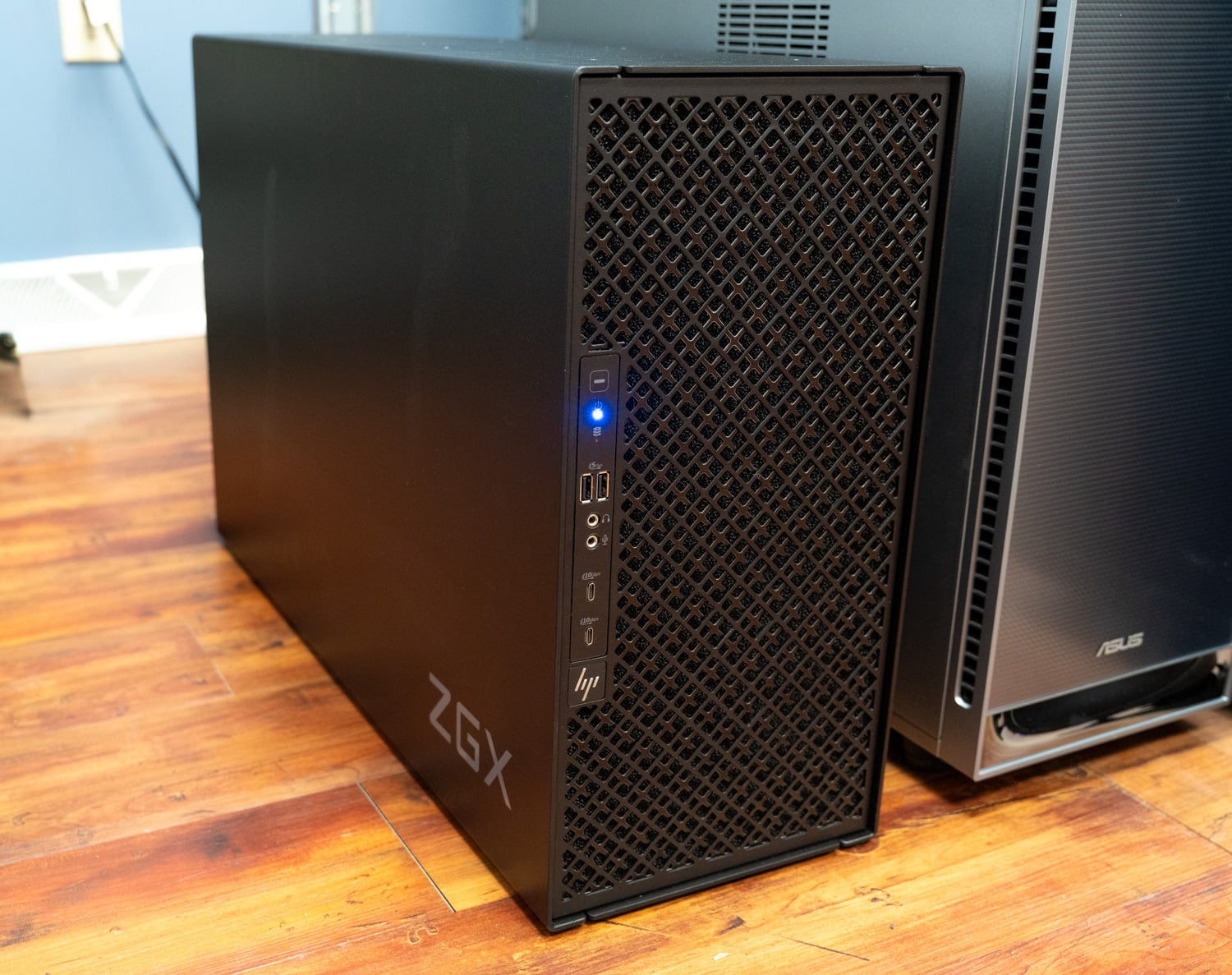
The HP ZGX Fury AI Station, the third GB300-class system to reach our lab, following the MSI WS300 and ASUS ET900N G3 whose two-tower results landed within 2% of each other
HP’s ZGX Fury AI Station is in our lab now. It is built on the same NVIDIA GB300 Grace Blackwell Ultra platform as the MSI XpertStation WS300 above, which makes it the first chance to see how two vendors’ implementations of the DGX Station architecture compare on the same bench: thermals, acoustics, sustained clocks, and the practical experience of living with the machine.
Its first public numbers are already out: the ZGX Fury served as the second tower in our two-Station GB300 cluster test, running decode for the disaggregated GLM-5.3 Flash configuration and half of every tensor-parallel run. The solo review is under way, and the ZGX Fury enters the rankings when its own bench numbers are in.
The ZGX Fury is also one of the first two systems Microsoft named for DGX Station for Windows, alongside the Dell Pro Precision with GB300, with NVIDIA listing the Windows version for the fourth quarter. The hardware matches the GB300 towers we have tested on Ubuntu, and whether serving stacks run natively on Windows or under WSL is the open question for this version.
On the Horizon: AMD Threadripper Halo Station
Announced at IFA 2026 and not yet in any lab, AMD’s Threadripper Halo Station is the first direct answer to the GB300 class above. The pitch inverts NVIDIA’s bet: instead of one large coherent memory pool, AMD pairs a 96-core Threadripper PRO on a platform with up to 2TB of eight-channel DDR5 and 128 PCIe 5.0 lanes with two 600W Instinct MI350P accelerators carrying 144GB of HBM3E each, and a stated path to four cards and 576GB of HBM. The whole system is liquid-cooled, and the x86 host sidesteps the Arm toolchain friction we flagged in the WS300 review.
The open question is how well models straddle PCIe-attached cards against NVLink-C2C coherence, and AMD has shown no benchmarks, pricing, or availability, so this is a watch item, not a pick. Details are in our announcement coverage; it enters the rankings if and when hardware reaches the lab.
Also Tested: Deskside AI Appliances
These systems have been through the same lab process and are solid choices that did not take a category slot: Dell Pro Max with GB10, ASUS Ascent GX10, GIGABYTE AI TOP ATOM, HP ZGX Nano G1n, and HP EliteDesk 8 Mini G1a.
Workstation Towers for Local AI
When response time matters more than acquisition cost (interactive coding assistants, multi-user serving, agentic pipelines with long tool-call chains), discrete VRAM still rules. These towers are ranked here on inference throughput and memory ceiling, and for each we list the GPU configuration we tested alongside the chassis maximum, since what a chassis can ultimately hold matters as much as what shipped in our build; they are ranked separately on our Best Desktop Workstations page against SPECworkstation and rendering workloads, because they answer two different questions.
Best Tower for Local AI: Dell Precision 7875
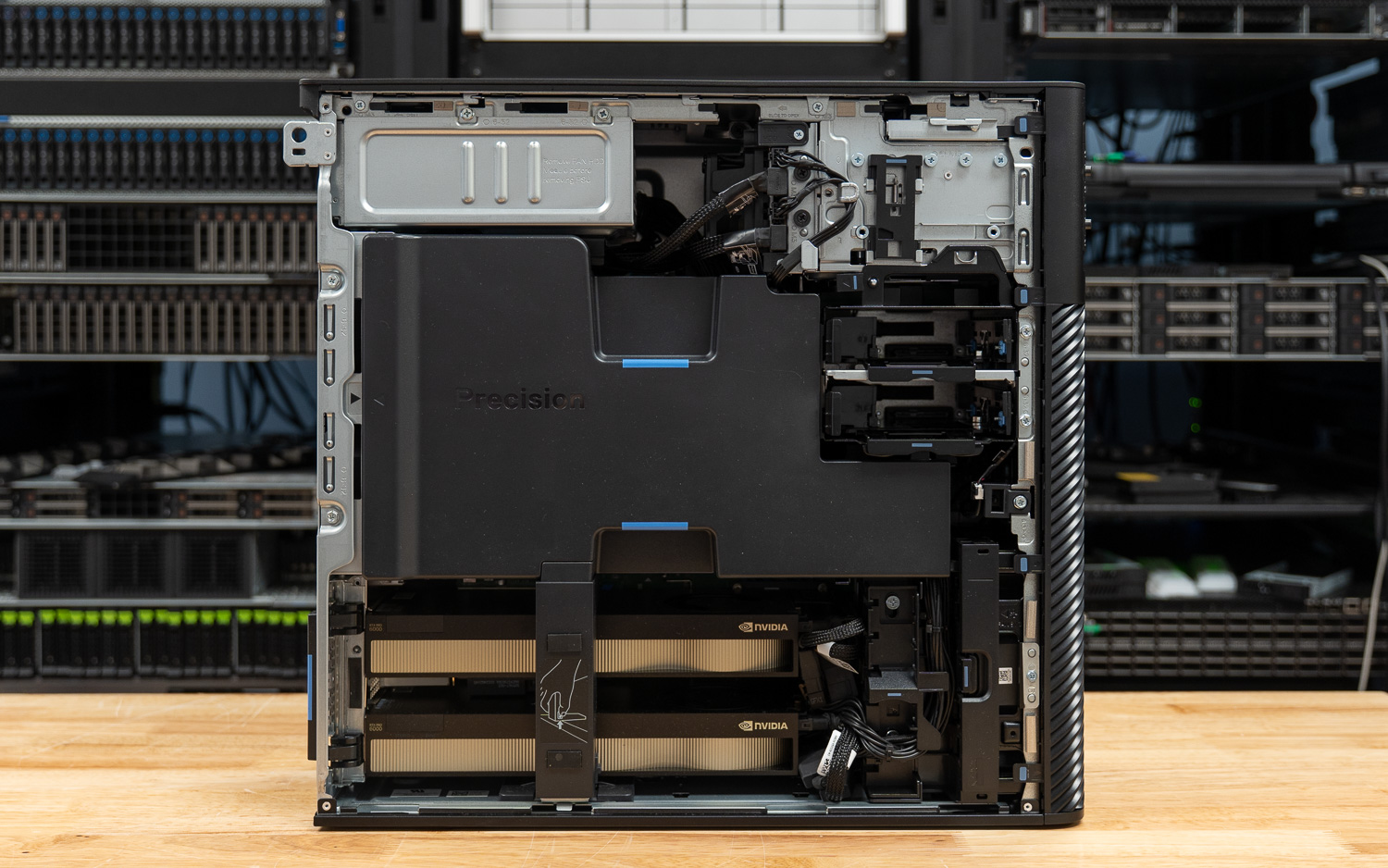
Dual RTX PRO 6000 Blackwell GPUs make the Precision 7875 the fastest standard-form-factor system we’ve tested for local inference. With a Threadripper PRO 9995WX and 192GB of combined VRAM across two cards, it holds 100B-class models entirely in GPU memory while delivering interactive-grade time-to-first-token that no unified-memory appliance approaches. Know the ceiling, though: the 7875 chassis supports a maximum of two dual-width cards, so our dual-GPU build is the maxed-out configuration; there is no adding a third later.
Read the full Precision 7875 review
Best Multi-GPU Platform: HP Z8 Fury G6i
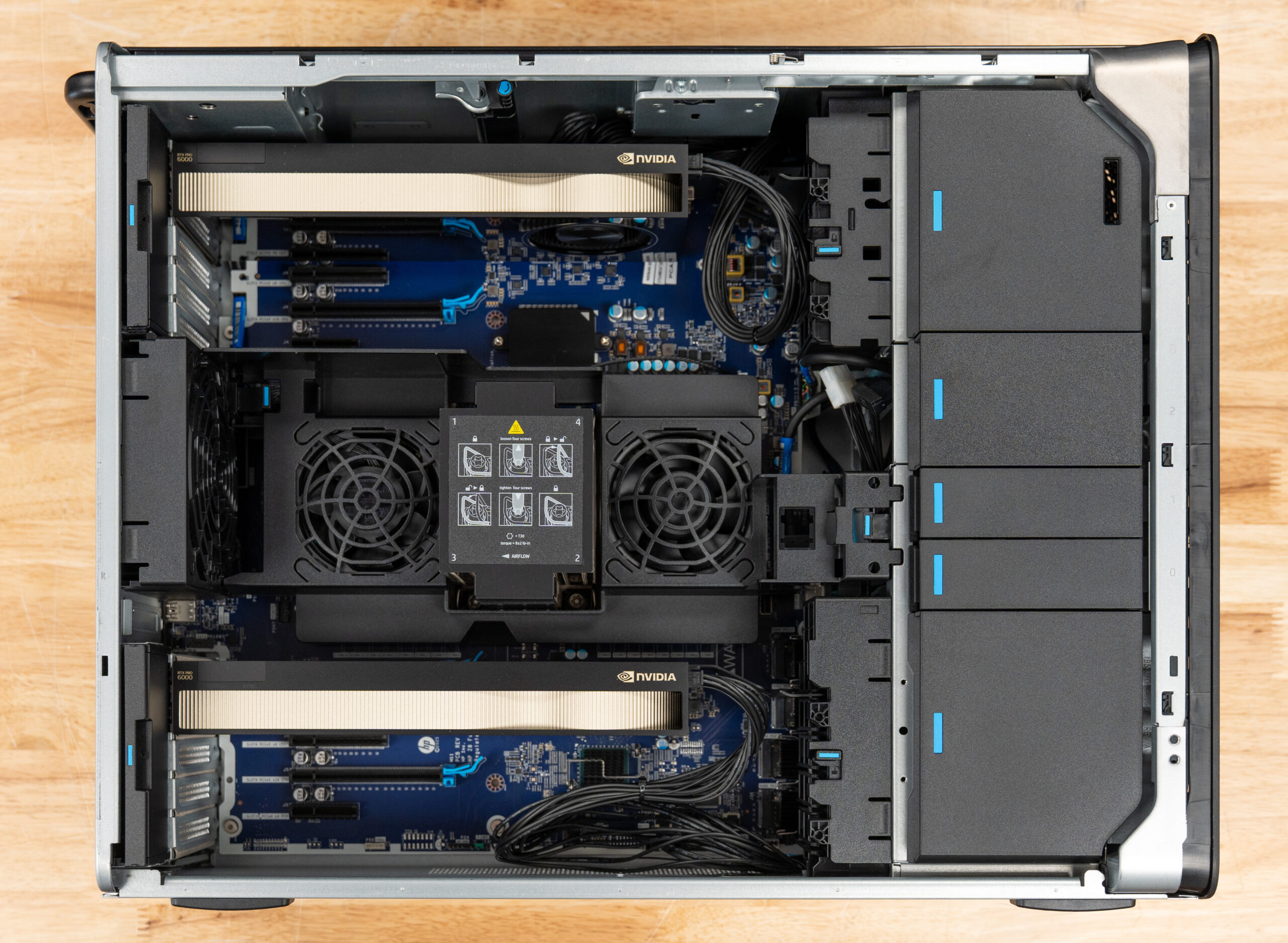
The Z8 Fury G6i is the tower you buy when you plan to grow into more GPUs. Our review build ran two RTX PRO 6000 Max-Q cards for 192GB of combined VRAM, but the chassis, fed by dual power supplies totaling up to 2700W, supports up to four Blackwell cards and 384GB of VRAM. That gap between as-tested and maximum is the point: no standard OEM tower we have tested offers more GPU headroom, and the path from two cards to four requires no chassis change.
Read the full Z8 Fury G6i review
The Extreme Pick: Comino Grando RTX PRO 6000
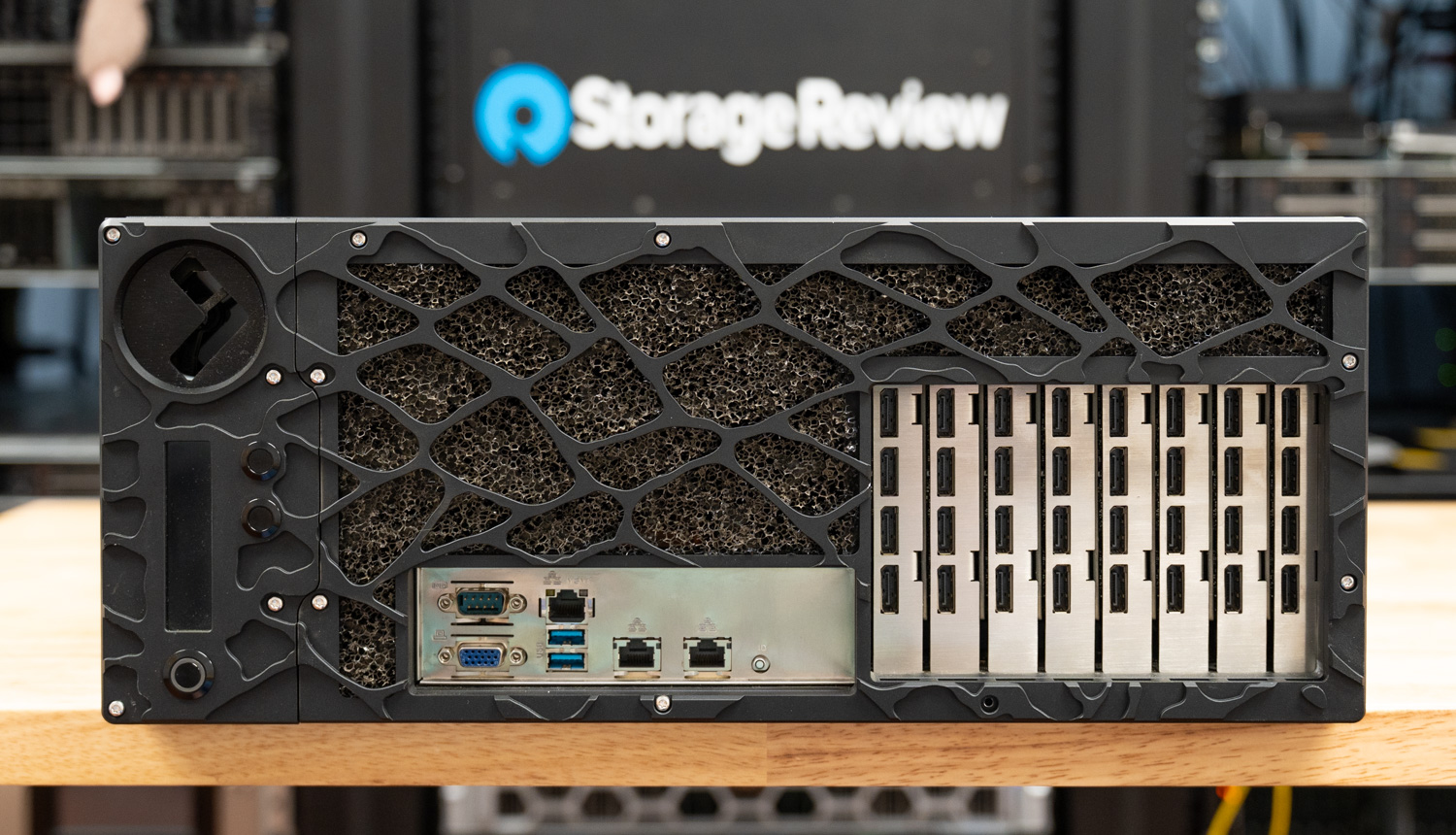
768GB of VRAM in a liquid-cooled 4U chassis: the Grando exists for the buyer whose model does not fit anywhere else. Our review unit shipped with eight RTX PRO 6000 Blackwell cards at 96GB each, the chassis maximum, and Comino’s liquid cooling sustains all eight at full TDP around the clock without throttling. That is more GPU memory than many rack servers, in something that can still live beside a desk. It is loud on price, not on acoustics, and it is deliberately the outlier on this list: proof of where the deskside ceiling sits.
Read the full Comino Grando review
How We Rank
Three rules govern every StorageReview leaderboard, and the first is that only lab-tested systems are ranked: if we have not benchmarked it, it can be mentioned, but it cannot hold a category. Second, systems are ranked once per measurement basis. The towers above also appear on our desktop workstation leaderboard, ranked there by SPECworkstation and rendering performance, ranked here by inference throughput and memory ceiling, so a different question on different data sometimes produces a different winner. Third, there is a viability bar: a system must run a 30B-class model at interactive speeds, or offer at least 96GB of model-accessible memory, to be ranked on this page.
Rankings are derived from a composite of vLLM online serving throughput, time-to-first-token, time-per-output-token, MAMF compute efficiency, GDSIO storage performance, and street price. Editorial judgment breaks ties within scoring bands. Vendors do not see rankings before publication, and no placement on this page is paid.
Local AI Desktop FAQ
What is the best desktop for agentic AI?
Agentic workloads such as coding agents, tool-calling pipelines, and multi-step autonomous tasks are throughput- and latency-sensitive in a way single-chat use is not, because agents chain many model calls with large context. That favors the tower tier: the Dell Precision 7875’s discrete VRAM delivers the sustained time-to-first-token that keeps long agent chains responsive. For budget-conscious agentic experimentation, a GB10-class appliance runs the same stacks at lower speed. Our full sizing guidance is in RAM, GPU & Storage for Agentic AI.
How much memory do I need to run a 70B model locally?
As a working rule, a 70B model at 4-bit quantization needs roughly 40-48GB of model-accessible memory before context; comfortable interactive use with a long context wants more. That is why 128GB unified-memory appliances handle 70B-class models well, and why 24-32GB single-GPU systems do not make this page.
Do I need special power to run these systems?
For the appliance tier, no: GB10-class boxes and Strix Halo systems run comfortably on a standard office outlet. The towers deserve a real conversation with whoever owns the building. A fully configured HP Z8 Fury G6i can carry dual power supplies totaling up to 2700W, more than a standard 15-amp, 120V circuit can deliver, and the Comino Grando specifies 2000W hot-swap supplies that require 180-264V input, dropping to 1000W units on 110V service.
Before buying from the top of this page, check what the wall can feed; a dedicated circuit or 208/240V service may be part of the true cost of a full GPU loadout. Heat follows the same math, since every watt drawn ends up in the room.
What about a Mac Studio?
Not right now, and not only because we have yet to lab-test one. Apple has stopped selling the high-memory Mac Studio configurations, which were the machine’s one real advantage for local AI: enough unified memory to hold very large models. Without those configurations, the current lineup is not a serious contender for this page. Apple is expected to refresh the Mac Studio this year; if high-memory options return, we will test one and reconsider.


 Amazon