

The Seagate IronWolf Pro 32TB is the NAS-tuned member of Seagate’s first 32TB CMR generation, announced alongside matching 32TB Exos and SkyHawk AI variants in 2026, and has been shipping through Seagate’s channel since January. The drive is built on the Mozaic3+ platform, which uses heat-assisted magnetic recording (HAMR) to push areal density past 3TB per disk while still presenting to the host as a conventional magnetic recording (CMR) device. Inside the helium-sealed enclosure, ten platters and twenty heads deliver 32TB of capacity via a SATA 6Gb/s interface and a 7200RPM spindle, with the ST32000NT000 targeting SMB collaboration, creative media workflows, and on-premises AI storage use cases.
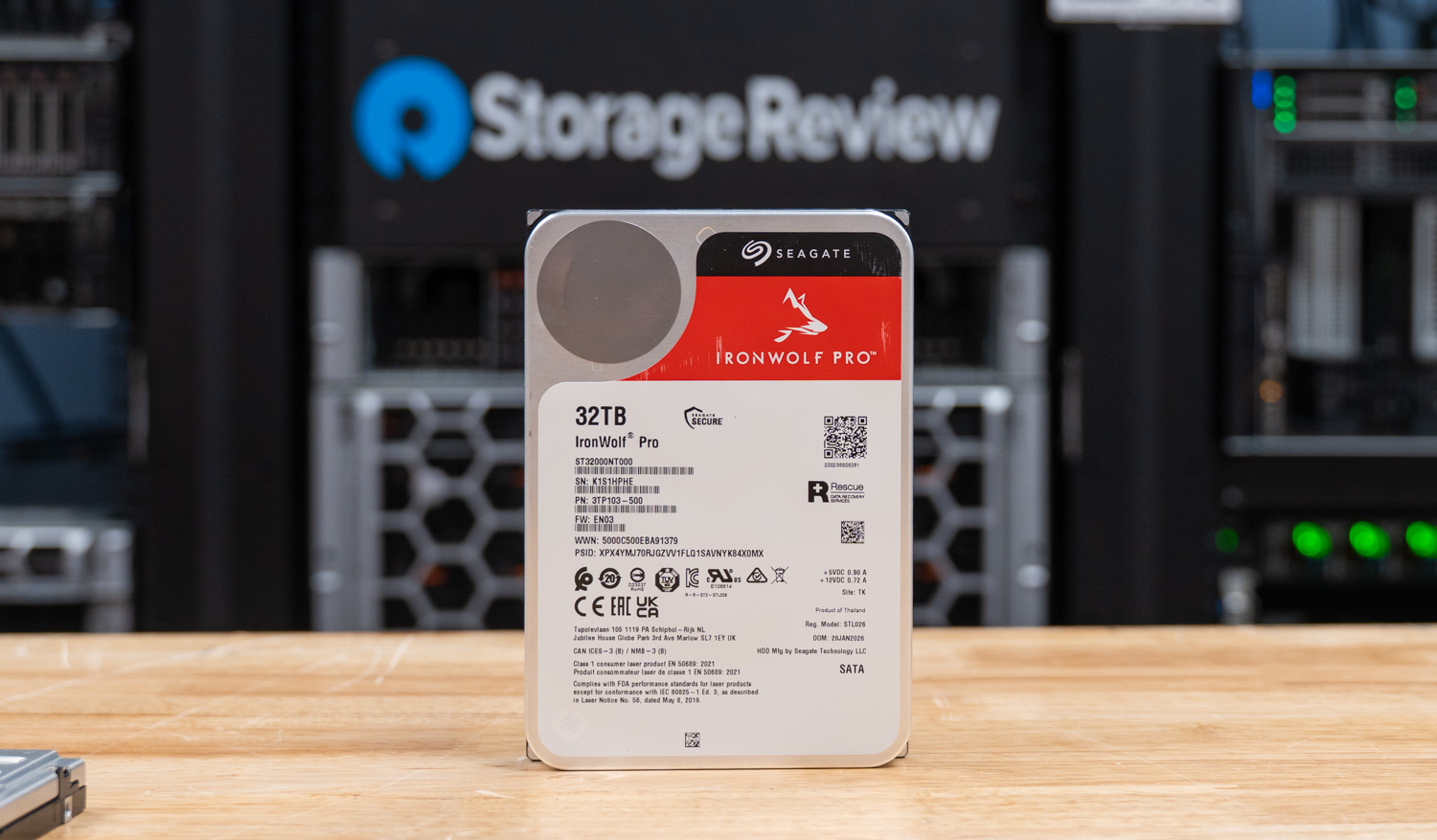
Seagate IronWolf Pro 32TB Features
This is the same drive used in our recent LaCie 8big review, where the higher per-drive capacity substantially increased the total enclosure capacity without changing the physical footprint. The same density story applies in multi-bay NAS systems, where Seagate pairs the platform with AgileArray firmware (dual-plane balancing, time-limited error recovery, and rotational vibration tolerance), built-in RV sensors, and IronWolf Health Management for predictive maintenance and recovery guidance in supported NAS platforms. The drive carries a 550 TB/year workload rating, a 2.5 million-hour MTBF, and is designed for continuous use in multi-user deployments.
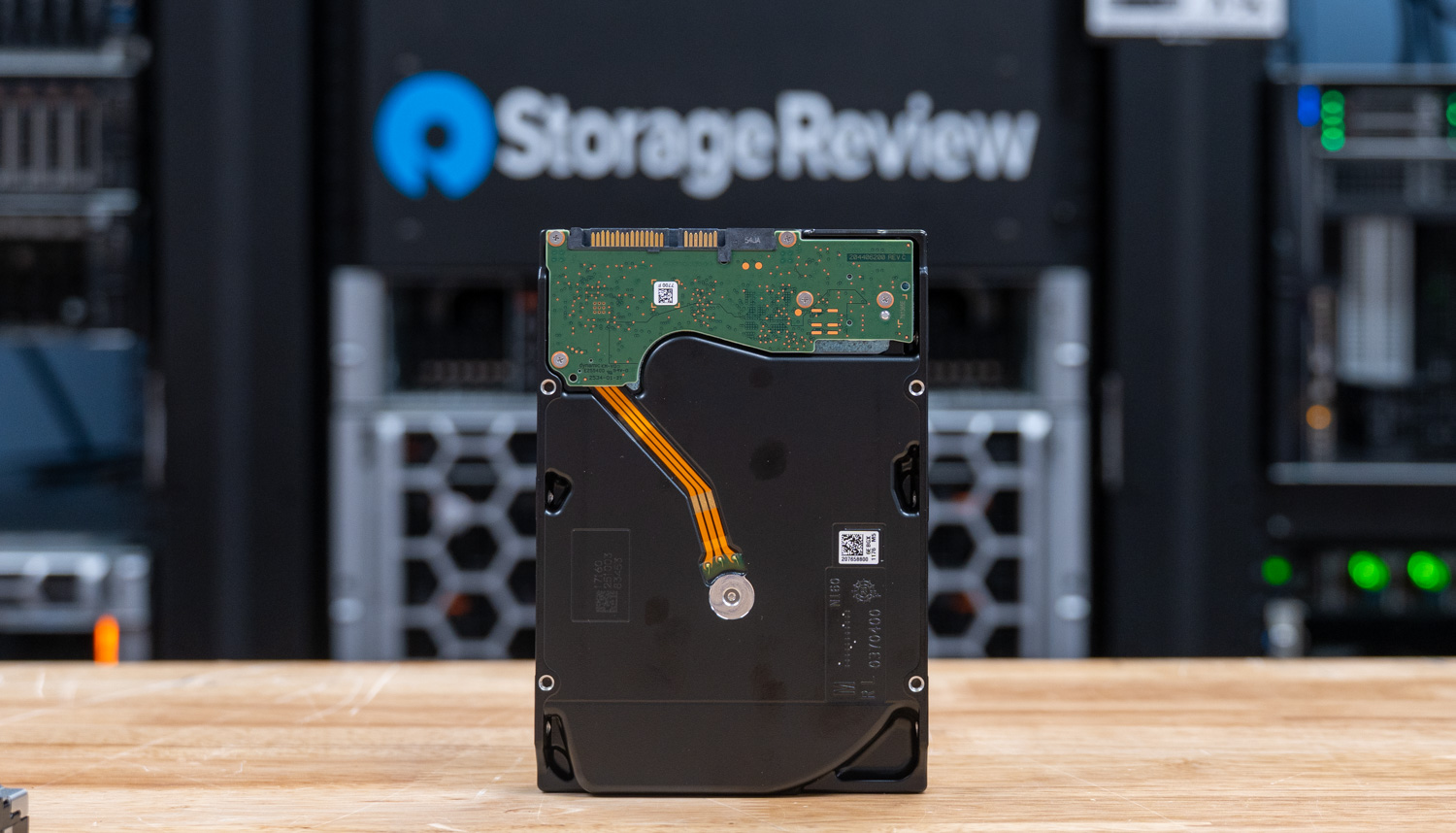
Sustained transfer rate at the outer diameter is listed as up to 285MB/s, paired with a 512 MB cache to handle bursty I/O for large file transfers, backups, media libraries, and shared project data. Power consumption averages 6.8W idle and 8.3W operating, both worth tracking when sixteen, twenty-four, or more drives share a chassis. Acoustics are rated at 28dBA idle and 32dBA seek.
The IronWolf Pro 32TB currently sits around $1,159.99 direct from Seagate, with retail varying by region and reseller. The drive ships with a five-year limited warranty and three years of Rescue Data Recovery Services.
Seagate IronWolf Pro 32TB Specifications
| Specification | Seagate IronWolf Pro 32TB |
|---|---|
| Overview | |
| Standard Model Number | ST32000NT000 |
| Interface | SATA 6Gb/s |
| Features | |
| Drive Bays Supported | Unlimited |
| Recording Technology | CMR |
| Drive Design (Air or Helium) | Helium |
| Workload Rate Limit (WRL) | 550TB/year |
| Rotational Vibration (RV) Sensors | Yes |
| Cache (MB) | 512MB |
| Reliability/Data Integrity | |
| Mean Time Between Failures (MTBF) | 2,500,000 hours |
| Nonrecoverable Read Errors per Bits Read, Max | 1 per 10E15 |
| Power-On Hours (per year) | 8760 |
| Sector Size (Bytes per Logical Sector) | 512e |
| Rescue Data Recovery Services (years) | 3 |
| Limited Warranty (years) | 5 |
| Performance | |
| Spindle Speed (RPM) | 7200RPM |
| Interface Access Speed (Gb/s) | 6.0, 3.0, 1.5 |
| Max Sustained Transfer Rate OD (MB/s) | 285 |
| Rotational Vibration (10–1500 Hz, rad/s) | 12.5 |
| Power Consumption | |
| Startup Current, Typical (12V, A) | 2.0A |
| Idle Power, Average (W) | 6.8W |
| Average Operating Power (W) | 8.3W |
| Standby Mode, Typical (W) | 1.2W |
| Sleep Mode, Typical (W) | 1.2W |
| Power Supply Requirements | +12V and +5V |
| Environmental/Temperature | |
| Operating Temperature (ambient, min) | 10°C |
| Operating Temperature (drive reported, max) | 60°C |
| Nonoperating Temperature (ambient, min) | -40°C |
| Nonoperating Temperature (ambient, max) | 70°C |
| Environmental/Acoustics | |
| Vibration, Nonoperating (10Hz to 500Hz, Grms) | 2.27 |
| Acoustics, Idle (typical, dBA) | 28 |
| Acoustics, Seek (typical, dBA) | 32 |
| Environmental/Shock | |
| Shock, Operating 2ms (Read/Write) | 30/30 Gs |
| Shock, Nonoperating (1ms and 2ms) | 200 Gs |
| Physical | |
| Height (mm/in, max) | 26.11mm / 1.028in |
| Width (mm/in, max) | 101.85mm / 4.01in |
| Depth (mm/in, max) | 146.99mm / 5.787in |
| Weight (g/lb, typical) | 695g / 1.53lb |
| Carton Unit Quantity | 20 |
| Cartons per Pallet / Cartons per Layer | 40 / 8 |
Seagate IronWolf Pro 32TB Performance
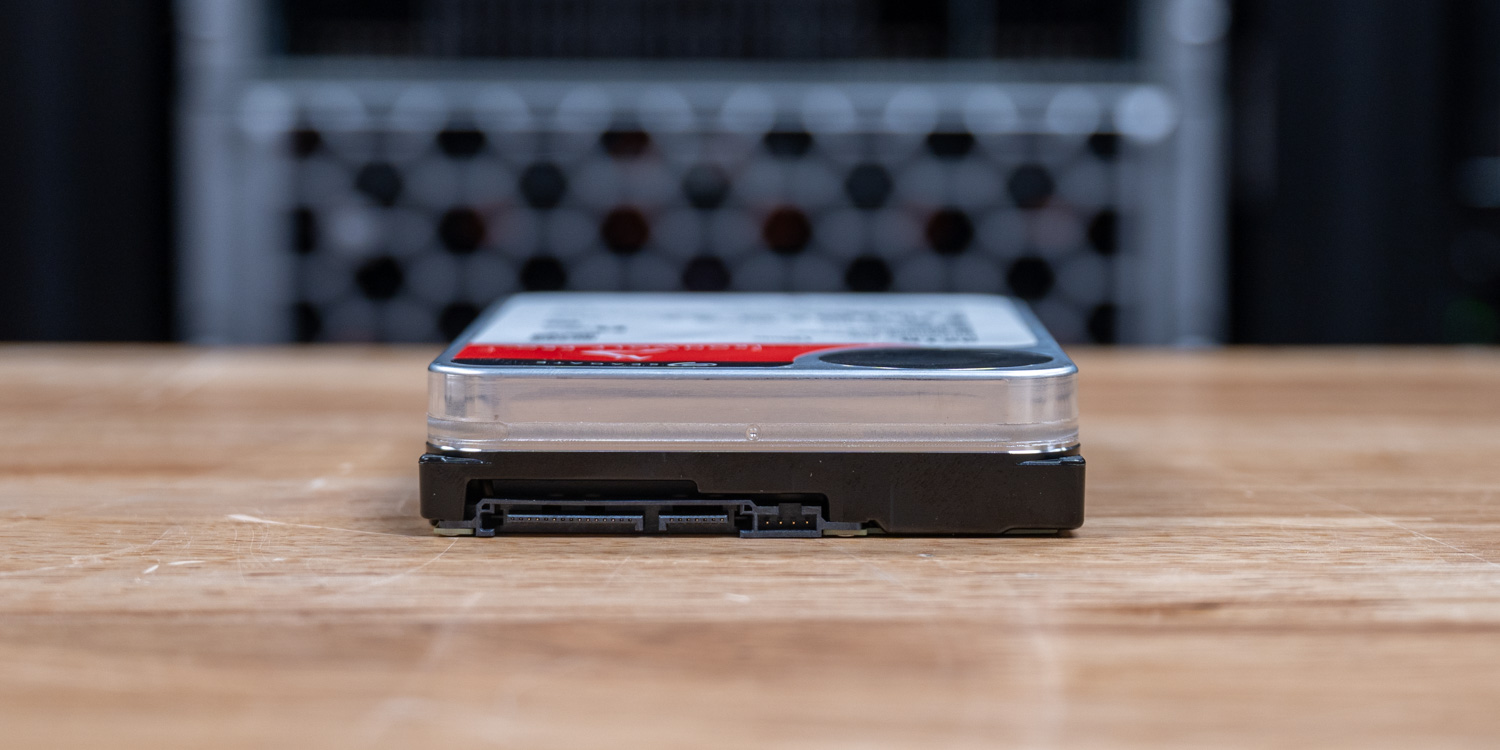
Before diving into the benchmarks, here’s a list of comparable capacity HDDs used to evaluate the performance of the Seagate IronWolf Pro 32TB.
- Seagate x24 24TB
- WD Gold 24TB
- WD Red Pro 22TB
- Seagate IronWolf Pro 30TB
- WD Ultrastar DC HC590
- Seagate Exos M 30TB
The high-performance test rig we used for storage benchmarking includes:
- CPU: AMD Ryzen 7 9800X3D
- Motherboard: Asus ROG Crosshair X870E Hero
- RAM: G.SKILL Trident Z5 Royal Series DDR5-6000 (2x16GB)
- GPU: NVIDIA GeForce RTX 4090
- OS: Windows 11 Pro, Ubuntu 24.10 Desktop
Peak Synthetic Performance
The FIO test is a flexible and powerful benchmarking tool used to measure the performance of storage devices, including SSDs and HDDs. It evaluates metrics such as bandwidth, IOPS (Input/Output Operations Per Second), and latency under different workloads, like sequential and random read/write operations. This test helps to assess the peak performance of storage systems, making it useful for comparing different devices or configurations. We measured the peak burst performance for this test, limiting the workload to a 10GB footprint on all tested HDDs.
The Seagate IronWolf Pro 32TB delivered performance that largely tracked the middle of the comparison group in the FIO workload tests. In sequential workloads, the drive posted 284MB/s read and 283MB/s write throughput, keeping it very close to the Seagate x24 24TB, WD Gold 24TB, and Exos 30TB drives, with only a relatively small spread separating the top-performing models in the stack.
For random 4K reads, the IronWolf Pro 32TB reached 203 IOPS with 156.87ms latency, again aligning closely with the majority of the tested drives. Random write performance came in at 315 IOPS with 101.40ms latency, placing it ahead of the IronWolf Pro 30TB but behind drives like the Seagate x24 24TB and WD Gold 24TB, which posted significantly stronger small-block write throughput in this burst-oriented test.
| FIO Test (higher MB/s/IOPS is better) | Sequential 128K Read (1T/64Q) | Sequential 128K Write (1T/64Q) | Random 4K Read (16T/32Q) | Random 4K Write (16T/32Q) |
|---|---|---|---|---|
| Seagate Exos 30TB | 292MB/s (28.72ms) | 289MB/s (29.04ms) | 205 IOPS (155.58ms) | 341 IOPS (93.79ms) |
| Seagate IronWolf Pro 30TB | 287MB/s (29.23ms) | 267MB/s (31.39ms) | 205 IOPS (155.74ms) | 301 IOPS (105.95ms) |
| Seagate x24 24TB | 285MB/s (29.42ms) | 285MB/s (29.42ms) | 210 IOPS (152.03ms) | 749 IOPS (42.70ms) |
| Seagate IronWolf Pro 32TB | 284MB/s (29.53ms) | 283MB/s (29.59ms) | 203 IOPS (156.87ms) | 315 IOPS (101.40ms) |
| WD Gold 24TB | 283MB/s (29.66ms) | 286MB/s (29.36ms) | 214 IOPS (148.98ms) | 651 IOPS (49.11ms) |
| WD Red Pro 22TB | 271MB/s (31.00ms) | 276MB/s (30.37ms) | 214 IOPS (149.17ms) | 421 IOPS (75.92ms) |
| WD Ultrastar DC HC590 26TB | 268MB/s (31.28ms) | 280MB/s (30.00ms) | 198 IOPS (161.18ms) | 663 IOPS (48.23ms) |
Average LLM Load Time
The Average LLM Load Time test evaluated the load times of three different LLMs: DeepSeek R1 7B, Meta Llama 3.2 11B Vision, and DeepSeek R1 32B. Each model was tested 10 times, and the average load time was calculated. This test measures how quickly each drive can load large language models into memory, which is important for AI workflows where faster model loading can reduce wait times and improve responsiveness.
The Seagate IronWolf Pro 32TB landed toward the lower end of the stack in the Average LLM Load Time test, though the overall spread between drives remained relatively tight. In the DeepSeek R1 7B model, the drive posted an average load time of 48.78 seconds, placing it behind the Seagate Exos 30TB and WD Gold 24TB, which led the group at roughly 46.4 and 46.7 seconds, respectively.
With the larger Meta Llama 3.2 11B Vision and DeepSeek R1 32B models, the IronWolf Pro 32TB continued to trend toward the slower side of the comparison set, recording 73.24 seconds and 73.89 seconds, respectively. That positioned it near the Seagate x24 24TB, while drives like the WD Gold 24TB and WD Ultrastar DC HC590 26TB maintained somewhat lower load times.
| Average LLM Load Time (lower is better) | DeepSeek R1 7B | Meta Llama 3.2 11B Vision | DeepSeek R1 32B |
|---|---|---|---|
| Seagate Exos 30TB | 46.4424s | 68.7064s | 72.7249s |
| WD Gold 24TB | 46.7133s | 68.8183s | 68.9720s |
| WD Ultrastar DC HC590 26TB | 47.9877s | 71.0063s | 69.7892s |
| Seagate IronWolf Pro 30TB | 48.4175s | 69.9071s | 72.3803s |
| Seagate IronWolf Pro 32TB | 48.7773s | 73.2398s | 73.8927s |
| Seagate x24 24TB | 48.6615s | 71.4855s | 73.8097s |
| WD Red Pro 22TB | 49.0575s | 71.4783s | 71.1382s |
3DMark Storage
The 3DMark Storage Benchmark measures gaming-focused storage performance, including game loading, saving progress, installing files, and gameplay recording. The benchmark reflects how well each drive handles modern gaming workloads.
In the 3DMark Storage Benchmark, the Seagate IronWolf Pro 32TB scored 175 points, placing it in the middle to lower range of the comparison group. It trailed the faster Seagate x24 24TB, Exos 30TB, and IronWolf Pro 30TB models, which led the chart with scores ranging from 223 to 234, but remained ahead of the WD Ultrastar DC HC590 26TB, WD Red Pro 22TB, and WD Gold 24TB drives.
The results show that while the IronWolf Pro 32TB is not tuned specifically for gaming-oriented workloads, it still delivered competitive performance relative to several other high-capacity HDDs in the stack. The lower score compared to some other Seagate drives likely reflects the trade-offs that come with pushing capacity higher, though the drive still maintained a solid position among the broader group of large-capacity disks.
| 3DMark Storage Benchmark (higher is better) | Overall Score |
|---|---|
| Seagate x24 24TB | 234 |
| Seagate Exos 30TB | 223 |
| Seagate IronWolf Pro 30TB | 231 |
| Seagate IronWolf Pro 32TB | 175 |
| WD Ultrastar DC HC590 26TB | 168 |
| WD Red Pro 22TB | 156 |
| WD Gold 24TB | 150 |
BlackMagic Disk Speed Test
The BlackMagic Disk Speed Test measures sequential read and write throughput and is commonly used to estimate performance for video editing and large media workflows.
In the BlackMagic Disk Speed Test, the Seagate IronWolf Pro 32TB delivered 253.4MB/s read and 228.3MB/s write throughput, placing it toward the lower end of the comparison group in both categories. The drive trailed the Seagate Exos 30TB and IronWolf Pro 30TB models, which posted some of the strongest write performance in the stack, as well as the WD Ultrastar DC HC590 26TB and WD Red Pro 22TB drives.
That said, the IronWolf Pro 32TB maintained sequential throughput well above 200MB/s, keeping it within the expected range for modern high-capacity HDDs. More importantly, this is a NAS-focused drive designed around high-capacity storage, reliability, and sustained multi-user environments rather than maximizing workstation or scratch-disk performance.
| BlackMagic Disk Speed (MB/s, higher is better) | Read MB/s | Write MB/s |
|---|---|---|
| Seagate Exos 30TB | 274.6 | 275.2 |
| WD Gold 24TB | 272.8 | 213.0 |
| Seagate x24 24TB | 271.0 | 164.4 |
| Seagate IronWolf Pro 30TB | 267.6 | 272.7 |
| WD Ultrastar DC HC590 26TB | 267.0 | 264.5 |
| WD Red Pro 22TB | 260.9 | 258.3 |
| Seagate IronWolf Pro 32TB | 253.4 | 228.3 |
PCMark 10 Storage
PCMark 10 Storage Benchmarks evaluate real-world storage performance using application-based traces. These tests measure how drives perform under practical desktop and workstation workloads.
In the PCMark 10 Data Drive benchmark, the Seagate IronWolf Pro 32TB posted a score of 609, placing it below the faster Seagate Exos 30TB, IronWolf Pro 30TB, and WD Ultrastar DC HC590 26TB drives, but comfortably ahead of the WD Gold 24TB and WD Red Pro 22TB models at the bottom of the stack. The results position the IronWolf Pro 32TB in the middle of the comparison group for mixed desktop-style workloads.
| PCMark 10 Data Drive (higher is better) | Overall Score |
|---|---|
| WD Ultrastar DC HC590 26TB | 853 |
| Seagate IronWolf Pro 30TB | 771 |
| Seagate Exos 30TB | 769 |
| Seagate x24 24TB | 671 |
| Seagate IronWolf Pro 32TB | 609 |
| WD Gold 24TB | 397 |
| WD Red Pro 22TB | 380 |
Conclusion
The Seagate IronWolf Pro 32TB landed mid-to-lower in our comparison group across the LLM Load Time, 3DMark Storage, BlackMagic, and PCMark 10 runs, generally trailing both the Exos 30TB and the prior-generation IronWolf Pro 30TB. The gap is small in absolute terms, with sequential reads at 253.4MB/s and sustained throughput rated at 285MB/s, which is the relevant figure for the streaming and shared-file workloads NAS systems actually run. Single-drive benchmarks tend to undersell this class of drive, since the value in a NAS deployment shows up in RAID consistency, vibration tolerance, and sustained performance across many drives rather than peak throughput on a single drive.
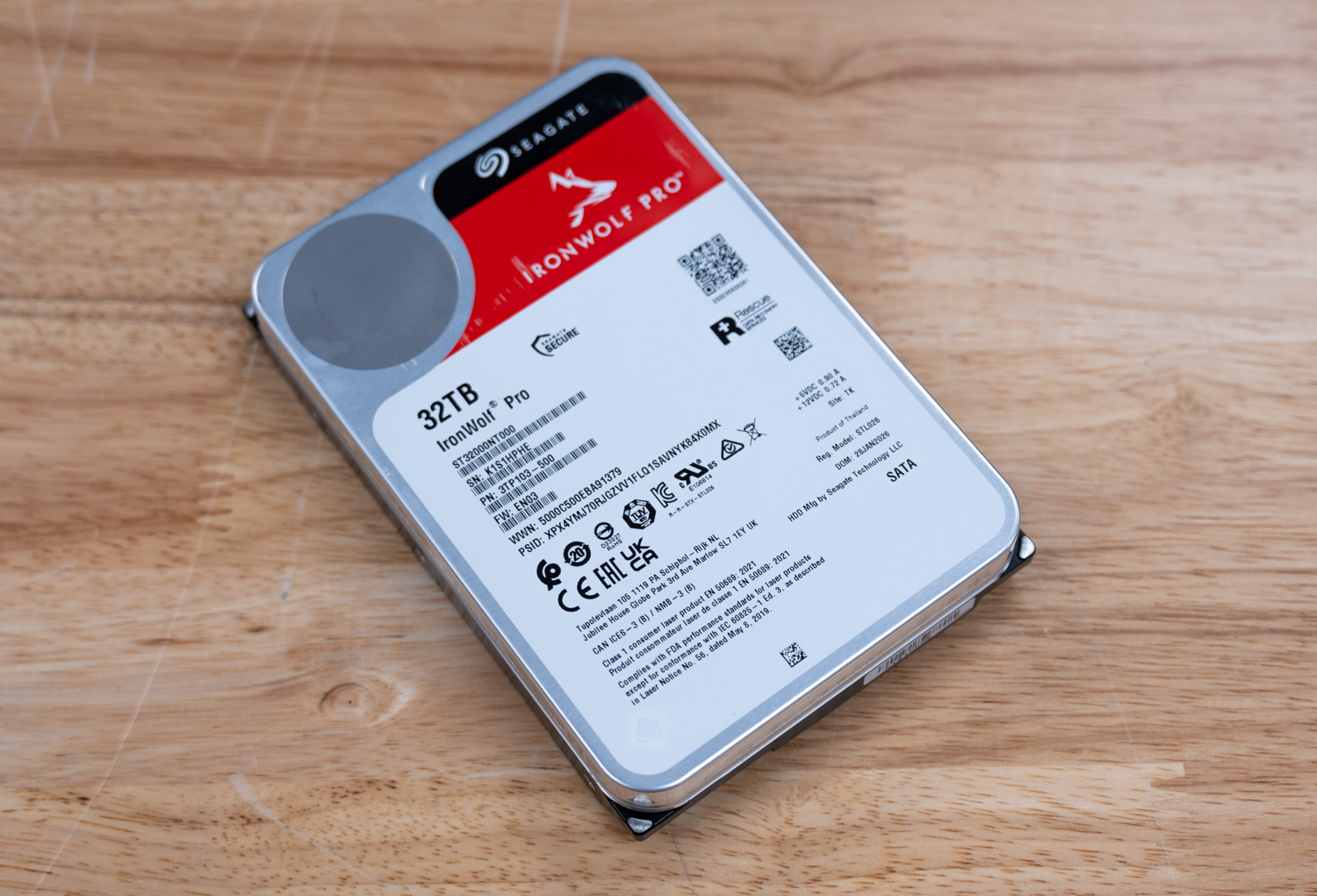
On the platform side, the IronWolf Pro 32TB stands out. The Mozaic3+ HAMR base delivers 32TB inside the same 3.5-inch helium-sealed envelope, and the NAS-specific feature set, including AgileArray, IronWolf Health Management, built-in RV sensors, a 550TB/year workload rating, a 2.5 million-hour MTBF, a five-year limited warranty, and three years of Rescue Data Recovery Services, is what SMBs and creative teams are paying for. For a multi-bay NAS or a DAS like the LaCie 8big we tested recently, the per-bay capacity jump from what they’re using today to 32TB lets builders pack much more usable storage into the same chassis without revisiting compatibility, vibration, or power budgets.
The trade-off is price, and that’s an industry issue, not specific to Seagate. At an $849.99 launch MSRP and current direct-from-Seagate pricing closer to $1,159.99, the IronWolf Pro 32TB isn’t inexpensive. For buyers who need the NAS feature stack and the long warranty, that premium is the cost of getting Seagate’s newest high-capacity HAMR platform in NAS trim. Even so, your workload either benefits from the density and related benefits or it does not. For those who have a strong business case for these drives, the 32TB drive density will be easy to monetize.


 Amazon