

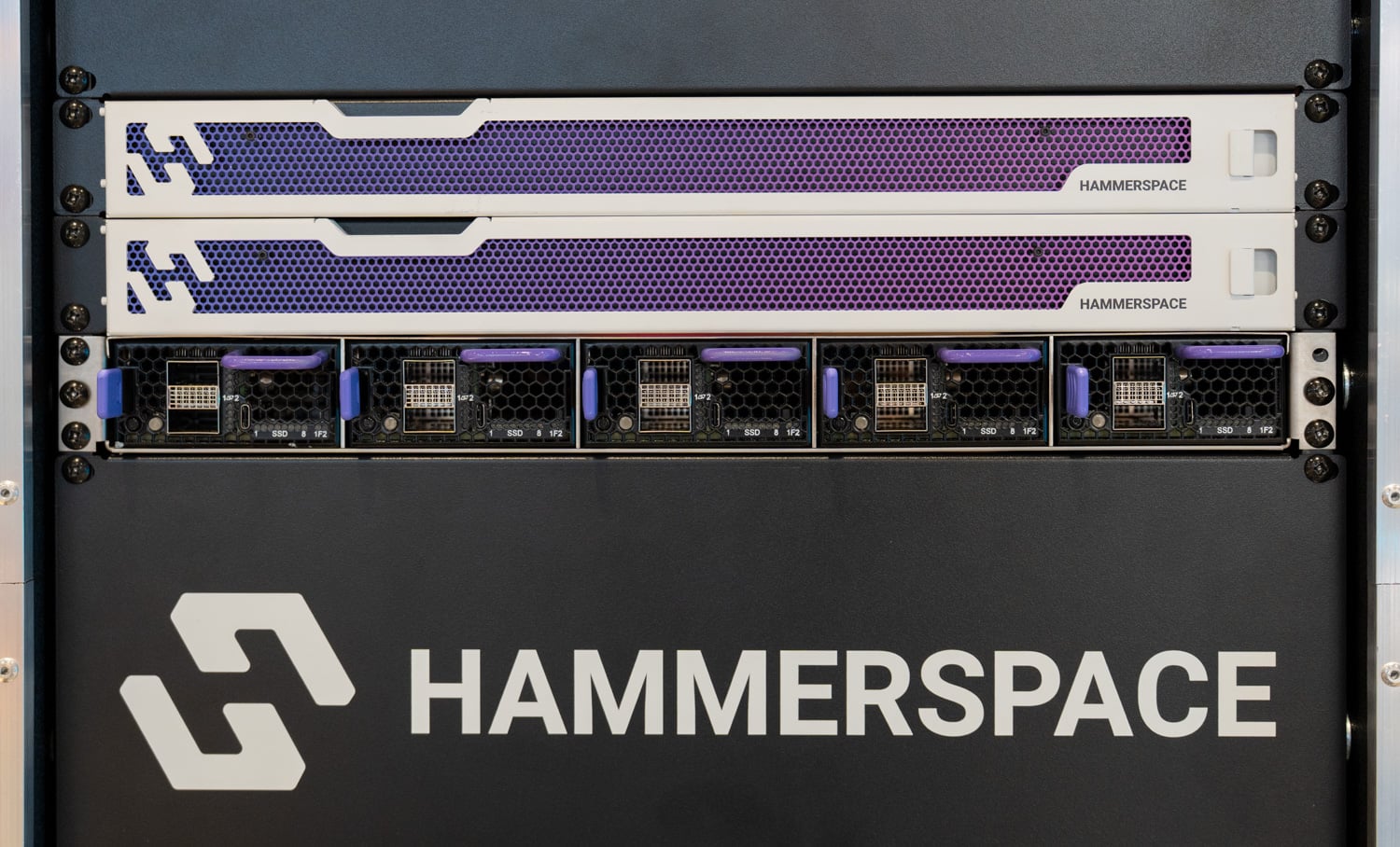
Hammerspace has turned its software-defined Data Platform into the Hammerspace Data System and, for the first time, will sell it as a complete system with hardware. The centerpiece is the Hammerspace Open Flash Platform (OFP), a 1U tray that holds five DPU-based flash nodes with no x86 storage server, rated by the company at 390GB/s of writes and 15 million IOPS per rack unit and up to 9.83PB raw. The launch also adds a data intelligence layer and a KV cache role for GPU-local NVMe. OFP is available to quote now and ships in the first half of 2027.
From Data Platform to Data System
Hammerspace’s core product is a parallel global file system that separates metadata from the data path and presents existing NAS, object, and cloud storage as one namespace over pNFS, NFS, SMB, and S3. Clients reach it through the NFSv4.2 client built into standard Linux distributions, with no proprietary agent, using the Flex Files layout that Hammerspace says it engineered for the NFS specification. The company describes the Data System as an extension of that software, organized around five capabilities: data unification, intelligence, orchestration, acceleration, and storage, of which intelligence and storage are new.
The commercial change is that the whole system can be bought from Hammerspace, with software, metadata nodes, and storage installed and supported by the company. The metadata nodes, which Hammerspace calls Anvils, are 1U x86 servers in Standard and Large M-Series configurations with two 100GbE data ports, deployed as a high-availability pair at each site to run the control plane that manages the namespace and executes placement policies. Software-only deployment on customer hardware continues, as do Hammerspace Ready Nodes from Dell, Supermicro, and Hitachi Vantara, and marketplace images on AWS, Azure, Google Cloud, and Oracle Cloud.
The system option answers a pattern Hammerspace has seen in sales, where the software won the technical evaluation, and the customer still bought an integrated product from another vendor for the simpler purchase. The software is licensed as a subscription priced by capacity under management. Hammerspace storage is usually brought in when a new GPU cluster needs high-performance storage while the customer’s existing data sits on NetApp, PowerScale, or object systems that the namespace can take over in place.
Each site’s cluster pairs those Anvils with a set of data services nodes, and clusters join into one global file system. Metadata replicates between sites continuously, with about a second of lag between distant locations, while the data itself moves only when a policy or an access request calls for it. Job schedulers can start that movement through the API and native connectors. The company gave the example of life sciences customers that ingest instrument data over SMB, process it over pNFS, and serve it over S3 from the same system.
Evaluations usually run as a proof of concept, with bring-your-own-license cloud images as the self-service route. Disk capacity comes from JBODs and storage servers built by hard drive suppliers; OFP is a Hammerspace design built by a contract manufacturer, and reseller and integration partners deliver the systems. A block array joins the namespace only when it can be mounted over NFS.
“Simply adding more storage isn’t the answer,” said David Flynn, Founder and CEO of Hammerspace. Flynn framed the launch as bringing to data the consolidation that AI factory designs brought to compute.
Inside the Open Flash Platform
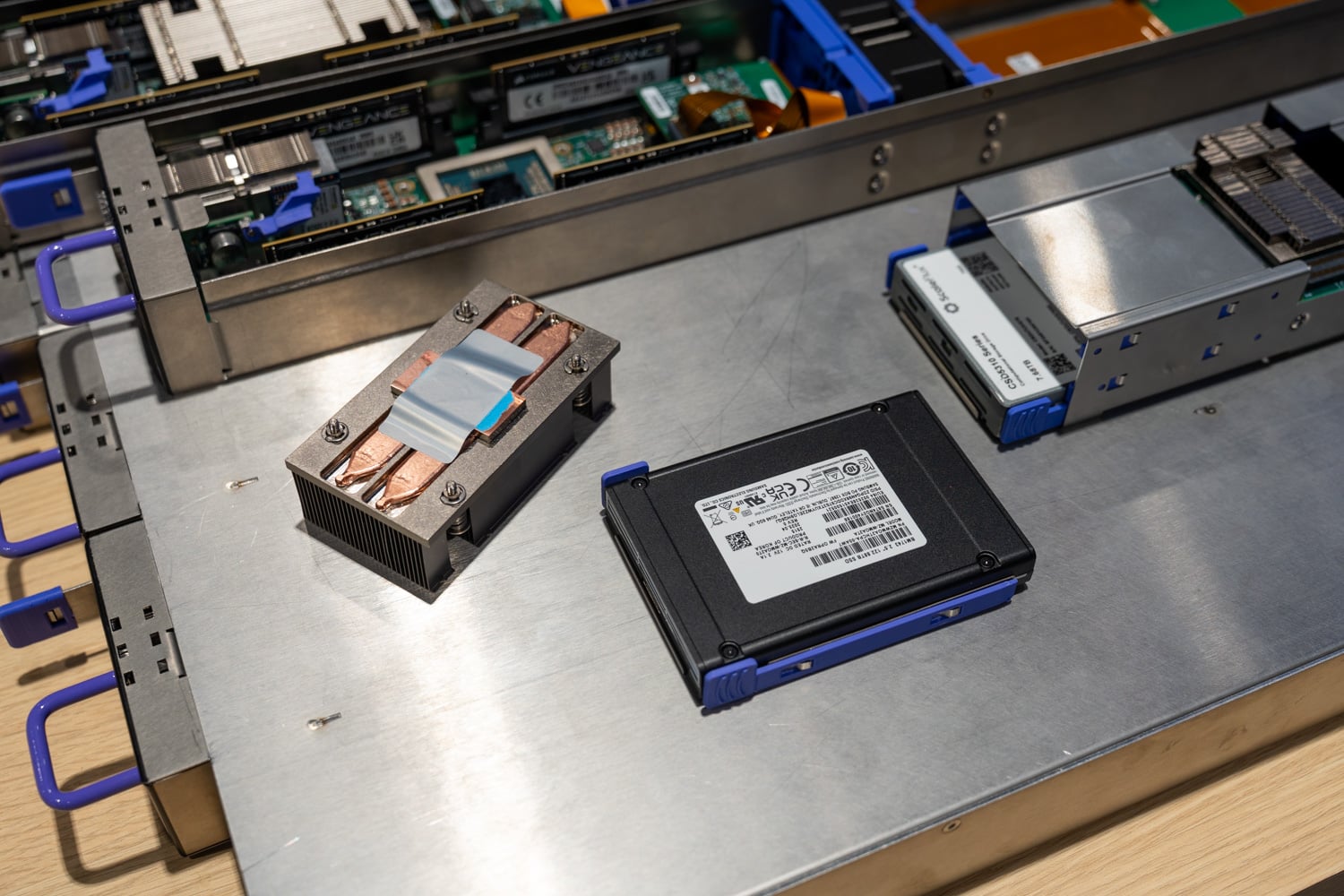
Each OFP sled is a complete storage node, one-fifth of a rack unit wide, with eight U.2 or U.3 NVMe SSDs in two removable four-drive packs, two 400GbE QSFP-DD ports, and a 64-core Arm DPU in place of an x86 motherboard. The DPU is the Xsight Labs E1, which Xsight builds on TSMC’s 5nm process with 64 Arm Neoverse N2 cores, two 400G MACs, PCIe Gen5, and a typical power figure of 70W. It runs standard Linux, and each sled appears to the Hammerspace file system as an NFS server.
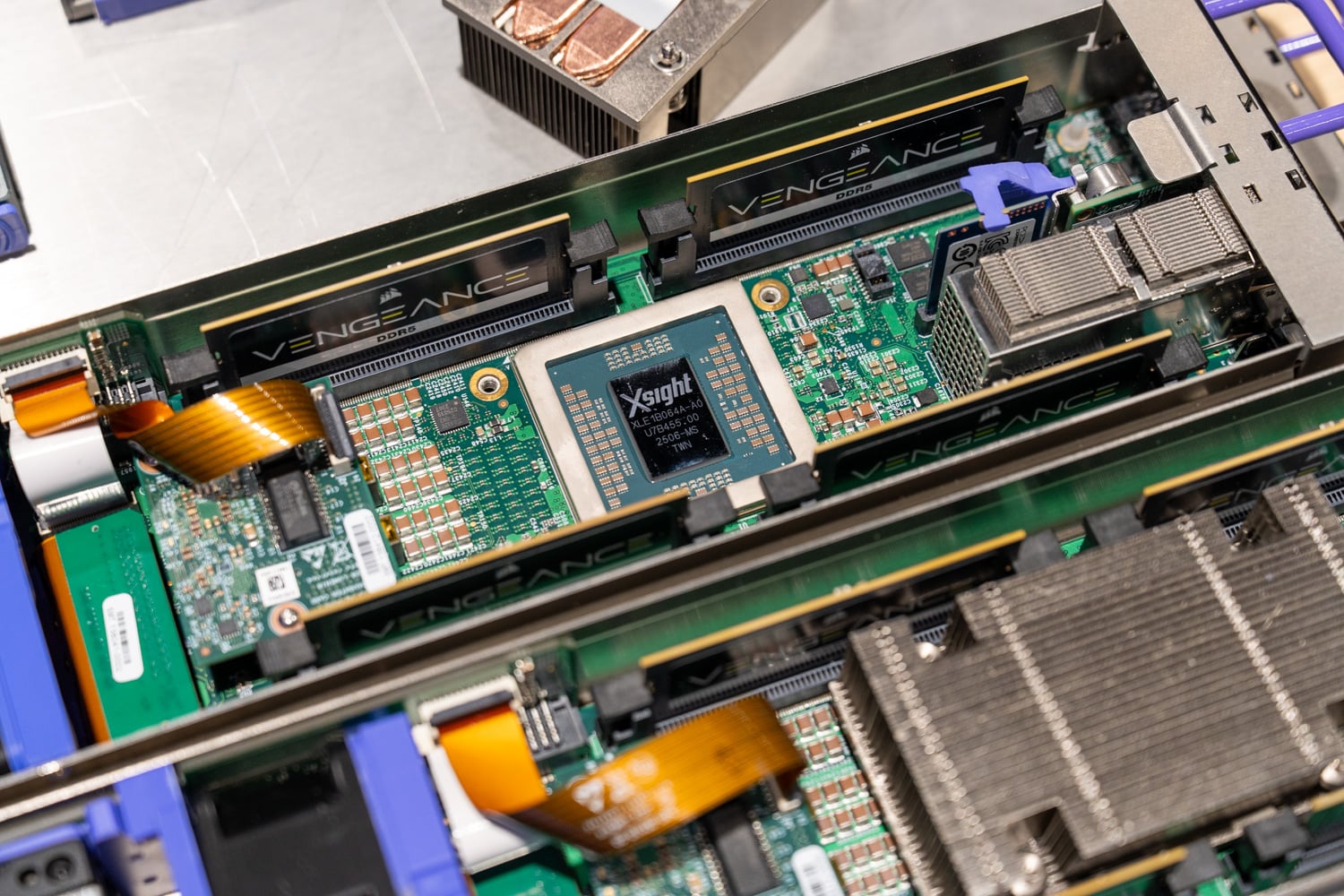
A 1U tray holds one to five sleds, for up to 40 drives, 320 Arm cores, and ten 400GbE ports per rack unit. Hammerspace lists a maximum of 360W per sled and 1,800W per tray on dual 2,160W Titanium power supplies, with tool-less service for sleds and drive packs and IPMI and Redfish for management. The tray is 106.64cm deep and requires a 1,200mm rack, which rules out shallower enterprise cabinets. Hammerspace puts drive density at 3.3 times that of a typical 2U, 24-bay NVMe server, at 160 SSDs in 4U against 48.
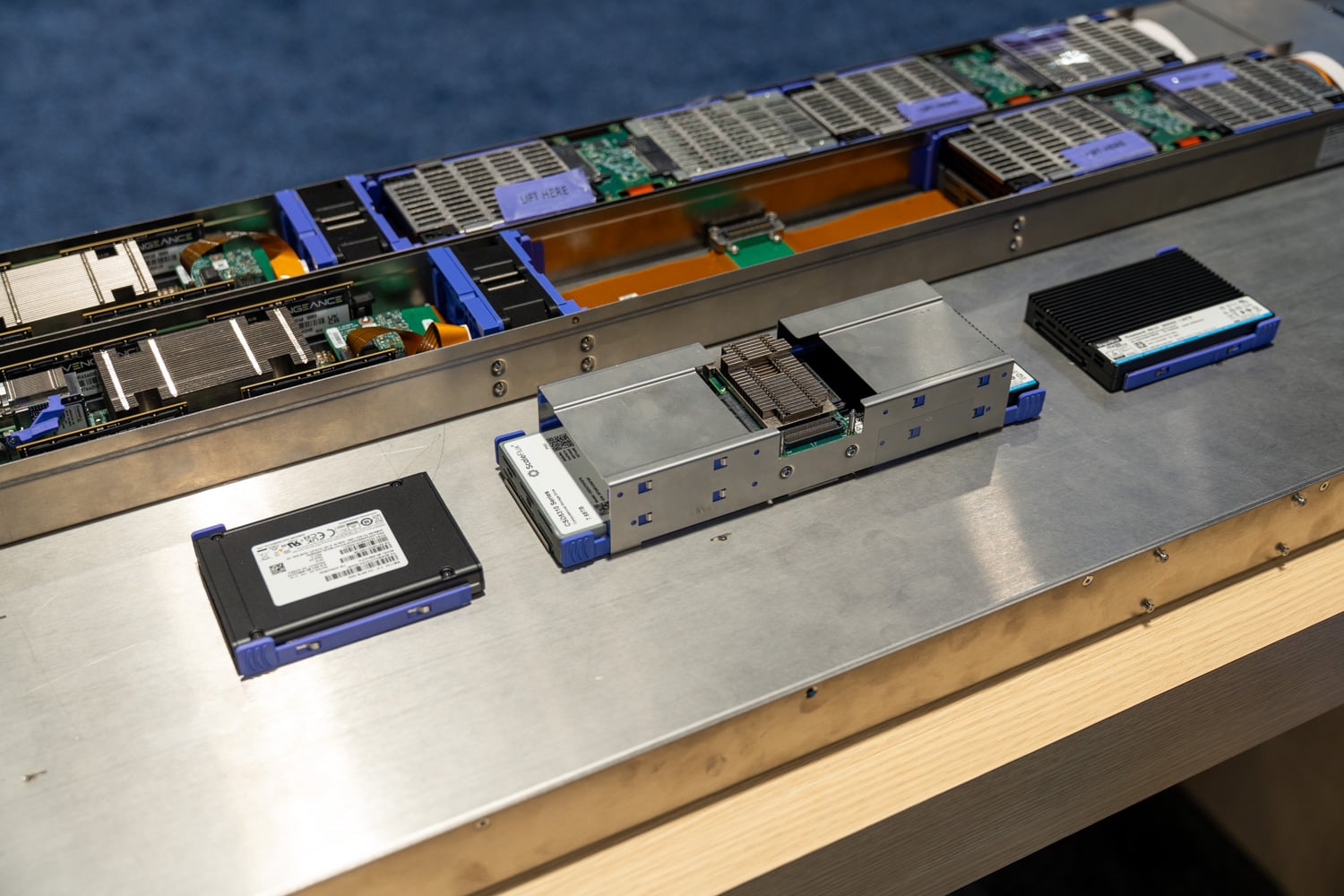
With eight 245.76TB QLC SSDs, the largest Hammerspace lists and the capacity of drives such as the KIOXIA LC9, a sled holds 1.97PB raw and a full tray holds 9.83PB. At the tray’s 1,800W maximum, that is about 183W per raw petabyte. Sleds accept TLC or QLC drives on PCIe Gen5 or earlier, and Hammerspace positions TLC for performance and QLC for capacity. A 42U rack filled with trays would hold about 413PB and draw up to 75.6kW.
The design traces to the Open Flash Platform initiative that Hammerspace started in 2025, with Xsight Labs and Los Alamos National Laboratory among the named participants. In October 2025, Hammerspace said production systems would be available in early 2026, so the schedule has moved by about a year. The sled uses U.2 and U.3 drives because those ship in volume now, and Hammerspace laid out the design with denser form factors in mind. Hammerspace and Xsight have described a path to an exabyte per rack, more than twice what a full 42U of the largest current drives would hold.
Hammerspace said prototype work on the sled began about two years ago, and that early adoption has come from hyperscalers that place one or two trays at the top of each GPU rack and value rack and performance density over the power savings. In that layout, Hammerspace maps the NVMe inside GPU servers to the tier NVIDIA labels G3 and a TLC-filled OFP tray in each rack to G4.
Performance Claims and Test Conditions
Hammerspace rates a five-sled tray at 390GB/s of write throughput without mirroring and 15 million 4K random read IOPS. The stated conditions are NFSv4.2 with pNFS over TCP on a 400GbE fabric with enterprise Gen5 TLC SSDs. Reads are rated at up to 80GB/s per sled, or 400GB/s per tray. That is about 40GB/s through each of a sled’s two 400GbE ports, which essentially saturates the links once protocol overhead is counted, so the network ports set the ceiling on read throughput.
Protection is by mirroring, set per file or directory by policy and changeable online. Writes fall to 195GB/s per tray with two-way mirroring and 130GB/s with three-way, and two-way mirroring also halves usable capacity, to about 4.9PB on a fully populated QLC tray. Hammerspace suggests running without mirrors for data that can be regenerated, such as KV cache. The company claims two to five times the per-rack-unit performance of an unnamed nearest competitor. It has not published latency, client counts, or IO500 and MLPerf Storage results for OFP, and we did not run or audit these tests.
| Spécifications | Hammerspace Open Flash Platform |
|---|---|
| En savoir plus sur la plateforme | |
| Architecture | DPU-based flash storage nodes with no x86 storage server |
| Traîneau | 8 x U.2/U.3 NVMe SSDs in two 4-drive packs 64-core Arm DPU (Xsight Labs E1) 2 x 400GbE QSFP-DD |
| 1U Tray | 1 to 5 sleds Jusqu'à 40 XNUMX SSD Up to 320 Arm cores Jusqu'à 10 x 400 GbE |
| Assistance Drive | Qualified U.2/U.3 SSDs, PCIe Gen5 or earlier TLC ou QLC |
| Capacité brute maximale | 1.97PB per sled 9.83PB per tray Based on 245.76TB QLC SSDs |
| Protocoles | NFSv4.2 with pNFS |
| Protection des données | Mirroring by policy per file or directory: none, 2-way, or 3-way |
| Performance (Hammerspace figures, Gen5 TLC SSDs, 400GbE, TCP) | |
| Débit de lecture | 80GB/s per sled 400GB/s per tray |
| Write Throughput, No Mirror | 78GB/s per sled 390GB/s per tray |
| Write Throughput, 2-Way Mirror | 39GB/s per sled 195GB/s per tray |
| Write Throughput, 3-Way Mirror | 26GB/s per sled 130GB/s per tray |
| Lecture aléatoire 4K | 3 million IOPS per sled 15 million IOPS per tray |
| Puissance et physique | |
| Puissance maximale | 360W per sled 1,800W per tray |
| Alimentations | Dual 2,160W Titanium per tray |
| Facteur de forme | 1U tray, 106.64cm deep Requires a 1,200mm rack |
| Refroidissement | Air, 40C maximum inlet temperature at sea level |
| Direction | IPMI, Redfish |
| Disponibilité | Quoting now Shipping in the first half of 2027 |
Tier 0 and KV Cache
Hammerspace positions OFP as Tier 1, behind a Tier 0 made of the NVMe already inside GPU servers, which it exports over NFS and aggregates into a shared, cluster-wide tier with no client or agent on the compute nodes. Data written there is mirrored across the cluster for protection and moved to other tiers by policy, and Hammerspace says a common pattern is to write training checkpoints locally and let the system move older ones to object storage. Hammerspace quotes 4.4 times the sequential bandwidth and 56 percent lower latency for Tier 0 against external shared storage, without publishing the test configuration.
The KV cache role uses the same tier, on the reasoning that an inference server which can reload the computed context of a conversation from shared storage does not have to recompute those tokens on the GPU. Hammerspace does not act as the cache manager, and it presents the pooled Tier 0 NVMe, with OFP behind it, as POSIX storage for the inference software’s cache manager to use.
Data Intelligence: Catalog, DeepScan, and Natural-Language Queries
The data intelligence layer starts with a catalog that indexes file and object metadata across every storage system in the namespace without moving data. A second level, DeepScan, opens files to look for personal, financial, and protected health information on demand or on a schedule, and its findings become searchable tags. Queries can be written in natural language through an LLM of the customer’s choice. Results feed the existing policy engine, which Hammerspace calls objectives, so an administrator can find every file tagged as training-ready or restricted to one country and set a placement rule on that set.
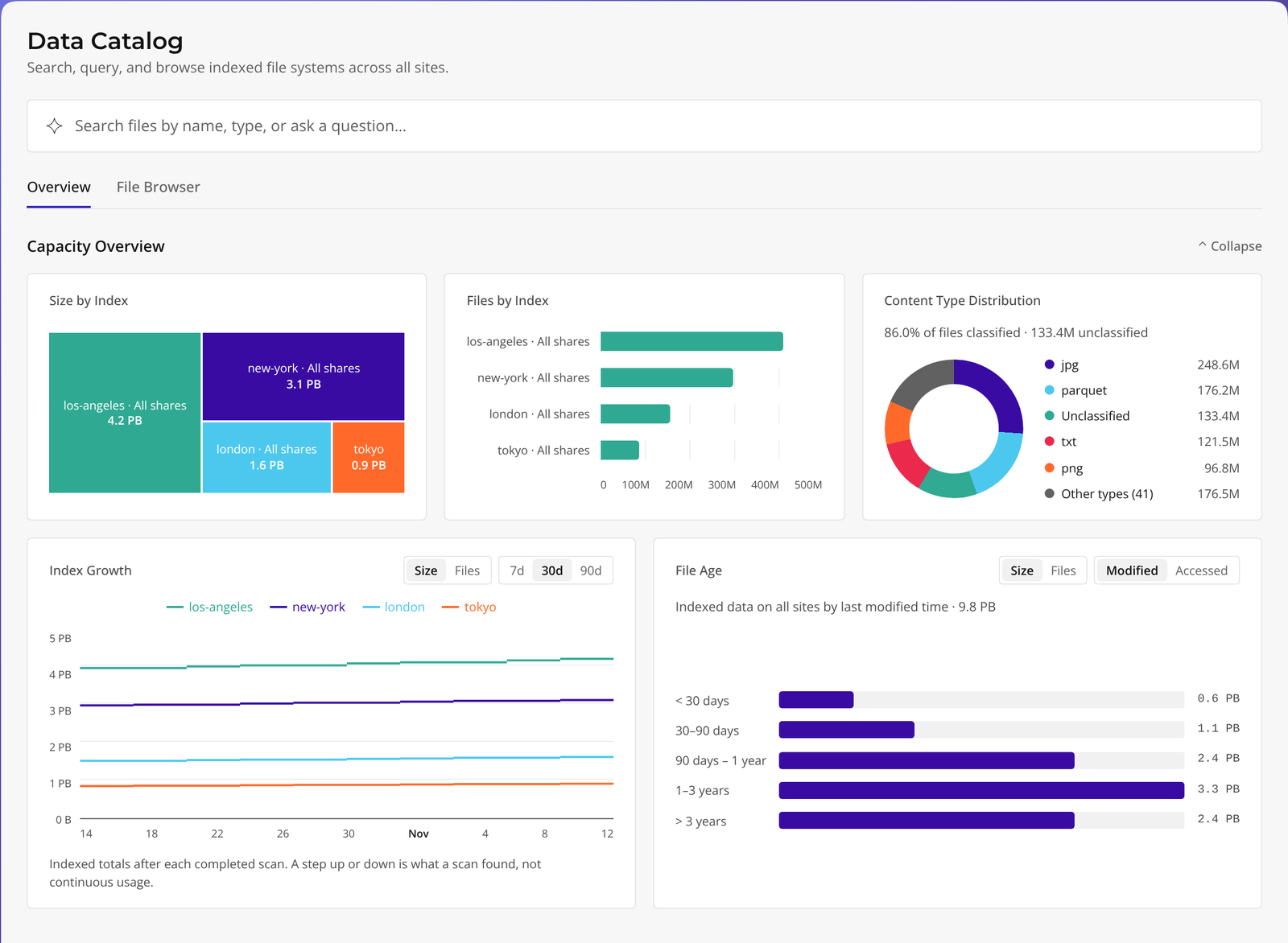
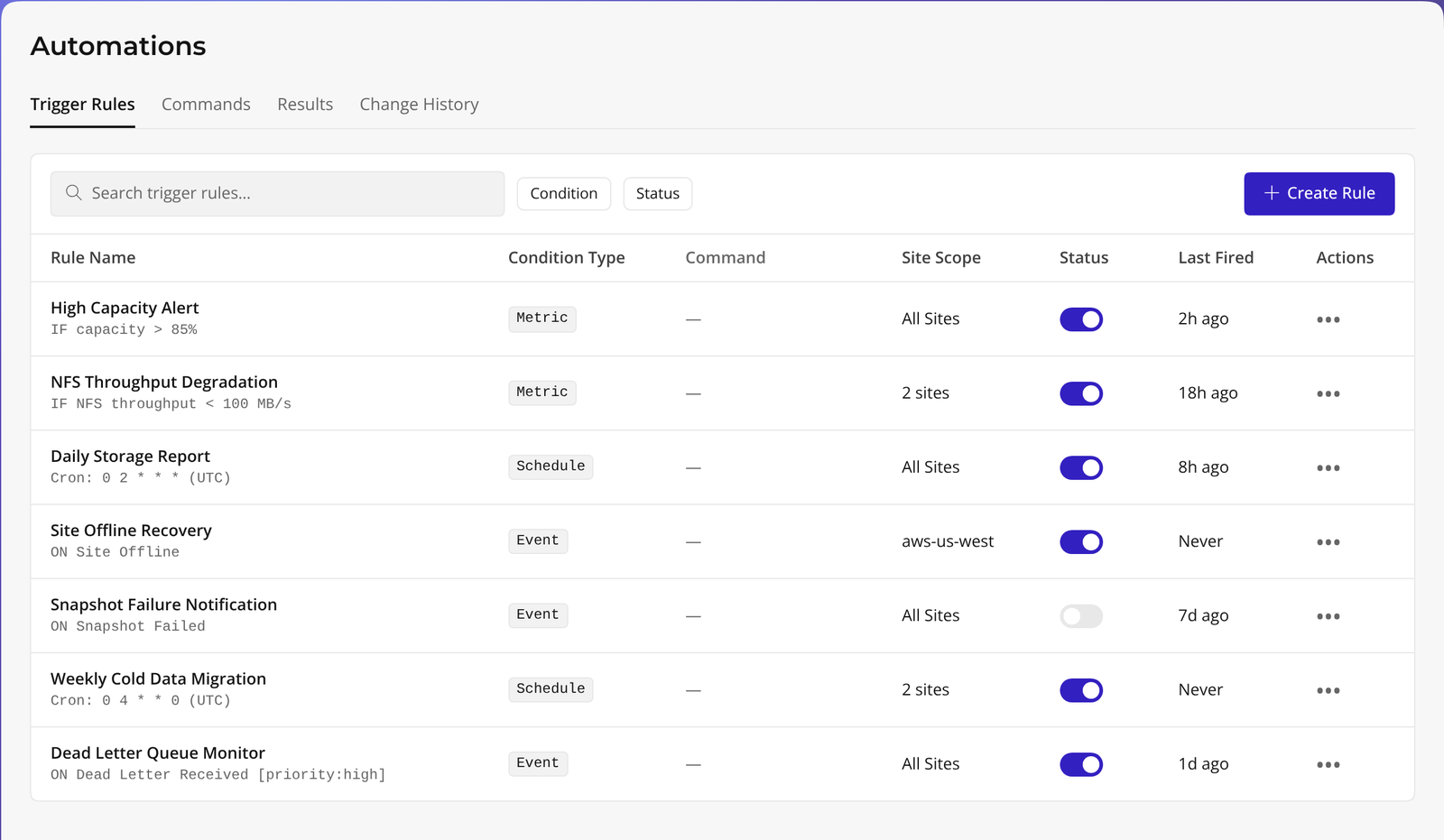
Objectives are declarative rules attached to a share, volume, directory, or file, such as moving data untouched for 30 days or keeping three copies at three sites. New automations trigger them from conditions that include capacity thresholds, schedules, and events, with a preview step before changes are approved. Tags inherit down the directory tree and follow files between storage systems and clouds. The software covers file and object stores from any vendor and does not manage structured data.
Early Customers and Outlook
The reference customer at launch is kaiko, a clinical AI company with offices in Amsterdam and Zurich that trains models on imaging and pathology data. Kaiko runs Hammerspace across Microsoft Azure and the Nebul and Nebius GPU clouds as one namespace, uses the NVMe in its GPU nodes as Tier 0 for training, and has checkpoints placed on Azure Blob Storage by policy. Hammerspace says all of kaiko’s ML engineering workflows on those three clusters have moved to the system. The case study does not involve OFP hardware.
Hammerspace told us kaiko adopted the system while growing from about 128 GPUs to more than 1,000 on Nebius, and that its existing all-flash NAS in the Nebul cloud was brought into the namespace in place. The company also described an unnamed hyperscale AI research lab that replaced Amazon FSx for Lustre with a 30PB Hammerspace cluster in AWS after a year in which Lustre was its largest source of support tickets, and is now extending the namespace to an on-premises data center. Hammerspace cites about three times faster large-file operations there.
OFP joins other designs that put a DPU where the storage server’s processor used to be, including the BlueField-4 STX reference architecture NVIDIA introduced at GTC, and Hammerspace’s version differs in pairing it with a file system that also runs without its hardware. Hammerspace is demonstrating the hardware at SC26 and has not published pricing.
We filmed a walkthrough of the OFP sled and tray with Hammerspace at SC26, and we will add the video to this article when it publishes.



 Amazon