

Dell Technologies has introduced a broad infrastructure refresh spanning storage, servers, cyber resilience, and private cloud automation, positioning the portfolio around a common enterprise problem: modern AI and high-performance workloads are scaling faster than many existing data centers were built to support.
The announcement combines a new flagship PowerStore platform, a sizable PowerEdge server update, tighter cyber-recovery integration, and an expanded automation stack aimed at private cloud and distributed infrastructure. Taken together, the release is less about a single product launch and more about Dell tightening the link between performance, density, recovery, and operational simplicity across the data center.
PowerStore Elite
Dell’s headline storage launch is PowerStore Elite, a new high-end version of the PowerStore platform for organizations that need more performance and capacity without a disruptive migration. Dell says it delivers 3x the performance and density of prior generations and scales to 5.8PB of effective capacity in a single 3U appliance, backed by a 6:1 data reduction guarantee.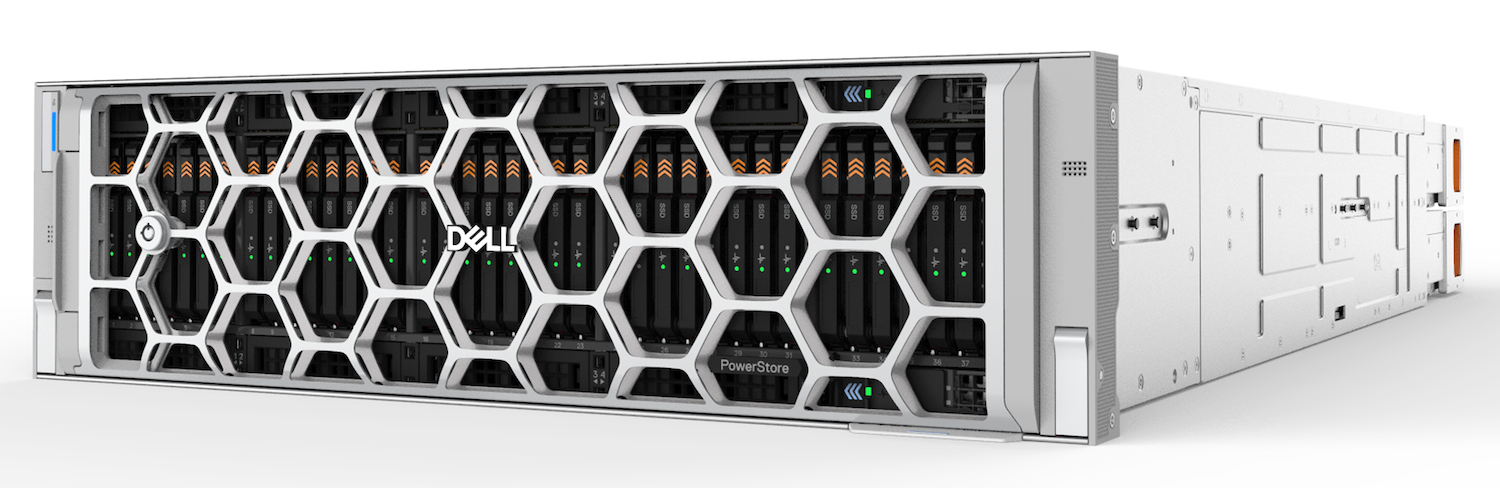
PowerStore Elite continues Dell’s shift toward modular upgrades instead of forklift refreshes. Drives, controllers, and networking are field-upgradable, allowing in-place hardware modernization. Dell is also moving to industry-standard E3 flash to improve cost efficiency per workload while aligning with newer enterprise flash supply chains and denser drive designs.
Introducing 18th-Gen PowerEdge
On the compute side, Dell introduced its 18th-generation PowerEdge portfolio, which the company says delivers up to 70% better performance and 13:1 consolidation. The refresh spans air-cooled and liquid-cooled systems and targets AI, HPC, enterprise consolidation, and space-constrained deployments.
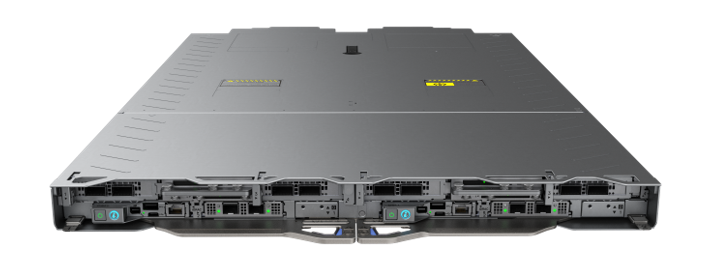
For higher-density AI and HPC environments, the new Dell PowerEdge M9825 pairs 6th Gen AMD EPYC processors with a liquid-cooled design housed in factory-integrated IR7000 racks. This is intended for customers pushing beyond the practical limits of traditional air cooling, particularly in environments where rack-level thermal planning and deployment predictability matter as much as raw performance.
Dell is also expanding its PCIe-based AI server options with the PowerEdge XE5845 and XE7845, both air-cooled platforms designed for next-generation GPU deployments. These systems target organizations that want AI acceleration without immediately adopting more specialized, liquid-cooled infrastructure.
For more conventional enterprise workloads, Dell introduced the PowerEdge R9825 and R9815, built around 6th-gen AMD EPYC processors. These systems are positioned as high-core-count air-cooled platforms, reaching up to 256 cores per system while increasing I/O bandwidth for demanding workloads. The key point is that Dell is trying to deliver denser compute in standard data center environments without forcing cooling retrofits.
Dell also previewed the PowerEdge R9810, a high-end single-socket 2U platform based on Intel’s next-generation server processor, Diamond Rapids. Dell says the platform will offer double the memory bandwidth, larger cache capacity, and up to 50% more cores, with PCIe expansion aimed at consolidation-heavy use cases.
At the lower end of the footprint spectrum, Dell introduced the 1U PowerEdge R8815 and R6815, both using 6th Gen AMD EPYC to collapse traditional dual-socket footprints into more efficient single-socket systems. That matters for customers focused on software licensing, power, and cooling efficiency rather than simply chasing maximum socket count.
Dell rounded out the AMD-based lineup with the PowerEdge R7815, R7815xd, and R7825. These systems address flexible PCIe Gen6 configurations, storage-dense designs, and dual-socket scale-out requirements for virtualization and analytics. Collectively, the server refresh shows Dell leaning harder into single-socket efficiency where it makes sense, while still reserving dual-socket and liquid-cooled designs for higher-end consolidation and AI workloads.
PowerProtect One
Cyber resilience is another major part of the announcement. Dell launched PowerProtect One, a platform that unifies PowerProtect Data Manager for protection orchestration and PowerProtect Data Domain for protection storage under a single control plane.

This is a practical step to reduce operational sprawl in backup and recovery environments. Instead of managing data protection software, backup storage, and cyber recovery workflows as separate administrative layers, Dell packages them into a unified operating model with centralized visibility and third-party support. Dell says this can cut management overhead by 50% while preserving Data Domain’s data reduction and large-scale recovery capabilities.
Cyber Detect
Dell also announced Cyber Detect integration for both PowerStore and PowerMax. The feature brings AI-driven ransomware detection closer to the storage layer itself, where Dell says it inspects data at the byte level and has been trained on thousands of ransomware variants.
According to Dell, the platform can identify the last known clean copy with 99.99% accuracy, a capability designed to accelerate recovery and reduce the guesswork that often slows response during an active incident. Extending that intelligence into primary enterprise storage is notable because it shifts ransomware analysis earlier in the data lifecycle, rather than relying exclusively on downstream backup or vault workflows.
Automation Platform
Dell’s management story centers on the Dell Automation Platform, which becomes the common control layer for private cloud deployments and future AI-driven operations. The broader strategy is to give customers a more unified way to deploy infrastructure, automate lifecycle tasks, and apply AIOps-style telemetry analysis across compute, storage, and networking.
Within that framework, Dell Private Cloud is positioned as a disaggregated alternative to traditional HCI-based deployments. The platform supports cloud stacks from Broadcom, Microsoft, Nutanix, and Red Hat, with automated lifecycle management and independent scaling of compute and storage. Dell says this model can deliver up to 65% cost savings compared with HCI, although the practical value will depend on the customer’s architecture and licensing assumptions.

New ecosystem updates include support for VMware Cloud Foundation 9.1, Microsoft Azure Local, and Dell PowerStore integration with Nutanix AHV. Those additions matter because they make the platform less about a single software stack and more about offering Dell infrastructure as a common base for multiple private cloud operating models.

Dell also updated its distributed infrastructure story with Dell Distributed Private Cloud, the new name for Dell NativeEdge. The platform is aimed at edge and remote environments. It adds support for two-node high-availability clusters, automatic failover, enhanced VM live migration, built-in zero-trust security, and zero-touch endpoint support. For distributed retail, branch, manufacturing, and field deployments, the emphasis is on resilience and lower-touch operations rather than central data center scale.
Agentic AI
Dell is also moving deeper into AI-assisted infrastructure operations. The company said the Automation Platform will add agentic AI capabilities later this year through a personalized generative interface designed to adapt to how teams build and manage infrastructure. Integrated with Dell AIOps, the model is intended to turn telemetry into recommended or automated actions while keeping the customer in control.

That strategy extends into Dell Automation Studio, a premium set of capabilities built on the Automation Platform. Automation Studio is designed to help organizations create AI-driven workflows across compute, storage, and networking using familiar tooling and operational processes. In practical terms, Dell is trying to package infrastructure automation as an extensible, full-stack layer rather than a set of isolated admin utilities.
Availability
Dell provided the following availability windows:
- Dell PowerStore Elite: July 2026
- Dell PowerEdge M9825, R9825, and R9815: 2H 2026
- Dell PowerEdge XE5845 and XE7845: Q1 2027
- Dell PowerEdge R9810: 2027
- Dell PowerEdge R8815, R6815, R7815, R7815xd, and R7825: 2027
- Dell PowerProtect One: available now
- Dell Cyber Detect for PowerStore: Q3
- Dell Cyber Detect for PowerMax: 2H 2026
- Dell Private Cloud with VMware VCF 9.1 support: June 2026
- Dell Private Cloud with Microsoft Azure Local: June 2026
- Dell Private Cloud with Nutanix and PowerStore support: July 2026
- Dell Distributed Private Cloud: available now
- Dell Automation Platform agentic AI capabilities: later this year
- Dell Automation Studio: June 2026


 Amazon