

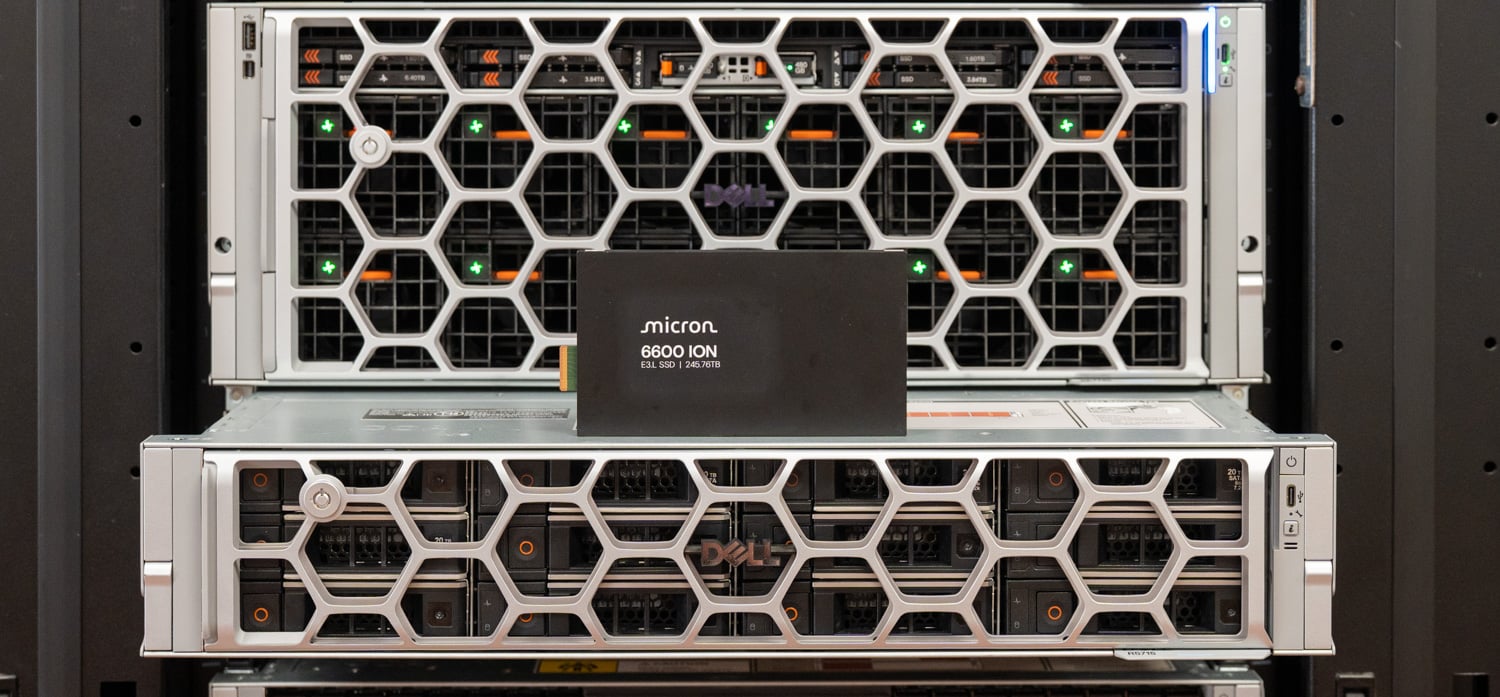
Brian hosted Bill Bollengier, Senior Director of Product Management at Micron, for a live podcast on LinkedIn on October 15, with Bill calling in from the floor of the OCP Global Summit. The subject was the Micron 6600 ION 245TB SSD and what a quarter petabyte per drive bay does to floor space, power budgets, rack density, form factors, and the warm tier hard drives have held for decades. We reviewed the drive in June and followed it with a Micron exabyte study in September that found the flash footprint collapses from 22 racks of hard drives to 6, freeing the 120kW that runs a GB200 NVL72.
Bill spent 18 years at Intel in strategic planning, product line management, and engineering management across China, Taiwan, and the U.S., took a one-year detour into international sales at Daiya Foods, and joined Micron in January 2020 as a product line manager. He became Senior Director of Product Management in October 2025 and runs Micron’s data center SSD line, which now spans 480GB M.2 boot drives to the 245TB E3.L.
Micron has been a steady presence in our lab for more than 15 years; the Mikron 9550 MAX holds the top spot on our Ranking najlepszych dysków SSD dla przedsiębiorstw, the 6600 ION holds the high-capacity slot, and the 9650 was among the first PCIe Gen6 enterprise drives.
The episode runs about 43 minutes. The numbers that stuck with us: SSDs hold 12 to 15 percent of data center bits today, the 245TB drive is aimed at the next 10 percent that sits on warm hard drives, a one-exabyte deployment on 245TB drives saves about 921 megawatt-hours a year against hard drives, customers are building racks that approach 200PB, and the drive keeps a 16K indirection unit so nobody has to rewrite a software stack. If you don’t have time to listen end-to-end, we have broken it into segments so you can choose what matters most to you.
[00:00] OCP as the Enterprise Bellwether
Bill joins from the OCP Global Summit, and the opening segment is about how a hyperscaler show became the place to see what enterprise infrastructure looks like two years out.
- Brian’s read is that busbar power, liquid cooling, and new storage form factors all showed up at OCP first and are now mainstream enterprise conversation, and Bill describes the mood as an unprecedented period with as much talk about supply as about innovation.
- Data centers are no longer homogeneous, and Bill says one-size-fits-all server design has stopped working at hyperscale, with storage, memory, compute, and GPUs each needing a separate answer.
- Micron’s data center SSD roadmap runs from 480GB boot drives to the 245TB tier, with use cases at every capacity point in between.
[03:38] EDSFF: E1.S to E3.L, and E2 Next
The 6600 ION’s E3.L form factor is the reason it exists, and this segment covers why Micron builds every EDSFF variant and what the next large form factor adds.
- Bill says U.2 ran into signal integrity problems at PCIe Gen6, while EDSFF was designed with headroom for Gen6, Gen7, and beyond, and every variant shares one connector.
- Micron supports all the EDSFF form factors and the direct liquid cooling designs coming out of the SNIA specifications.
- E1.S and E3.S cover compute-oriented systems and smaller capacities; E3.L carries the large capacities, and E2 is next, with the most PCB real estate for NAND placements and capacities well past 245TB.
- Server and storage vendors are redesigning backplanes for flexibility across those lengths, a shift Brian says started showing up a few months ago.
[06:40] SKU Sprawl and the In-House Controller
Brian asks how Micron manages a product list that has grown from a few U.2 capacities to a matrix of form factors, NAND types, and endurance classes.
- Bill’s engineering team pushes to limit options, but the market demands flexibility, so Micron builds every family on a common core design it carries forward from one generation to the next.
- Micron SSDs use Micron NAND, Micron DRAM, and Micron controllers, which Bill says keeps the architecture consistent across families and shortens customer qualification cycles.
- The 245TB drive complements the existing 122TB model at the top of the line, and Micron was among the first with PCIe Gen6 drives at the performance end.
[10:08] 30 to 245TB in a Few Years, and the Warm Tier
Capacity went from 30TB to 60TB to 122TB to 245TB in a short window, and this segment covers what is driving it and where the drives land.
- Bill, who remembers when 2MB floppies were good enough, says the thirst for data and the need to store it in less space and less power are pushing customers to higher capacities faster than before the AI boom.
- Brian’s lab finding from the exabyte study: eight idle hard drives draw more power than one 245TB drive writing at full speed, which is why he calls efficiency per terabyte per watt the real headline.
- Bill is clear that flash will not replace every hard drive; SSDs are 12 to 15 percent of data center bits today depending on whose estimate you use, and the 245TB targets the next 10 percent, the warmer data that sits on higher-end hard drives.
- Micron’s figures for that tier: up to 86 percent better storage efficiency per watt than hard drives, and about 921 megawatt-hours saved per year on a one-exabyte deployment.
[15:56] Tiering, LTO-10, and TLC Running in SLC Mode
Neither host thinks the answer is all flash, and the conversation turns to data placement across tape, hard drives, and several kinds of NAND.
- Brian points to LTO-10 tape libraries as a still-valid cold tier and says the hard part is getting smarter about scheduling data movement and rehydration, whether the source is tape, hard drives, or slow flash.
- Micron ships TLC and QLC drives and in some cases runs TLC NAND in SLC mode for endurance and performance; the 245TB is QLC.
- Micron plans four, five, and ten years out while some customers at OCP say they cannot predict their requirements twelve months ahead.
- Brian’s examples of why the portfolio is wide: KV cache wants write endurance and performance, capacity tiers suit read-heavy QLC, and transactional databases and logging still want TLC.
[20:54] QLC Since 2018, 200PB Racks, and the Blast Radius
QLC was pitched for years as the density and cost play; Bill explains where it has landed and what dense racks do to the rest of the system.
- Micron was first to put QLC in the data center in 2018, and the 6600 ION continues that line into data lakes, object storage, hard drive displacement, and media streaming.
- Customers are building racks that near 200PB, and Brian points to what a mainstream 2U 40-bay box holds when every bay carries a 245TB drive, which works out to about 9.8PB raw.
- Bill’s planning list for high-capacity deployments: network bandwidth into the box so the rack is not stranded, a 16K indirection unit that avoids software rewrites, and power.
- On blast radius, Bill says he has heard the same objection at 8TB, 16TB, and 32TB, and the drives have proven their reliability each time; Brian adds that erasure coding and array-level protection have always been part of the answer.
[25:36] Is There a Capacity Cap? The 314-Trillion-Digit Pi Run
Brian asks whether there is a point where more capacity stops helping, and the answer leads into the record the two companies set together.
- Bill will not predict a cap: NAND die density and PCB real estate are physics problems, but he saw the same “who could use it” argument about CPU speed earlier in his career, and the software ecosystem always found a use.
- Brian cites the 314-trillion-digit Pi calculation StorageReview ran with Micron, which holds the Guinness World Record, and notes that scientists have since mined the dataset for number patterns nobody had access to before.
- The only planning constant, in Brian’s words, is that you will need more.
[28:14] Indirection Units, Explained
A short detour into the mapping table inside every SSD and why 16K is the number Micron is holding at.
- The SSD keeps a lookup table that maps host addresses to physical NAND locations, and the indirection unit is how much data each entry covers; a larger unit means fewer entries and less DRAM.
- Traditional drives used 4K, which does not scale to 122TB and 245TB, and some have discussed 32K or 64K.
- Micron holds its high-capacity drives at 16K to keep the mapping table and DRAM cost in check without adding overhead on the host software side.
[29:57] PCIe Gen6 and Which Drives Get It First
Our lab has Gen6 drives running in AMD Venice and NVIDIA Vera platforms, and Brian asks what customers are asking about beyond the doubled read bandwidth.
- Micron introduced Gen6 with the 9650, timed to NVIDIA’s platform cadence and in work with the CPU vendors, so storage is not the bottleneck behind GPU and CPU bandwidth gains.
- Gen6 lands in the high-performance segment first; high-capacity drives stay on Gen4 and Gen5, and the 245TB is a Gen5 drive, because driving that many NAND dies at Gen6 bandwidth takes more power than the capacity tier wants.
- Bill works closely with Micron’s memory side, which supplies the DRAM in every Micron SSD, and frames the whole problem as tiering by distance from the GPU and CPU, HBM included.
[34:11] Planning a Server Refresh
Brian asks what a customer planning a refresh around new silicon should think about beyond raw speed.
- Bill’s advice is to start from the workload and ask the platform vendor about compute versus storage options, since the portfolio now spans high-performance, mainstream, high-capacity, and boot drives, each with a time and place.
- Network bandwidth into the building matters for on-prem builds, and the service level agreement matters for hosted ones.
- Brian’s point is that buyers who are prescriptive about CPU, GPU, and memory should be just as prescriptive about storage, and Bill adds that a box with the latest XPU and the latest drives is not automatically the right box for the workload.
[38:59] Demand in the Super Cycle and the Close
The last segment covers what has surprised Bill about high-capacity deployments and why density matters to enterprises that cannot add floor space.
- Bill says the surprise is that demand for 245TB stays strong despite supply constraints and pricing in an AI-driven super cycle, which he reads as the value proposition holding.
- Brian’s case for density: a single rack of 245TB drives replaces five racks of servers that would otherwise need power, and most enterprises cannot add 20,000 or 50,000 square feet or four or five megawatts on a whim.
- Bill’s summary of the pitch is more data, less power, less space, and the two close on what comes after 245TB and the Gen6 opportunity now in front of customers.
Możesz przeczytać naszą Recenzja Micron 6600 ION 245TBThe exabyte power studyi Pi record write-up for the work discussed in the episode.


 Amazon