

Kimi Antonelli won the United States Grand Prix from pole on a one-stop, beating Charles Leclerc by 13.078 seconds with Max Verstappen third; the pit wall held against Verstappen’s two-stop undercut. Ferrari had owned the timing sheets until then, Leclerc fastest in Friday’s second practice and Lewis Hamilton in Saturday’s final session, so the Mercedes that turned up for qualifying caught the paddock, and the fans, off guard. Antonelli still left Austin without the title, because George Russell’s eighth place and Hamilton’s fourth each kept the arithmetic alive.
I watched Sunday from home; what I want to write about is the two days before it, when HPE put a group of news media and analysts inside the Mercedes-AMG PETRONAS F1 program at Circuit of the Americas, because the car that won on Sunday was not the car that rolled out of the garage on Friday morning, and the gap between those two cars is where HPE’s work happens.
The short version: HPE has been Mercedes’ IT partner since 2018, and supplies compute, storage, and networking from the Brackley factory to the garage at the track. The longer version included a Thursday evening panel with Antonio Neri, Toto Wolff, and team CIO Michael Taylor; a Friday in the Silver Arrows Lounge above the pit wall; and a garage tour where, sadly, photos weren’t allowed.
The Car Is Never Finished
The moment that organized my weekend came between the two Friday practice sessions. Mercedes pipes a garage briefing into the lounge, a presenter walks the cameras through what the mechanics are doing, and the numbers he opened with were two and a half hours to turn both cars around and remove all the bodywork within minutes of the FP1 checkered flag. The engineers had not sent the setup changes yet. The mechanics had the cars open anyway, waiting for tuning direction from the factory.
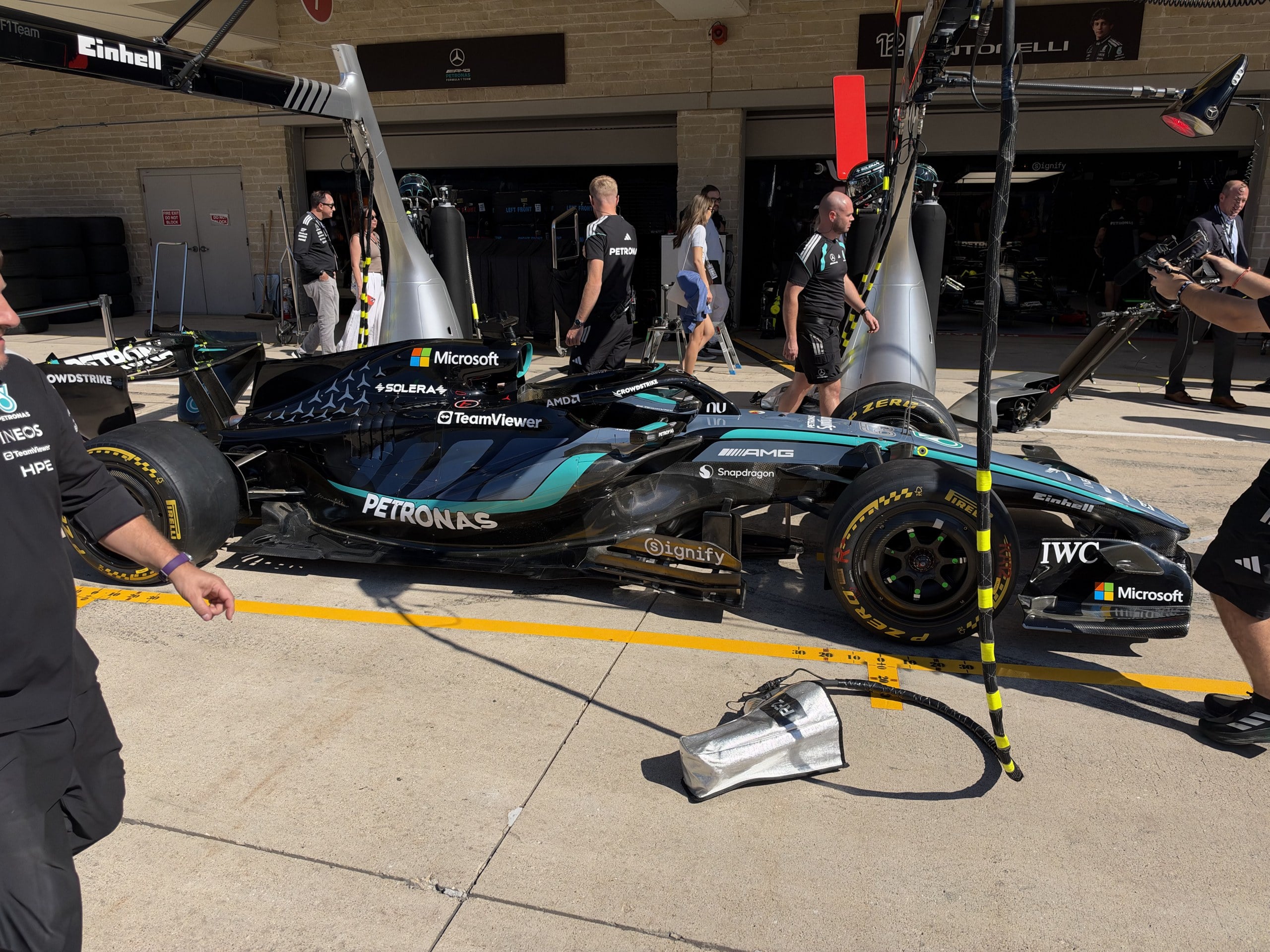
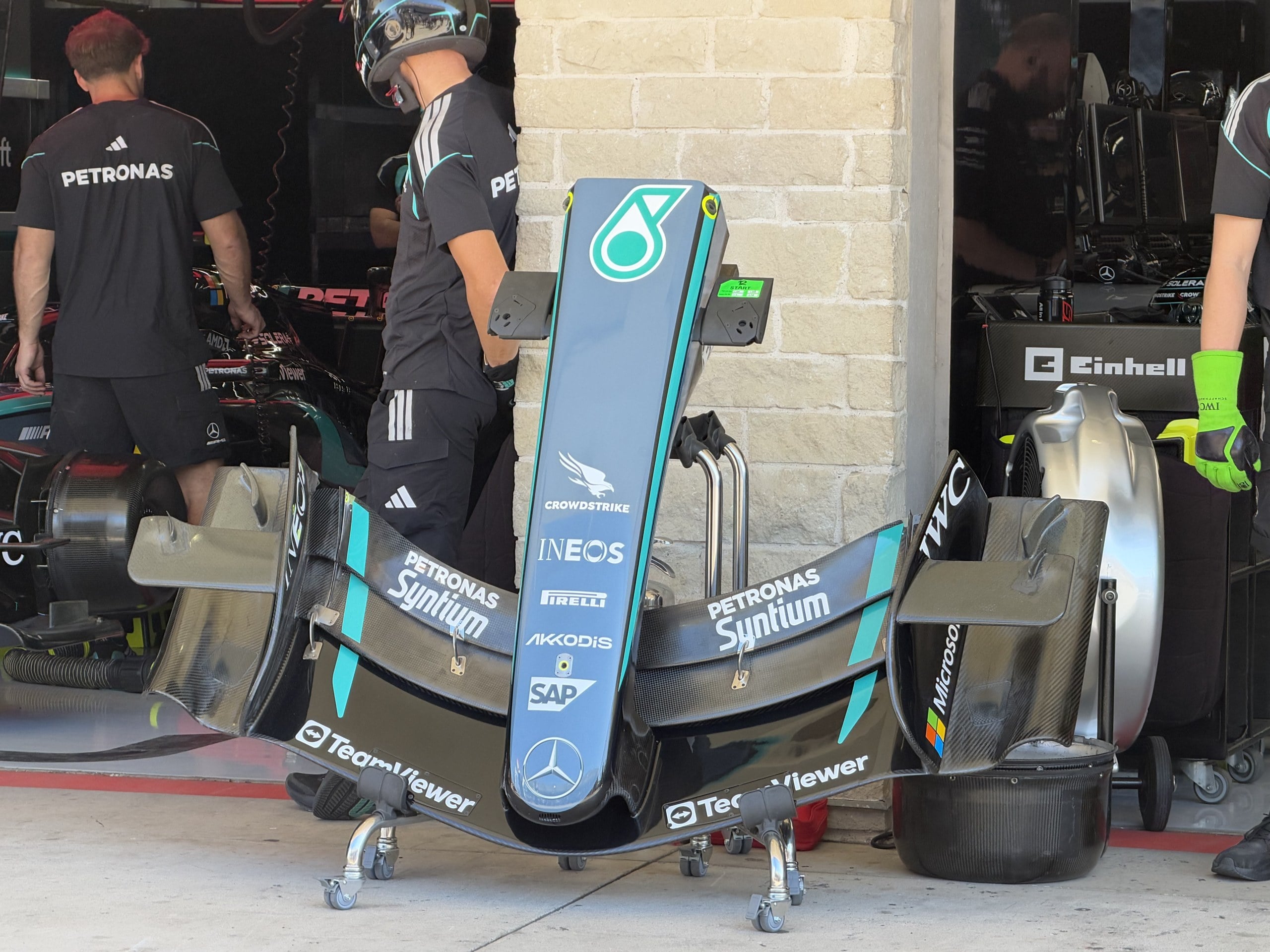
The changes arrived for Russell’s car first. More negative camber on the rear tires, the test steering rack from FP1 swapped back to the original, and a new rear anti-roll bar to shift the mechanical balance. All three targeted the same complaint, what the team calls three-wheeling, where the inside rear lifts through a corner. Russell radioed “Check front wing, something has happened” in FP1, locked up into Turn 1, and his side of the garage was the busy side. Antonelli’s car, the presenter said, needed far less.
The FP2 run plan was new mediums and new softs for both drivers, then a long run on the used mediums for Antonelli, because the team had not run the medium at all in FP1. After FP2, the cars would come fully apart for system checks, and no further setup work would happen at the track that night. The next setup decisions would come from the simulator in Brackley, running through the Texas night on UK time, while the trackside mechanics hit the FIA curfew.
FP2 ended with Leclerc on 1:35.291, Antonelli 0.042 seconds back, Verstappen third, and Russell fifth at 0.744. Antonelli’s seat had come loose early in the session and cost him several minutes in the garage; he called it “a good step forward” afterward. I am not going to pretend the anti-roll bar explains the gap between the two Mercedes, but the Friday I watched was a car being rebuilt twice in a day to answer two drivers who were telling the engineers different things.
What the Upgrade Is and Why Austin
Mercedes declared nothing new to the FIA for Austin, after a bit of back-and-forth from prior races. The package it ran on both cars is the floor and rear end it introduced in Malaysia plus the front wing and endplate it filed in Singapore under “Performance, Flow Conditioning,” together on both cars for the first time. Singapore was a split test: Antonelli ran the new package and Russell the old one, and the new front wing ran for a single hour of practice because, as deputy team principal Bradley Lord put it, “we only had one there, so we’d rushed it through production.”

The garage presenter called the new wing a “double drop,” and that phrase is worth breaking down. The 2026 rules make the front wing active: it is 100mm narrower than last year’s and carries a two-element flap that opens in X-mode on any straight longer than about three seconds, with Z-mode as the cornering default. The previous Mercedes wing dropped one element on the straights; the new one drops two. The mechanics also suggested the new package is easier to build.
Wolff gave the panel a version of this story that underscores how, for all the technology deployed, racing is as much magic as science. Two races earlier, the team put an upgrade on the car that the simulations indicated was worth 3.5 tenths, and the car came out 3.5 tenths slower. The car’s sensors said the aerodynamic load was there. The drivers said the car was unpredictable, locked the inside wheel on the brakes, and understeered on turn-in. “The engineer says it’s all there,” Wolff said, “and the driver says the car is unpredictable.”
Translator, or Therapist
Wolff’s answer to who you believe in that situation was humorous. “I trust the most expensive sensor,” he said, “and that’s definitely the one that sits in the car.” He described his job as “a little bit a translator between what the data say and the engineering team says, and then what the driver needs in order to drive a car fast.”
He then told the story of Russell reporting that the car “feels like a three-legged chair,” and of engineers spending months chasing a lifting wheel before someone asked Russell to describe the feeling and learned it was an oscillation, the wheel coming up and down, which was a different problem with a different fix.
Having now watched his garage respond to a driver complaint with a steering rack and an anti-roll bar inside two and a half hours, I think translator undersells it. What Wolff described, and what the Friday turnaround looked like, is a therapist’s job: two sides, each telling the truth, and needing someone in the middle to get them to a car both can trust. “Data don’t take decisions,” he said. “Whoever human is in charge needs to take that decision.”
What HPE Runs at the Track
Max Walker, the HPE chief technologist who has worked the Mercedes account since 2018, opened Thursday with the origin story. When HPE arrived, the trackside compute was, in his words, a personal computer. HPE replaced it with an Edgeline system for density and consistency, laid an Aruba wired and wireless network across the garage, and later did the same across the Brackley campus and data center. The team runs Wi-Fi 7 now. At the start, the HPE team on the account was three people: a data scientist, a software engineer, and a program manager.

The data path Wolff and Taylor described runs from the car to the garage by Wi-Fi during the session and by umbilical when the car is on the stands, gets filtered at the track for what matters in the moment, and goes to the Race Support Room in Brackley, sometimes immediately and sometimes overnight; there’s a tremendous amount of data that comes from the telemetry on both cars and their supporting systems.
The FIA caps how many people a team can bring to the circuit, so the headcount that is not at the track still works the session from the factory. Taylor’s trackside priority was unambiguous: reliability first, performance second, because the engineers need the data from the previous run to be there when they go to analyze it.
I didn’t get to peek inside the racks to see the HPE gear deployed trackside, but I did find them. Behind the Mercedes pit wall, between the tires and tool chests, sit two sealed racks with louvered vent panels at the back, built for the sand, dust, and heat the circuit calendar throws at them, along with air filters and extra fans to move air over the racks. HPE’s people suggested they hold Edgeline systems, which fits Walker’s account. The Aruba access points in the garage were easier to spot on the ceiling, and the HPE logo sits on the monitors and systems in and around the garage.

The Factory and the Cost Cap
Taylor describes his department as a small IT team in an organization where everyone is an engineer, and he uses HPE as an extension of that team for three-month projects his staff cannot absorb, with the 2018 software-defined data center as an example.
He framed performance as coming from the factory. Aerodynamic ideas start in CFD, the best go to a 60 percent scale model in the wind tunnel, and over a season that pipeline adds more than a second to the car’s lap time. By HPE’s count, the team generates up to 50TB of CFD data a week, and HPE claims the current AMD-based ProLiant HPC refresh cuts a three-day simulation cycle to one, so results come back to the aerodynamicists the same day. We did not audit either figure.
The cost cap sits over all of it. Wolff was candid that the cap equalized spending among Mercedes, Ferrari, and Red Bull and now limits what the team can buy, including AI. Neri’s answer, and Taylor’s, was consumption: HPE GreenLake, with HPE Financial Services, structures infrastructure spend so the team has room to maneuver inside the cap, whether a purchase lands as capital or operating expense.
The next step in that pipeline is already on its way to Brackley. Walker said Mercedes will be the first UK customer to receive a ProLiant Gen13 engineering unit, which it will test for performance, sustainability, and workload density ahead of general availability. The unit is the HPE ProLiant DL525 Gen13, the 1U single-socket server we covered at the Gen13 launch, built on AMD’s 6th Gen EPYC, the Venice parts, and the first of the four Gen13 systems to ship.

CFD is a memory bandwidth problem, and that is where Venice changes what’s possible for a team under a spending cap. One DL525 socket carries up to 256 cores and 16 memory channels, which AMD rates at 1.6TB/s, with up to 4TB of DDR5-8000 or 2TB of MRDIMM-12800, PCIe Gen6, and a 600W envelope, in a chassis that fits 20 E3.S drives and optional direct liquid cooling into one rack unit.
For a team that pays for every watt and every rack unit out of the same budget that buys wind tunnel time, the whole point of the test is more simulation cycles per rack and per kilowatt, and the sustainability line is the same measurement we keep hearing about in large-scale data centers.
The Mercedes stack also includes HPE Morpheus Enterprise. Walker said the team uses it to run an IT-as-a-service model, carrying automation workflows from the software-defined data center into a catalog where engineers request infrastructure, and using it as a lower-cost virtualization platform under the cap.
Last year, we spent time with the hypervisor side of that family in our SimpliVity and VM Essentials review, where the KVM-based VM Essentials layer delivered two-node high availability, live migration, and policy-based placement without a separate hypervisor license. Walker didn’t say which Morpheus components Mercedes runs beyond Enterprise, but the economics he described match what the review found.
AI Under the Cap and the Rules
Neri used a question about agentic AI to describe how HPE itself uses it. The company has 1,500 internal AI use cases, and its AI spending run rate has quadrupled in three quarters, from a baseline he called one dollar to four. He said he is fine with that because it lowers his overall cost structure. He noted that Mercedes AI adoption is constrained less by the cap than by regulation, since FIA rules specify where AI can and cannot be used in car development.
Taylor’s examples came from the last month or so of work. In that window, the team has started self-hosting open-weight models on HPE infrastructure, which he called the most cost-effective way to put models in front of more than 200 developers across the organization without the spend showing up where the cap bites.
He described the near future as a lead developer with a swarm of agentic developers, prompting as a skill his placement students already have, and less spending on commercial off-the-shelf tools because the team can build what it needs. He was equally clear that the deterministic problem of setting up a race car is still years away from an AI solution.

Wolff took the skill-set question first, with a joke at his engineers’ expense. His nirvana, he said, would be no engineers at all, just “blinking stacks and GPUs,” because then “I don’t need to cope with the complexity of the nerds.” He added, “They don’t complain, they don’t sleep,” and handed the question to Taylor.
When he returned to it, a number was attached. He has given the team’s support functions, legal, marketing, communications, compliance, and sponsorship, what he called “irrational targets”: 30 percent more efficient within six months, with agentic tools making the difference. “The reaction that I get is it’s impossible,” he said. Legal warned the results would get worse, and his response has been to keep sending the departments AI-generated content until they concede, which, in his telling, they already know is a lost case. Neri also walked the room through where HPE’s internal AI tooling is headed next, which isn’t yet for public consumption, but sounds compelling.
Reklama
HPE played its “self-driving network” spot before the panel. If you haven’t seen it, which seems impossible at this point given the airtime, Russell hears the “self-driving” pitch in the garage, texts Antonelli “You hear that?”, and Antonelli spends the rest of the spot forlorn: at a press conference, at lunch over a plate of pasta he’s too sad to eat, and in bed, texting Russell “What about US?” with three crying emojis. Neri said the spot has been in airports, the New York subway, and NFL and college football broadcasts for months.

It lands because the partnership’s real product is invisible. Nobody in the Paddock Club sees a CFD cycle finish a day early or a Race Support Room get a telemetry file before the car is back on the stands. The joke in the ad is that the network runs itself; Taylor’s version is that a network nobody has to babysit frees someone to fix something that makes the car faster.
Sobota
Saturday answered the question Friday left open, with Hamilton topping final practice at 1:34.893, Verstappen 0.168 seconds back, and Leclerc third, and the two Mercedes sat fourth and fifth, Antonelli 0.303 off and Russell 0.488, with Antonelli losing a lap to track limits at Turn 9, a somewhat comical theme for him this season. Two hours later, though, he put the car on pole at 1:34.035, 0.179 seconds clear of Verstappen, with Isack Hadjar, Leclerc, and Hamilton covered by 0.276 and Russell sixth at 0.441. It was his seventh pole of the season.

Wolff said in the garage before the session to expect third to fifth, and afterward called the lap beyond expectations. His explanation was the thread of the whole weekend: “What is clear with our updates is that the car now has a narrower window of operation,” and on the other side of the garage, “if you are not hitting that peak completely, that you fall out of it, and then you’re having three to four tenths deficit.” Russell’s account was two bad laps in Q3, with a Q2 time two and a half tenths quicker than anything he managed in the final session.
Antonelli’s version was the Friday process paying off. “We have been working really hard with this update to get it into a good window,” he said, and “we have focused on building up to the limit, getting the car in a good place.” He credited the factory, “they’ve done a tremendous job on this package, and we are now seeing results,” and named one detail that decided it: “one of the keys was not doing any track limits,” after his deleted FP3 lap had drawn a “you were doing so well” from his engineer.
Wolff was not entertaining a Sunday coronation, and said so: “I don’t think we are quickest in the race, so it’s about scoring points,” he said, and called a clinch in Austin “not realistic.”
Niedziela
Sunday was the data’s day, and it began on the medium tire: Antonelli started with Verstappen alongside on softs, led into Turn 1, and made a single stop onto hards while Red Bull and Ferrari stopped twice; when Verstappen pitted again on lap 31, Leclerc inherited the lead for a few corners, and Antonelli took it back at Turn 12.
The pit wall had modeled the undercut before the race and did not waver. “We discussed it, that Max could undercut us, and we stayed firm with the decision,” Wolff said. “In theory, it was eight seconds quicker, and at the end, it was a little bit more.” His summary of the afternoon was five words: “stick to the data, trust your data.”
Russell’s race ended where his Friday had pointed. He went wide at Turn 12 on the opening lap, holding off the McLarens, took a five-second penalty for leaving the track and gaining an advantage, served it at his only stop, came out behind Oscar Piastri, and spent half the race within a second of him without a way past. He finished eighth, 54 seconds behind his teammate, with a race pace he called “rubbish.” Same car, same package, same engineering team, but the two cars ended up in quite different places.

Antonelli leaves Austin on 365 points to Russell’s 242 and Hamilton’s 241, 123 clear with 125 left to race for, and a top-nine finish in Mexico City next weekend makes him the youngest champion in the sport’s history. Wolff told Sky Sports that Antonelli had said before the race, “I’m going to enjoy this ride now, and it’s weird, I’m not thinking about the championship at all,” and called the drive “exceptional at any time.” Mercedes leads the constructors’ standings at 605 points to Ferrari’s 474.
What I took home from Austin is that the Mercedes IT story is the therapist’s story. The data, drivers, and engineers all tell the truth; they describe the same car in different ways, and the people in the middle must get those descriptions to converge before the next session to extract the best lap times. Wolff’s instruction to his pit wall on Sunday, trust your data, is the engineering half of that conversation, and Russell’s eighth place reminds us that the driver still has to be accounted for, regardless of the data.
HPE’s job, as far as I could see it from the lounge and the garage, is to make sure that conversation happens at the speed of a race weekend, with the factory awake in Brackley while the mechanics sleep in Austin, and the data the pit wall trusted on Sunday waiting where it was supposed to be.
On Thursday, Wolff had told the room where that job started. A year into the partnership, he said, Neri gave him an acrylic block with a chip inside, and a motto to go with it: “How can HPE help us to create the unfair advantage against our competitors?” Neri cut in from the next chair, “Within the rules, always within the rules,” then added, “You have to win.” Wolff said that was when he decided this was a CEO who gets it. On Sunday, within the rules, Kimi’s margin was 13 seconds, and a World Drivers’ Championship and Constructors’ Championship are within easy reach thanks in large part to the technology partnership that, at a minimum, gives Mercedes an advantage.



 Amazon