---
description: The Sabrent Rocket 4 Plus NVMe SSD is a solid-performing M.2 2280 drive that leverages the new PCIe Gen4 interface and TLC NAND Flash memory.
title: Sabrent Rocket 4 Plus SSD Review
image: https://www.storagereview.com/wp-content/uploads/2021/01/Sabrent-rocket-4-plus-front.jpg
---

[![Storage Review]()](https://storagereview.com/)

---

[Facebook](https://www.facebook.com/@storagereview) [X (Twitter)](https://twitter.twitter.com/storagereview) [Instagram](https://www.instagram.com/storagereview/) [LinkedIn](https://www.linkedin.com/company/storagereview-com) [YouTube](https://www.youtube.com/user/storagereview?sub_confirmation=1) [Email](mailto:info@storagereview.com) [Spotify](https://open.spotify.com/show/1y6VnznABhHeOSMOmbDTz0) [Reddit](https://www.reddit.com/r/StorageReview/) [Discord](https://discord.gg/TwMHb4azdC) [RSS Feed](https://www.storagereview.com/rss.xml) [TikTok](https://www.tiktok.com/@storagereview)

[Facebook](https://www.facebook.com/@storagereview) [X (Twitter)](https://twitter.com/storagereview) [Instagram](https://www.instagram.com/storagereview/) [LinkedIn](https://www.linkedin.com/company/storagereview-com) [YouTube](https://www.youtube.com/user/storagereview?sub_confirmation=1) [Email](mailto:info@storagereview.com) [Spotify](https://open.spotify.com/show/1y6VnznABhHeOSMOmbDTz0) [Reddit](https://www.reddit.com/r/StorageReview/) [Discord](https://discord.gg/TwMHb4azdC) [RSS Feed](https://www.storagereview.com/rss.xml) [TikTok](https://www.tiktok.com/@storagereview)

[![StorageReview.com](https://www.storagereview.com/wp-content/uploads/2026/07/Storage-Review-2x.png)](https://www.storagereview.com)

≡ Menu

- [Home](https://www.storagereview.com/)
- [Storage Reviews](https://www.storagereview.com/review)
  - [Consumer Reviews](https://www.storagereview.com/consumer)
  - [Enterprise Reviews](https://www.storagereview.com/enterprise)
  - [Ubiquiti Reviews](https://www.storagereview.com/best/ubiquiti-reviews)
- [SR Merch](https://store.storagereview.com)
- [Leaderboards](https://www.storagereview.com/best)
  - [Best Storage Arrays](https://www.storagereview.com/best/storage-arrays)
  - [Best Enterprise SSDs](https://www.storagereview.com/best/enterprise-ssds)
  - [Best Servers](https://www.storagereview.com/best/servers)
  - [Best Desktops for Local AI](https://www.storagereview.com/best/desktops-local-ai)
  - [Best Laptops for Local AI](https://www.storagereview.com/best/laptops-local-ai)
  - [Best Local LLM Tools](https://www.storagereview.com/best/local-llm-tools)
  - [Agentic AI Hardware](https://www.storagereview.com/best/agentic-ai-hardware)
  - [Best SSDs & Hard Drives](https://www.storagereview.com/best_drives)
  - [Best Portable SSDs](https://www.storagereview.com/best/portable-ssds)
  - [Best Business Laptops](https://www.storagereview.com/best/business-laptops)
  - [Best Mobile Workstations](https://www.storagereview.com/best/mobile-workstations)
  - [Best Desktop Workstations](https://www.storagereview.com/best/desktop-workstations)
  - [Best Laptop Battery Life](https://www.storagereview.com/best/laptop-battery-life)
- [Storage Reference Guide](https://www.storagereview.com/storage-reference-guide)
- [About SR](https://www.storagereview.com/about-storagereview)
  - [StorageReview.com Sweepstakes Rules and Regulations](https://www.storagereview.com/storagereview-com-sweepstakes-rules-and-regulations)

Search

[Home](https://www.storagereview.com/) » [Review](https://www.storagereview.com/review) » Sabrent Rocket 4 Plus SSD Review

# Sabrent Rocket 4 Plus SSD Review

by Lyle Smith on January 29, 2021

[Client SSD](https://www.storagereview.com/consumer/client-ssd)  ◇  [Consumer](https://www.storagereview.com/consumer)

The Sabrent Rocket 4 Plus is the company’s newest addition to their NVMe PCIe Gen4 portfolio. Released back in December, the Rocket 4 Plus comes equipped with the new [Phison PS5018-E18](https://www.storagereview.com/news/phison-showcases-new-controllers-at-ces) controller, which was demonstrated at the CES 2021 in January, and features TLC NAND and DDR4 cache. It currently is available in capacities up to 2TB, with the 4TB model expected to be available in the coming months.

![Sabrent Rocket 4 plus feature](https://www.storagereview.com/wp-content/uploads/2021/01/Sabrent-rocket-4-plus-feature.jpg)

Looking first at performance, the Rocket 4 Plus is quoted to deliver sequential read and write speeds up to 7.1GB/s and 6.6GB/s, respectively while random speeds are expected to reach up to 650,000 IOPS read and 700,000 IOPS write for the 2TB model. While reads are mostly the same with the 1TB model, it is quoted with noticeably less write performance with 5.3GB/s in sequential and 350,000 IOPS in random speeds.

That said, though PCIe Gen4 is all about the next level of performance for SSDs, supported motherboards are still very limited for now. This means users will only be able to get close to these potential numbers only if their system has a specific set of compatible components. Even so, we haven’t seen a drive yet that has been able to take full advantage of the new performance ceiling that this new PCIe interface offers. The SSD is backward compatible with PCIe 3.0, though the Sabrent drive would be maxed out at the interface’s limit of 3.5GB/s if you install it on this type of motherboard.

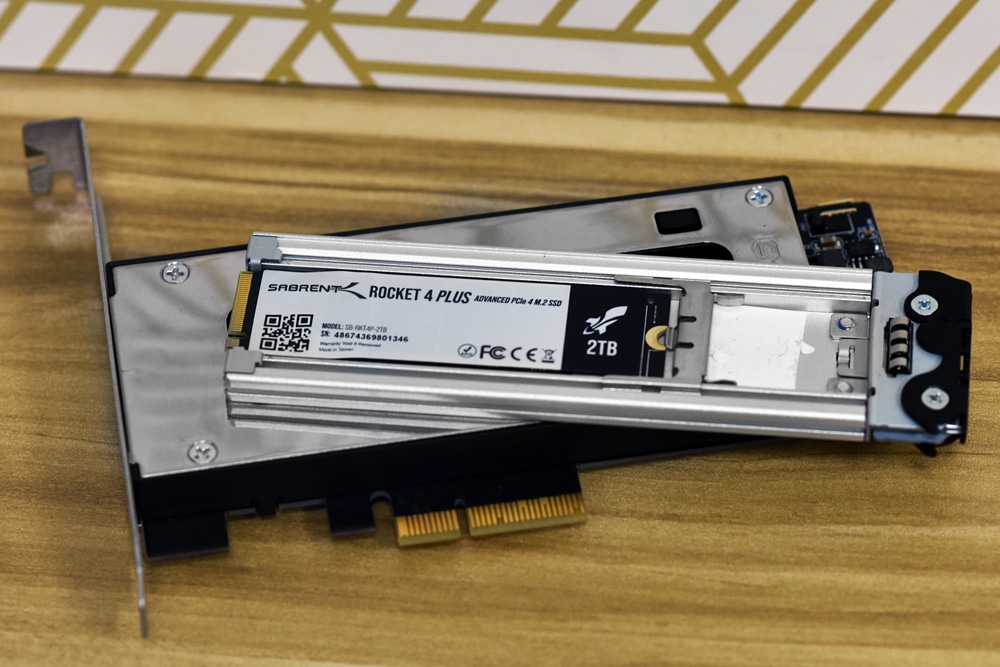
The Sabrent Rocket 4 Plus has an optional heatsink made of aluminum and copper to help dissipate heat during intense workloads to avoid throttling. It is fully compatible with single/double-sided M.2 2280 SSDs. Though this beast is not really necessary for most use cases, it will certainly keep the drive cool, or at least looking cool, if you have the room in your PC case.

To assist with managing the SSD over time, the Rocket 4 Plus comes with Sabrent Rocket Control Panel, an SSD management software that offers features like displaying the health of the drive and firmware upgrades. Users also have access to the company’s own version of Acronis True Image, an integrated backup software suite that allows for easy data recovery in the event of unexpected disasters like power outages, accidental deletions, and hard drive crashes.

Backed by a 5-year warranty (when the drive is registered), the [Sabrent Rocket 4 Plus goes for roughly $300 and $400 for the 1TB and 2TB](https://amzn.to/3pAGF9o) models, respectively. We will be looking at the 2TB model for this review.

## **Sabrent Rocket 4 Plus Specifications**

| Capacities | 1TB, **2TB**, 4TB (coming soon) |
| --- | --- |
| NAND | B27 |
| Controller | Phison E18 |
| Interface | PCIe Gen4x4 |
| Max Seq. Read | <ul><li>7GB/s (1TB)</li><li>7.1TB/s (2TB)</li></ul> |
| Max Seq. Write | <ul><li>5.3GB/s (1TB)</li><li>6.6GB/s (2TB)</li></ul> |
| Random 4K Read IOPS | <ul><li>350K (1TB)</li><li>650K (2TB)</li></ul> |
| Random 4K Write IOPS | <ul><li>700K (1TB)</li><li>700K (2TB)</li></ul> |
| Power Supply | 3.3V |
| Form Factor | M.2 2280 |
| MTBF | 1,600,000 |
| Shock resistant | 1,500G |
| Data Correction | LDPC |
| TBW | <ul><li>700 (1TB)</li><li>1,400 (2TB)</li></ul> |
| Warranty | 5-years with registration |

## **Sabrent Rocket 4 Plus** **Design and build**

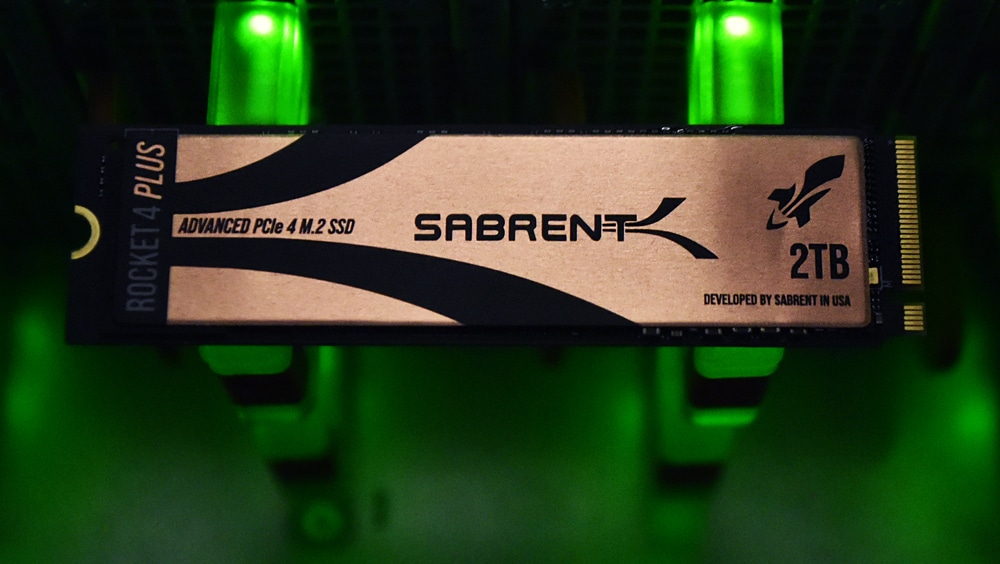
The Rocket 4 Plus features the same overall design as the other recently released Sabrent drives. It has a slick black and copper-colored sticker, which displays the company logo, product name, and drive capacity.

![Sabrent Rocket 4 plus front]()

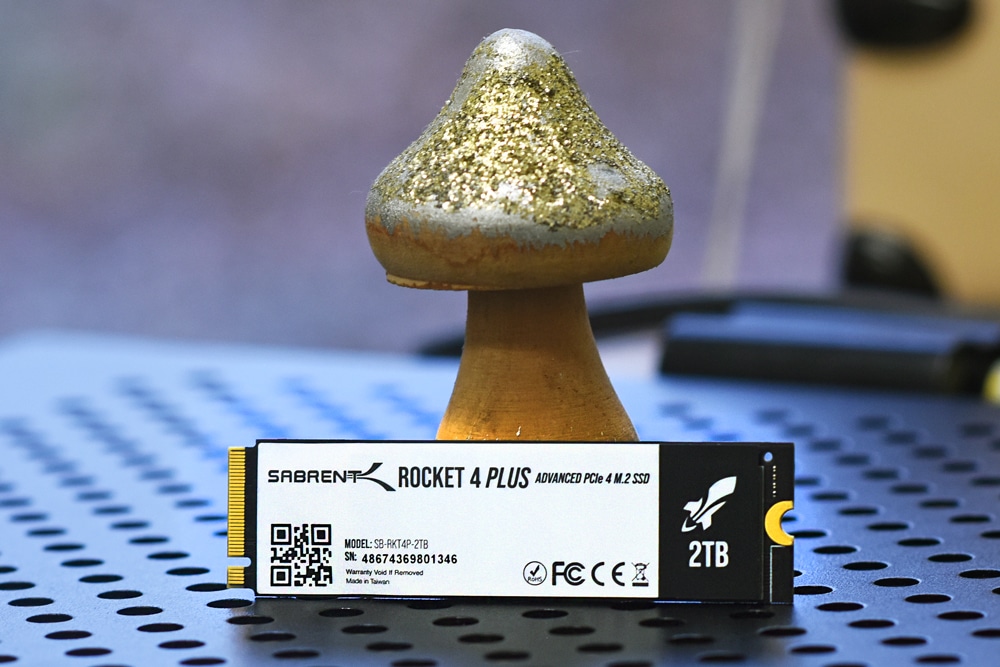
Turning the drive reveals the usual sticker with other detailed information about the drive, including serial numbers and certifications.

![Sabrent Rocket 4 plus back]()

The Rocket 4 Plus also comes with an optional heat sink pad that consists of a top heat spreader, copper heat coils (which effective head dissipation), an aluminum heat sink, and thermal tape on the top. Underneath, is another strip of thermal tape and an aluminum tray. This comprehensive and sizable heat sink certainly helps to keep the drive cool during heavy workloads while curbing performance throttling due to high thermal levels.

While this heat sink is not really necessary, it certainly gives the drive a very unique look.

## **Sabrent Rocket 4 Plus Performance**

**Testbed**

As we migrate into testing newer NVMe Gen4 SSDs, it required a platform shift in our lab to support the newer interface. Lenovo has been out in the front of the pack with PCIe Gen4 support, including up to the front-mount U.2 bays, while others still only offer edge-card support. In our Gen4 reviews, we leverage the [Lenovo ThinkSystem SR635 server](https://www.storagereview.com/review/lenovo-thinksystem-sr635-review), equipped with an AMD 7742 CPU and 512GB of 3200Mhz DDR4 memory.

NVMe is tested natively through an M.2 to PCIe adapter card in the edge-card slot, while U.2 drives are loaded in the front. The methodology used better reflects end-user workflow with the consistency, scalability, and flexibility testing within virtualized server offers. A large focus is put on drive latency across the entire load range of the drive, not just at the smallest QD1 (Queue-Depth 1) levels. We do this because many of the common consumer benchmarks don’t adequately capture end-user workload profiles.

**SQL Server Performance**

Each SQL Server VM is configured with two vDisks: 100GB volume for boot and a 500GB volume for the database and log files. From a system resource perspective, we configured each VM with 16 vCPUs, 64GB of DRAM and leveraged the LSI Logic SAS SCSI controller. While our Sysbench workloads tested previously saturated the platform in both storage I/O and capacity, the SQL test is looking for latency performance.

This test uses SQL Server 2014 running on Windows Server 2012 R2 guest VMs and is stressed by Quest’s Benchmark Factory for Databases. StorageReview’s  [Microsoft SQL Server OLTP testing protocol ](https://www.storagereview.com/sql_server_oltp_benchmark)employs the current draft of the Transaction Processing Performance Council’s Benchmark C (TPC-C), an online transaction-processing benchmark that simulates the activities found in complex application environments.

The TPC-C benchmark comes closer than synthetic performance benchmarks to gauging the performance strengths and bottlenecks of storage infrastructure in database environments. Each instance of our SQL Server VM for this review uses a 333GB (1,500 scale) SQL Server database and measures the transactional performance and latency under a load of 15,000 virtual users.

**SQL Server Testing Configuration (per VM)**

- Windows Server 2012 R2
- Storage Footprint: 600GB allocated, 500GB used

- SQL Server 2014

-
  - Database Size: 1,500 scale
    - Virtual Client Load: 15,000
    - RAM Buffer: 48GB

- Test Length: 3 hours
  - 2.5 hours preconditioning
  - 30 minutes sample period

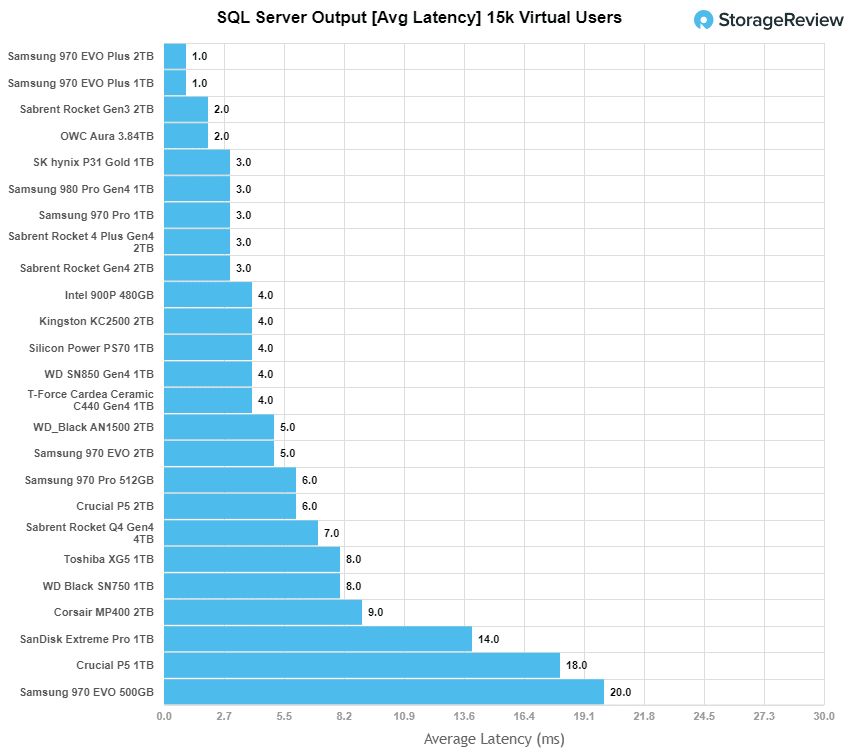
Looking at SQL Server average latency, the Sabrent drive showed a solid average latency of 3ms, placing among the leaders of the long list of tested consumer drives, and right up there with the Samsung 970 Pro.

![StorageReview-Sabrent Rocket 4 Plus Gen4 2TB SQL server latency]()

**VDBench Workload Analysis**

When it comes to benchmarking storage devices, application testing is best, and synthetic testing comes in second place. While not a perfect representation of actual workloads, synthetic tests do help to baseline storage devices with a repeatability factor that makes it easy to do apples-to-apples comparison between competing solutions. These workloads offer a range of different testing profiles ranging from “four corners” tests, common database transfer size tests, to trace captures from different VDI environments.

All of these tests leverage the common vdBench workload generator, with a scripting engine to automate and capture results over a large compute testing cluster. This allows us to repeat the same workloads across a wide range of storage devices, including flash arrays and individual storage devices.

Profiles:

- 4K Random Read: 100% Read, 128 threads, 0-120% iorate
- 4K Random Write: 100% Write, 64 threads, 0-120% iorate
- 64K Sequential Read: 100% Read, 16 threads, 0-120% iorate
- 64K Sequential Write: 100% Write, 8 threads, 0-120% iorate

**Comparables for this review:**

- [Sabrent Rocket NVMe 4.0 2TB](https://www.storagereview.com/review/sabrent-rocket-nvme-4-0-ssd-review)
- [XPG GAMMIX S50](https://www.storagereview.com/review/xpg-gammix-s50-lite-pcie-4-0-ssd-review)
- [Samsung Pro 980 Pro 1TB](https://www.storagereview.com/review/samsung-980-pro-pcie-4-0-nvme-ssd-review)
- [T-Force Cardea Ceramic C440 1TB](https://www.storagereview.com/review/teamgroup-t-force-cardea-ceramic-c440-m-2-ssd-review)
- [Silicon Power US70 1TB](https://www.storagereview.com/review/silicon-power-us70-pcie-4-0-ssd-review)

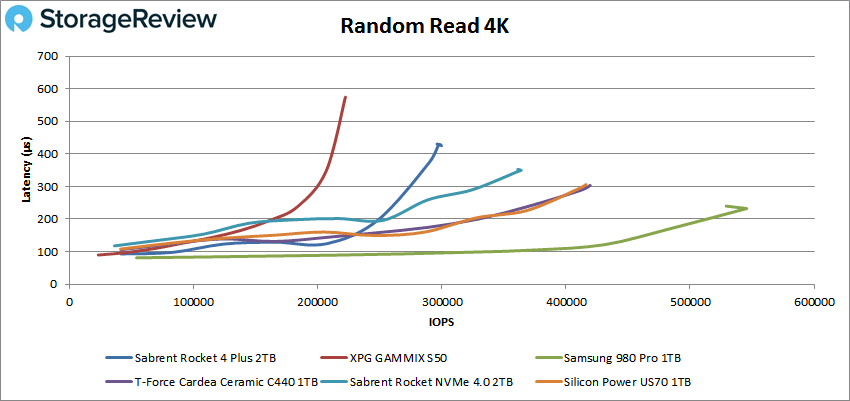
In 4K random read, the Sabrent Rocket 4 Plus had one of the weaker results, with a peak of 297,855 IOPS at a latency of 425.5µs.

![StorageReview-Sabrent Rocket 4 Plus Gen4 2TB random 4K read performance]()

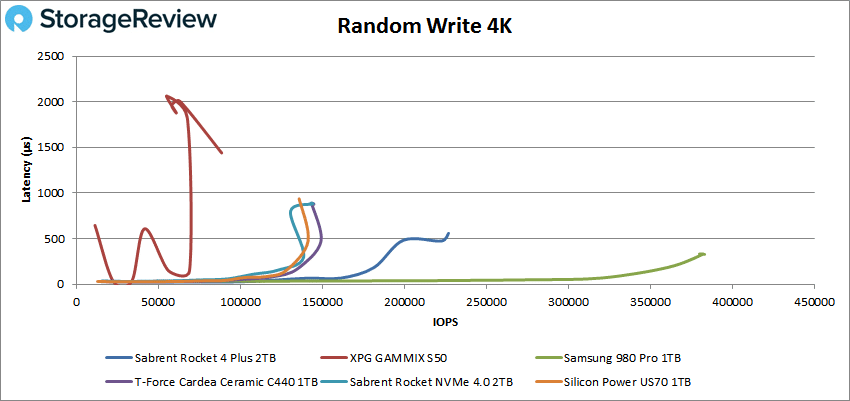
For 4K random write, the Rocket 4 Plus posted much better results, with a peak of 226,955 IOPS at a latency of 558µs for second among the tested drives; however, it was still well back of the Samsung 980 Pro.

![Sabrent Rocket 4 Plus Gen4 2TB random 4K write performance]()

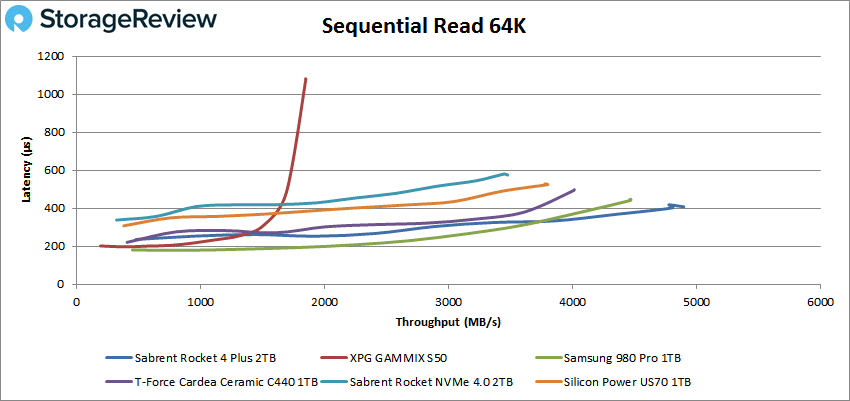
Switching over to sequential workloads, we first look at 64K read. Here, the Sabrent Rocket 4 Plus boasted very impressive performance, beating all other tested drives with a peak of 78,315 IOPS (or 4.89GB/s) at a latency of 407.5µs.![Sabrent Rocket 4 Plus Gen4 2TB sequential read performance]()

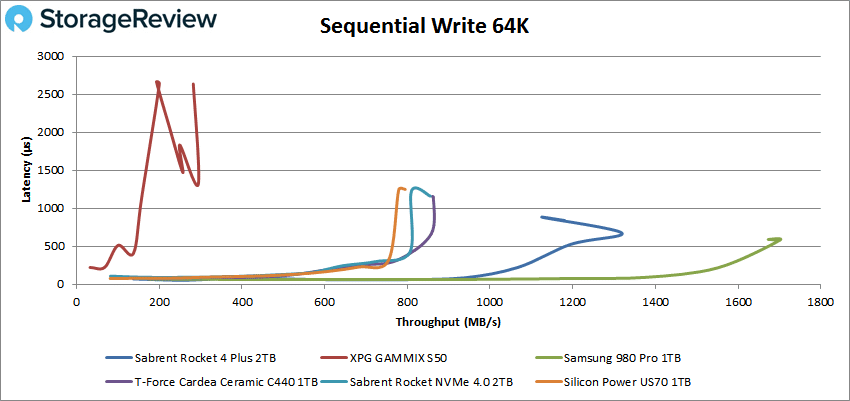
For writes, the Sabrent Rocket 4 Plus peaked at 21,100 IOPS or 1.31GB/s at a latency of 674.6µs for second place, though it took a sharp dip in performance at the end of the test.

![Sabrent Rocket 4 Plus Gen4 2TB 64K sequential write performance]()

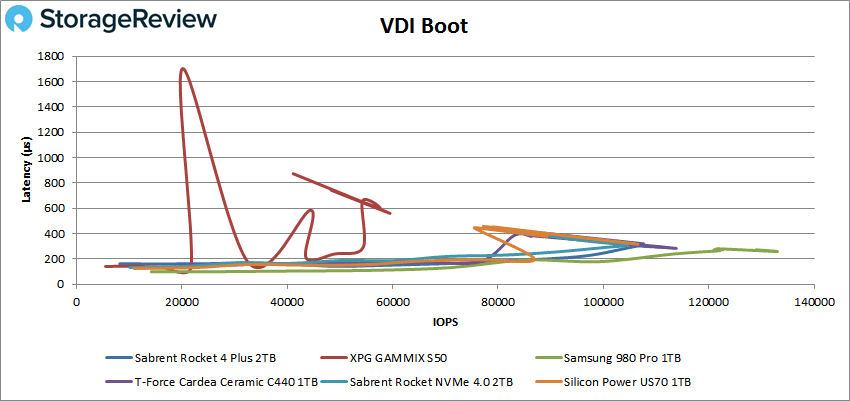
Next, we looked at our VDI benchmarks, which are designed to tax the drives even further. These tests include Boot, Initial Login, and Monday Login. Looking at the Boot test, the Sabrent Rock Plus 4 showed steady performance throughout, with a peak of 111,447 IOPS at a latency of 290.5µs.

![]()

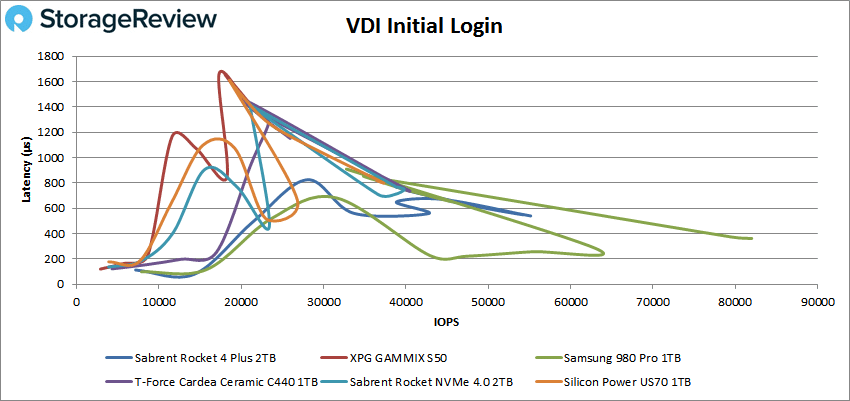
In Initial Login, the Rocket 4 Plus showed a peak performance of 55,174 IOPS at a latency of 539.6µs, though it became more unstable nearing the end of the test.

![]()

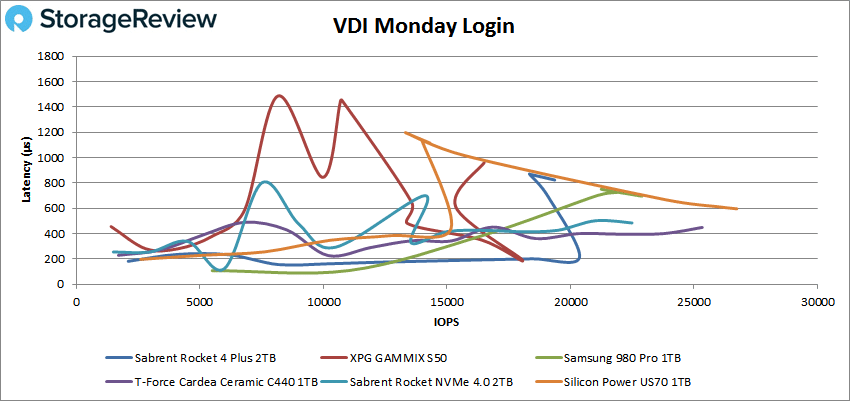
Our VDI Monday Login told a similar story, as the Sabrent had the best peak performance by a mile with 20,361 IOPS before it took a significant hit in latency all the way up to 866.6µs near the very end of the test.

![]()

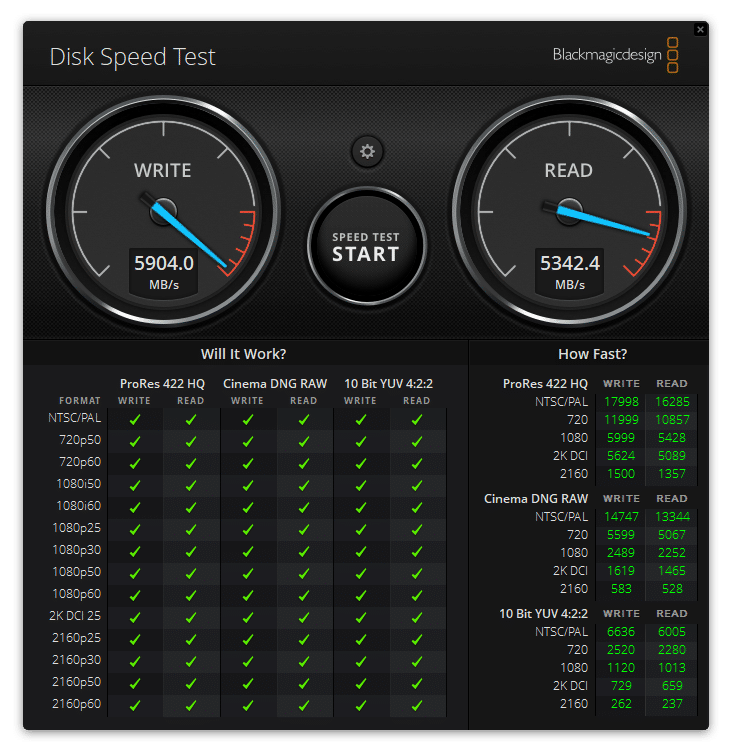
To further test the Sabrent Rocket 4 Plus, we ran the Blackmagic Disk Speed Test on the [Lenovo ThinkStation P620](https://www.storagereview.com/review/lenovo-thinkstation-p620-review).

Here, the Rocket 4 Plus hit 5.3GB/s read and 5.9GB/s write, numbers that didn’t quite reach its quoted performance by Sabrent.

![]()

## **Conclusion**

The Sabrent Rocket 4 Plus NVMe SSD is a solid-performing M.2 2280 drive that leverages the new PCIe Gen4 interface and TLC NAND Flash memory. Available in capacities up to 2TB (though a 4TB model is on the horizon), the Rocket 4 Plus supports both SMART and TRIM commands, Advanced Wear Leveling, Bad Block Management, Error Correction Code, and Over-Provision technology.

Like the other Rocket drives from the Sabrent line, 4 Plus comes bundled with software like Acronis True Image as well as the company’s handy SSD toolbox for easy access to the drive’s health and firmware updates. The main differences between this drive and the recently-released Rocket 4 are the controller. The Rocket Plus 4 uses the new Phison PS5018-E18 while the [ Rocket NVMe 4.0](https://www.storagereview.com/review/sabrent-rocket-nvme-4-0-ssd-review) uses the E16 version.

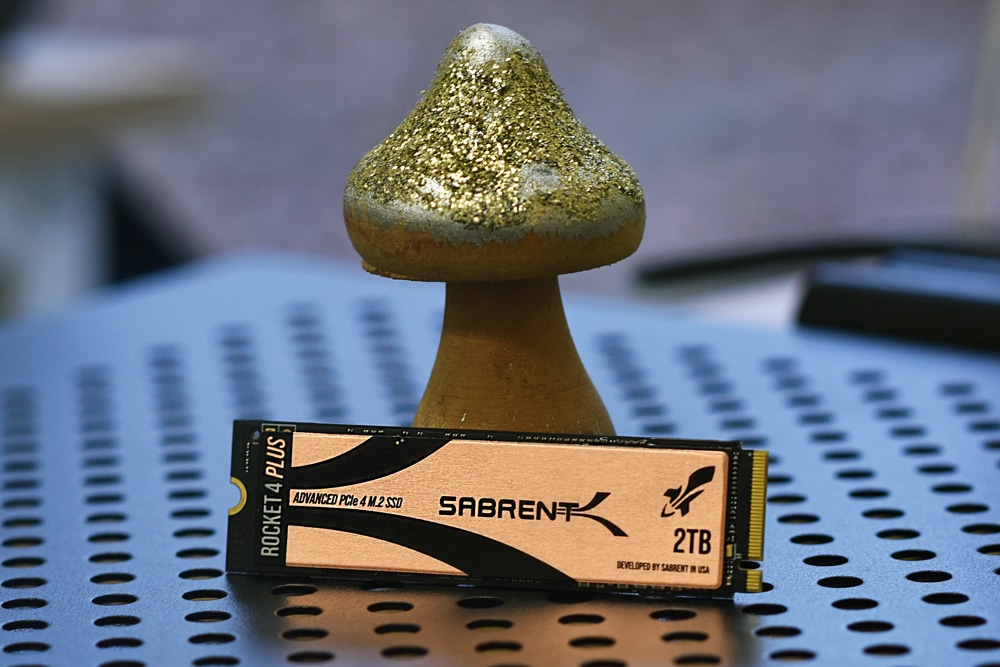
![Sabrent Rocket 4 plus lifestyle]()

Looking at performance specifics, the Rocket 4 Plus posted some pretty good numbers for a PCIe Gen4 drive. First tested was the SQL Server benchmark. This gave us an average latency of just 3ms, place it near the top of the leaderboard and among some pretty heavy hitters like the Samsung Pro line. In VDBench, the Sabrent drive had peaks of 297,855 IOPS in 4K read, 226,955 IOPS in 4K writes, 4.89GB/s in 64K read, and 1.31GB/s in 64K write. For our VDI benchmarks, the drive hit a peak of 111,447 IOPS in boot, 55,174 IOPS in Initial Login, and 20,361 IOPS in Monday Login. Blackmagic gave us an impressive 5.3GB/s read and 5.9GB/s write.

Like all PCIe Gen4 drives currently on market, performance still hasn’t completely reached its true potential ceiling. Sabrent states a maximum of 7GB/s in sequential reads, and though its performance was impressive, it almost 2GB/s less than this quoted number during our BlackMagic test. Most drives using the PCIe Gen4 interface are more in line with high-end Gen3 consumer-grade drives at the moment, but as we keep saying, we hope to see these numbers increase over the year as support improves. That said, the Rocket 4 Plus’ read speeds are one of the highest we’ve seen in a consumer SSD (even better than the [Samsung 980 Pro](https://www.storagereview.com/review/samsung-980-pro-pcie-4-0-nvme-ssd-review))

Overall, the Sabrent Rocket 4 Plus is a great drive and is ideal for enthusiasts looking to bring high-performance to their system. Its current price point of $400 for the 2TB model and $300 for the 1TB may dissuade the average buyer. There are other high performing PCIe Gen4 SSDs out there that have a more affordable price tag like the Samsung 980 Pro, which [currently goes for around $230](https://amzn.to/3oyupop) (1TB). Nonetheless, the Rocket 4 Plus offers a good performance profile and as prices fall, is a viable option in the Gen4 space.

[Sabrent Rocket 4 Plus on Amazon](https://amzn.to/3pAGF9o)

**Engage with StorageReview**

[Newsletter](https://www.storagereview.com/storage_newsletter) |  [YouTube](https://www.youtube.com/user/StorageReview "Opens in a new window") | Podcast  [iTunes](https://podcasts.apple.com/gb/podcast/storagereview-com-storage-reviews/id1060681115 "Opens in a new window")/ [Spotify](https://open.spotify.com/show/1y6VnznABhHeOSMOmbDTz0 "Opens in a new window") |  [Instagram](https://www.instagram.com/storagereview/ "Opens in a new window") |  [Twitter](https://twitter.com/storagereview "Opens in a new window") |  [TikTok](https://www.tiktok.com/@storagereview? "Opens in a new window") |  [RSS Feed](https://www.storagereview.com/rss.xml)

![]()

### Lyle Smith

Lyle is a writer for StorageReview, covering a broad set of end user and enterprise IT topics.

Previous post: [Corsair MP600 Core SSD Review](https://www.storagereview.com/review/corsair-mp600-core-ssd-review)

Next post: [XPG GAMMIX S70 SSD Review](https://www.storagereview.com/review/xpg-gammix-s70-ssd-review)

Trusted Vendors

Products and solutions from our affiliate partners:

- [  
  ![Ubiquiti Logo](https://www.storagereview.com/wp-content/uploads/2024/11/2-1.webp)  
   Ubiquiti](https://store.ui.com/us/en?a_aid=StorageReview "Opens in a new window")
- [  
  ![Newegg Logo](https://www.storagereview.com/wp-content/uploads/2025/11/newegg.webp)  
   Newegg](https://click.linksynergy.com/fs-bin/click?id=g5terNMDhz0&offerid=1207190.18&subid=0&type=4 "Opens in a new window")
- [  
  ![Amazon Logo](https://www.storagereview.com/wp-content/uploads/2025/11/amazon.webp) Amazon](https://amzn.to/4fLJUEW "Opens in a new window")

Newsletter

Subscribe to the StorageReview newsletter to stay up to date on the latest news and reviews. We promise no spam!

1  

Leave this field empty if you’re human:

## Advertisement

Content Categories

[Facebook](https://www.facebook.com/@storagereview) [X](https://twitter.com/storagereview) [Instagram](https://www.instagram.com/storagereview/) [LinkedIn](https://www.linkedin.com/company/storagereview-com) [YouTube](https://www.youtube.com/user/storagereview?sub_confirmation=1) [Email](mailto:info@storagereview.com) [Spotify](https://open.spotify.com/show/1y6VnznABhHeOSMOmbDTz0) [Reddit](https://www.reddit.com/r/StorageReview/) [Discord](https://discord.gg/TwMHb4azdC) [RSS](https://www.storagereview.com/rss.xml) [TikTok](https://www.tiktok.com/@storagereview)

Copyright © 1998-2025 Flying Pig Ventures, LLC Cincinnati, Ohio. All rights reserved.

Manage your privacy

To provide the best experiences, we and our partners use technologies like cookies to store and/or access device information. Consenting to these technologies will allow us and our partners to process personal data such as browsing behavior or unique IDs on this site and show (non-) personalized ads. Not consenting or withdrawing consent, may adversely affect certain features and functions.

Click below to consent to the above or make granular choices. Your choices will be applied to this site only. You can change your settings at any time, including withdrawing your consent, by using the toggles on the Cookie Policy, or by clicking on the manage consent button at the bottom of the screen.

Functional Functional Always active

The technical storage or access is strictly necessary for the legitimate purpose of enabling the use of a specific service explicitly requested by the subscriber or user, or for the sole purpose of carrying out the transmission of a communication over an electronic communications network.

Preferences Preferences

The technical storage or access is necessary for the legitimate purpose of storing preferences that are not requested by the subscriber or user.

Statistics Statistics

The technical storage or access that is used exclusively for statistical purposes. The technical storage or access that is used exclusively for anonymous statistical purposes. Without a subpoena, voluntary compliance on the part of your Internet Service Provider, or additional records from a third party, information stored or retrieved for this purpose alone cannot usually be used to identify you.

Marketing Marketing

The technical storage or access is required to create user profiles to send advertising, or to track the user on a website or across several websites for similar marketing purposes.

Statistics

Marketing

Features

Always active

Always active

- Manage options
- Manage services
- Manage {vendor\_count} vendors
- [Read more about these purposes](https://cookiedatabase.org/tcf/purposes/)

Accept Deny Manage options Save preferences Manage options

- {title}
- {title}
- {title}

Manage your privacy

To provide the best experiences, we use technologies like cookies to store and/or access device information. Consenting to these technologies will allow us to process data such as browsing behavior or unique IDs on this site. Not consenting or withdrawing consent, may adversely affect certain features and functions.

Functional Functional Always active

The technical storage or access is strictly necessary for the legitimate purpose of enabling the use of a specific service explicitly requested by the subscriber or user, or for the sole purpose of carrying out the transmission of a communication over an electronic communications network.

Preferences Preferences

The technical storage or access is necessary for the legitimate purpose of storing preferences that are not requested by the subscriber or user.

Statistics Statistics

The technical storage or access that is used exclusively for statistical purposes. The technical storage or access that is used exclusively for anonymous statistical purposes. Without a subpoena, voluntary compliance on the part of your Internet Service Provider, or additional records from a third party, information stored or retrieved for this purpose alone cannot usually be used to identify you.

Marketing Marketing

The technical storage or access is required to create user profiles to send advertising, or to track the user on a website or across several websites for similar marketing purposes.

Statistics

Marketing

Features

Always active

Always active

- Manage options
- Manage services
- Manage {vendor\_count} vendors
- [Read more about these purposes](https://cookiedatabase.org/tcf/purposes/)

Accept Deny Manage options Save preferences Manage options

- {title}
- {title}
- {title}

Manage consent Manage consent

```json
{"@context":"https:\/\/schema.org","@graph":[{"@type":"WebPage","@id":"https:\/\/www.storagereview.com\/review\/sabrent-rocket-4-plus-ssd-review","url":"https:\/\/www.storagereview.com\/review\/sabrent-rocket-4-plus-ssd-review","name":"Sabrent Rocket 4 Plus SSD Review - StorageReview.com","isPartOf":{"@id":"https:\/\/www.storagereview.com\/#website"},"primaryImageOfPage":{"@id":"https:\/\/www.storagereview.com\/review\/sabrent-rocket-4-plus-ssd-review#primaryimage"},"image":{"@id":"https:\/\/www.storagereview.com\/review\/sabrent-rocket-4-plus-ssd-review#primaryimage"},"thumbnailUrl":"https:\/\/www.storagereview.com\/wp-content\/uploads\/2021\/01\/Sabrent-rocket-4-plus-front.jpg","datePublished":"2021-01-29T22:28:00+00:00","dateModified":"2021-05-11T14:37:00+00:00","description":"The Sabrent Rocket 4 Plus NVMe SSD is a solid-performing M.2 2280 drive that leverages the new PCIe Gen4 interface and TLC NAND Flash memory.","breadcrumb":{"@id":"https:\/\/www.storagereview.com\/review\/sabrent-rocket-4-plus-ssd-review#breadcrumb"},"inLanguage":"en-US","potentialAction":[{"@type":"ReadAction","target":["https:\/\/www.storagereview.com\/review\/sabrent-rocket-4-plus-ssd-review"]}]},{"@type":"ImageObject","inLanguage":"en-US","@id":"https:\/\/www.storagereview.com\/review\/sabrent-rocket-4-plus-ssd-review#primaryimage","url":"https:\/\/www.storagereview.com\/wp-content\/uploads\/2021\/01\/Sabrent-rocket-4-plus-front.jpg","contentUrl":"https:\/\/www.storagereview.com\/wp-content\/uploads\/2021\/01\/Sabrent-rocket-4-plus-front.jpg","width":1000,"height":667,"caption":"Sabrent Rocket 4 plus front"},{"@type":"BreadcrumbList","@id":"https:\/\/www.storagereview.com\/review\/sabrent-rocket-4-plus-ssd-review#breadcrumb","itemListElement":[{"@type":"ListItem","position":1,"name":"Home","item":"https:\/\/www.storagereview.com\/"},{"@type":"ListItem","position":2,"name":"Review","item":"https:\/\/www.storagereview.com\/review"},{"@type":"ListItem","position":3,"name":"Sabrent Rocket 4 Plus SSD Review"}]},{"@type":"WebSite","@id":"https:\/\/www.storagereview.com\/#website","url":"https:\/\/www.storagereview.com\/","name":"StorageReview.com","description":"StorageReview.com is a leading provider of news and reviews throughout the entire IT stack - from the datacenter to the edge, and all points in between.","publisher":{"@id":"https:\/\/www.storagereview.com\/#organization"},"potentialAction":[{"@type":"SearchAction","target":{"@type":"EntryPoint","urlTemplate":"https:\/\/www.storagereview.com\/?s={search_term_string}"},"query-input":{"@type":"PropertyValueSpecification","valueRequired":true,"valueName":"search_term_string"}}],"inLanguage":"en-US"},{"@type":"Organization","@id":"https:\/\/www.storagereview.com\/#organization","name":"StorageReview.com","url":"https:\/\/www.storagereview.com\/","logo":{"@type":"ImageObject","inLanguage":"en-US","@id":"https:\/\/www.storagereview.com\/#\/schema\/logo\/image\/","url":"https:\/\/www.storagereview.com\/wp-content\/uploads\/2020\/02\/Storage-Reviews-2-2.png","contentUrl":"https:\/\/www.storagereview.com\/wp-content\/uploads\/2020\/02\/Storage-Reviews-2-2.png","width":344,"height":61,"caption":"StorageReview.com"},"image":{"@id":"https:\/\/www.storagereview.com\/#\/schema\/logo\/image\/"},"sameAs":["https:\/\/x.com\/storagereview","http:\/\/youtube.com\/user\/storagereview"]}]}
```