

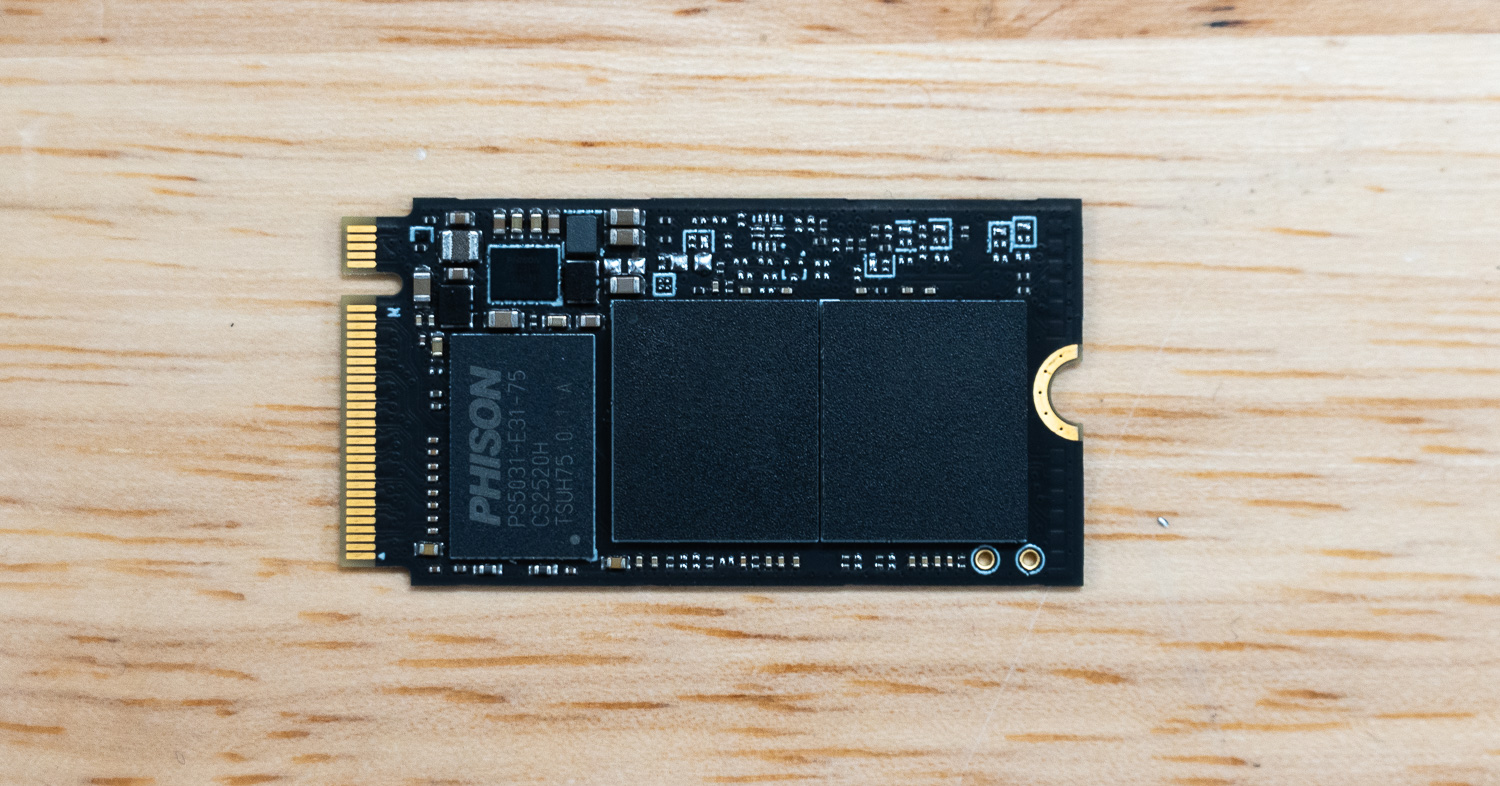
The Corsair MP700 MICRO 4TB SSD delivers next-generation storage bandwidth in a more compact form factor. Built around the compact M.2 2242 form factor using a PCIe Gen5 x4 interface, this drive is designed for thin and light laptops as well as small-form-factor workstations that need serious storage throughput on a much shorter PCB. With a hefty 4TB capacity, it also addresses a common limitation in this segment, where higher capacities in 2242 SSDs are still relatively rare.
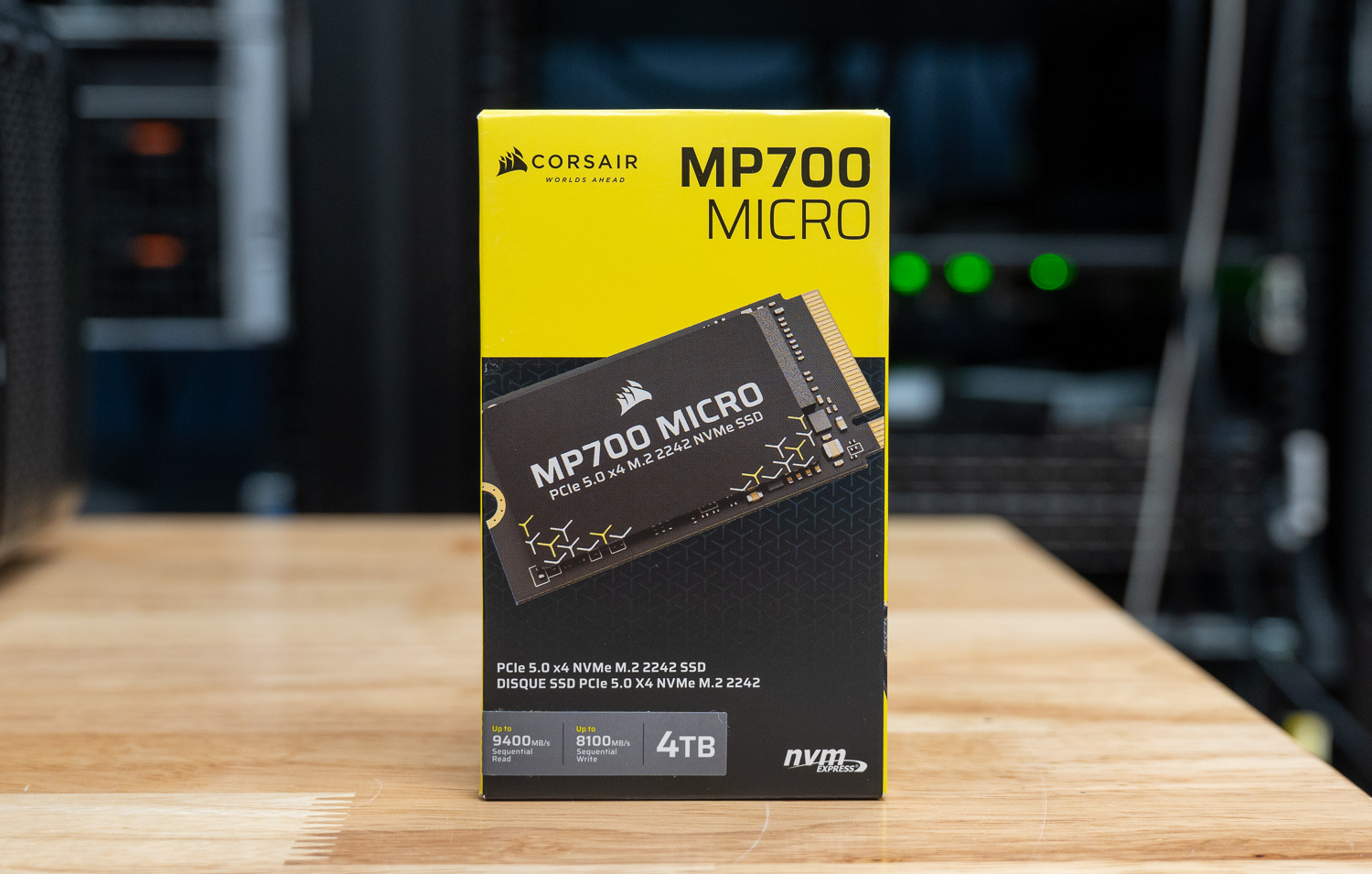
The MP700 MICRO supports the NVMe 2.0 interface over PCIe Gen5 x4 and is rated for up to 10,000 MB/s read and 8,500 MB/s write speeds. For systems with only a single 2242 slot, 4TB lets you keep everything internal instead of managing external drives, while still leaving room for large game libraries or creative projects.
The storage is based on 3D TLC NAND, which remains the preferred choice for performance-oriented consumer and workstation SSDs due to its balance of endurance and cost-efficiency compared to QLC. The drive also supports S.M.A.R.T. monitoring for health and diagnostics. The drive also supports DEVSLP and low-power NVMe PS4 idle states below 3 mW, which is important for mobile systems where idle power consumption affects battery life.
Corsair MP700 MICRO Features and Market Positioning
With a listed price of $1,034.99, the MP700 MICRO 4TB is in the premium tier of this segment, with costs driven mainly by its Gen5 interface and 4TB capacity in a 2242 form factor. Corsair backs the drive with a 5-year warranty, which is normal for most other high-end NVMe SSDs.
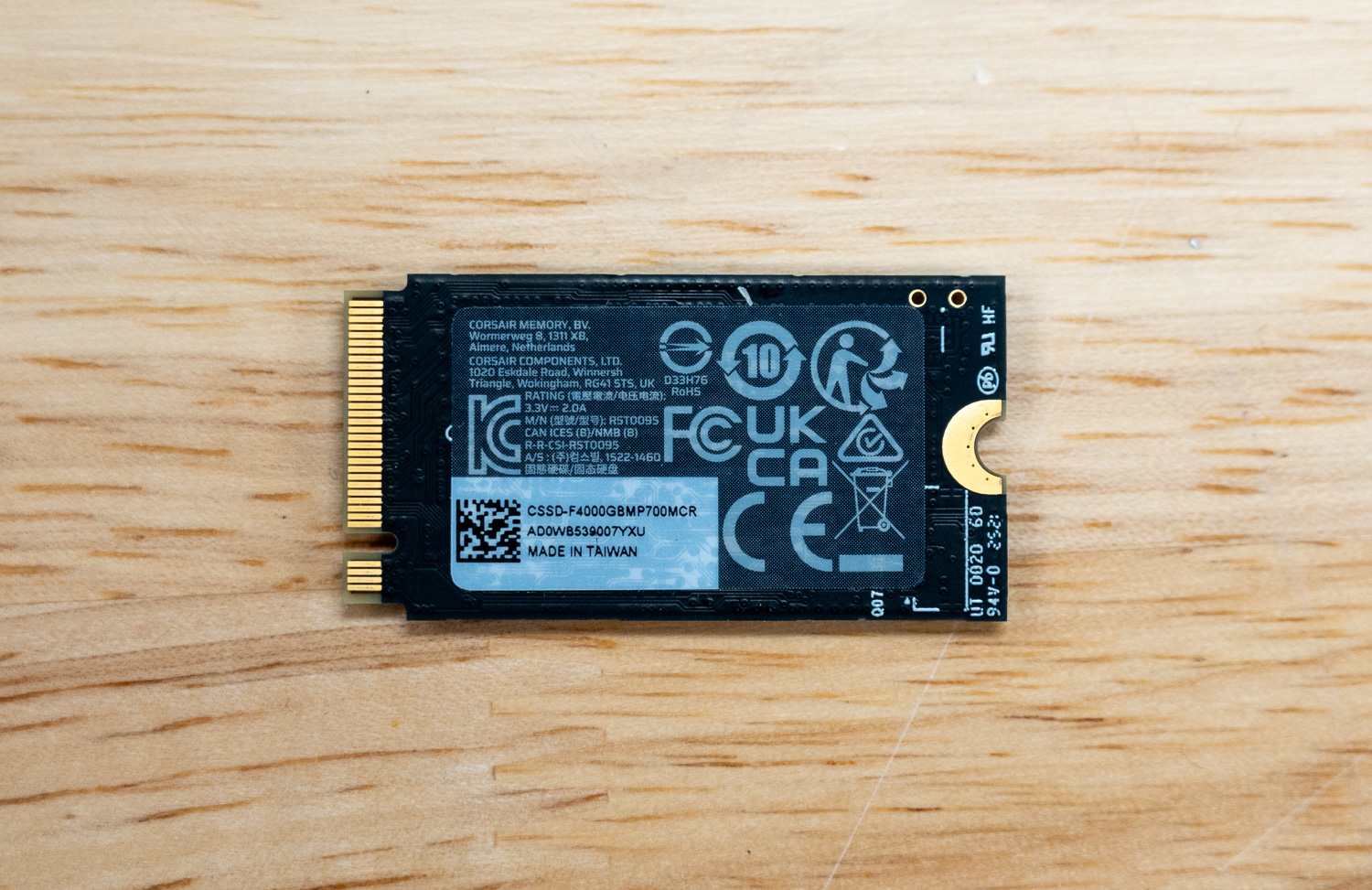
In terms of positioning, the MP700 MICRO 4TB targets a very specific segment of buyers. There are not many 2242 drives offering Gen5 speeds, and even fewer that go all the way to 4TB. This makes it less of a general upgrade option and more of a specific solution for compact systems where space is fixed, but performance is important.
What makes the MP700 MICRO particularly interesting is how it fits into the class of compact AI workstations and Spark systems, including those we recently reviewed. These platforms rely exclusively on the shorter M.2 2242 form factor, which imposes tighter limits on storage options than traditional 2280 deployments. Because of that constraint, finding a drive that combines high capacity with modern Gen5 bandwidth in this size becomes much more challenging.
Corsair MP700 MICRO Specifications
| Specification | Detail |
|---|---|
| Overview | |
| Storage Form Factor | M.2 2242 |
| SSD Package Contents | MP700 MICRO M.2 SSD |
| SSD Compatibility | M.2 2242 Interface Connector Windows 11, Windows 10, Mac OS X |
| Interface & Features | |
| Interface | PCIe Gen 5 x 4 |
| NAND Technology | 3D TLC |
| SSD Smart Support | Yes |
| DEVSLP | PS4: <3mW |
| Environmental | |
| SSD Operating Temperature | 0°C to +65°C |
| Storage Temperature | -40°C to +85°C |
| Storage Humidity | 93% RH (40° C) |
| Durability | |
| Vibration | 20Hz~80Hz/1.52mm, 80Hz~2000Hz/20G |
| SSD Shock | 1,500 G |
| Physical | |
| Weight | 0.024kg |
Corsair MP700 MICRO Performance
Peak Synthetic Performance
The FIO test is a flexible and powerful benchmarking tool for measuring the performance of storage devices, including SSDs and HDDs. It evaluates metrics such as bandwidth, IOPS, and latency under different workloads, like sequential and random read/write operations. This test helps to assess the peak performance of storage systems, making it useful for comparing different devices or configurations. We measured the peak burst performance for this test, limiting the workload to a 10GB footprint on both SSDs.
In the FIO synthetic benchmarks, the Corsair MP700 MICRO shows a performance profile that demonstrates the constraints of its compact 2242 design. Its sequential read speed reaches 9,169 MB/s with an average latency of 0.91ms, placing it below most full-size Gen5 drives that exceed 13,000 MB/s, though it remains competitive with high-end Gen4 drives such as the WD SN850X and Samsung 990 Pro. Sequential writes reach 7,948 MB/s with 1.06ms latency, again trailing larger Gen5 models but remaining competitive with high-end Gen4 drives.
For random performance, the Corsair MP700 MICRO posts 1.277M IOPS in 4K reads and 1.540M IOPS in 4K writes, which places it slightly ahead of drives like the Crucial P510 and Samsung 990 Pro in some cases but below the stronger Gen5 performers that push past the 2M IOPS mark. While the MP700 MICRO does not compete with the fastest desktop-class Gen5 SSDs, it still delivers decent performance for a drive built around the much smaller M.2 2242 form factor.
| FIO Test (higher MB/s/IOPS is better) | Sequential 128K Read (1T/64Q) | Sequential 128K Write (1T/64Q) | Random 4K Read (16T/32Q) | Random 4K Write (16T/32Q) |
|---|---|---|---|---|
| SanDisk SN8100 | 15,000 MB/s (0.56ms avg latency) | 14,100 MB/s (0.59ms avg latency) | 2.312M IOPS (0.22ms avg latency) | 2.144M IOPS (0.24ms avg latency) |
| Kingston FURY Renegade G5 | 14,600 MB/s (0.57ms avg latency) | 14,100 MB/s (0.59ms avg latency) | 2.028M IOPS (0.25ms avg latency) | 2.028M IOPS (0.25ms avg latency) |
| Samsung 9100 Pro | 14,600 MB/s (0.57ms avg latency) | 13,300 MB/s (0.63ms avg latency) | 2.734M IOPS (0.18ms avg latency) | 2.734M IOPS (0.19ms avg latency) |
| SK hynix Platinum P51 | 14,500 MB/s (0.58ms avg latency) | 13,500 MB/s (0.62ms avg latency) | 2.369M IOPS (0.22ms avg latency) | 2.669M IOPS (0.19ms avg latency) |
| Crucial T705 | 14,400 MB/s (0.58ms avg latency) | 12,300 MB/s (0.68ms avg latency) | 1.585M IOPS (0.32ms avg latency) | 2.703M IOPS (0.19ms avg latency) |
| TEAMGROUP GE Pro 2TB | 13,900 MB/s (0.60ms avg latency) | 12,800 MB/s (0.65ms avg latency) | 2.585M IOPS (0.23ms avg latency) | 1.818M IOPS (0.28ms avg latency) |
| Lexar Professional NM1090 PRO | 13,800MB/s (0.61ms avg latency) | 13,600 MB/s (0.62ms avg latency) | 2.251M IOPS (0.23ms avg latency) | 1.818M IOPS (0.28ms avg latency) |
| TEAMGROUP GC Pro 2TB | 13,600 MB/s (0.62ms avg latency) | 12,700 MB/s (0.66ms avg latency) | 2.110M IOPS (0.24ms avg latency) | 1.686M IOPS (0.28ms avg latency) |
| PNY CS2150 | 10,400MB/s (0.80ms avg latency) | 8,801MB/s (0.95ms avg latency) | 1.379M IOPS (0.371ms avg latency) | 1.623M IOPS (0.32ms avg latency) |
| Corsair MP700 MICRO 4TB | 9,169 MB/s (0.91ms avg latency) | 7,948 MB/s (1.06ms avg latency) | 1.277M IOPS (0.40ms avg latency) | 1.540M IOPS (0.33ms avg latency) |
| Crucial P510 | 8,835 MB/s (0.90 ms avg latency) | 9,961 MB/s (0.80 ms avg latency) | 1.163M IOPS (0.44ms avg latency) | 1.196M IOPS (0.51ms avg latency) |
| Micron 3610 2TB | 6,839 MB/s (1.23ms avg latency) | 9,673 MB/s (0.87ms avg latency) | 1.523M IOPS (0.34ms avg latency) | 1.871M IOPS (0.27ms avg latency) |
| Samsung 990 Pro | 7,483 MB/s (1.12ms avg latency) | 7,197 MB/s (1.16ms avg latency) | 1.400M IOPS (0.36ms avg latency) | 1.403M IOPS (0.36ms avg latency) |
| Crucial P310 2TB | 7,197 MB/s (1.16ms avg latency) | 6,376 MB/s (1.31ms avg latency) | 1.163M IOPS (0.44ms avg latency) | 1.196M IOPS (0.43ms avg latency) |
| WD SN850X 2TB | 6,632 MB/s (0.76ms avg latency) | 7,235 MB/s (0.92ms avg latency) | 1.2M IOPS (0.43ms avg latency) | 825K IOPS (0.62ms avg latency) |
| Micron 2600 2TB | 5,702 MB/s (1.47ms avg latency) | 6,612 MB/s (1.27ms avg latency) | 1.11M IOPS (0.46ms avg latency) | 1.36M IOPS (0.38ms avg latency) |
Average LLM Load Time
The Average LLM Load Time test evaluated the load times of three different LLMs: DeepSeek R1 7B, Meta Llama 3.2 11B, and DeepSeek R1 32B. Each model was tested 10 times, and the average load time was calculated. This test measures the drive’s ability to load large language models (LLMs) into memory quickly. LLM load times are critical for AI-related tasks, especially for real-time inference and processing large datasets. Faster loading enables the model to process data more quickly, thereby improving AI responsiveness and reducing wait times.
When it comes to loading Large Language Models into memory, the Corsair MP700 MICRO 4TB places near the bottom of the chart despite its Gen5 interface. Since LLM loading is almost entirely read-bound, the drive’s more modest sequential throughput compared to full-size Gen5 SSDs shows up quickly in this test. The MP700 MICRO posts 3.47 seconds for the DeepSeek R1 7B model, 5.21 seconds for the Meta Llama 3.2 11B Vision model, and 5.39 seconds for the larger DeepSeek R1 32B model.
Across the board, those results trail most of the Gen5 drives in the comparison, with many of them loading the 7B model closer to the mid-2-second range and completing the 32B model in roughly 4 to 4.8 seconds. While the MP700 MICRO still edges out the Micron 3610 in every model test, it cannot compete with the fastest desktop-class Gen5 drives for AI model loading.
| Average LLM Load Time (lower is better) | DeepSeek R1 7B | Meta Llama 3.2 11B Vision | DeepSeek R1 32B |
|---|---|---|---|
| SK hynix Platinum P51 | 2.5481s | 3.5809s | 4.1790s |
| SanDisk SN8100 | 2.5702s | 3.5856s | 4.2870s |
| Samsung 9100 Pro 4TB | 2.6173s | 3.6017s | 4.3735s |
| PNY CS2150 | 2.8107s | 3.6820s | 4.8962s |
| Crucial T705 2TB | 2.8758s | 3.6312s | 5.1080s |
| Samsung 990 Pro 2TB | 2.8758s | 3.6312s | 5.1080s |
| Crucial P510 1TB | 2.8817s | 3.6631s | 5.0594s |
| TEAMGROUP GE Pro 2TB | 2.9092s | 3.9136s | 4.8974s |
| TEAMGROUP GC Pro 2TB | 2.9379s | 3.9267s | 4.8188s |
| WD SN850X 2TB | 3.0082s | 3.6543s | 5.4844s |
| Kingston FURY Renegade G5 | 3.1843s | 4.8009s | 4.6523s |
| Crucial P310 2TB | 3.1889s | 3.7083s | 5.4844s |
| Lexar Professional NM1090 PRO | 3.2135s | 4.9504s | 7.2108s |
| Micron 2600 2TB | 3.3178s | 3.9174s | 5.9060s |
| Corsair MP700 MICRO 4TB | 3.4694s | 5.2106s | 5.3990s |
| Micron 3610 2TB | 3.5348s | 5.3853s | 5.5731s |
GPU Direct Storage
One of the tests we conducted on this testbench was the Magnum IO GPU Direct Storage (GDS) test. GDS is a feature developed by NVIDIA that allows GPUs to bypass the CPU when accessing data stored on NVMe drives or other high-speed storage devices. Instead of routing data through the CPU and system memory, GDS enables direct communication between the GPU and the storage device, significantly reducing latency and improving data throughput.
How GPU Direct Storage Works
Traditionally, when a GPU processes data stored on an NVMe drive, the data must first travel through the CPU and system memory before reaching the GPU. This process introduces bottlenecks because the CPU acts as a middleman, adding latency and consuming valuable system resources. GPU Direct Storage eliminates this inefficiency by enabling the GPU to access data directly from the storage device via the PCIe bus. This direct path reduces data-movement overhead, enabling faster, more efficient data transfers.
AI workloads, especially those involving deep learning, are highly data-intensive. Training large neural networks requires processing terabytes of data, and any delay in data transfer can lead to underutilized GPUs and longer training times. GPU Direct Storage addresses this challenge by ensuring that data is delivered to the GPU as quickly as possible, minimizing idle time and maximizing computational efficiency.
In addition, GDS is particularly beneficial for workloads that involve streaming large datasets, such as video processing, natural language processing, or real-time inference. By reducing the reliance on the CPU, GDS accelerates data movement and frees up CPU resources for other tasks, further enhancing overall system performance.
For comparison in these tests, we are using several Spark systems that we recently reviewed, each equipped with a different NVMe SSD configuration. These platforms provide a useful cross-section of both Gen4 and Gen5 storage implementations, allowing us to see how the Corsair MP700 MICRO behaves relative to drives in real-world GPU compute environments:
- Dell Pro Max with GB10 (Phison 4TB Gen4)
- Acer Veriton GN100 (Samsung 4TB Gen5)
- ASUS Ascent GX10 (Phison 1TB Gen4)
GDSIO Read Throughput 1M
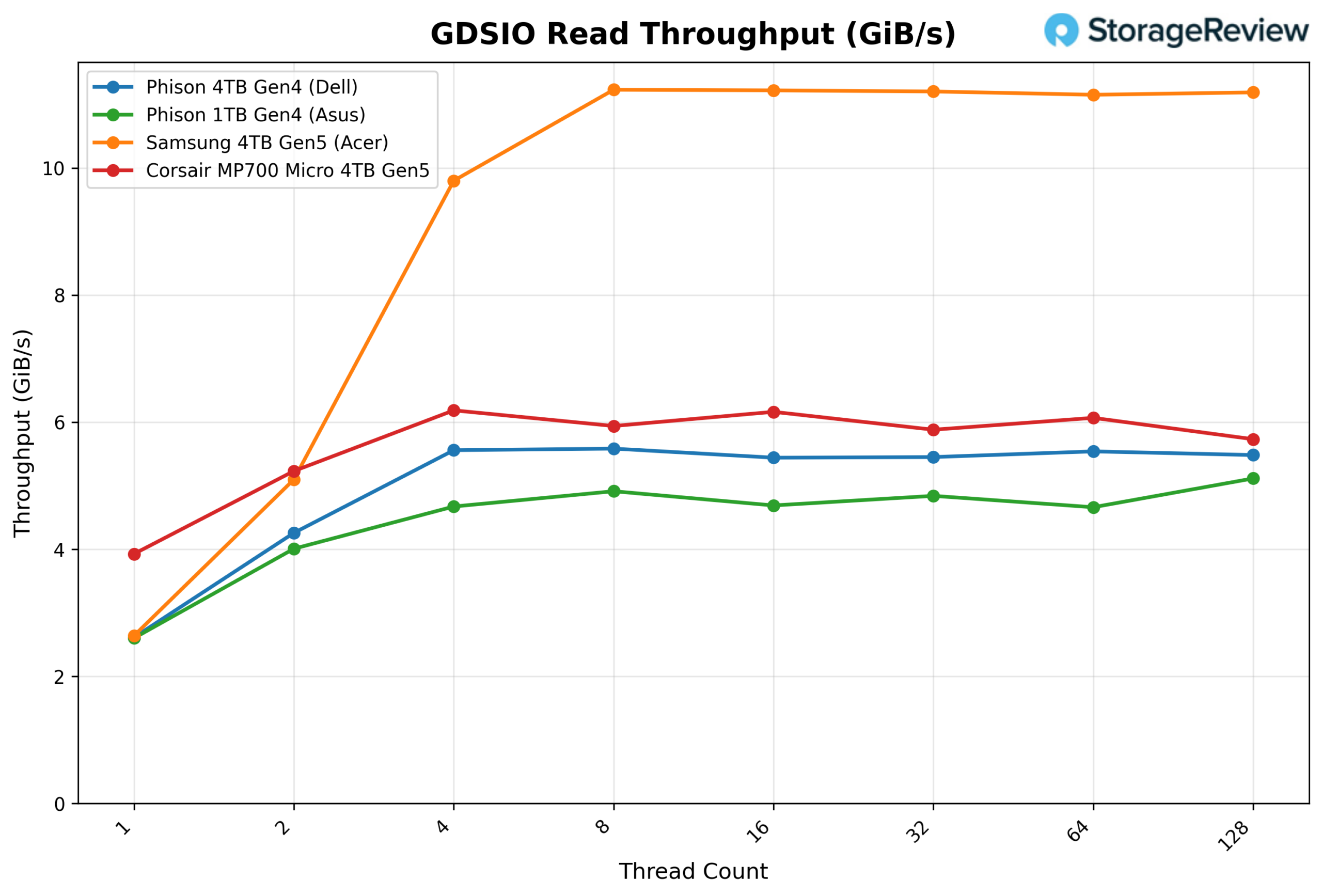
In the 1MB sequential read test using GPU Direct Storage, the Corsair MP700 MICRO shows solid scaling early on, then levels off as thread counts increase. With a single thread, the drive delivers 3.93 GiB/s, quickly climbing to 5.23 GiB/s with two threads and peaking at about 6.19 GiB/s with four threads. Past that point, throughput stabilizes in the 5.7-6.1 GiB/s range up to 128 threads.
GDSIO Read Latency 1M
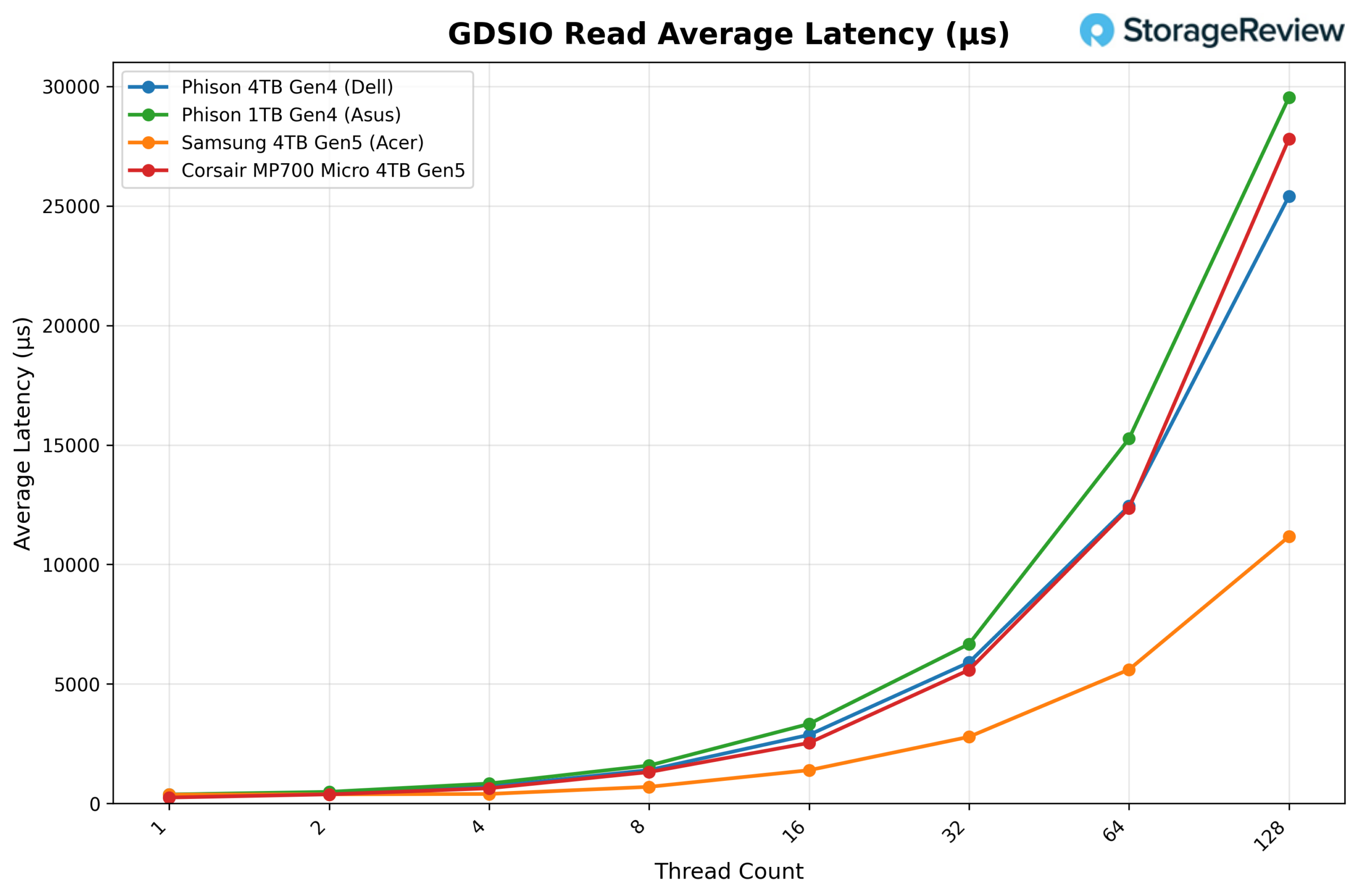
Latency trends follow the expected pattern as queue depth increases. On a single thread, average latency is about 248µs, which gradually increases to roughly 381µs with two threads and 636µs with four threads as additional parallel requests are introduced. As concurrency increases, latency rises more noticeably, reaching about 1,315µs at 8 threads, 2,535µs at 16 threads, and eventually climbing to roughly 27,807µs at 128 threads.
GDSIO Write Throughput 1M
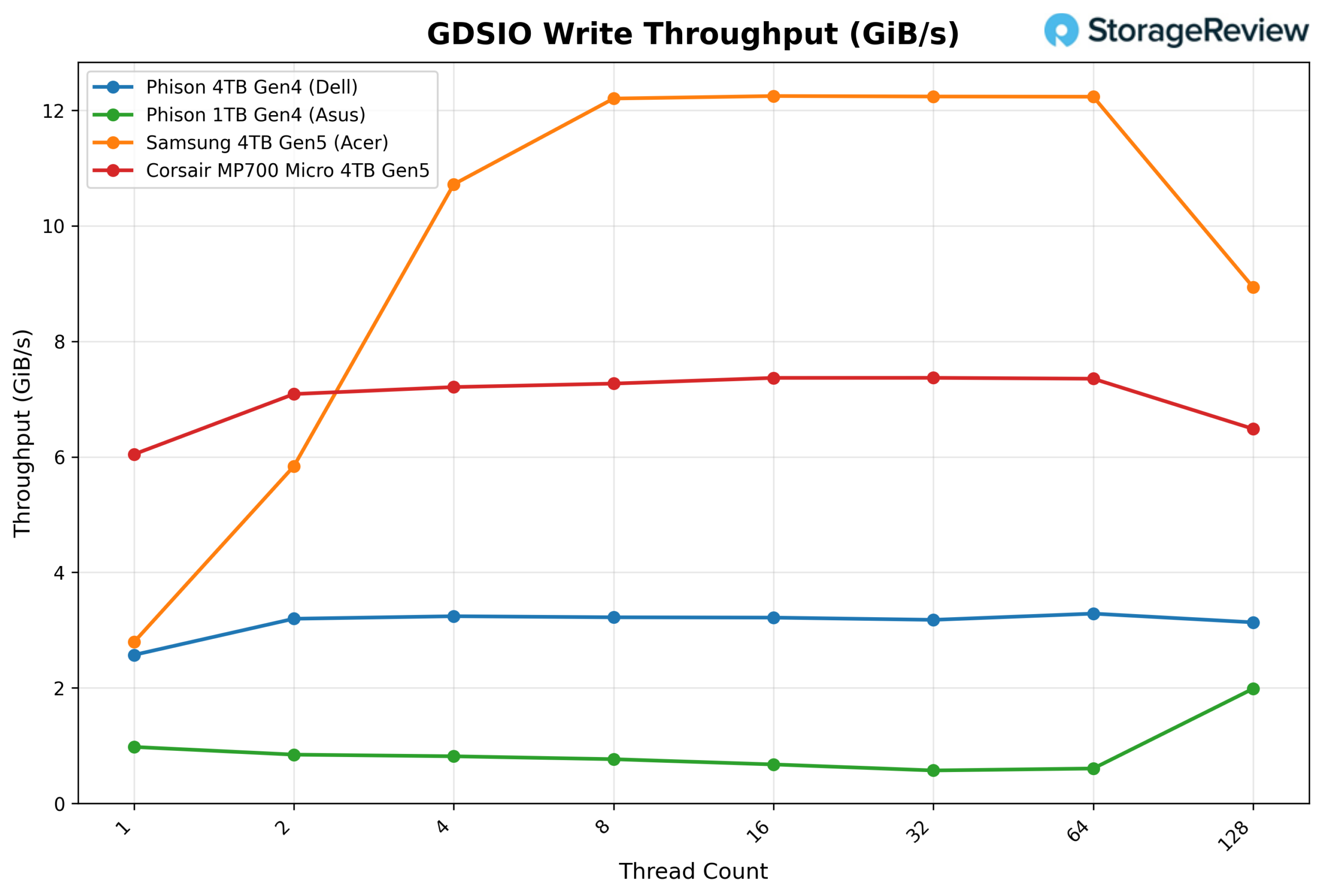
In the 1MB sequential write test using GPU Direct Storage, the Corsair MP700 MICRO ramps up quickly, then settles into a stable throughput range as concurrency increases. With a single thread, the drive posts 6.04GiB/s, climbing to 7.09GiB/s at two threads and 7.21GiB/s at four threads. Performance continues to inch upward as thread counts increase, peaking at about 7.37GiB/s around the 16 to 32 thread range before flattening out. Beyond that point, throughput holds steady through 64 threads before dropping slightly to 6.48 GiB/s at 128 threads. Compared with the other drives in the chart, the MP700 MICRO trails the full-size Samsung Gen5 drive that exceeds 12GiB/s, though it maintains a lead over the Gen4 Phison-based models throughout most of the test.
GDSIO Write Latency 1M
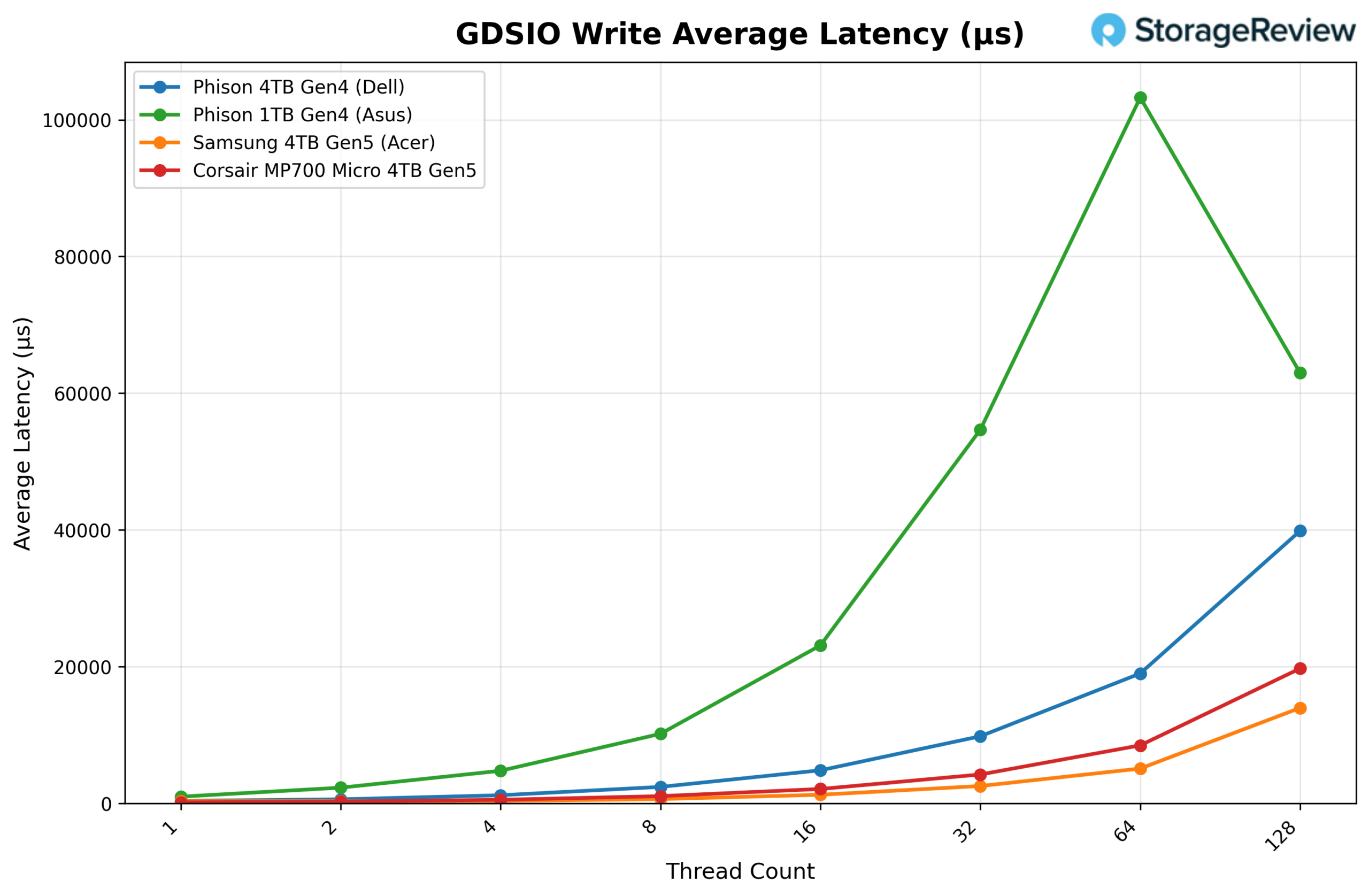
Latency increases as thread counts rise due to the greater queue depth on the drive during the GDS workload. At one thread, the MP700 MICRO records an average latency of about 162µs, increasing to roughly 276µs at two threads and 542µs at four threads. As concurrency grows, latency scales upward to about 1,075µs at eight threads, 2,120µs at sixteen threads, and 4,240µs at thirty-two threads. Higher thread counts increase latency, reaching roughly 8,500 µs at 64 threads and about 19,749 µs at 128 threads. Even with this increase, the MP700 MICRO still has lower latency than the slower Gen4 configuration shown in the chart. It tracks relatively close to the higher-performing Samsung drive across most of the test range.
GDSIO Read Throughput 16K
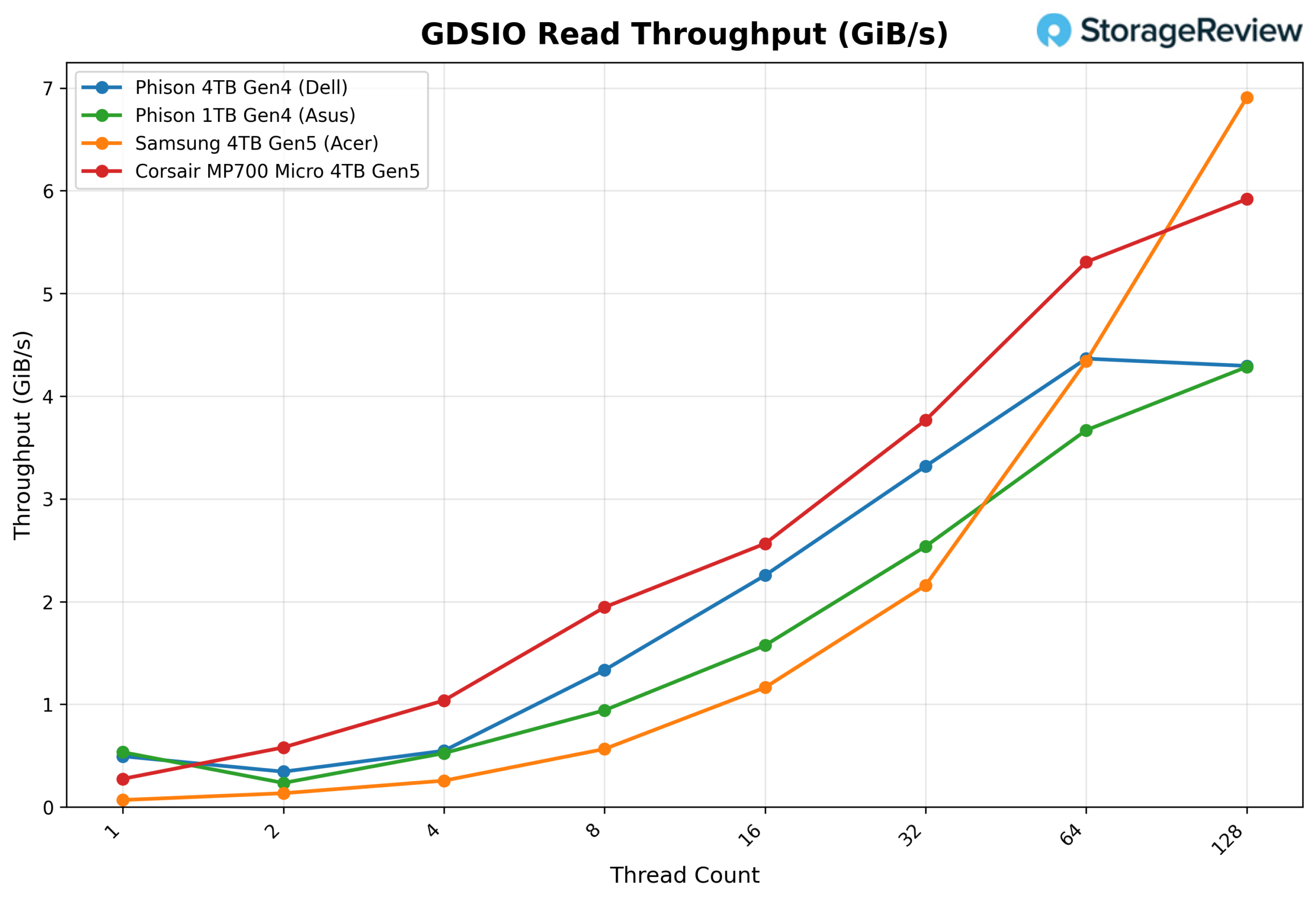
In the 16K read test using GPU Direct Storage, the Corsair MP700 MICRO shows steady scaling as thread counts increase, gradually building throughput. Starting at 0.27GiB/s with a single thread, performance climbs to 0.58GiB/s at two threads and 1.04GiB/s at four threads. The drive continues to scale efficiently with higher queue depths, reaching 1.94GiB/s at eight threads and 2.56GiB/s at sixteen threads. Throughput continues rising to 3.77GiB/s at thirty-two threads and 5.31GiB/s at sixty-four threads, eventually topping out around 5.92GiB/s at 128 threads. Compared to the other drives in the chart, the MP700 MICRO performs particularly well at moderate thread counts, leading the group through much of the midrange before the Samsung Gen5 drive overtakes it at the highest thread count.
GDSIO Read Latency 16K
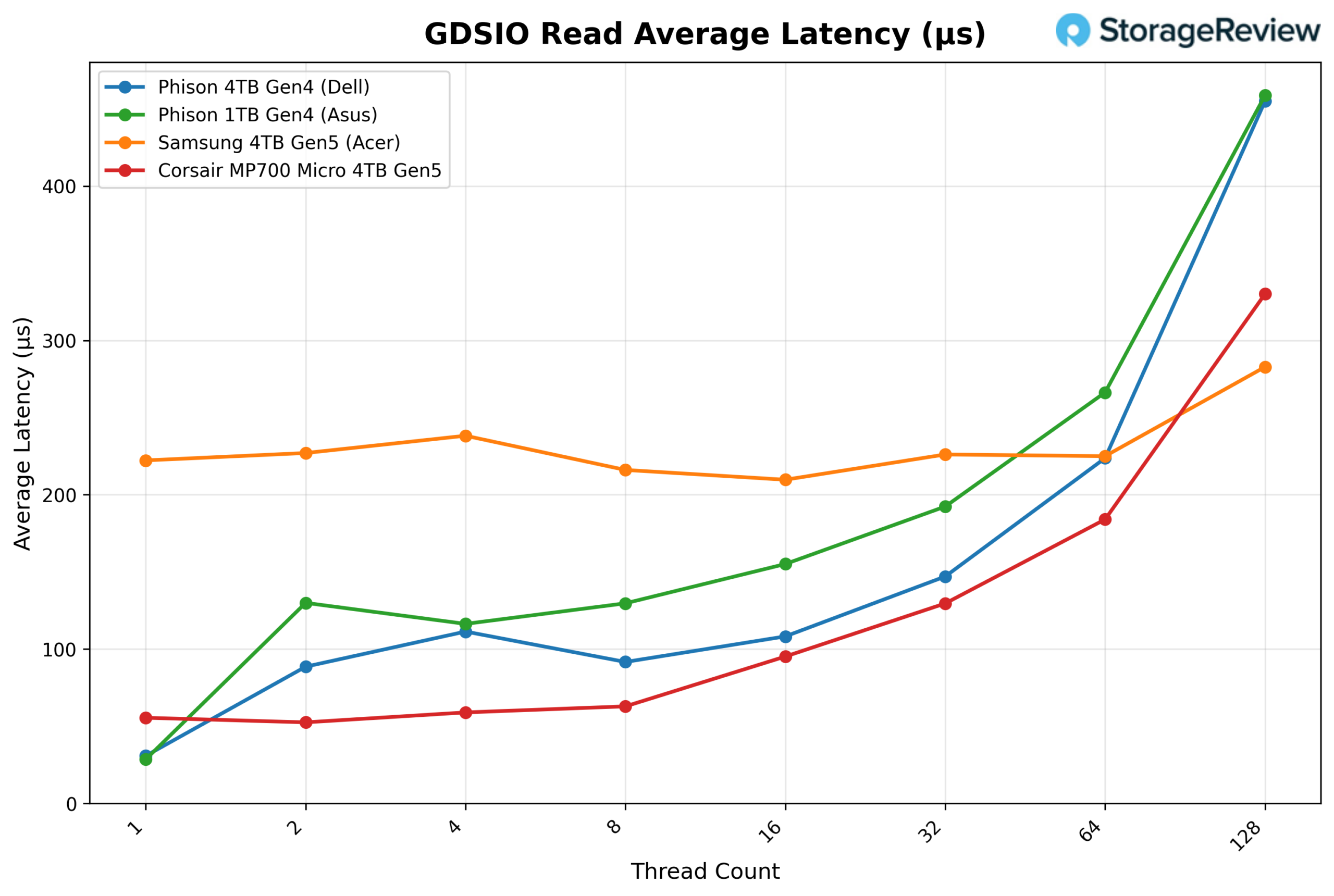
Latency for the 16K read workload starts relatively low and increases gradually as concurrency builds. At one thread, the Corsair MP700 MICRO records an average latency of about 55.5µs, improving slightly to around 52.6µs with two threads before rising to 59.0µs at four threads and 62.9µs at eight threads. As the queue depth increases further, latency grows more noticeably, reaching about 95.2µs at sixteen threads and 129.6µs at thirty-two threads. Higher thread counts continue this upward trend, with latency measuring roughly 184.0 µs at 64 threads and 330.0 µs at 128 threads. Even as the thread count increases, latency remains relatively controlled through the midrange of the test, only climbing more sharply once the workload reaches the highest thread counts.
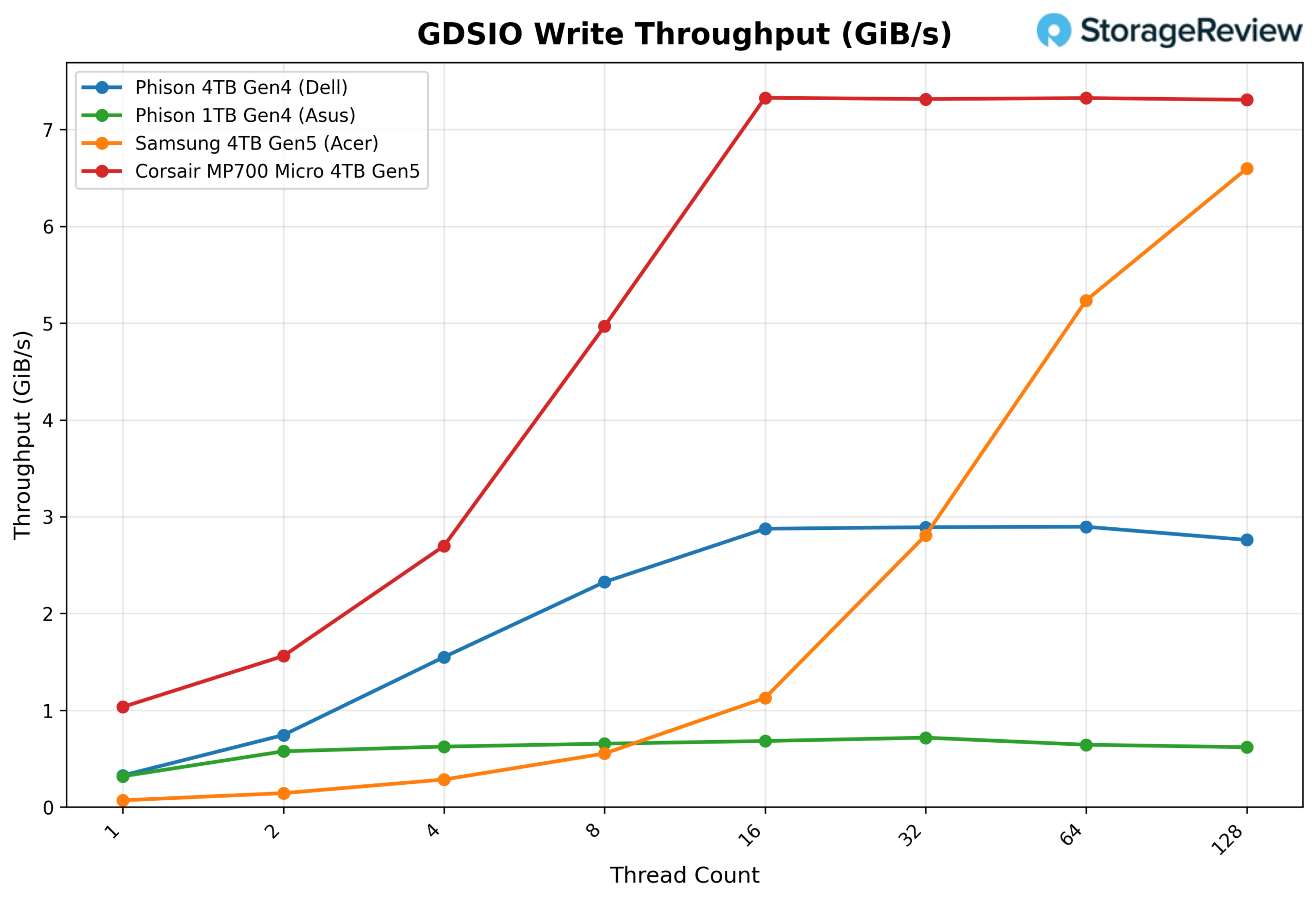
GDSIO Write Throughput 16K
In the 16K write workload using GPU Direct Storage, the MP700 MICRO scales aggressively as thread counts increase, quickly climbing into its steady-state performance range. Starting at 1.03GiB/s with a single thread, throughput rises to 1.56GiB/s at two threads and 2.70GiB/s at four threads. Performance continues ramping with higher thread counts, reaching 4.97GiB/s at eight threads and peaking around 7.33GiB/s at sixteen threads. Beyond that point, the drive effectively plateaus, maintaining roughly 7.31 to 7.32GiB/s through 32, 64, and 128 threads. Compared with the other drives in the chart, the MP700 MICRO reaches its maximum throughput much earlier and maintains that level for the rest of the test, maintaining its lead throughout.
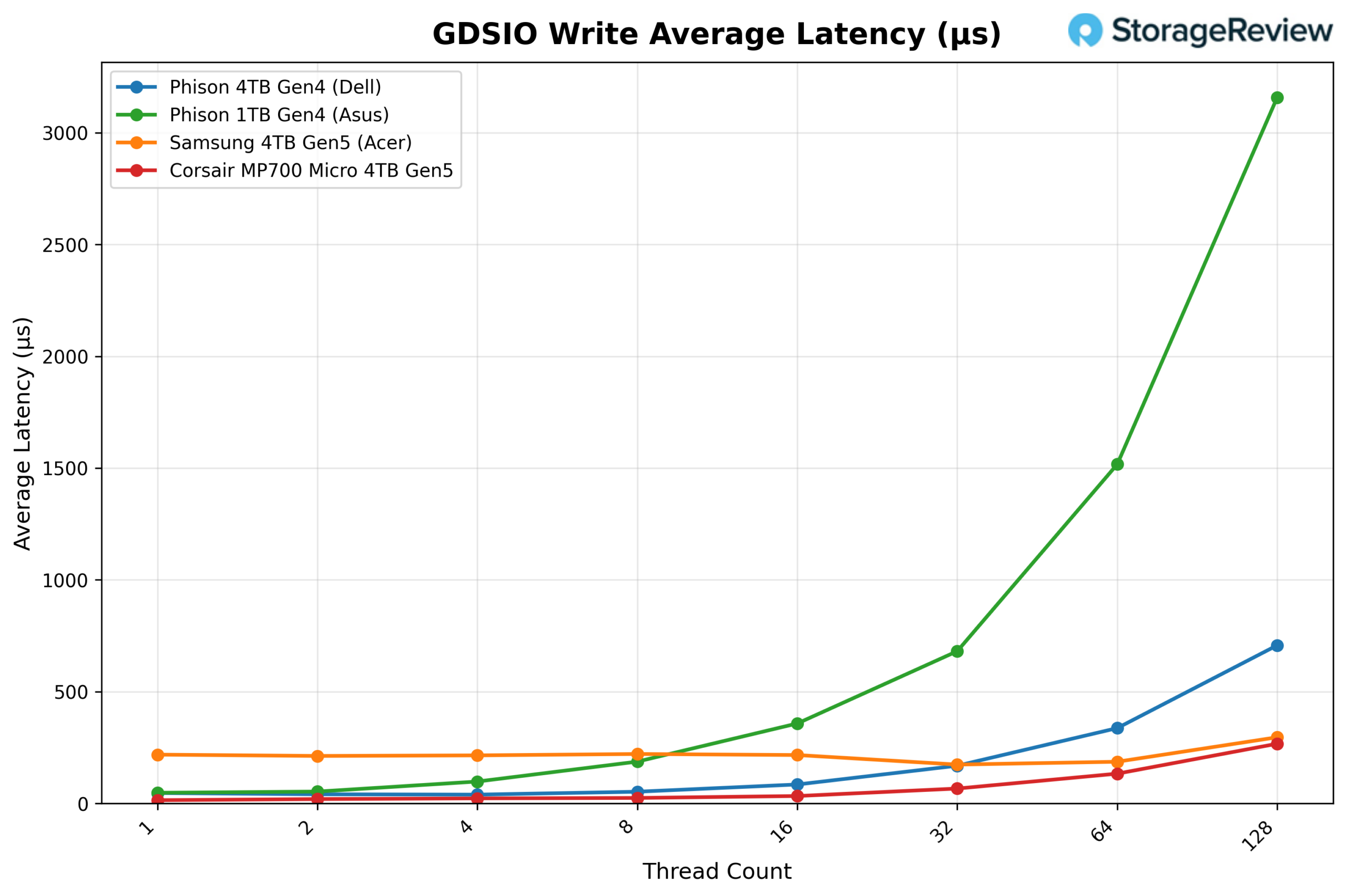
GDSIO Write Latency 16K
Latency begins very low in the 16K write test and stays that way as the leader. At a single thread, the Corsair MP700 MICRO records an average latency of about 14.7µs, rising to 19.6µs at two threads and 22.8µs at four threads. Even as throughput scales rapidly, latency remains relatively controlled by moderate queue depths, measuring 24.8 µs at eight threads and 33.3 µs at sixteen threads. As the number of threads increases, latency rises to 66.8µs at 32 threads, 133.3µs at 64 threads, and eventually about 267.2µs at 128 threads.
 Conclusion
 Conclusion
Overall, the Corsair MP700 MICRO 4TB delivers strong performance in a compact M.2 2242 form factor, offering a high-capacity option for systems that need serious storage throughput in a very limited physical footprint. Systems such as the Spark-class AI workstations rely entirely on that shorter module length, which narrows the range of drives that can be installed. In that environment, a drive that combines PCIe Gen5 bandwidth with 4TB of TLC NAND provides a nice upgrade path for local storage capacity and throughput. Other compact platforms, including high-end laptops that rely on a single 2242 slot, benefit from sufficient internal capacity for large datasets, AI models, and project files while still maintaining the high transfer speeds expected of modern NVMe storage.
Compared with the OEM Phison Gen4 drives used in the Dell Pro Max with GB10 and the ASUS Ascent GX10, the Corsair drive delivers stronger overall performance across several workloads, including GPU Direct Storage tests, where throughput scales quickly and remains steady at higher thread counts. Read-heavy scenarios still favor the Samsung Gen5 drive (which was used inside the Acer Veriton GN100), particularly in tests such as LLM model loading and peak sequential throughput. Ultimately, the Corsair drive primarily serves as an upgrade over Gen4 configurations, but it falls behind the faster Samsung Gen5 implementation.
The value of the MP700 MICRO becomes most apparent when the form-factor constraint is taken into account. Delivering PCIe Gen5 speeds alongside a full 4TB capacity within a 2242 module is still relatively uncommon. That combination gives compact compute platforms significantly more local storage headroom than many alternatives in this size class. Systems built around the Spark ecosystem, compact AI workstations, and thin mobile platforms all benefit from that added capacity and bandwidth when working with large datasets or model files. Priced at $1,034.99 on Corsair’s website and backed by a 5-year warranty, the MP700 MICRO is a premium option for users who require both high capacity and modern interface performance in a 2242 storage slot.


 Amazon