

Lenovo has introduced two ThinkSystem V5 servers built on AMD’s 6th Gen EPYC 9006 SP7 processors: the SC755 V5, a Neptune liquid-cooled dual-socket node for HPC clusters, and the SR755 V5, an air-cooled single-socket 2U rack server. Announced ahead of SC26, the launch also covers the ThinkSystem DE6500 and DE6800 NVMe block arrays, validation of the Cornelis CN5000 fabric, and new AI factory and colocation services. A full rack of SC755 V5 trays holds 96 processors and more than 24,000 cores.
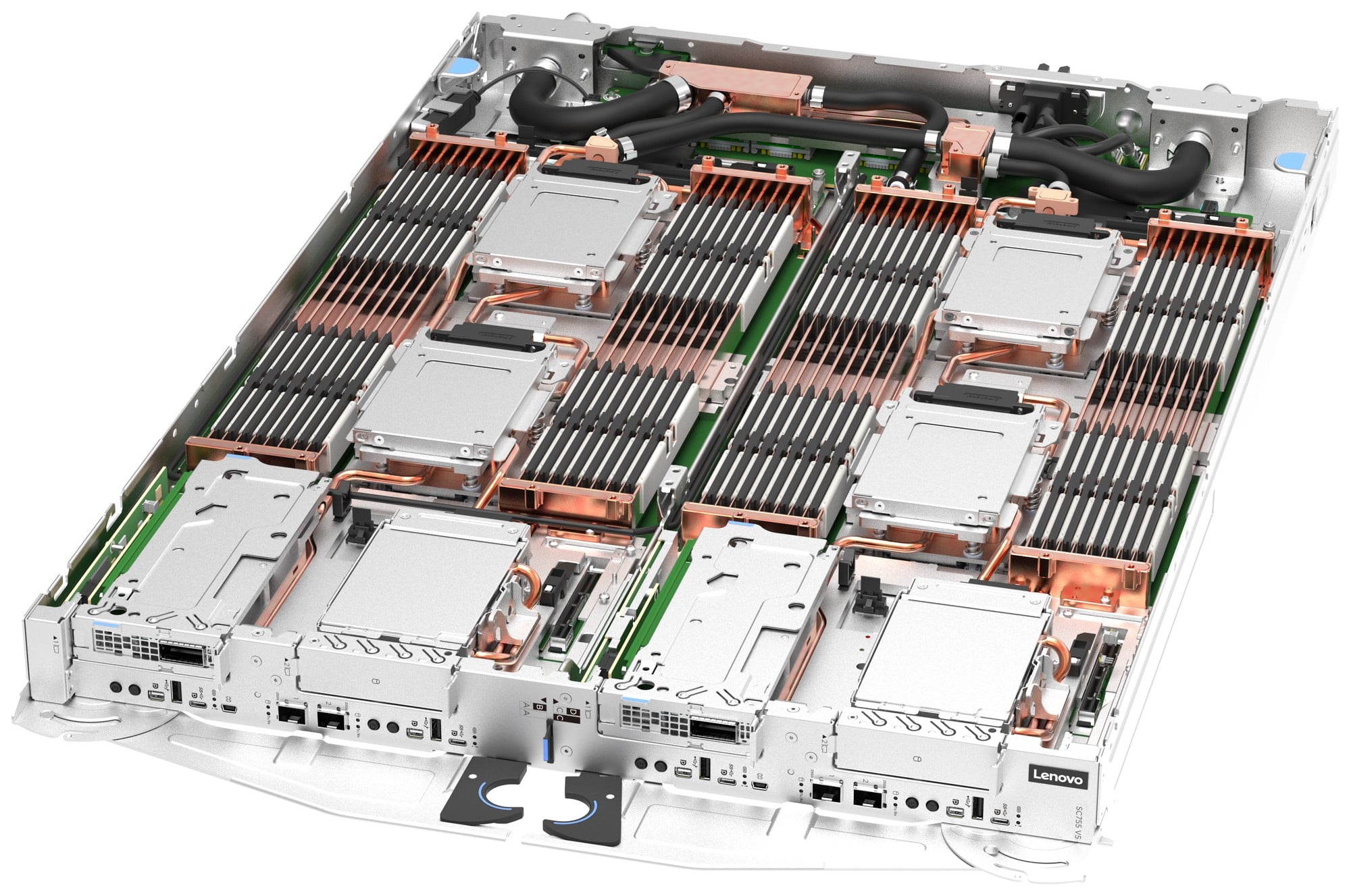
ThinkSystem SC755 V5: Liquid-Cooled EPYC 9006 at Up to 600W
The SC755 V5 puts two dual-socket nodes on a vertical compute tray that slides into Lenovo’s 13U N1380 Neptune enclosure and blind-mates to power, water, and network with no cabling. Each enclosure takes eight trays, and three enclosures fit a standard 19-inch rack, for 48 nodes, 96 processors, and 192TB of DDR5 across two floor tiles. Direct warm-water cooling lets each node run a pair of EPYC 9006 SP7 processors with up to 256 cores and 600W apiece.
Each node has 16 memory channels per CPU and takes up to 4TB across 32 DIMM slots, with RDIMMs at 8,000MT/s and MRDIMMs at 12,800MT/s supported. It adds two PCIe Gen6 x16 low-profile slots, up to six E3.S SSDs, and two 25GbE ports, and Lenovo lists InfiniBand, Omni-Path, and Ethernet as fabric options. The enclosure integrates up to four 15kW Titanium power conversion stations with N+1 redundancy and accepts inlet water from the dew point up to 45°C, which Lenovo says removes the need for chillers.

Lenovo says the design removes up to 100% of system heat through water and delivers up to 40% higher sustained performance than similar air-cooled systems, figures from internal testing that vary with configuration, workload, and facility water temperature. Dynamic Partitioning lets operators split the two dual-socket nodes on a tray into four single-socket systems and back, for smaller HPC or agentic AI jobs that do not need the full core count. Dell took the other route with the same 600W processors, cooling two of them on air in the 3U PowerEdge R9825.

“AI and high-performance computing are converging around a simple customer need: the ability to turn increasingly complex workloads into real outcomes,” said Scott Patti, Vice President, Infrastructure Solutions Group, Lenovo. “That means getting more useful performance from every watt, overcoming growing power and cooling constraints, and moving faster from infrastructure deployment to operational AI.”
ThinkSystem SR755 V5: One Socket and 256 Cores on Air
The SR755 V5 is a 2U rack server with a single EPYC 9006 processor of up to 256 cores and 16 DDR5 slots at one DIMM per channel, for up to 4TB of RDIMM or MRDIMM memory. Storage runs to 16 front E3.S drives, and two hot-swap M.2 boot drives, and expansion to six PCIe Gen6 slots, two OCP 3.0 slots, and two double-width or two single-width GPUs.
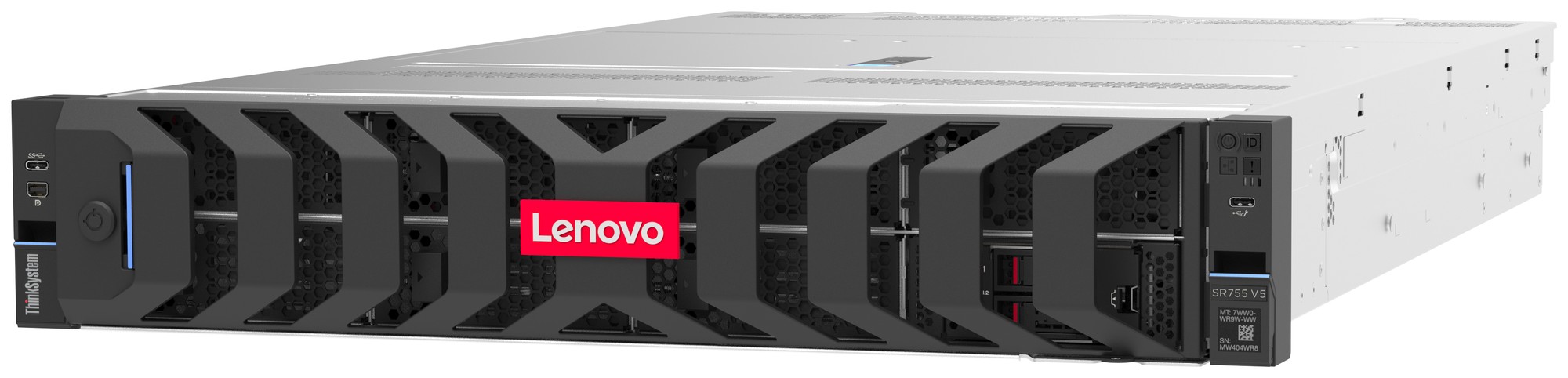

Lenovo aims the SR755 V5 at large-scale virtualization, electronic design automation, financial modeling, engineering, and agentic AI infrastructure in data centers that are staying on air. The company argues that one 256-core socket gives lower power consumption and better economics than dual-socket configurations, a claim it bases on internal analysis. Security features include FIPS 140-3 support, NIST SP800-193 platform firmware resiliency, and post-quantum cryptography readiness through the XClarity Controller.

| Spécifications | ThinkSystem SC755 V5 | Think System SR755 V5 |
|---|---|---|
| Facteur de forme | Two dual-socket nodes per vertical tray Eight trays per 13U N1380 enclosure Three enclosures per rack |
Serveur rack 2U |
| Processeurs | Two EPYC 9006 SP7 per node Up to 256 cores and 600W each |
One EPYC 9006 Jusqu'à 256 cœurs |
| Mémoire | 32 DIMM slots per node, 16 channels per CPU Up to 4TB per node RDIMM at 8,000MT/s or MRDIMM at 12,800MT/s |
16 DIMM slots, 16 channels at 1DPC Jusqu'à 4TB RDIMM at 8,000MT/s or MRDIMM at 12,800MT/s |
| Stockage | Up to six E3.S SSDs per node | Up to 16 front E3.S drives Two hot-swap M.2 boot drives |
| Expansion | Two PCIe Gen6 x16 low-profile slots per node | Up to six PCIe Gen6 slots Up to two OCP 3.0 slots at PCIe Gen5 x8 |
| Prise en charge du GPU | Non listé | Up to two double-width or two single-width |
| Réseautage à bord | Two 25GbE SFP28 ports per node | OCP 3.0 and PCIe adapters |
| Refroidissement | Direct water cooling, inlet from dew point to 45°C | Air |
| Tuning Moteur | Up to four 15kW Titanium power conversion stations per enclosure, N+1 | 1+1 CRPS, Titanium or Platinum |
| Direction | XClarity Controller 4 on OpenBMC | Contrôleur XClarity |
ThinkSystem DE6500 and DE6800 NVMe Arrays
The DE6500 and DE6800 are 2U, dual-controller block arrays with 24 2.5-inch NVMe bays, and SAS expansion shelves take either to a maximum of 7.2PB raw. Lenovo rates the DE6500 at 1.7 million IOPS and up to 41GB/s of sustained throughput, and the DE6800 at 5 million IOPS and up to 110GB/s. The DE6800 offers up to 12 ports of 200Gb NVMe over InfiniBand, RoCE, or TCP, where the DE6500 tops out at eight 100Gb NVMe over RoCE ports.
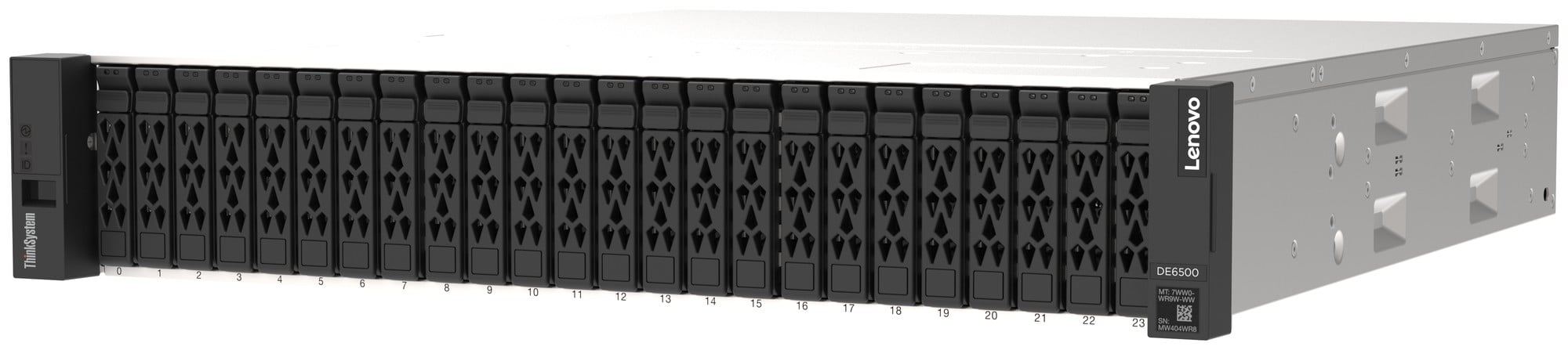


| Spécifications | ThinkSystem DE6500 | ThinkSystem DE6800 |
|---|---|---|
| Facteur de forme | 2U, 24 NVMe bays, dual controllers | 2U, 24 NVMe bays, dual controllers |
| Capacité brute maximale | 7.2PB | 7.2PB |
| Nombre maximal de lecteurs | 24 SSD NVMe 96 SAS SSDs Disques durs 240 |
24 SSD NVMe 96 SAS SSDs Disques durs 240 |
| IOPS | 1,700,000 | 5,000,000 |
| Débit soutenu | Jusqu'à 41 Go/s | Jusqu'à 110 Go/s |
| La mémoire système | 64GB | 128GB |
| Host ports per system | 8x 100Gb NVMe over RoCE 16x 32Gb or 64Gb Fibre Channel 16x 10Gb or 25Gb iSCSI |
12x 200Gb NVMe over InfiniBand, RoCE, or TCP 12x 100GbE RoCE 24x 32Gb or 64Gb Fibre Channel |
| Hosts per partition | 512 | 1,024 |
Cornelis CN5000 Validation and AI Factory Services
Lenovo has also validated the Cornelis CN5000 fabric as an interconnect option for AI and HPC clusters. On the services side, it is adding GPU deployment, configuration, and optimization work to its Hybrid AI Factory Services, with multi-node support for Red Hat AI Enterprise and NVIDIA AI Enterprise with Run:ai. New gigafactory services bring NVIDIA Infrastructure Services expertise for deployment and cluster validation on large builds.
For customers short on data center capacity, Lenovo can now arrange colocation in Digital Realty facilities and act as the single point of contact. That includes use of the Digital Realty Innovation Lab to validate infrastructure and workloads, with financing available through Lenovo TruScale Infrastructure as a Service. Lenovo is showing the new systems at SC26 in booth 3023.



 Amazon