

NVIDIA announced Minerva at GTC Berlin, an AIOps platform that pulls telemetry from GPUs, networking, storage, schedulers, and the AI workloads running on them, then applies machine learning to find a degrading component before it slows a training job. Dell Technologies, Lenovo, and Supermicro will offer it in their AI factory operations portfolios, IREN is already running it, and IBM, Jio, Lambda, Quake AI, Tesla, Aolani, and Bitdeer AI plan to deploy it. NVIDIA has not published pricing or a general availability date.
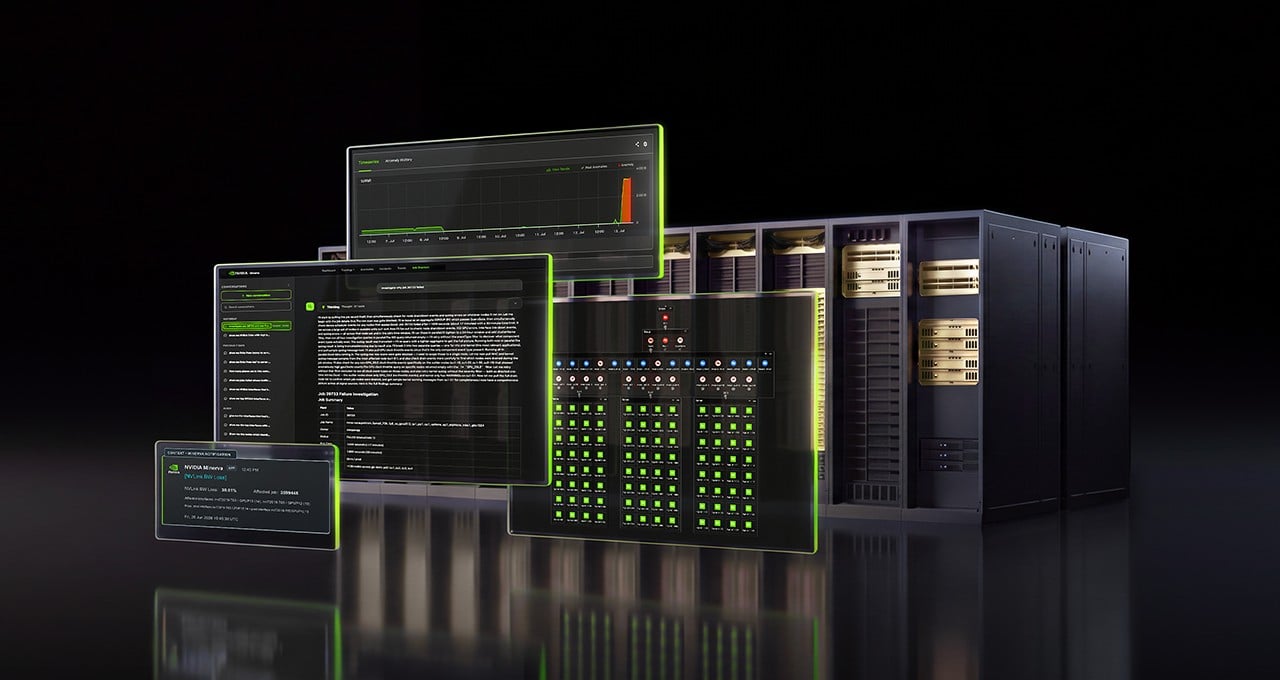
The problem Minerva targets is one every large cluster operator knows: thousands of GPUs on a high-speed fabric behave as one machine, so a single part running out of spec drags the whole job with it. NVIDIA’s examples are a GPU running hotter than its neighbors and an NVMe drive losing performance under load, the kind of data signal that today sits in a networking tool, a compute tool, and an ML team’s dashboard, each with a separate view of the same cluster.
What Minerva Watches
Minerva builds a dynamic knowledge graph that maps GPUs, SuperNICs, switches, cables, and the jobs scheduled onto them, then analyzes what NVIDIA describes as billions of data points per hour with supervised and unsupervised machine learning. The models learn normal behavior for the factory, flag anomalies they have not seen before, predict failures that are developing, and correlate related events using the topology, so a slow training job can be traced to the component responsible across factories NVIDIA sizes at hundreds of thousands of GPUs.
The output is organized as incidents, with related events grouped into a single item and a likely root cause attached, which NVIDIA says replaces a flood of alerts with one actionable item. A built-in assistant answers natural-language questions against the live telemetry and recommends a fix, and the platform connects to external agentic tools. Operators choose whether a person applies the remediation or whether Minerva hands it to automation through infrastructure APIs and external systems.
NVIDIA frames the payoff as AI factory yield, which it measures in GPU hours, goodput, cluster uptime, and token production. The claimed results are longer intervals between interruptions, faster repairs, and fewer alerts to triage, with the operations team moving from reactive to proactive maintenance. Those are vendor claims without figures attached; NVIDIA has not published mean-time-to-repair or uptime numbers for Minerva.
Where It Sits in the Stack
NVIDIA already sells operations software for its reference designs. Centre de contrôle, introduced in March 2025, handles cluster provisioning through Base Command Manager, workload management through Run:ai, telemetry, and autonomous job recovery for DGX SuperPOD systems. The same week as Minerva, NVIDIA put three open source DSX OS components into developer preview for AI factory lifecycle management: Config Manager for network configuration, Rack Management Service for rack-level power, inventory, firmware, and switch management, and Cluster Readiness Engine for validating GPU clusters with distributed workloads.
The scale of the problem Minerva is aimed at was on display in Meta’s Prometheus write-up last week. Meta runs each NVL72 domain as a 64-GPU slice with the other eight GPUs held as in-rack spares, keeps about 2 percent of racks in reserve, and quarantines every repaired system until it passes validation. A year of root-cause work with NVIDIA engineers on site cut interruptions by 99 percent and pushed the mean time between interruptions past 54,000 GPU hours, with a target of 100,000.
That is a hyperscaler running a purpose-built telemetry pipeline and a joint triage team with NVIDIA. Minerva looks like a packaged version of that discipline, something closer to out of the box for an enterprise or neocloud that wants hyperscaler-grade visibility into GPU, fabric, and storage health, and the spare-and-restart workflow that goes with it, delivered through the same OEMs that sell it the racks.
NVIDIA has not said how Minerva relates to Mission Control or DSX OS, whether it ships as software, an appliance, or a hosted service, or what the OEM packaging from Dell, Lenovo, and Supermicro will look like. The product’s documentation page directs customers to their NVIDIA account team for the user guide. The customer reference is IREN, which NVIDIA says is using Minerva to optimize its AI factories today.
“NVIDIA Minerva gives our operations team one view across the network, the GPUs and the jobs running on them,” said Denis Skrinnikoff, chief technology officer of IREN, who credited it with shifting the team’s time toward proactive maintenance.
For the storage side of the house, the interesting claim is that drive behavior under load is an input alongside GPU and fabric telemetry, since an NVMe device that is slowing down rarely shows up in GPU utilization until a checkpoint or data-loading stage stalls. How deep that storage telemetry goes, and which OEM and array platforms feed it, is the detail that will be interesting to dive into as we see this solution come to market.



 Amazon