

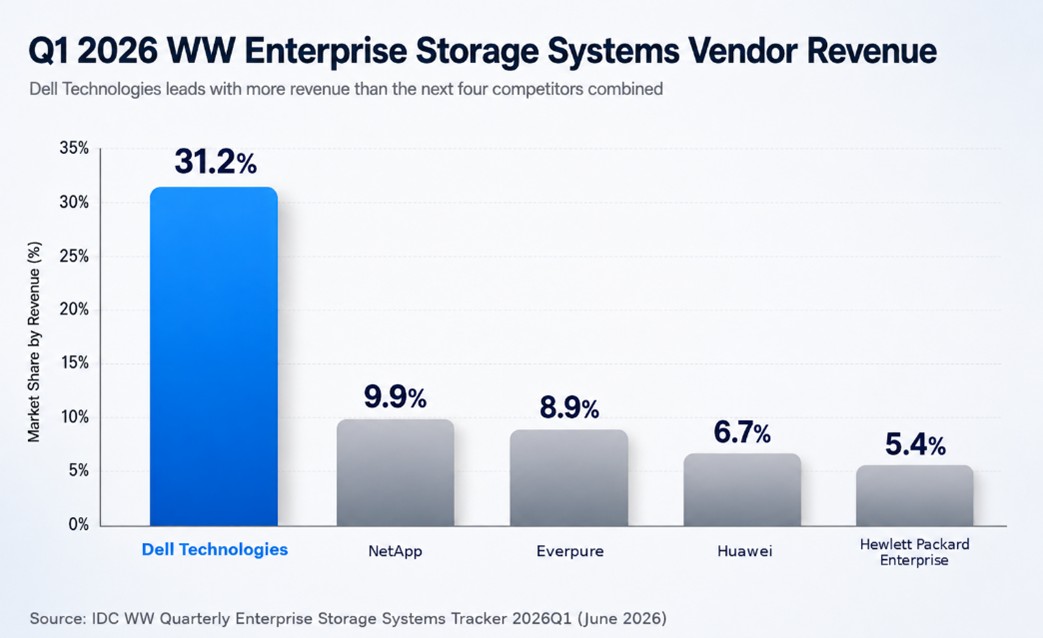
Dell Technologies closed the first quarter of 2026 as the top external enterprise storage vendor worldwide, according to IDC’s Worldwide Quarterly Enterprise Storage Systems Tracker released in June, posting 31.2% market share on 40.8% year-over-year growth, nearly double the 22.7% pace of the overall segment. By IDC’s count, the rest of the top five vendors combined did not outsell Dell for the quarter. While the share figure is the headline, Dell’s broader message is that the result reflects continued execution around three customer priorities: private cloud flexibility, AI infrastructure built on enterprise-owned data, and cyber resilience embedded into the platform.
That positioning is especially relevant for Dell because the enterprise storage conversation has shifted beyond raw capacity and performance. Customers increasingly want infrastructure that supports mixed hypervisor environments, AI data pipelines, and faster recovery from cyber events without requiring wholesale architectural changes. Dell’s current portfolio, with PowerStore at the center of the midrange discussion, is being framed around that convergence.
On the private cloud side, Dell is targeting enterprises that want both operational simplicity and infrastructure choice. Through Dell Private Cloud and the Dell Automation Platform, customers can deploy cloud software stacks from Broadcom, Microsoft, Nutanix, and Red Hat on disaggregated Dell infrastructure rather than being tied to a single hyperconverged model. At Dell Technologies World, the company added support for VMware Cloud Foundation 9.1, Microsoft Azure Local, and PowerStore integration with Nutanix AHV.
The practical value of that approach is that compute and storage can scale independently while lifecycle management remains automated. Dell is also making a cost argument, saying this model can reduce costs by up to 65% compared with traditional HCI approaches. For infrastructure teams trying to balance modernization with budget control, that flexibility is a meaningful part of the story.
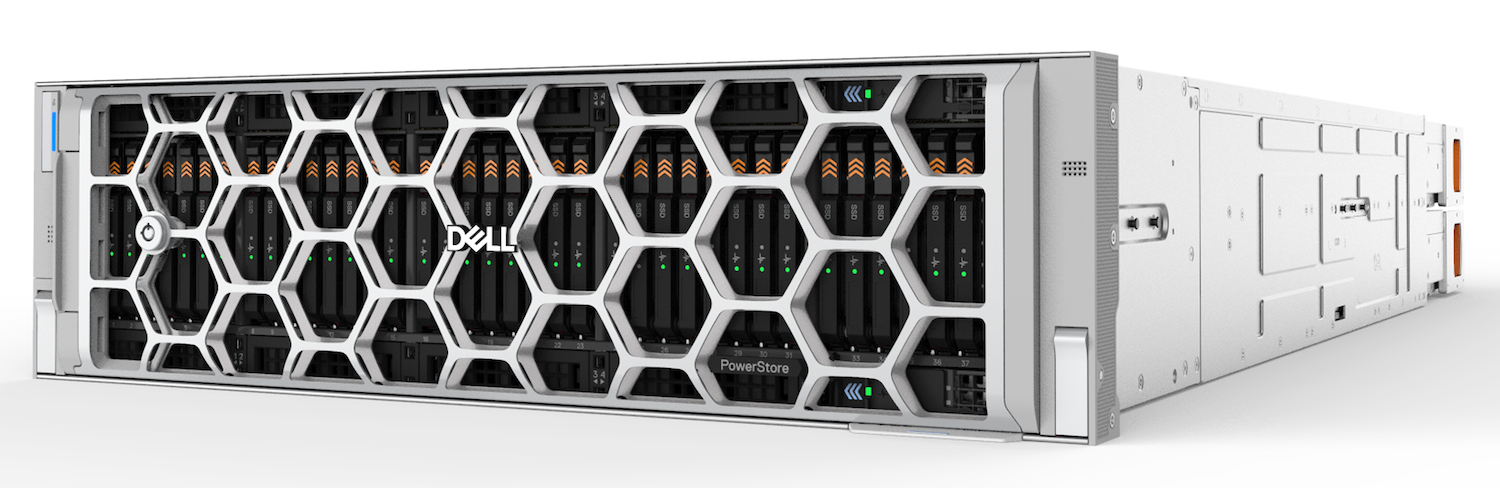
PowerStore remains a key piece of that strategy. Dell is positioning PowerStore Elite as the storage foundation for organizations that need to consolidate block, file, virtual machine, and container workloads on a single platform while maintaining hypervisor flexibility. The company says the platform delivers up to three times the performance of prior models, includes a 6:1 data reduction guarantee, and supports non-disruptive upgrades. Existing customers can also modernize through mixed-generation clustering, which allows newer and older systems to operate together and reduces the operational friction that often comes with hardware refresh cycles.
That upgrade path is one reason PowerStore continues to resonate in the market. It gives customers a way to evolve their infrastructure without forcing a hard cutover while keeping pace with changing workload demands across virtualized environments, databases, and increasingly containerized applications. For a platform with broad enterprise deployment, continuity matters as much as peak performance.
Dell is making a similarly integrated case around AI. The company’s view is that successful enterprise AI initiatives depend less on public data sources and more on the ability to discover, govern, and operationalize internal data. Its AI Data Platform, part of the broader Dell AI Factory framework, is designed to index billions of unstructured files and orchestrate them through managed data pipelines to move customers from AI pilots into production more quickly.
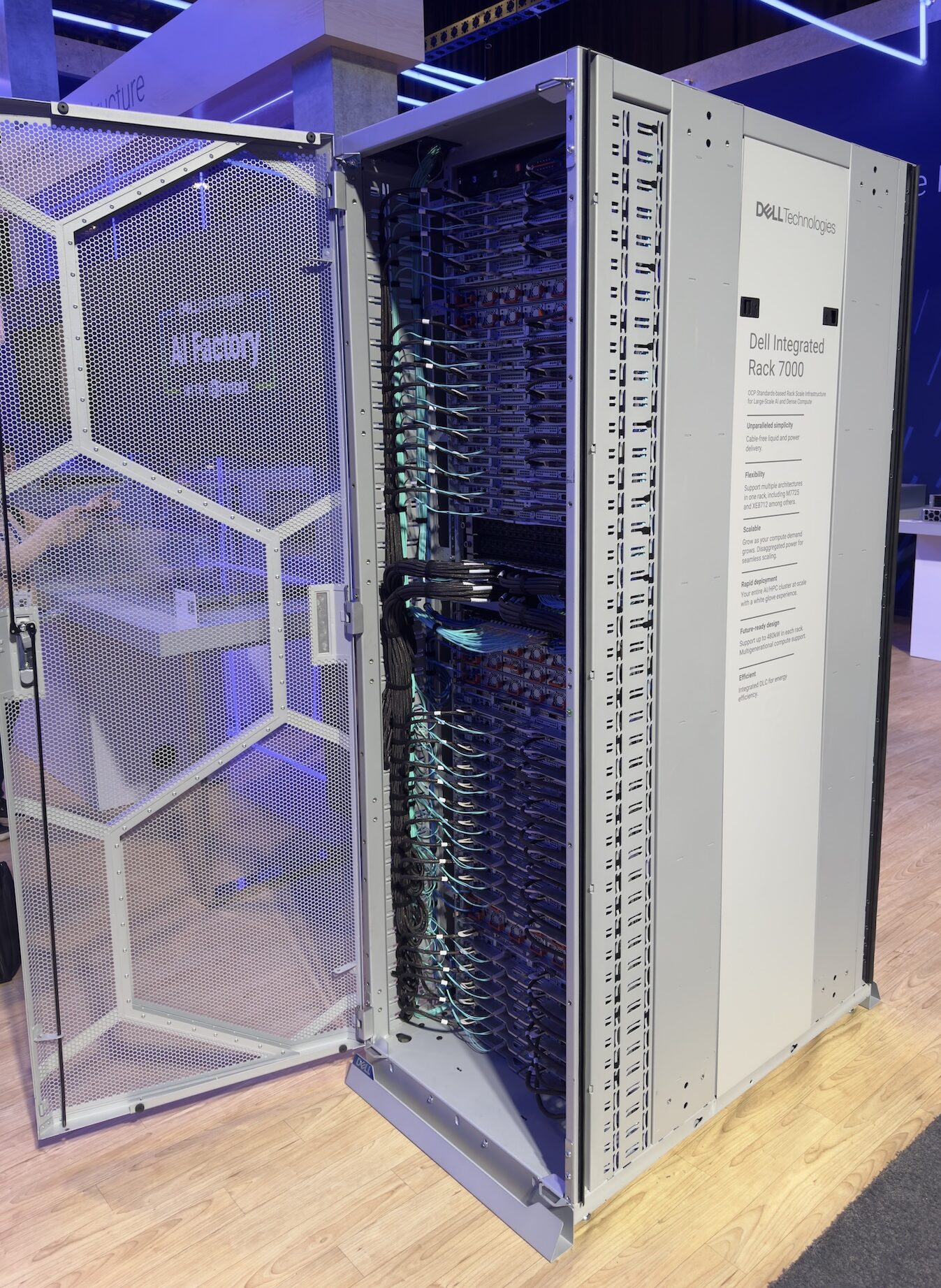
Dell also highlighted GPU-accelerated analytics, noting that the platform can deliver SQL query performance up to 6 times faster when paired with NVIDIA Blackwell GPUs. Underneath that software layer, storage remains central. PowerScale and ObjectScale are positioned as the systems that turn fragmented enterprise data into AI-ready repositories. Dell said the new ObjectScale X7700 ultra-dense appliance offers up to 45% more HDD capacity than its predecessor, improving economics for large-scale object storage deployments. The company also said support for 245TB all-flash drives is coming, which would more than triple ObjectScale’s flash density.
Cyber resilience is the third pillar of Dell’s current storage narrative and is increasingly tied to both private cloud and AI deployments. Enterprise customers are no longer treating cyber recovery as a secondary planning exercise. Instead, the expectation is that ransomware detection, protection orchestration, and large-scale recovery need to be part of the platform itself.
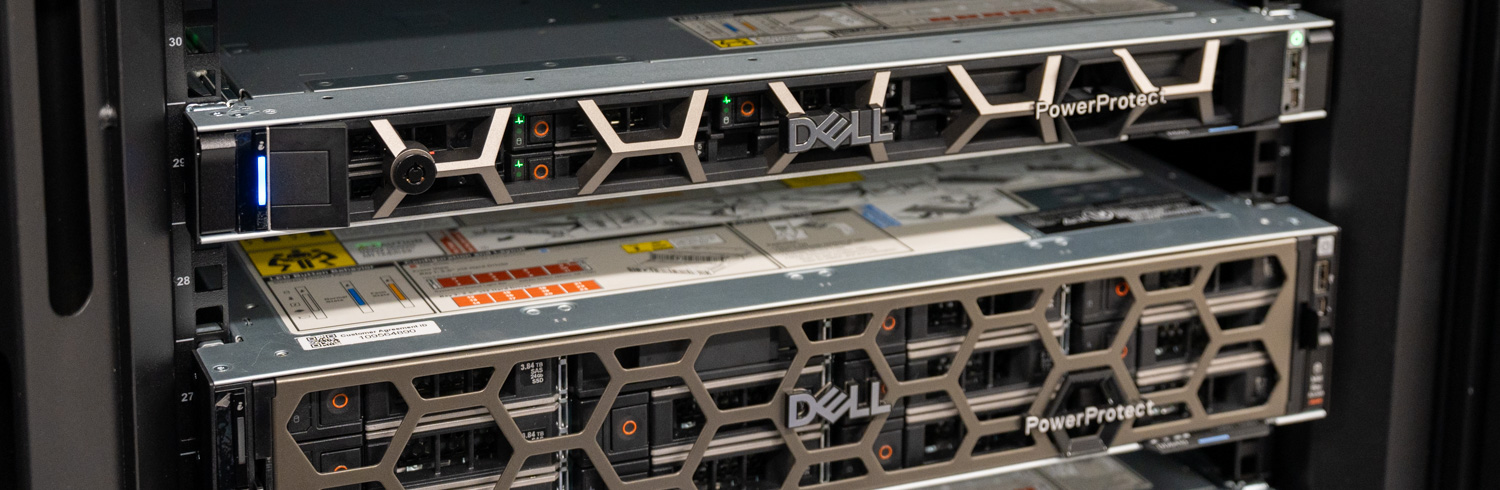
Dell is addressing that with PowerProtect One, which brings data protection orchestration and storage under a single control plane. The company said this can reduce management overhead by up to 50% while preserving large-scale recovery capabilities and established data reduction efficiency. It also pointed to Cyber Detect, which integrates AI-based ransomware detection with PowerStore and PowerMax; Dell cites a 99.99% detection confidence from a third-party validation of the underlying Index Engines technology, with the goal of initiating recovery operations as soon as suspicious activity is detected.
Taken together, these elements help explain why Dell’s storage message is landing with enterprise buyers. Rather than presenting private cloud, AI infrastructure, and cyber recovery as separate product discussions, Dell is tying them back to a common infrastructure foundation. In that context, PowerStore plays an important role because it sits at the intersection of consolidation, modernization, operational simplicity, and resilience.
For customers already invested in Dell infrastructure, that consistency reduces friction. For prospective buyers, it strengthens the case that Dell’s storage portfolio is not just broad, but aligned with how enterprise IT priorities are evolving. The Q1 share gains and growth numbers may capture attention. Still, the more durable story is that Dell continues to pair scale with a portfolio strategy that maps cleanly to current enterprise requirements.


 Amazon