

At the RAISE Summit in Paris, DDN introduced Infinia 2.4, the latest release of its AI data platform designed for production AI, large-scale inference, and sovereign AI deployments. The update expands enterprise capabilities with multi-tenancy, governance, identity management, and new POSIX support while continuing to optimize data access for GPU-accelerated AI infrastructure.
As enterprise AI deployments mature beyond model training, infrastructure priorities are shifting toward improving inference efficiency, reducing cost per token, and maximizing GPU utilization. DDN positions Infinia 2.4 as an enterprise data platform intended to help organizations operate AI factories more efficiently by reducing storage bottlenecks and simplifying operations across shared environments.
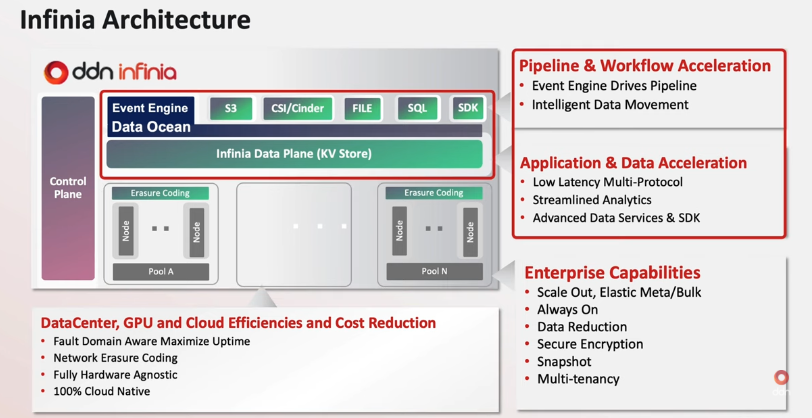
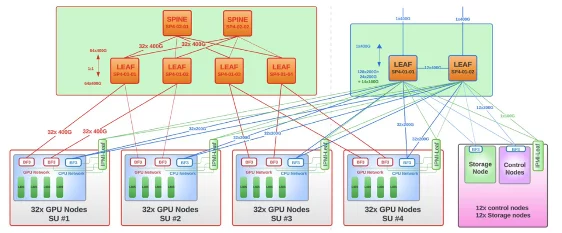
The release also enhances NVIDIA DSX-based AI factory deployments, referencing NVIDIA’s Omniverse DSX blueprint for gigascale AI factories, by improving data throughput and GPU utilization while streamlining infrastructure management. DDN says these improvements can accelerate inference performance and improve the return on the billions of dollars organizations are investing in GPU infrastructure.
DDN CEO and Co-Founder Alex Bouzari said the industry focus is moving from GPU acquisition toward operational efficiency metrics such as inference performance, GPU utilization, and cost per token. He added that enterprise AI deployments require infrastructure that combines performance, governance, and security to maximize the value of AI investments.
Focus on Inference Performance
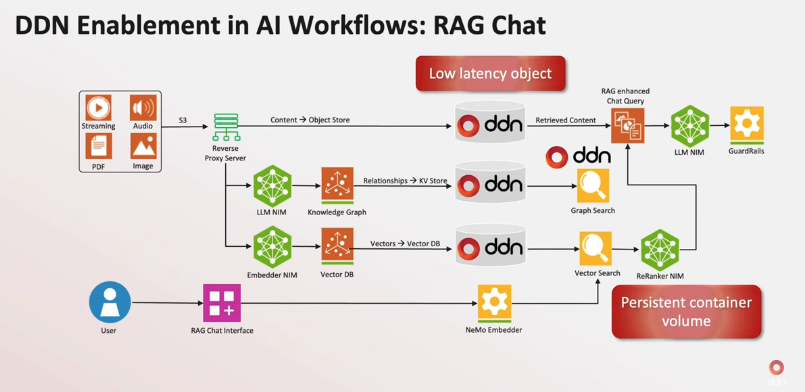
Inference has become the dominant operational cost for many enterprise AI deployments as organizations expand the use of retrieval-augmented generation (RAG), AI copilots, agentic AI, and autonomous applications. Infinia 2.4 is designed to improve inference efficiency through low-latency data access, high-performance object storage, and data services intended to keep accelerators fully utilized.
Key platform enhancements include:
- High-performance distributed KV cache acceleration
- Sub-millisecond access to AI datasets and model artifacts
- High-concurrency support for multi-tenant inference environments
- Optimizations for RAG, vector databases, agentic AI, and large-scale inference workloads
- Improved GPU utilization to reduce infrastructure overhead
DDN says these capabilities are intended to improve response times while lowering the cost per token for production AI services.
Expanded Enterprise Capabilities
A significant focus of Infinia 2.4 is support for shared enterprise AI infrastructure. The platform adds capabilities DDN says are required by many of NVIDIA’s cloud partners, managed AI service operators, and enterprise AI platforms, including advanced multi-tenancy, identity integration, quota enforcement, governance controls, and stronger operational isolation between tenants.
These additions allow multiple organizations, business units, or sovereign AI environments to share a common infrastructure while securely maintaining operational separation.
Initial POSIX Support
Infinia 2.4 also introduces limited availability POSIX support, expanding application compatibility beyond object storage. The initial release includes qualified POSIX clients for Red Hat Enterprise Linux and Ubuntu, documented deployment guidance, and defined throughput commitments. The feature enables additional AI and data-intensive workloads while maintaining the platform’s existing performance architecture.
S3 Compatibility
Existing deployments can upgrade to Infinia 2.4 without modifying applications built around Amazon S3 APIs. DDN says the platform maintains compatibility with current S3 environments and SDKs while providing the latest performance and scalability improvements.
Broader AI Infrastructure Strategy
The release aligns with DDN’s continued focus on enterprise AI, hyperscale infrastructure, inference platforms, and sovereign AI initiatives. According to the company, its technology is deployed across AI infrastructure supporting organizations including NVIDIA, xAI, Salesforce, Mistral, SK Telecom, Yotta, and multiple government and research institutions, where it is used to improve resource utilization, accelerate model deployment, and support large-scale AI operations.


 Amazon