

Updated September 3, 2026: Best High-Capacity pick expanded with measured power data from our Micron 6600 ION watts-and-racks analysis. Originally published August 14, 2026. Ranked on our current enterprise bench (FIO, GDSIO, and DLIO); drives tested on the older suite are noted in Also Tested.
Every drive ranked on this page has been through the StorageReview lab. We do not rank announced products or vendor spec sheets, which matters more in enterprise storage than anywhere else we cover: the datasheet numbers are achievable, and the interesting question is what happens at sustained load, at low queue depth, and during AI checkpointing. Every pick links to the full review holding the data.
The enterprise field split into two distinct races this cycle. TLC drives are competing on mixed-use throughput and latency consistency for databases, analytics, and AI training. QLC drives are competing on capacity per watt, and they have run away with it: a single bay now holds 245.76TB at roughly 8.2TB per watt, against about 4.4TB per watt for the densest hard drives. The picks below cover both races, plus the form-factor question that increasingly decides deployments before performance does.
At a Glance
| Category | Drive | Class | Standout Lab Result | Full Review |
|---|---|---|---|---|
| Best Overall Enterprise SSD | Micron 9550 MAX | Gen5 TLC, 3 DWPD, up to 25.6TB | 10,957.9 MB/s 128K sequential write, the highest in our comparison group | 9550 MAX Review |
| Best Read-Intensive | Kioxia CD9P-R | Gen5 TLC, 1 DWPD, up to 61.44TB | ~30 us 4K random read latency at QD1 against 60 to 90 us for the field | CD9P-R Review |
| Best for Latency-Critical Workloads | KIOXIA CM9-R | Gen5 TLC, 1 DWPD, up to 30.72TB E3.S / 61.44TB U.2 | 8.2 µs 4K random write latency at QD1, the fastest small-block response in the group | CM9-R Review |
| Best High-Capacity | Micron 6600 ION 245.76TB | Gen5 QLC, up to 245.76TB | A quarter petabyte per bay at roughly 8.2TB per watt | 6600 ION Review |
| Best Capacity Efficiency | Solidigm D5-P5336 122.88TB | Gen4 QLC, 0.6 DWPD, 122.88TB | 134.3PBW endurance in a 24W active envelope, our Editor’s Choice | D5-P5336 Review |
| Best for EDSFF Deployments | Micron 7600 MAX | Gen5 TLC, 3 DWPD, up to 12.8TB | 1.78M IOPS peak 4K random write inside a 14W envelope | 7600 MAX Review |
| Best High-Capacity Alternative | DapuStor R6060 122TB | Gen5 QLC, 0.6 DWPD, up to 245TB | 13,274.8 MB/s 64K random read and dual-port support | R6060 Review |
The Picks
Best Overall Enterprise SSD: Micron 9550 MAX
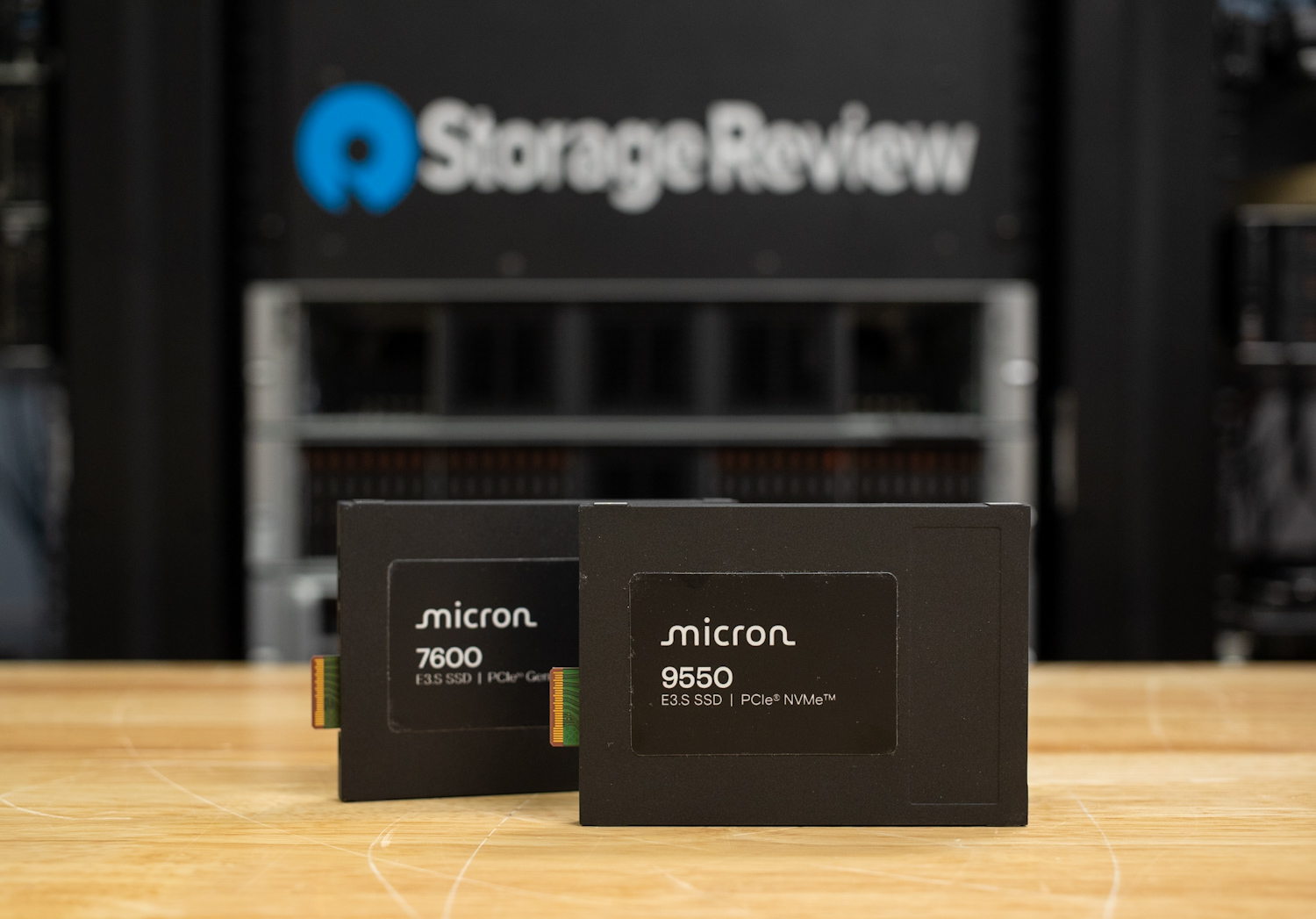
The Micron 9550 MAX, our Best Overall enterprise SSD for mixed-use workloads
The 9550 MAX is the drive that wins on the numbers that matter for mixed-use deployments. In our FIO sweep it led 128K sequential write at 10,957.9 MB/s, roughly 2.5GB/s clear of the next drive in the group, and did it at the lowest write latency in the field at 182.2 microseconds. It was the only drive in that comparison to scale past 10GB/s in 64K random write, averaging 7.34GB/s with a 10.6GB/s peak, and it held the tightest latency curves across nearly every sweep we ran.
Built on Micron 232-layer TLC with a 3 DWPD rating, it comes in 3.2TB through 25.6TB, in both U.2 and E3.S, and our 12.8TB sample is rated for 70,080TBW random and 143,100TBW sequential. In DLIO checkpointing against LLAMA 3.1 405B it posted the lowest average completion times in the group. If one drive has to cover databases, analytics, and AI training pipelines, this is it.
Review: Micron 9550 MAX Review: Balanced Performance for AI, DB, and Analytics
Best Read-Intensive: Kioxia CD9P-R
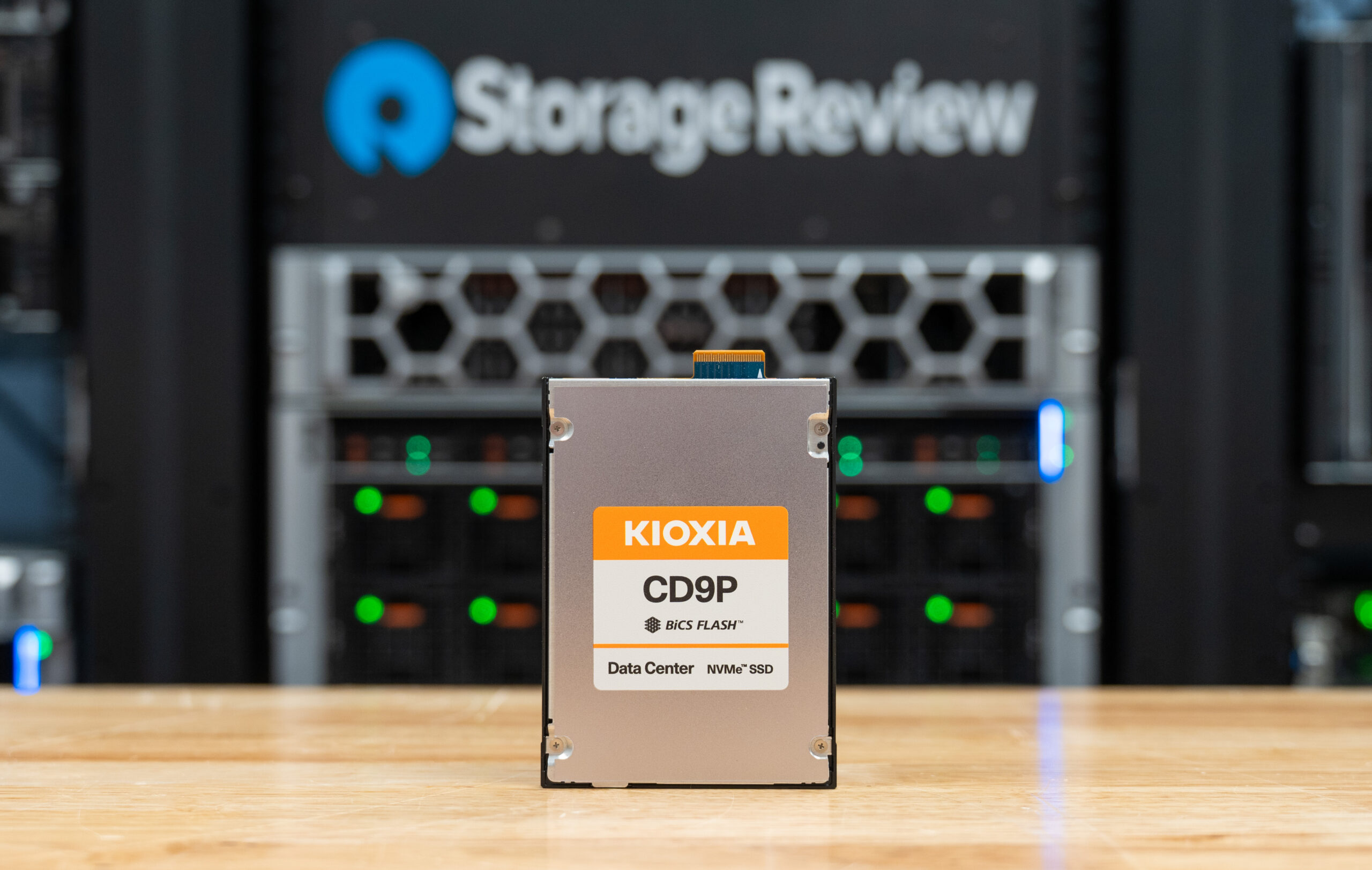
The Kioxia CD9P-R, the read-latency leader in our Gen5 comparison group
Read-heavy fleets care about latency at low queue depth more than peak throughput, and that is where the CD9P-R separates itself. At QD1 it served 4K random reads in roughly 30 microseconds while the rest of the group sat between 60 and 90, and it delivered 32.3K IOPS at a single job and single queue depth, clearly ahead of the field. In our latest group refresh its CM9-R sibling edges it at queue depth 1, but the CD9P-R keeps the deep-queue read throughput read-intensive fleets buy for. It also tied for the top 128K sequential read at 14,235.9 MB/s and posted the group’s highest 1M GPU Direct Storage read at about 6.2 GiB/s.
The generational jump is real: random write IOPS went from 200K on the CD8P-R at the same capacity to 450K, a 2.25x improvement, with sequential read up 23 percent. It runs BiCS FLASH TLC at 1 DWPD, reaches 61.44TB in 2.5-inch, and our 7.68TB E3.S sample drew 23W active. The tradeoff is honest: it finished last in the group on 128K sequential write at 6,912.4 MB/s. Buy it for reads.
Review: Kioxia CD9P-R Review: Read-Intensive Gen5 Up to 61.44TB
Best for Latency-Critical Workloads: KIOXIA CM9-R
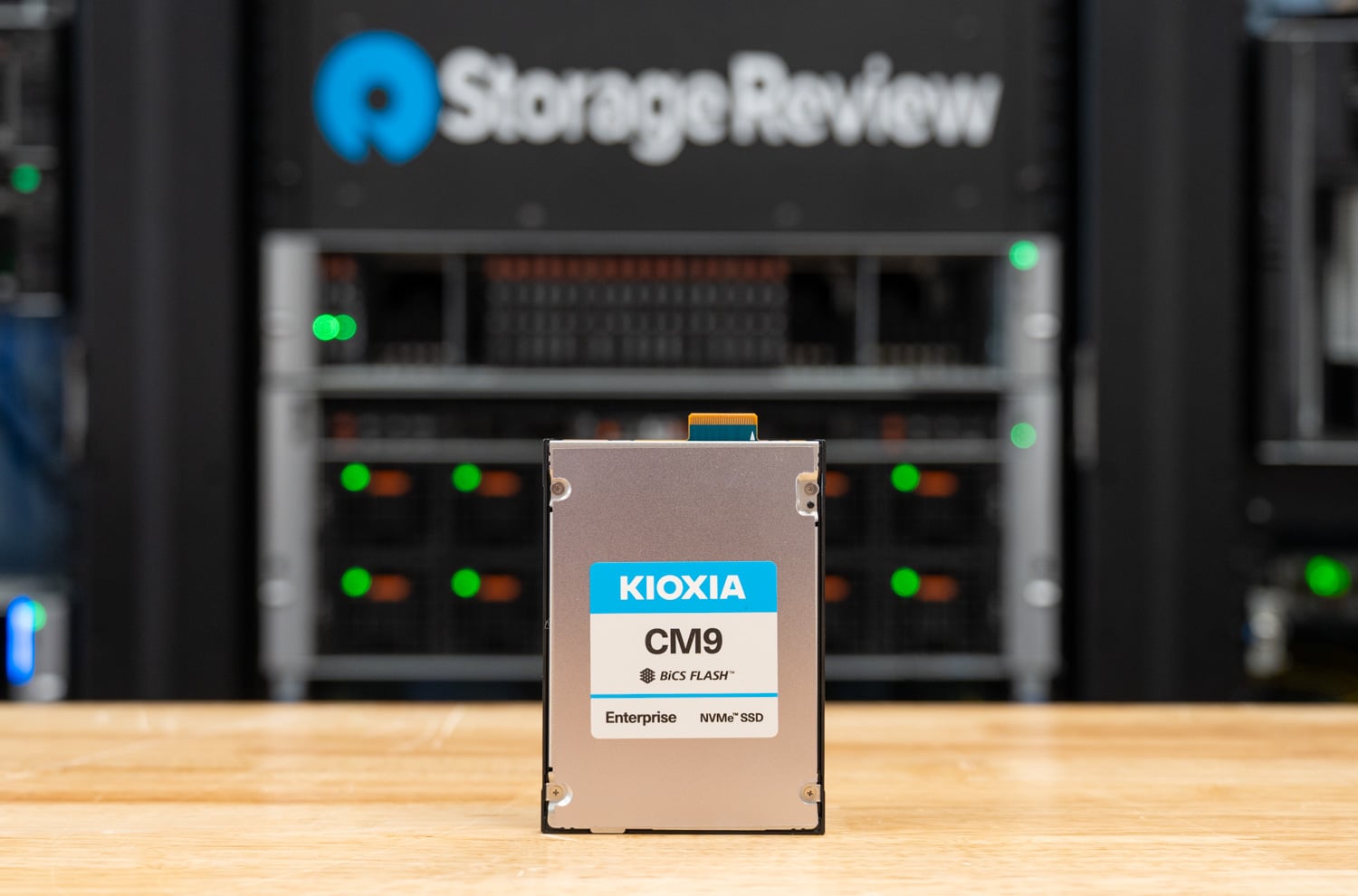
The KIOXIA CM9-R 15.36TB, the lowest queue-depth-1 latency in our current Gen5 enterprise group
OLTP databases, transaction logs, and real-time serving feel single-request response time long before they feel peak throughput, and no drive in our current Gen5 enterprise group answers a lone request faster than the CM9-R. The first enterprise-class SSD on KIOXIA’s BiCS8 flash led every low-queue-depth chart we ran: 115.8K IOPS at 8.2 µs on 4K random writes, 33.6K IOPS at 29.3 µs on 4K random reads, 10.4 µs single-worker 16K sequential writes, and 1,359.0 MB/s 64K reads at 45.6 µs, all inside a 25W typical power envelope. GPU Direct Storage adds to the case with the group’s best small-block read IOPS at 136.4K and the steadiest sustained write line on the bench, peaking at 5.51 GiB/s.
The trade is at saturation: the CM9-R’s deep-queue 4K read peak of 1,973.4K IOPS sat seventh of eight in our sweep, so fleets chasing maximum parallel read throughput are better served by the CD9P-R above. Pick the CM9-R when response time is the number your workload feels. Read our KIOXIA CM9-R review.
Best High-Capacity: Micron 6600 ION 245.76TB
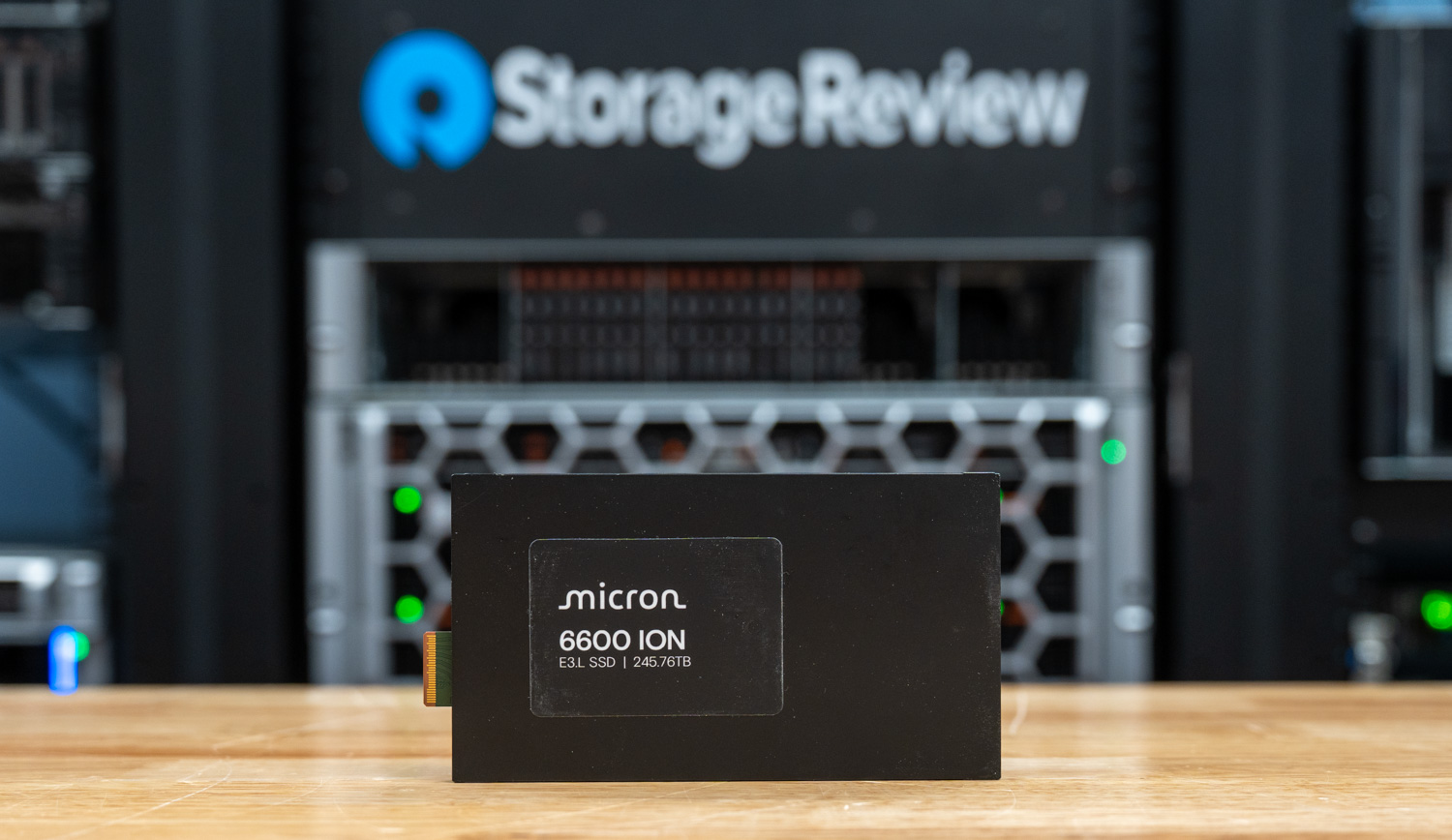
The Micron 6600 ION packs 245.76TB of G9 QLC into a single drive bay
A quarter petabyte in one bay is a category unto itself. The 6600 ION reached 12,729.8 MB/s in 128K sequential read and roughly 1.75 million IOPS in 4K random read in our testing, which is more than enough to feed read-centric workloads, but the real argument is density per watt. At a 30W ceiling it works out to about 8.2TB per watt against roughly 4.4TB per watt for the highest-capacity enterprise hard drives, and a 720-bay E3.L rack lands at 176.9PB versus 31.7PB filled with 44TB HDDs.
Read the fine print before deploying. Endurance is 1.0 SDWPD sequential but drops to 0.075 RDWPD on 4K random writes, the top capacity uses a 16K indirection unit, and it posted the slowest DLIO passes and the highest 1M GDS write latency in its group at 53.7 milliseconds. For object stores, AI data lakes, and content repositories, those are acceptable trades. For write-mixed tiers, they are not.
That density-per-watt math is no longer spec-sheet arithmetic. In September 2026 we measured the 245TB ION against eight Seagate Exos M 30TB drives in RAID5 inside the same Dell R5715, and the flash configuration writing at full speed drew less system power than the HDD array sitting idle: 170.2W against 173.5W. Every measured state freed roughly 50 to 64W per swap, sequential reads delivered 72.7 MB/s per watt against the array’s 10.4, and at exabyte scale the footprint collapses from 22 racks of best-case HDD density to 6, handing 16 rack positions back to the compute plan.
Review: Micron 6600 ION 245TB SSD Review: A Quarter Petabyte Per Drive Bay
Power analysis: Micron 6600 ION 245TB: Swap the Hard Drives, Power an NVL72 for Free
Best Capacity Efficiency: Solidigm D5-P5336 122.88TB
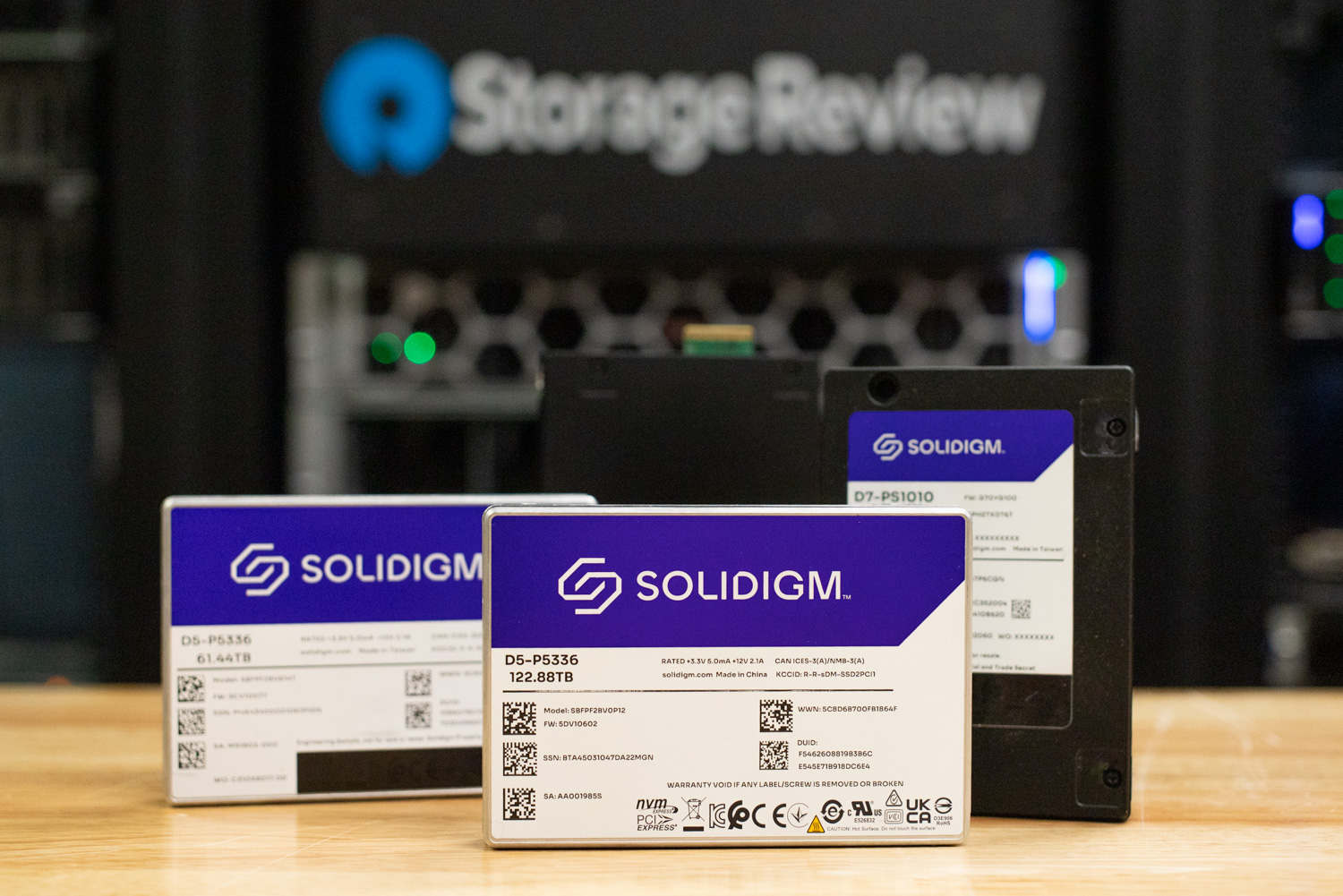
The Solidigm D5-P5336 122.88TB, the only Editor’s Choice in this field
Solidigm pioneered enterprise QLC and the 122.88TB D5-P5336 is still the efficiency benchmark, and the only drive on this page to earn our Editor’s Choice. It pairs 0.6 DWPD with a 134.3PBW endurance rating over a five-year warranty inside a 24W active envelope, and its 192-layer QLC with a 32K indirection unit delivered 3,152.5 MB/s in 128K sequential write, 25.9 percent faster than the 61.44TB model, with latency 20 percent lower.
It runs on Gen4 rather than Gen5, which caps sequential reads around 7GB/s, but that is often beside the point at this capacity. Know its limit: 16K random write showed no scaling at all between low and high queue depths, holding at about 35,145 IOPS, where the 61.44TB version scaled to 162,711. It is also broadly qualified on major OEM platforms already, which matters when deployment timelines run in quarters.
Review: Solidigm 122.88TB D5-P5336 Review: High-Capacity Storage Meets Operational Efficiency
Best for EDSFF Deployments: Micron 7600 MAX
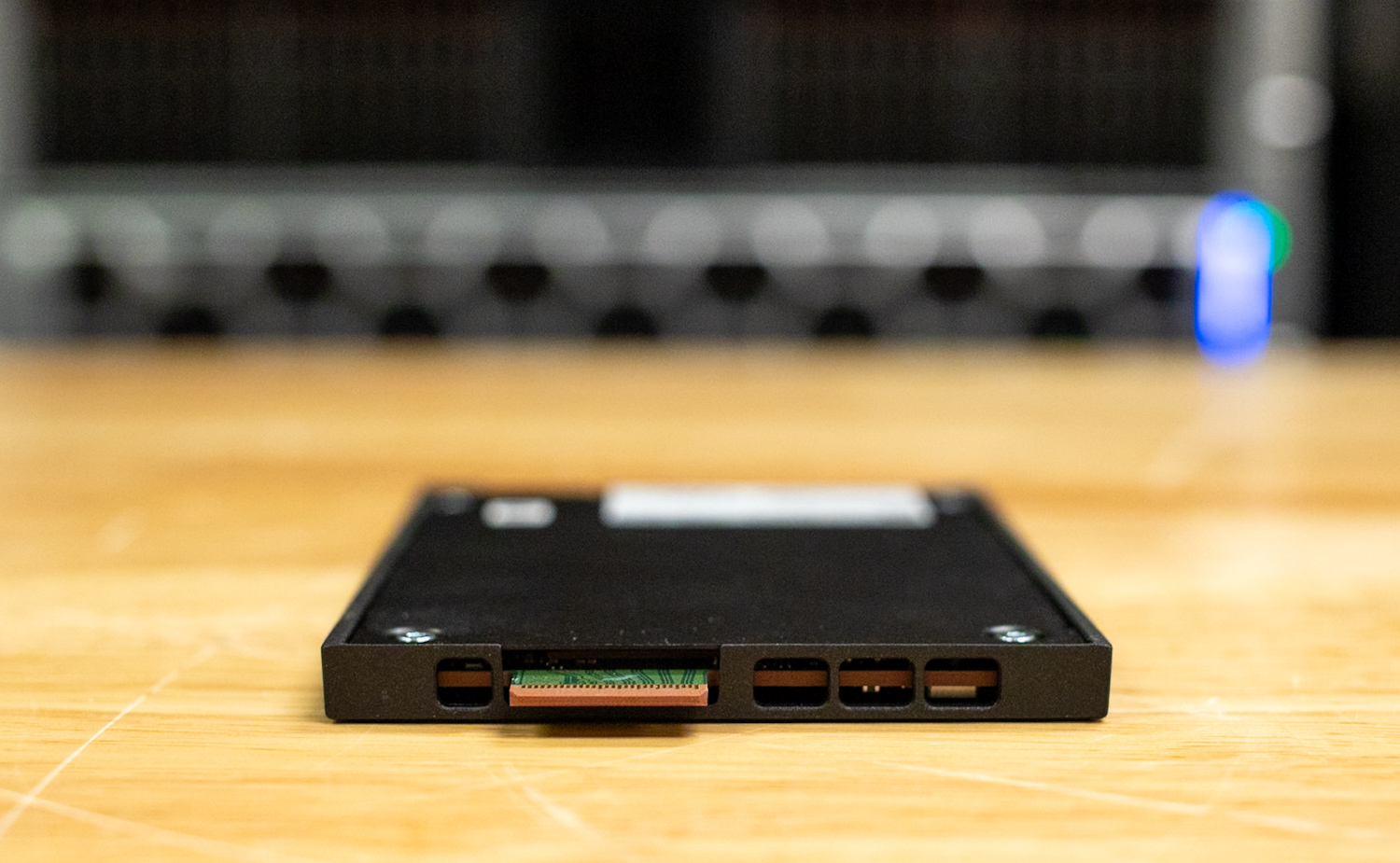
The Micron 7600 MAX ships in U.2, E1.S, and E3.S, the widest form-factor spread in this field
The 7600 MAX is the drive to specify when the chassis, not the benchmark, drives the decision. It is the only pick here shipping in all three of U.2, E1.S, and E3.S, and it is built on Micron G9 TLC at 3 DWPD with a 14W sequential power envelope, the lowest on this page. In our testing it was the most aggressive scaler in 4K random write, peaking just over 1.78 million IOPS, and it held the tightest 16K sequential read latency in its group at 0.13 milliseconds average.
Peak throughput is not its story. It finished last in the group in both 128K sequential charts, at 6,960.6 MB/s write and 11,240.5 MB/s read, the only drive under 12GB/s. What you get instead is composure under sustained load in a small, power-disciplined package, which is exactly what dense EDSFF servers need. We tested the 6.4TB E3.S; the family runs 1.6TB to 12.8TB.
Review: Micron 7600 MAX Review: Mixed Use 3 DWPD SSD Built for Modern Apps
Best High-Capacity Alternative: DapuStor R6060 122TB
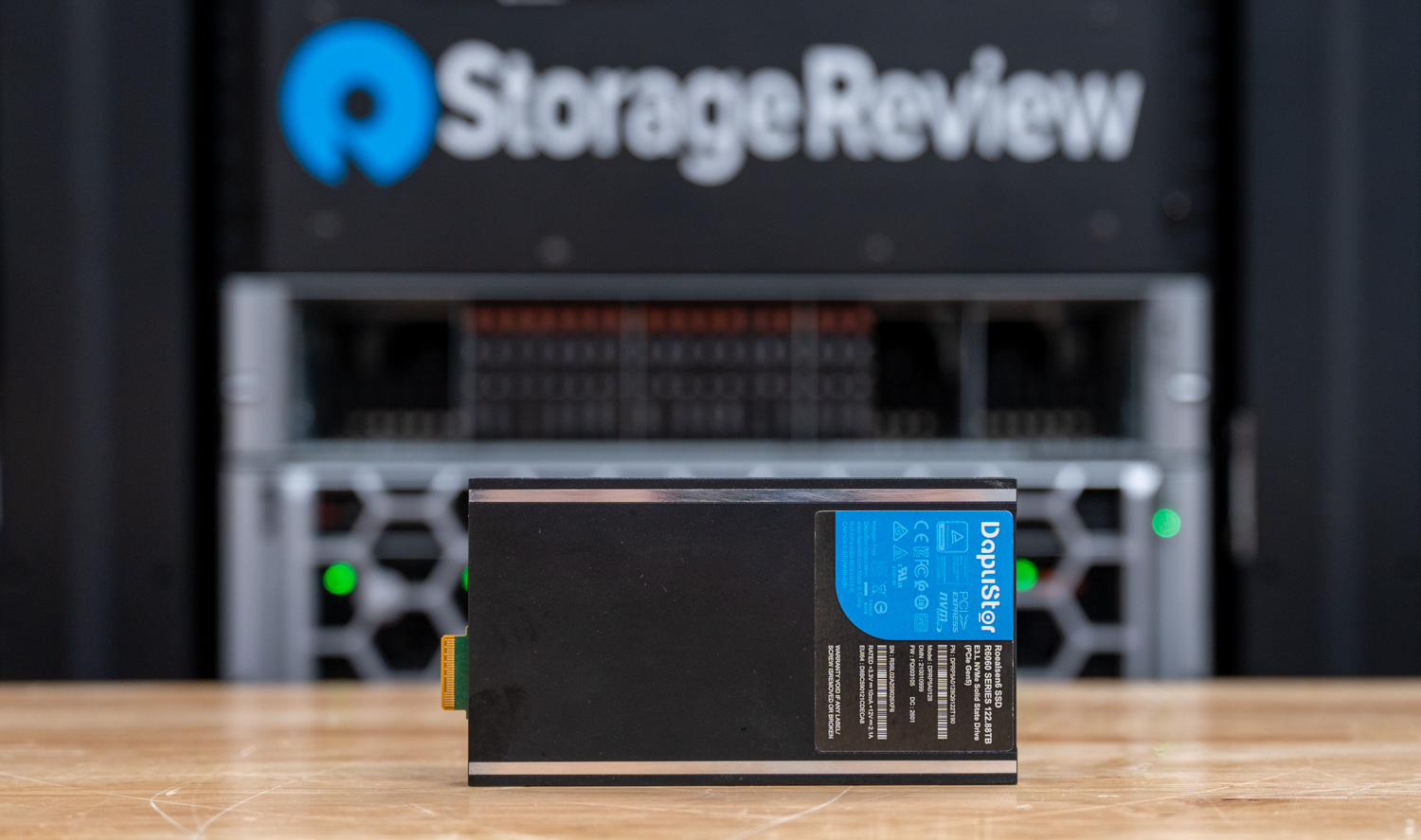
The DapuStor R6060 122TB brings dual-port Gen5 QLC to high-density tiers
The R6060 is the answer when the 6600 ION is not available or dual-port is a requirement. Its 122.88TB E3.L sample led its comparison group in 64K random read at 13,274.8 MB/s, matched the group high in 1M GDS sequential read at 5.9 GiB/s, and turned in the fastest first DLIO pass at 465.33 seconds. It supports PCIe 5.0 x4 or dual-port 2×2, carries 0.6 DWPD, and a 245TB SKU is in the family.
Small-block writes are the documented weakness, the same profile as every high-density QLC drive here, and the E3.L 2T form factor needs a chassis check before you commit. For read-heavy capacity tiers where dual-port matters, it earns its place.
Review: DapuStor R6060 122TB Review: Read-Heavy Gen5 QLC at Scale
Also Tested
These enterprise drives went through the same lab process and are worth a shortlist spot for the right deployment, even though they do not hold a category slot today.
- Phison Pascari X200P: topped the group in 128K sequential read at 14,242.1 MB/s, but posted the slowest DLIO checkpoint times in the field.
- Solidigm D7-PS1010: a strong 1 DWPD Gen5 drive at 14,163.3 MB/s sequential read, with a documented GPU Direct write collapse to 1.6 GiB/s at high thread counts.
- Solidigm D7-PS1030: the 3 DWPD arm of the same platform, second in the group in 4K random write at 1,595.8K IOPS and proven over weeks as the KV cache offload tier in our XE7740 inference work, though single-stream sequential writes trail the field.
- Western Digital SN861: the 4K random read leader at peak concurrency with 2,555.6K IOPS, though with more run-to-run variability than the 9550 MAX.
- Kingston DC3000ME: a mainstream Gen5 option at 8,477.4 MB/s sequential write, 1 DWPD and 14,016TBW at 7.68TB, aimed at system integrators.
- DapuStor J5060: 61.44TB of Gen4 QLC at 1.69M IOPS 4K random read, with 31.9K IOPS random write showing the QLC write ceiling clearly.
- Micron 6550 ION: the predecessor to the 6600 ION and still the sequential leader in its group at 13,979.7 MB/s read. Note this was a sponsored early look, and its efficiency figures are Micron-supplied.
- Kioxia CM7-R E3.S: solid Gen5 results at 714,623 IOPS 4K random read, tested on our older VDBench suite, so it is not directly comparable to the drives above.
- DapuStor Haishen5 H5100: benchmarked as a 16-drive RAID5 array at 205GB/s read and 18.1M IOPS, an array result rather than a single-drive comparison.
On the Horizon
Nothing in this section is ranked, because none of it has been through our lab. Every figure below is the vendor’s own claim, and the status label matters as much as the specs: shipping, sampling, and show-floor demo are three very different things when you are planning a refresh. We will rank these drives when we can measure them.
PCIe Gen6 arrives: Micron 9650, Samsung PM1763
The Gen6 generation is real and shipping, which is the biggest change coming to this page. Micron’s 9650 entered mass production in February 2026 as the first PCIe Gen6 enterprise SSD, with Micron claiming 28,000 MB/s sequential reads, 14,000 MB/s writes, and up to 5.5 million random read IOPS from G9 TLC in E1.S and E3.S, including a 9.5mm variant built for direct liquid cooling. It comes as a 1 DWPD PRO from 7.68TB to 30.72TB and a 3 DWPD MAX from 6.4TB to 25.6TB, inside a 25W envelope. Samsung followed with the PM1763 in July 2026, claiming 28,400 MB/s reads and 6.8 million random read IOPS, shipping first at 4TB, 8TB, and 15.36TB.
For context on what that means in practice, the fastest Gen5 drive on this page measured 14,235.9 MB/s sequential read in our testing. Gen6 claims roughly double that on paper. Whether it holds up under sustained load, at low queue depth, and through AI checkpointing is exactly what our bench exists to answer.
The capacity race past 245TB
The 6600 ION’s 245.76TB is the ceiling we have actually tested, and vendors are already past it on paper. DapuStor showed a 512TB QLC drive at FMS 2026 in the R6060 family, in E3.L and E2, pitched as a petabyte of flash in two drives. It is a demonstration unit: no performance figures, no pricing, and no availability date have been published. Kioxia’s LC9 at 245.76TB uses a 32-die stack of 2Tb QLC dies over PCIe 5.0 in 2.5-inch and E3.L, and has been sampling since mid-2025 without a confirmed general availability date. SK hynix began sampling its PS1101 QLC enterprise drive to cloud providers in August 2026, claiming roughly 55 percent more performance than its previous generation.
Also worth watching
Kioxia’s CM10 is its first PCIe 6.0 enterprise SSD, sampling as of July 2026, built on 332-layer BiCS FLASH with cold-plate liquid cooling support on the E3.S and E1.S models; Kioxia claims about 92 percent higher sequential read than the CM9, though it has not published absolute figures. Further out, the GP Series uses XL-FLASH with 512-byte access granularity to extend GPU memory rather than serve as conventional storage, with evaluation samples expected at the end of 2026. Solidigm has said publicly that it will ship 245TB-class drives before the end of 2026 but has not named a model or published specs.
How We Rank
Every drive ranked here was tested in the StorageReview lab on our current enterprise bench: a Dell PowerEdge R760 with a Serial Cables Gen5 JBOF running Ubuntu 22.04.2 LTS. The suite is FIO for four-corners and mixed block sizes, GDSIO for GPU Direct Storage paths, and DLIO checkpointing against LLAMA 3.1 405B with 1,636GB checkpoints, which is where AI infrastructure buyers actually feel storage. We rank a drive only after it has been through that bench; announced drives and vendor-supplied numbers do not qualify for a slot, no matter how good the specs look.
One consequence worth stating plainly: our test suite changed in April 2025. Drives reviewed before that ran VDBench or an earlier four-corners methodology, so their numbers are not apples-to-apples with the current field, and they sit in Also Tested with that noted rather than being ranked against newer results.
Enterprise SSD pricing is almost never public and moves with contract, volume, and capacity, so this page carries no value slot and no dollar figures. Where a drive earns a spot, it earns it on measured performance, endurance, efficiency, and form-factor fit.
Enterprise SSD FAQ
What is the best enterprise SSD in 2026?
For mixed-use workloads, the Micron 9550 MAX. It led 128K sequential write at 10,957.9 MB/s with the lowest write latency in our comparison group, was the only drive to scale past 10GB/s in 64K random write, and posted the lowest DLIO checkpoint times, all at 3 DWPD. Read-intensive fleets should look at the Kioxia CD9P-R instead, and capacity-driven tiers at the Micron 6600 ION.
TLC or QLC for the data center?
It depends on the write pattern, and the gap is wider than the datasheets suggest. TLC drives here carry 1 to 3 DWPD and scale small-block writes cleanly. QLC buys enormous capacity per watt, up to 245.76TB in a bay, but every QLC drive we tested showed a small-block write ceiling: the D5-P5336 did not scale 16K random writes at all, and the 6600 ION is rated at just 0.075 RDWPD for 4K random. For read-dominated tiers, object stores, and AI data lakes, QLC is the right economics. For databases and mixed workloads, stay on TLC.
How much endurance do I actually need?
Match DWPD to the workload rather than buying the highest number available. Read-heavy serving tiers run comfortably at 0.6 to 1 DWPD, which is where the high-capacity QLC drives and the CD9P-R sit. Databases, analytics, and AI training pipelines that checkpoint frequently want 3 DWPD, which is the 9550 MAX and 7600 MAX class. Also read the fine print on how endurance is specified: several drives quote different DWPD figures for sequential, 16K random, and 4K random traffic, and the 4K number is often dramatically lower.
Is PCIe Gen5 worth it, and what about Gen6?
Gen5 is the mainstream enterprise choice now, roughly doubling sequential ceilings to the 14GB/s range against about 7GB/s on the Gen4 drives here. Gen6 enterprise SSDs have been announced, with vendor claims up to 28GB/s, but we have not benchmarked one, so nothing Gen6 is ranked on this page. When a Gen6 drive reaches our lab, it will be ranked on measured results like everything else.
U.2, E1.S, or E3.S?
The industry is moving to EDSFF, and form factor increasingly decides the shortlist before performance does. U.2 remains the safe choice for existing 2.5-inch bays and is still where the largest capacities land. E3.S is where new Gen5 server designs are going, and E1.S suits dense, power-constrained nodes. The Micron 7600 MAX is the only drive on this page shipping in all three, which is why it holds the EDSFF slot. Check chassis compatibility before committing, especially for the taller E3.L 2T drives used at the highest capacities.
What is the largest enterprise SSD available?
The Micron 6600 ION at 245.76TB, which we have tested at that capacity. It is available in U.2 and E3.L, and DapuStor lists a 245TB SKU in the R6060 family as well. The practical consideration is not whether the capacity exists but whether your rack, your rebuild times, and your failure domains are ready for a quarter petabyte behind a single drive connector.


 Amazon