

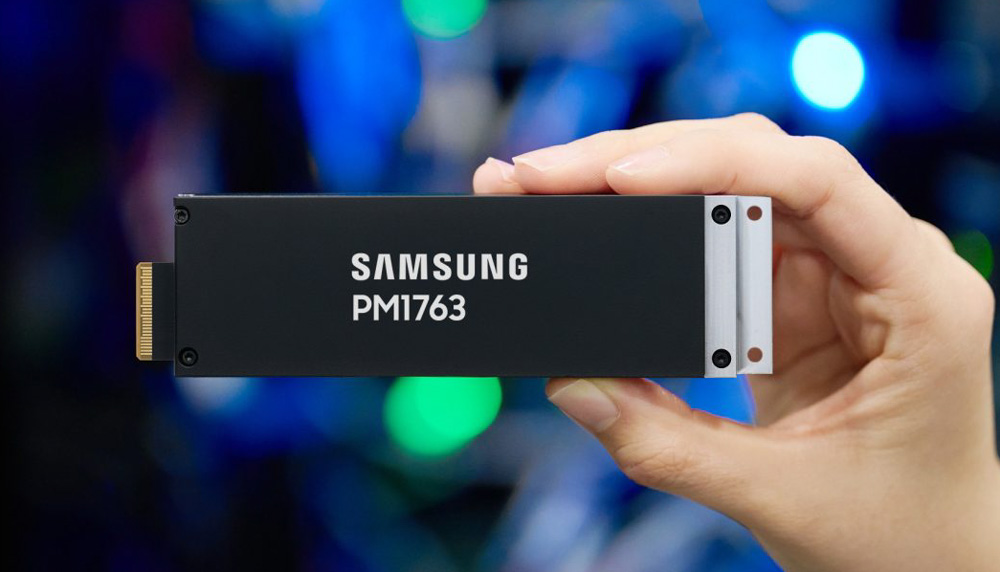
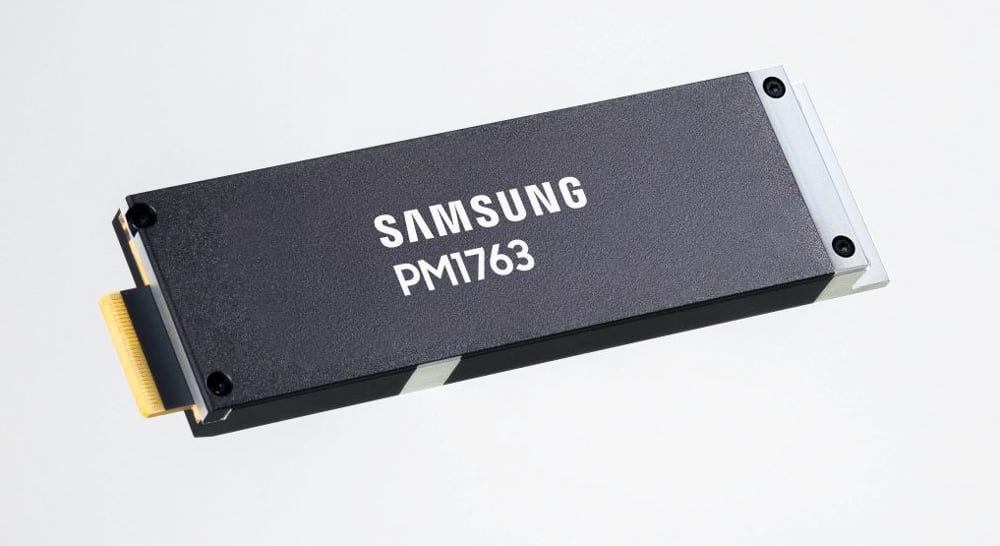
Samsung has started mass production of the PM1763, its first PCIe Gen6 enterprise SSD, pairing 9th-generation V-NAND with a newly developed 4nm controller. The 15.36TB flagship is rated for sequential reads up to 28,400 MB/s and writes up to 21,000 MB/s, with reads landing at 1.96x the 14,500 MB/s ceiling of the Gen5 PM1753 it replaces. Samsung says the PM1763 has completed validation for next-generation AI platforms, and the timing aligns with the first wave of Gen6-capable servers expected in the coming year.
Why PCIe Gen6 Matters
PCIe Gen6 doubles the per-lane signaling rate to 64 GT/s using PAM4, which puts roughly 32 GB/s of bandwidth each direction on the standard x4 SSD link, up from about 16 GB/s on Gen5. Gen5 drives have been bumping against that ceiling for a while, with the fastest models rated in the 14-14.5 GB/s range the interface allows.
The PM1763’s 28.4 GB/s rating uses most of the new headroom, and for AI infrastructure the practical effect is that fewer drives are needed to saturate a GPU server’s storage path, while checkpoint and model-load operations spend less time blocking accelerators. Samsung frames it in model terms, claiming a 40GB LLM can move from drive to memory in roughly 1.4 seconds, versus about 2.7 seconds on the PM1753. That 1.4-second figure is the sequential read rating for a 40GB file, not a measured transfer, so treat it as a best-case illustration of the interface math.
Random performance scales alongside the sequential numbers. Samsung’s product materials list up to 6.8 million random read IOPS and 950,000 random write IOPS for the 16TB-class configuration; the SCADA white paper’s measured 6.92 million IOPS per drive (covered below) suggests the read figure is conservative.
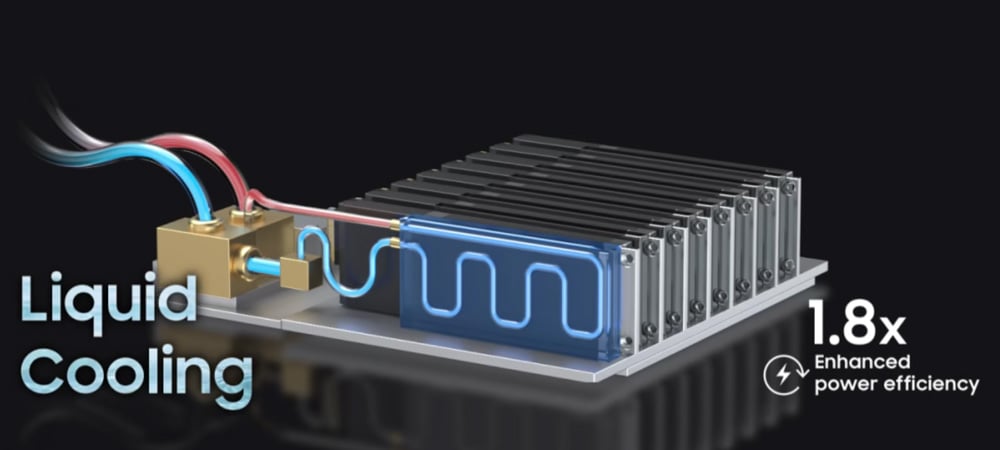
Power efficiency improves up to 1.8x over the prior generation, which matters as much as the raw speed in dense deployments, since Gen6 controllers run hot and every watt saved per drive multiplies across a dense chassis. To that point, Samsung has optimized the PM1763 for liquid-cooled servers with direct-to-chip (D2C) cooling, targeting sustained peak performance under extended load rather than burst figures.
PM1763 Specifications
| Specification | Samsung PM1763 |
|---|---|
| Platform Overview | |
| Interface | PCIe Gen6 x4, NVMe 2.1, OCP 2.6 |
| NAND | Samsung 9th-generation V-NAND |
| Controller | New Samsung 4nm controller |
| Capacities | 4TB, 8TB, 16TB-class (15.36TB formatted) at launch Product page lists 30.72TB and 61.44TB |
| Form Factors | E1.S E3.S U.2 (PCIe Gen5 only) |
| Performance (16TB) | |
| Sequential Read | Up to 28,400 MB/s |
| Sequential Write | Up to 21,000 MB/s |
| Random Read | Up to 6,800,000 IOPS |
| Random Write | Up to 950,000 IOPS |
| Power and Cooling | |
| Power Efficiency | Up to 1.8x improvement over PM1753 |
| Cooling | Optimized for liquid-cooled servers, direct-to-chip (D2C) |
| Security | |
| Features | Post-quantum cryptography (PQC) TEE Device Interface Security Protocol (TDISP) |
GPU-Driven I/O: 281 Million IOPS Across 42 Drives
Samsung has also published a white paper pairing the PM1763 with SCADA (Scaled Accelerated Data Access), the NVIDIA-developed framework that lets GPU threads submit NVMe commands directly to the drives, bypassing the CPU and kernel storage stack entirely. The argument for GPU-initiated I/O is concurrency: a CPU can keep roughly 45 million IOPS in flight across its thread pool, while a GPU dispatching from around 100,000 threads pushed past 95 million IOPS per GPU in Samsung’s testing.
The numbers come from a 512-byte random read workload on an H3 Falcon 6048 Gen6 server with one H100, two H200s, and 42 PM1763 E1.S 15.36TB drives behind three Broadcom PEX90144 Gen6 switches. A single PM1763 processed roughly 6.92 million GPU-issued IOPS, an 86% gain over the 3.72 million the Gen5 PM1753 managed in the same setup. With 14 drives per GPU, the system held near-linear scaling at about 96 million IOPS per GPU group, and the full 42-drive configuration aggregated 281 million IOPS, with per-drive results staying within 5% of the single-drive peak. We did not conduct this testing, nor did we independently audit the results, but the scaling behavior is interesting: latency consistency across drives, not peak IOPS, determined how well the aggregate held up.
What Gen6 Does for Dense Storage Servers
The question is what a shelf of these drives does inside a single box. We recently pushed the Dell PowerEdge R7725xd past 300 GB/s of local throughput with 24 Gen5 SSDs, each drive on dedicated x4 lanes from the CPU complex, and served 160 GB/s over the network with PEAK:AIO’s software keeping the queues saturated. That system rivals multi-node storage clusters from a single 2U chassis. Swap in Gen6 drives at the PM1763’s rated speeds and the same 24-bay topology carries a theoretical ceiling of roughly 681 GB/s of raw read bandwidth, though CPU lane budgets and network egress become the binding constraints well before the drives do.
Capacity density moves in tandem. PEAK:AIO’s 2U AI Data Server already packs 1.5PB using 61.44TB QLC drives while delivering 120 GB/s over RDMA. When Samsung ships the 61.44TB PM1763, that class of system gets Gen6 bandwidth and petabyte-plus density in a similar footprint (next-gen servers are likely to add a rack unit for cooling). For AI shops trying to keep GPU clusters fed without building out a parallel file system across a dozen nodes, the single-server storage argument keeps getting stronger.
Security and Availability
Samsung has also extended the drive’s security stack for multi-tenant AI environments. The PM1763 supports post-quantum cryptography algorithms ahead of anticipated quantum attacks on classical encryption, as well as TDISP (TEE Device Interface Security Protocol), which secures the data path between confidential VMs and the device in virtualized deployments.
“Built on industry-leading performance, PM1763 has successfully completed validation for next-generation AI platforms and is well positioned to support evolving AI infrastructure requirements,” said Jangseok Choi, Vice President and Head of Memory Product Planning at Samsung Electronics. “As AI models continue to grow in size and complexity, PM1763 will serve as a key solution that enables customers to efficiently scale memory capacity and optimize AI operations.”
The PM1763 is in mass production now in 4TB, 8TB, and 16TB capacities. Samsung has not announced ship dates for the larger capacity points.



 Amazon