

Brian recently caught up with Tim Shedd, an expert in thermal management and a pioneer in liquid cooling technologies. The podcast covers some of the historical aspects of data center liquid cooling, from Tim’s time working with Cray and spraying liquid across tubes to his more recent engagement with Dell’s PowerEdge XE9680.
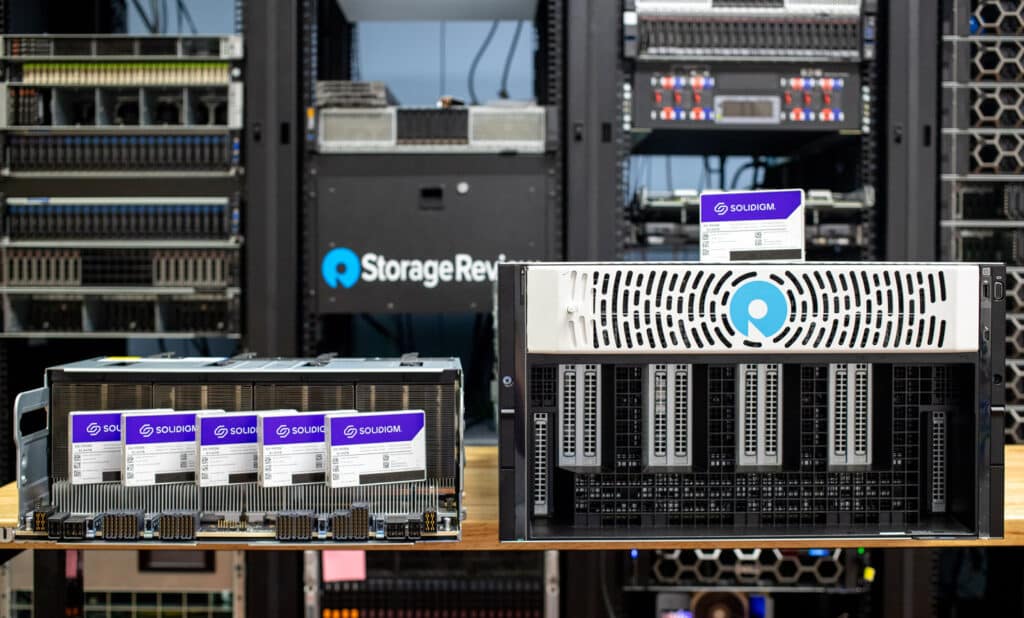
Dell PowerEdge XE9680 in the StorageReview lab
Tim Shedd is an industry expert and mechanical engineer specializing in thermal management, liquid cooling, and data center infrastructure. With a career spanning academic research as a professor at the University of Wisconsin-Madison, foundational engineering roles at Motivair, and senior technical leadership within Dell Technologies’ CTO organization, he has been at the forefront of high-density cooling architecture. His work focuses on bridging advanced thermal physics and hyperscale manufacturability, establishing standards for cooling distribution units, and optimizing data center power efficiency across air- and liquid-cooled hardware topologies.
This podcast delivers great insight into the evolution of thermals from mainframes, HPC platforms, and current server technology. In under an hour, you will come away with a better understanding of how this affects many aspects of keeping our technologies running efficiently.
If you don’t have time to watch this end-to-end, we have broken it into five-minute segments so you can choose what’s most important to you.
[00:00] The Evolution of Liquid Cooling from HPC to Enterprise AI
The initial segment outlines the historical progression of liquid cooling from specialized supercomputing installations to high-density commercial enterprise applications, highlighting early thermal design choices.
- Early compute environments relied on evaporative cooling and basic forced-air convection before reaching the limits imposed by high-density HPC and accelerated compute workloads.
- Initial academic experimentation with Cray architectures involved direct liquid spray over tubes, proving technically viable but commercially cost-prohibitive.
- The post-2015 inflection in rack power density pushed OEMs to engineer standardized enterprise liquid deployments, culminating in high-density rack production models by 2019.
- OEM supply chains pivoted from producing a few thousand liquid-cooled nodes annually to scaling delivery into thousands of production systems weekly.
- Workhorse enterprise platforms like the PowerEdge XE9680, the fastest-growing server in Dell history, balanced early AI thermal loads using dense air heatsinks paired with rear-door heat exchangers before full direct-to-chip adoption became mandatory.
[05:00] Testing Thermal Breakpoints and Fluid Physics at Scale
This section explores the laboratory evaluation of competing thermal technologies, detailing why single-phase direct-to-chip loops emerged as the dominant architecture over immersion systems.
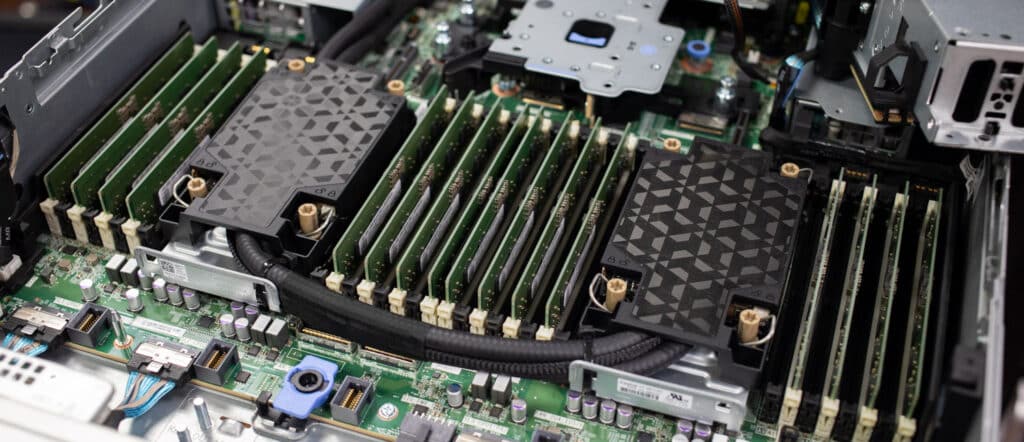
CoolIT direct-to-chip cold plates inside a Dell PowerEdge R760
- OEM validation labs conducted extensive testing across cold-plate loops, negative-pressure networks, immersion configurations, and two-phase systems to establish deployment baselines.
- Silicon thermal loads historically increased incrementally with each generation, allowing standard air-cooling and basic liquid-cooling approaches to suffice until TDPs exceeded the 500W-1000W range.
- Immersion cooling offers operational advantages for broadly distributed thermal profiles, such as crypto farms, but struggles with the localized, highly concentrated heat fluxes found on modern accelerators.
- Water blended with 25% propylene glycol (PG25), delivered through microchannel cold plates, became the primary standard due to its predictable scaling, supply availability, and established thermal transfer properties.
- Open ecosystem standards remain critical for sourcing cold plates, manifolds, and quick disconnects across multiple vendors without performance regressions.
[10:00] Standardization, Multi-Vendor Interoperability, and Mechanical Reliability
The discussion transitions to the operational realities of deploying liquid hardware, focusing on multi-vendor component integration, liability demarcation, and material integrity.
- Mixing cooling components from different vendors introduces significant mechanical compatibility hurdles and strict warranty limitations in the event of a fluid leak.
- Legal liability and service-level agreements remain primary industry obstacles preventing mixed-vendor plumbing architectures across production server floors.
- Legacy rope-style leak detection systems are giving way to integrated sensor topologies with automated pump trips and valve cutoffs.
- Advancements in peroxide-cured EPDM hose manufacturing have significantly reduced component-level failure rates in direct-to-chip plumbing.
- System unreliability in the field predominantly stems from manufacturing debris and inadequate initial line flushing rather than raw component fatigue.
[15:00] Debris Management, Heat Flux Limits, and the Physics of Negative Pressure
This timeframe examines precision cold-plate fluid dynamics, the catastrophic effects of microscopic particulate contamination, and the atmospheric physics that limit negative-pressure cooling loops.
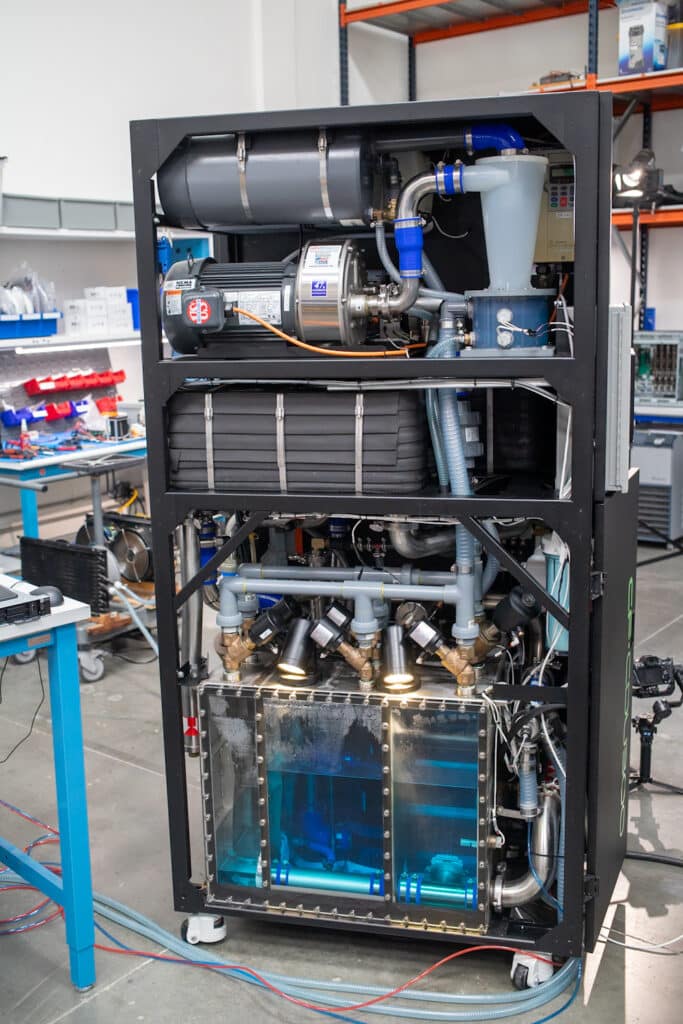
Chilldyne negative-pressure CDU
- Particulates of 100 to 200 microns, even a single wire-brush fiber caught in a quick disconnect, can obstruct microchannel fins and take down a rack through thermal throttling.
- Advanced computational fluid dynamics (CFD) modeling enables modern cold plates to dissipate 1500W loads while maintaining a narrow 30°C delta T penalty.
- Negative-pressure cooling systems are inherently constrained by atmospheric pressure, leaving only 7 to 9 PSI of usable differential pressure before the fluid reaches its boiling point at room temperature.
- Limited pressure budgets make negative-pressure loops difficult to route through long facility manifolds, CDUs, and high-resistance microchannel cold plates.
- Dedicated water chemistry analysis and ongoing chemical monitoring are essential to prevent corrosion, biological growth, and material degradation.
[20:00] Environmental Variables, Fluid Chemistry, and Advanced Leak Detection
Here, the conversation addresses regional climate impacts on data center operations, condensation risks, and the technological evolution of rapid-response leak-detection sensors.
- Regional humidity, altitude, and ambient conditions dictate secondary-loop water temperatures and facility cooling efficiency.
- Sub-ambient loop temperatures in high-humidity climates risk condensation formation on server chassis components and require dedicated dew-point controls.
- Traditional leak detection ropes suffer from supply chain bottlenecks and high trigger thresholds, requiring a significant volume of fluid before triggering an alert.
- Next-generation leak detection leverages flexible polymer-printed sensor traces, optical dye detection, and vapor sniffers to identify micro-leaks before catastrophic failure occurs.
- Intelligent rack controllers actively modulate CDU loop pressure upon sensing early fluid loss to minimize leak volume while preserving uptime.
[25:00] Evaluating Two-Phase Direct-to-Chip Potential and Refrigerant Chemistry
This segment explores the thermodynamic benefits of latent heat vaporization in two-phase cooling, alongside the supply-chain and chemical considerations surrounding low-GWP refrigerants.
- Two-phase direct-to-chip cooling eliminates the sensible heating penalty of single-phase loops, typically at least 5°C, maintaining a constant boiling temperature whether a chip dissipates 10W or 1,000W.
- Two-phase cooling minimizes water-related corrosion and the risk of electrical shorting in the rack, presenting a compelling deployment model for enterprise data halls.
- Scaling two-phase loops requires solving multi-vendor interoperability for phase-change manifolds, CDUs, and complex vapor condensers.
- Emerging low-GWP, non-flammable dielectric fluids (such as R-515B and R-1233zd) are overcoming regulatory constraints associated with legacy PFAS compounds.
- Modern data center infrastructure providers are acquiring specialist cooling vendors to assemble unified, turnkey liquid thermal portfolios.
[31:33] CDU Architectures, Dynamic Flow Control, and Blast Radius Mitigation
Focusing on the core pumping infrastructure, this section analyzes standardized testing methods, transient thermal response, and the engineering trade-offs between centralized and distributed CDUs.
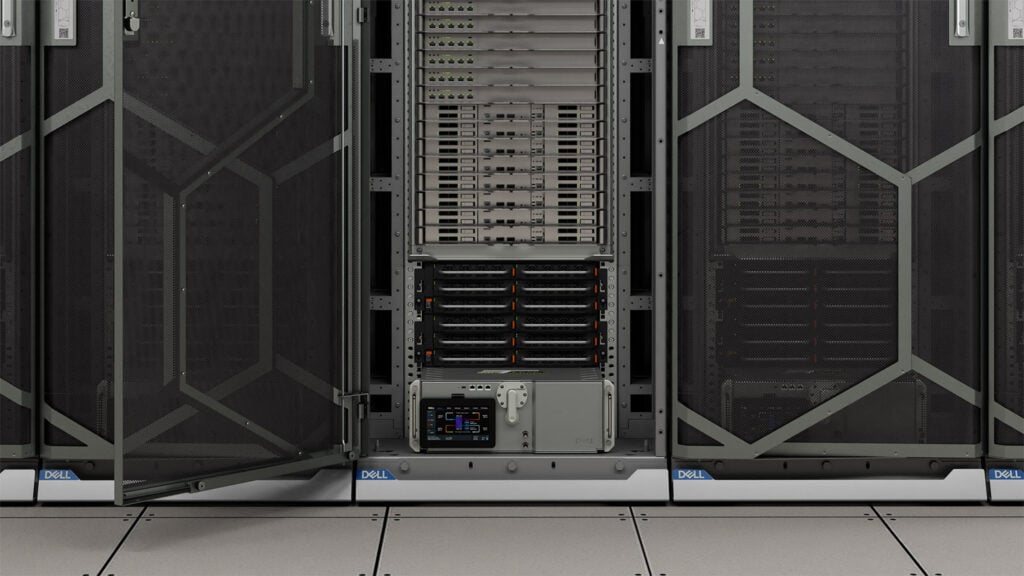
Dell PowerCool CDU
- ASHRAE Standard 127 established standardized testing methods to provide accurate, apples-to-apples comparisons of CDU thermal efficiency and pumping performance.
- Minor variations in coolant flow translate immediately into temperature fluctuations at the cold plate; a 10 percent flow change can trigger throttling events, demanding ultra-responsive control algorithms.
- Centralized multi-megawatt CDUs involve massive fluid volumes and large operational blast radii, such that a single contamination or leak event can take down an entire facility hall.
- Additive chemical incompatibilities make mixing proprietary coolants from different vendors hazardous, potentially causing precipitation and clogging.
- Distributed row-level and in-rack CDUs isolate mechanical failure domains, reduce fluid transit piping, and accelerate installation timelines.
[37:00] In-Rack CDUs versus Centralized Loops and the Viability of Air-Cooled Inference
This part evaluates high-performance in-rack CDU performance profiles and outlines why air cooling remains dominant across distributed enterprise inference clusters.
- Purpose-built in-rack CDUs can support 220kW thermal loads with a 4°C approach temperature, turning 41°C facility water into 45°C coolant for Vera Rubin racks at 1.5 liters per kilowatt.
- Dual-pump redundancy inside in-rack CDUs maintains continuous cooling operation even during single-pump maintenance events.
- Air cooling accounts for roughly 90 percent of all global server shipments and supports a substantial portion of enterprise inference deployments.
- Edge and enterprise inference hardware must be deployed directly within legacy, 10- to 15-year-old, air-cooled data halls where data is generated.
- Retrofitting older facilities with rear-door heat exchangers and evaporative cooling towers shifts parasitic cooling power into usable compute kilowatts for local AI inference boxes.
[45:20] Chassis Internal Aerodynamics and Fan Efficiency Frontiers
The final segment breaks down the mechanical trade-offs of closed-loop all-in-one coolers and examines how chassis aerodynamic optimization drives air-cooling capability to its physical limit.
- Server-level internal all-in-one liquid loops introduce mechanical failure points and chassis packaging complexity while offering only marginal gains over optimized vapor-chamber heatsinks.
- Sidecar liquid-to-air heat exchangers provide a cleaner, more serviceable path for localized liquid-cooled racks in facilities lacking facility water.
- Enterprise server fan efficiencies have increased from 15 to 20 percent a decade ago to modern electrical-to-mechanical conversion rates of 50 to 60 percent.
- Optimizing chassis aerodynamics around a 100 CFM per kilowatt design point, with every bit of intake air warming a uniform 18°C, maximizes thermal dissipation per kilowatt.
- Air has favorable thermal diffusivity properties that, when paired with precision ducting and advanced heat sinks, provide a solid foundation for next-generation enterprise hardware.
To keep up with everything around liquid cooling and efficient data center design, follow Tim Shedd on LinkedIn.


 Amazon