

Updated September 21, 2026: New FAQ on quantum-resistant SAN encryption, covering the CNSA 2.0 deadlines and the FC-SP-3 standard now shipping in HBAs.
Every major storage vendor claims to sell the best storage array, and for years the proxy for best was fastest. Almost none allow independent testing. Dell, Everpure (formerly Pure Storage), VAST, Weka, IBM, NetApp, and Huawei all market performance leadership, and nearly every number behind those claims comes from the vendor’s own internal testing, footnoted with “actual performance may vary.”
This page exists to sort that out. We divide storage performance evidence into three classes and label every number on this page accordingly: audited benchmark submissions (MLPerf Storage, IO500, SPC-1, where vendors submit results under published rules), vendor claims (spec sheets and launch numbers with no independent verification), and StorageReview lab results (systems we have measured ourselves). When a vendor will not let us test its array, we say so; the absence of verifiable data is part of the story.
The Leaders in AI Storage
These are the vendors that show up when an AI training cluster or a neocloud gets built. We are not ranking them because no single measurement has been agreed on. What we can do is give each one the same fact set: what the platform actually is, where it is deployed under a customer name, whether NVIDIA has validated it, whether it has an audited benchmark result, and which of its performance claims remain unverified. Where a vendor makes news about any of these, we update the profile.
The first four are AI-native storage specialists. The rest are established enterprise storage vendors with AI product lines. Both groups win real deployments; they arrive with very different amounts of evidence.
VAST Data
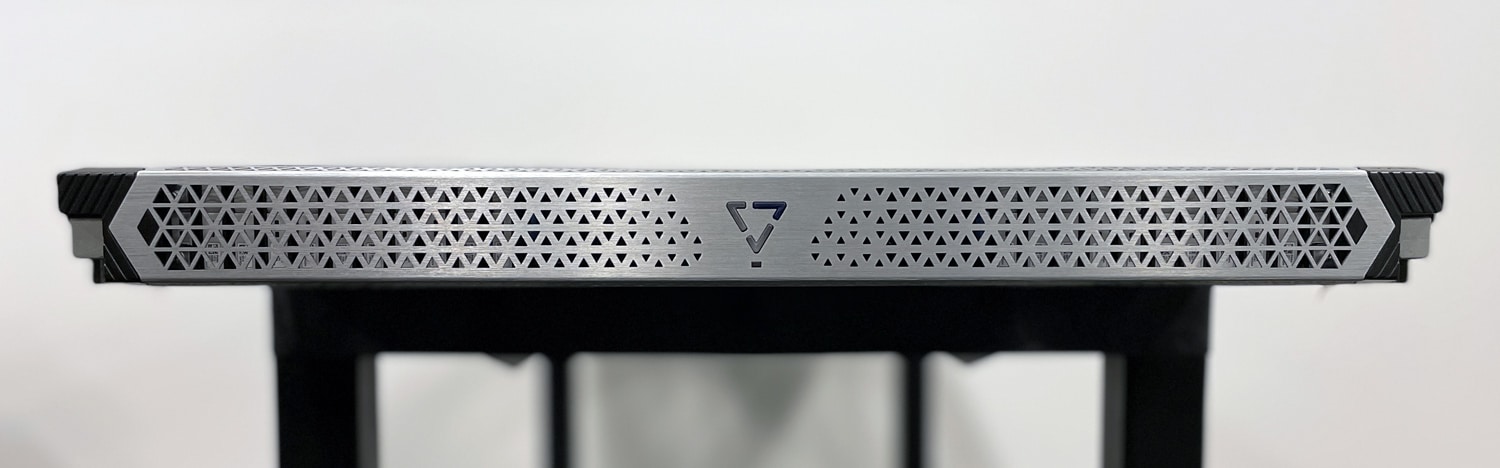
Platform: VAST AI Operating System, built on the DASE (Disaggregated, Shared-Everything) architecture. Stateless compute containers front a pool of NVMe enclosures over NVMe-oF and present a single namespace across file, object and database access. All-QLC media with a storage-class-memory write buffer.
Named deployments: CoreWeave, under a 1.17 billion dollar multi-year agreement announced in November 2025, which VAST describes as its largest customer. VAST was also added to the xAI Colossus Frontier AI Factory expansion, and it powers Mistral Compute AI factories running on NVIDIA GB300 NVL72.
NVIDIA validation: NVIDIA-Certified Storage launch partner, and validated for DGX SuperPOD.
Audited result: None. VAST has never submitted to MLPerf Storage.
Open claims: A joint VAST and AMD claim of 9x faster time-to-first-token through KV cache offload on Instinct, from vendor testing. The April 2026 Series F at a 30 billion dollar valuation sets expectations, but it is not a performance number.
Our coverage from the past year:
- VAST and AMD claim 9x faster time-to-first-token with KV cache offload (Jul 2026)
- Cloudera and VAST take aim at GPU starvation (Jul 2026)
- VAST powers Mistral Compute AI factories on GB300 NVL72 (May 2026)
- VAST unveils its agentic AI OS (Feb 2026)
- VAST Amplify aims to make existing SSDs feel 6x bigger (Jan 2026)
- VAST introduces DPU-native inference architecture (Jan 2026)
WEKA
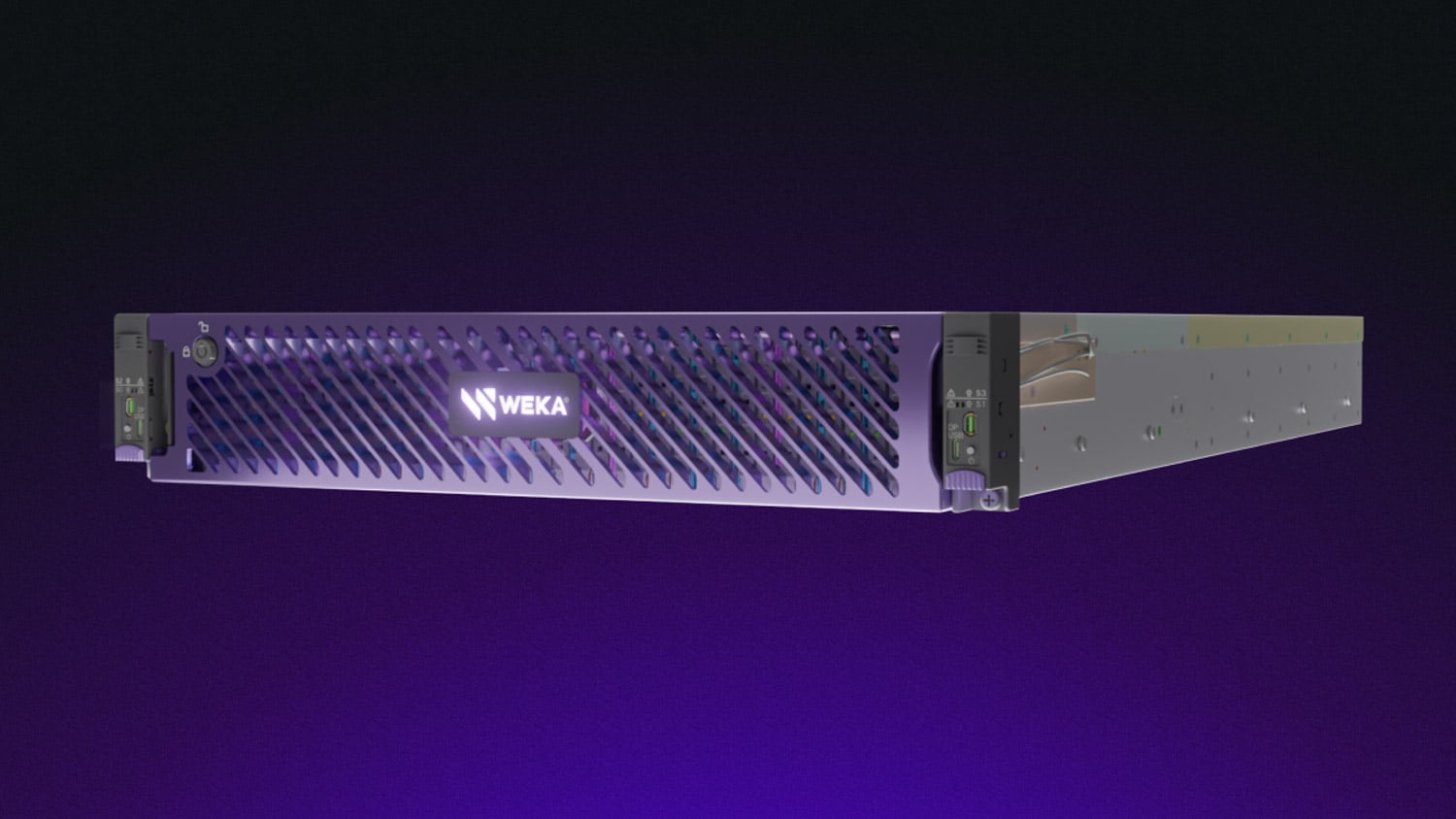
Platform: NeuralMesh, the software-defined parallel file system formerly known as WekaFS, sold as software and as WEKApod appliances. NeuralMesh Axon embeds the same data plane inside GPU servers so local NVMe joins the cluster instead of sitting idle.
Named deployments: Nebius runs NeuralMesh as the premium tier of its AI cloud. Andromeda standardized on NeuralMesh across roughly 50 GPU providers in July 2026. WEKA is also part of the multi-vendor stack at CoreWeave.
NVIDIA validation: NVIDIA-Certified Storage launch partner, with DGX SuperPOD and BasePOD validations.
Audited result: WEKA submitted to MLPerf Storage v1.0 in September 2024 but did not submit to v2.0 in August 2025. Its most recent audited numbers are a generation old.
Open claims: WEKApod 3 with NeuralMesh 6 is claimed at 1.1 EB and 10.2 TB/s in a single rack. Vendor figures, no audited submission behind them.
Worth knowing: HPE ended its WEKA, Qumulo and Scality partnerships in November 2025, so WEKA no longer reaches buyers through the HPE channel.
Our coverage from the past year:
- Andromeda standardizes on NeuralMesh across 50+ GPU providers (Jul 2026)
- WEKApod 3 breaks the single-rack exabyte barrier (Jul 2026)
- NeuralMesh AIDP reaches general availability (Mar 2026)
- NeuralMesh integrates with NVIDIA STX for inference memory (Mar 2026)
- WEKApod Prime and Nitro next-generation platforms (Nov 2025)
DDN
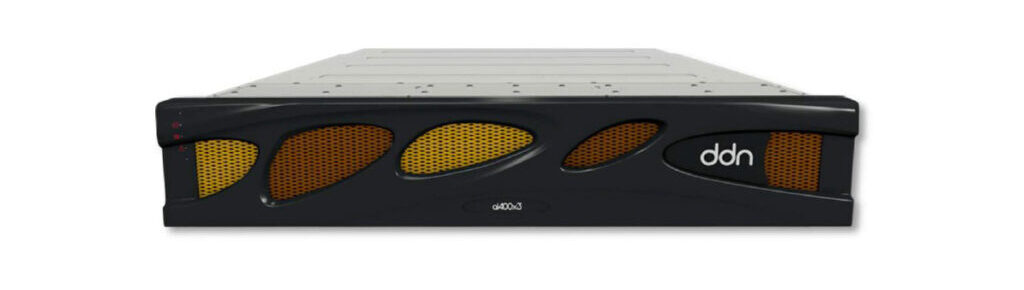
Platform: Two lines. EXAScaler, the Lustre-derived parallel file system behind the AI400X3 and AI400X3M appliances, handles training. Infinia, a key-value object platform that added multi-tenancy and POSIX support in 2.4, targets inference and AI factory workloads.
Named deployments: xAI Colossus, announced in November 2024 at 200,000 GPUs, on EXAScaler and Infinia. DDN also holds a long list of national lab and HPC installs that predate the AI cycle.
NVIDIA validation: NVIDIA-Certified Storage launch partner, with DGX SuperPOD validation.
Audited result: Yes, and it is current. In MLPerf Storage v2.0 the AI400X3 sustained 120.68 GB/s on 3D U-Net across multiple nodes, and handled Llama3-8b checkpoints at 30.6 GB/s read and 15.3 GB/s write from a 2RU appliance. On evidence, DDN is the strongest entry in this list.
Open claims: KV cache acceleration through NVIDIA Dynamo, validated jointly with Nebul rather than by an independent body.
Our coverage from the past year:
- DDN launches the AI400X3M at ISC 2026 (Jun 2026)
- Infinia 2.4 adds multi-tenancy and POSIX support (Jul 2026)
- DDN and Nebul validate KV cache acceleration (Jul 2026)
DDN led MLPerf Storage v2.0 on performance density but did not submit to the v3.0 round.
Hammerspace
Platform: The Hammerspace Global Data Platform, and Tier 0, which turns the local NVMe already sitting inside GPU servers into shared, checkpoint-capable capacity. It is built on standards, parallel NFS (NFS 4.2 with FlexFiles), and runs on ordinary servers rather than a proprietary appliance. There is no Hammerspace box to photograph, which is the point of the architecture.
Named deployments: Meta documented Hammerspace across two 24,576-GPU H100 clusters on its own engineering blog. That is the most specific first-party account of a large-scale AI storage deployment from any vendor on this page, because the operator wrote it rather than the vendor.
NVIDIA validation: None. Hammerspace holds no DGX SuperPOD, DGX BasePOD, NCP reference architecture or NVIDIA-Certified Storage designation.
Audited result: Yes, in both MLPerf Storage v1.0 and v2.0. In v2.0, Tier 0 delivered 420.8 GB/s on 3D U-Net across five nodes at 96.4 percent accelerator utilization, feeding 140 simulated H100s. Hammerspace has the best audited participation record in this list and the weakest NVIDIA validation story, the inverse of nearly everyone else here.
Our coverage: Hammerspace has not been through the StorageReview lab, and our recent coverage is thin. That is a gap on our side, not a knock on the platform.
Hammerspace, a v2.0 submitter, also sat out the v3.0 round.
Dell Technologies
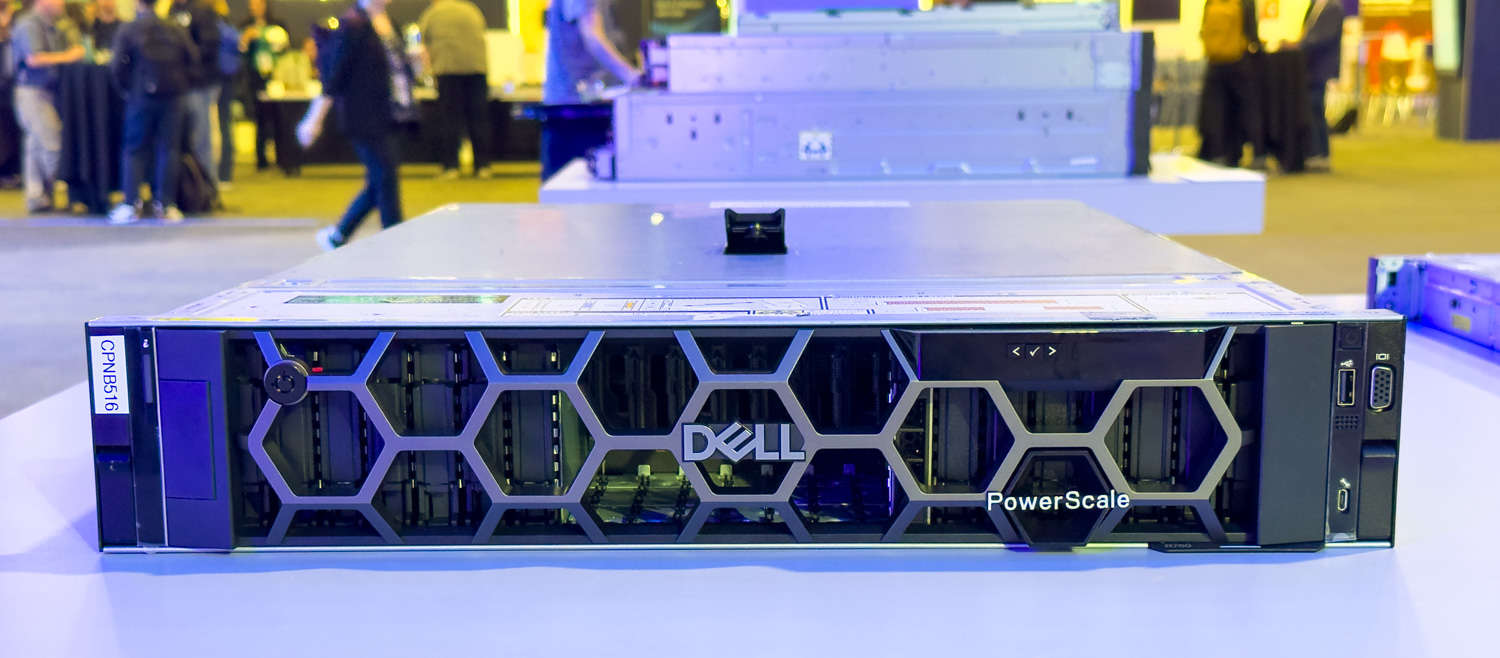
Platform: Three things, aimed at different parts of the pipeline. PowerScale is the scale-out NAS line, with all-flash F-series nodes. ObjectScale is the S3 layer, which picked up S3 over RDMA and KV cache offload in 2026. Lightning File System is a new parallel file system that went GA in April 2026 and is the piece Dell positions against DDN, VAST and WEKA.
Named deployments: We could not confirm a named large-scale AI training deployment on Dell storage. The most concrete public reference is Subaru, which runs a driver-safety AI lab on PowerScale. For a vendor of this size, that is a striking gap next to the neocloud wins the AI-native vendors publicize.
NVIDIA validation: NVIDIA-Certified Storage launch partner, and PowerScale earned NVIDIA Cloud Partner program certification in July 2025.
Audited result: None. Dell has never submitted to MLPerf Storage.
Open claims: Dell calls Lightning the world’s fastest parallel file system on the strength of internal analysis, and quotes Exascale Storage at multiple TB/s per rack. Both sit in the claims tracker below. A practical caveat for buyers: Lightning is GA, but it is scoped at AI factory builds, and most readers will not see it on a standard quote.
Our coverage from the past year:
- Dell holds its Leaders position in the 2026 Gartner MQ for Enterprise Storage (Aug 2026)
- ObjectScale hits 9.83PB in 2U with 245TB Kioxia SSDs and S3 over RDMA (Aug 2026)
- Dell outsells the rest of IDC’s top five combined in Q1 external storage (Jul 2026)
- Inside the PowerStore Gen 3 reset (May 2026)
- Lightning File System and Exascale Storage at GTC 2026 (Mar 2026)
- Our PowerEdge R5715 review, a storage-forward 2U we tested hands-on (Mar 2026)
HPE
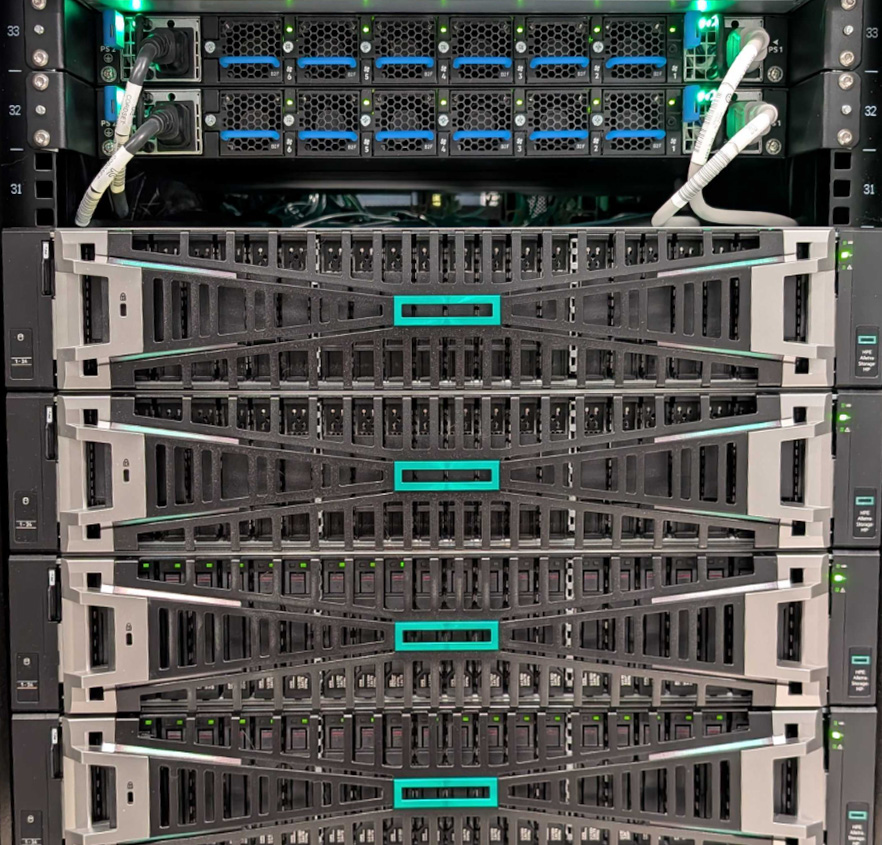
Platform: Alletra Storage MP, split into the B10000 for block and the X10000 for object, plus GreenLake for File. HPE also sells the compute and networking around it, which is how most of its AI storage actually ships.
Named deployments: Sovereign AI and AI factory builds where HPE supplies the full stack. No named neocloud win comparable to the VAST, WEKA or DDN examples above.
NVIDIA validation: NVIDIA-Certified Storage launch partner, with DGX BasePOD and SuperPOD validations.
Audited result: HPE has appeared in every MLPerf Storage round, v1.0 through v3.0, which puts it ahead of Dell and NetApp on participation. Read the file-side entries carefully, though: HPE’s strongest AI file results came through co-submissions with WEKA, and HPE ended that partnership, along with Qumulo and Scality, in November 2025. Those results no longer describe a product HPE can sell you today.
Our coverage from the past year: We have tested the Alletra platform hands-on.
- HPE holds its Leaders position in the 2026 Gartner MQ for Enterprise Storage (Aug 2026)
- Alletra Storage MP B10000 with NIST CSF 2.0, our hands-on testing (Jun 2026)
- Alletra Storage MP X10000 with the Data Protection Accelerator node (Feb 2026)
- CloudCasa adds Kubernetes DR for the B10000 (Jun 2026)
- MLPerf Storage v3.0: 345.8 GiB/s on 3D U-Net with the K3000, one of only two vendors on this page to submit this round.
IBM
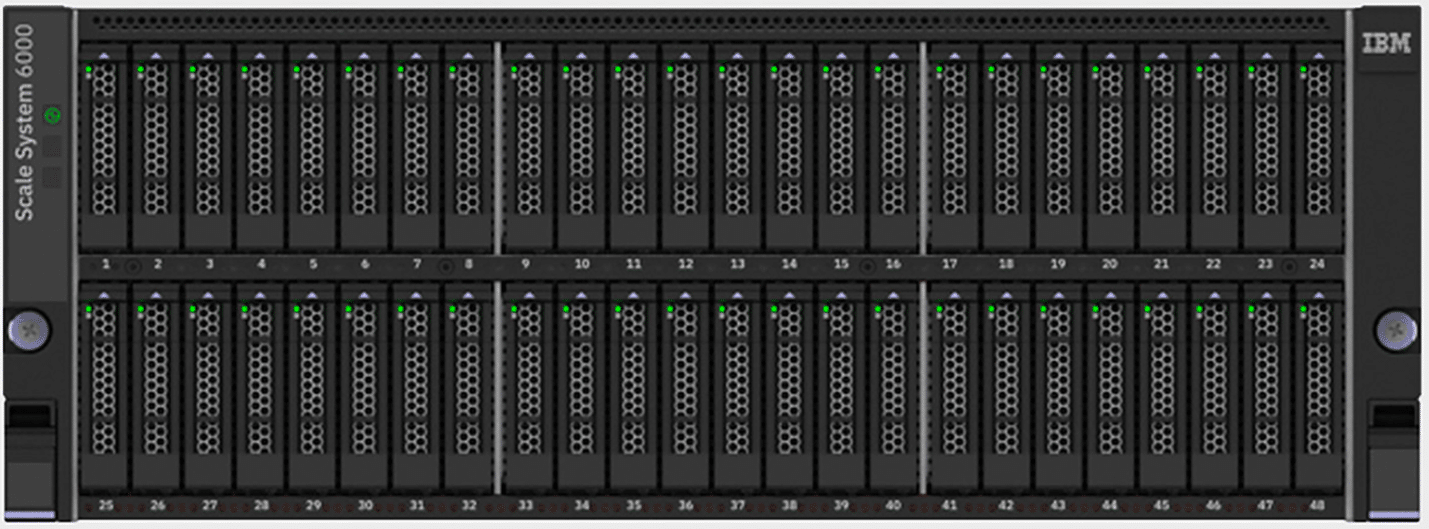
Platform: IBM Storage Scale, the parallel file system with GPFS lineage, sold as software and as Storage Scale System appliances, with Fusion packaging it for Kubernetes and AI pipelines.
Named deployments: Part of the multi-vendor stack at CoreWeave. IBM Cloud is also building a 240 million dollar dedicated HGX B300 inference cluster with Together AI, announced August 2026, though the storage layer has not been disclosed.
NVIDIA validation: NVIDIA-Certified Storage launch partner.
Audited result: Yes, in MLPerf Storage v2.0, including the checkpointing workload, where Storage Scale posted 656.7 GiB/s read on a Llama 3.1 1T model. Checkpoint restore is the metric that decides how much of a frontier training run you lose to a failure, and very few vendors have published an audited number for it.
Open claims: Nothing outstanding in the fastest-array category. IBM markets Storage Scale on scale and integration rather than a headline throughput record.
Our coverage from the past year:
- IBM holds its Leaders position in the 2026 Gartner MQ for Enterprise Storage (Aug 2026)
- IBM and Together AI put $240M into a dedicated HGX B300 inference cluster (Aug 2026)
- IBM introduces Content-Aware Storage for RAG workloads (Apr 2026)
- Next-generation FlashSystem with agentic AI (Feb 2026)
- Storage Scale System 6000, unified storage for AI and HPC (Nov 2025)
- Our IBM FlashSystem 5300 review, hands-on with IBM’s compact array and useful flavor for how the bigger systems behave (Sep 2024)
Everpure (formerly Pure Storage)
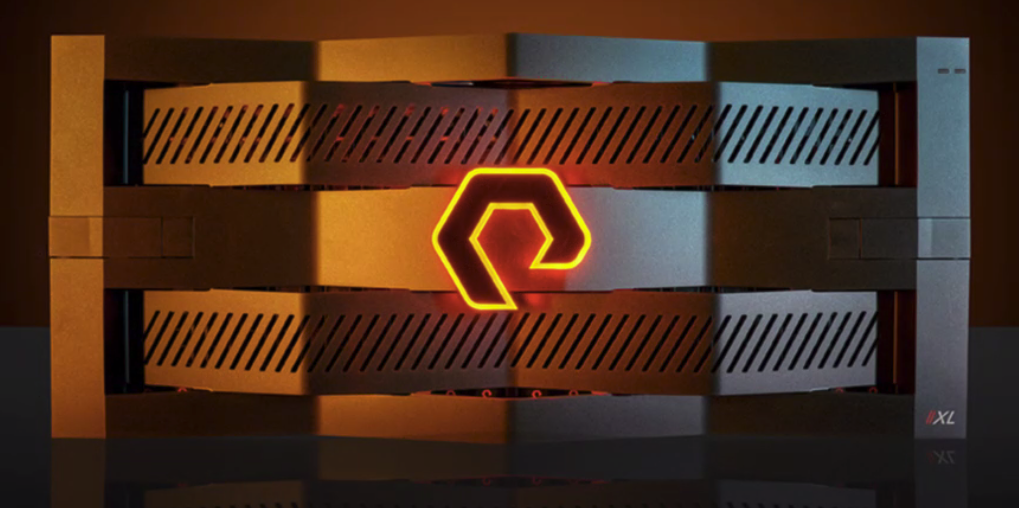
Platform: FlashBlade//EXA is the AI entry, splitting metadata and data paths so the data plane scales independently. FlashBlade//S and FlashArray cover the rest. Everpure builds its own DirectFlash Modules rather than buying finished SSDs, which is why its density and endurance figures do not track the rest of the market. The company legally became Everpure on February 23, 2026.
Named deployments: Part of the multi-vendor stack at CoreWeave. We could not confirm a named AI training deployment on FlashBlade//EXA specifically.
NVIDIA validation: NVIDIA-Certified Storage launch partner.
Audited result: MLPerf Storage v3.0 (September 2026), Everpure’s first submission: 877.5 GiB/s checkpoint write with 833.0 GiB/s read at 30 FlashBlade//EXA data nodes, the largest checkpoint numbers of the round, plus the round’s biggest KV cache result at 1,623.4 GiB/s. It also holds the SPECstorage Solution 2020_ai_image record at 6,300 AI Jobs, published February 17, 2026. Different benchmark, different workload model, but it is a real submission under a published rule set with a review process, and it counts.
Open claims: FlashBlade//EXA is marketed as the industry’s highest performing data storage platform, with projected throughput above 10 TB/s in a single namespace. Projected, not measured.
Our coverage from the past year:
- Everpure tops both axes of the 2026 Gartner MQ for the second straight year (Aug 2026)
- Everpure launches Data Stream for enterprise AI pipelines (Jun 2026)
- Data Intelligence and Enterprise Data Cloud enhancements (Jun 2026)
- Emulex SecureHBA with the Everpure XL130 R5, not an AI benchmark, but hands-on time with Everpure hardware (Mar 2026)
- MLPerf Storage v3.0 (September 2026): first submission, 877.5 GiB/s checkpoint write and 833 GiB/s read on FlashBlade//EXA, plus 1,623 GiB/s KV Cache read, the largest checkpoint and inference numbers of the round. Full v3.0 coverage.
NetApp
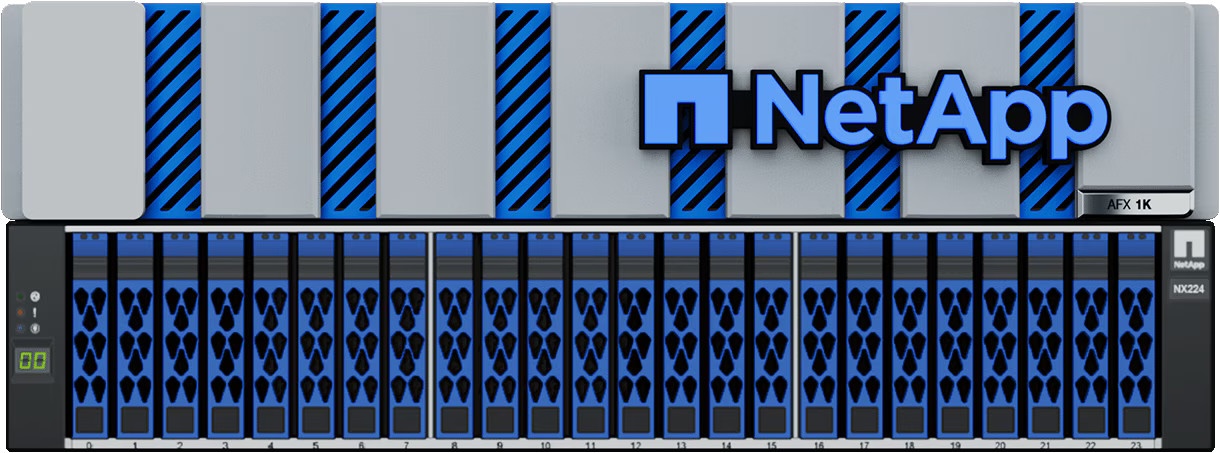
Platform: AFX, announced in October 2025, is disaggregated all-flash ONTAP built for AI data pipelines, with the AI Data Engine layered on top. AIPod is the NVIDIA-validated reference design.
Named deployments: None we can confirm at AI training scale. The strongest public artifacts are validated architectures rather than customer names, including the FlexPod AI designs with Cisco from June 2026.
NVIDIA validation: NVIDIA-Certified Storage launch partner, with DGX SuperPOD certification.
Audited result: None. NetApp has never submitted to MLPerf Storage.
Our coverage from the past year:
- NetApp holds its Leaders position in the 2026 Gartner MQ for Enterprise Storage (Aug 2026)
- HCLTech pairs Keystone with U4X for consumption-based AI storage (Aug 2026)
- NetApp buys DataPelago for GPU data processing (Jul 2026)
- StorageGRID 12.1 adds a federated namespace and up to 12 TB/s (Jun 2026)
- FlexPod validated AI architectures with Cisco (Jun 2026)
- The AFX launch (Oct 2025)
A Note on Huawei
Huawei posted the highest absolute throughput in MLPerf Storage v2.0, 698 GiB/s on 3D U-Net from an 8U dual-node OceanStor A800 feeding 255 simulated H100s, and it is listed in the audited table below. We leave it out of the leader profiles because it is not a practical purchase for buyers in the US, Europe or most of the markets this page serves. The number is real; the availability is not. The 2026 Gartner Magic Quadrant reaches the same balance from the other direction, keeping Huawei in its Leaders quadrant on the strength of OceanStor outside North America.
What the Analysts Say
Analyst placement is its own class of evidence: not an audited benchmark, but an independent assessment of execution and vision, which is closer to how these systems are actually bought. In the 2026 Gartner Magic Quadrant for Enterprise Storage Platforms, the same six vendors hold the Leaders quadrant as last year: Everpure, Huawei, HPE, NetApp, Dell, and IBM, with Everpure highest on ability to execute and furthest on completeness of vision for the second consecutive year. Two scoping notes matter for this page. Gartner evaluates the primary storage market and tracks the high-performance file and object crowd in separate research, which is where the AI-native specialists above live, so their absence from the Quadrant is a category boundary, not a verdict. And when six of eight evaluated vendors earn the Leader label, the label itself tells buyers little; the relative positions carry the signal.
What Would Change This List
Four things, in order of how much weight we would give them. A vendor gives us access to test its platform under our methodology, whether that is hardware we can host ourselves or access to a larger deployment. A vendor submits to a current audited round, MLPerf Storage or SPECstorage. An operator, rather than a vendor, documents a deployment the way Meta did with Hammerspace. Or a vendor loses a designation or partnership that its current positioning depends on, the way the WEKA and HPE split changed how both companies reach AI buyers. We update the profiles as those happen.
What the Audited Benchmarks Actually Show
AI training and the neocloud providers that serve it are where the storage performance race is actually being run in 2026, and it is the one segment with a healthy audited benchmark: MLCommons MLPerf Storage. The current published round is v3.0 (September 2026), with 19 submitting organizations and 143 results. For the first time the benchmark spans the full AI pipeline: training throughput, checkpointing, and two new inference tests (Vector Database and KV Cache), plus S3 object storage support that about one-sixth of submissions used. Because v3.0 moved its simulated accelerators from H100 to B200, results are not comparable with earlier rounds. MLPerf Storage does not crown a single winner; different systems lead different workloads and metrics.
| System | Audited Result (MLPerf Storage v3.0) | Class |
|---|---|---|
| Everpure FlashBlade//EXA | 877.5 GiB/s checkpoint write and 833 GiB/s read at 30 data nodes; 1,623 GiB/s KV Cache read | Checkpointing and inference leader |
| YanRongTech F9000X | 543.9 GiB/s on 3D U-Net feeding 99 simulated B200 accelerators | Highest training throughput submitted |
| TuringData F9200 | 541.5 GiB/s on 3D U-Net from three storage nodes; Checkpoint-70B at 539.9 GiB/s read and 307.1 GiB/s write | Performance density newcomer |
| Azure Managed Lustre | 642.2 GiB/s checkpoint write from a 4,096TiB managed cloud deployment | First hyperscale cloud service submitted |
| NVIDIA AIStore | 20 submissions over S3 object storage across OCI, AWS, and GCP | Object storage in parallel-file-system territory |
On the HPC side, the IO500 list (ISC 2026 edition) is led by Sugon ParaStor at SCNet with 26,888 GiB/s of measured bandwidth across 500 client nodes, with Intel DAOS systems (Argonne Aurora, LRZ) holding multiple top slots and Weka appearing via Samsung SSC-24. The v3.0 turnover is as newsworthy as the numbers: the v2.0 throughput leaders DDN, Huawei, Hammerspace, and Lightbits all sat this round out, while 11 first-time submitters showed up, Azure and NVIDIA among them. Full analysis in our MLPerf Storage v3.0 coverage.
Who Actually Powers the Neoclouds
Deployment wins are not benchmarks, but they are real evidence of what operators buy when performance is their business. Note that the largest AI factories are multi-vendor; no single storage company owns any of these sites outright.
| AI Cloud | Storage | Details |
|---|---|---|
| CoreWeave | VAST Data (plus WEKA, DDN, IBM Storage Scale, Everpure in the stack) | 1.17 billion dollar multi-year agreement, November 2025, VAST’s largest customer |
| xAI Colossus | DDN EXAScaler and Infinia, with VAST Data added in the Frontier AI Factory expansion | DDN announced November 2024 at 100K GPUs; multi-vendor as of late 2025 |
| Nebius | WEKA NeuralMesh | Premium tier of Nebius AI Cloud, announced June 2025 |
| Together AI | IBM Cloud (HGX B300 systems) | 240 million dollar deal announced August 2026; storage layer not yet disclosed |
The Claims Tracker
These are the current “fastest” claims in the AI storage segment. None have been independently verified, and each is footnoted by its vendor as internal testing.
| Vendor Claim | Number | Status |
|---|---|---|
| Everpure FlashBlade//EXA, “industry’s highest performing data storage platform” (March 2025) | Projected 10+ TB/s reads in a single namespace | Vendor projection; no audited submission |
| Dell Lightning File System, “world’s fastest parallel file system” (GA April 2026) | Up to 150 GB/s per rack unit, based on Dell internal analysis | Vendor claim; no audited submission |
| Dell Exascale Storage (GTC 2026) | Up to 6 TB/s per rack | Vendor claim; no audited submission |
| Huawei New-Gen OceanStor Dorado (Sept 2024) | 100 million IOPS spec-sheet ceiling at 0.03 ms latency | Vendor spec; a Huawei-commissioned Omdia test measured 2.58M sustained IOPS at 70 microseconds on a real Oracle RAC workload, a useful reality check on spec-sheet maximums |
| WEKA, WEKApod 3 with NeuralMesh 6, single-rack exabyte claim (July 2026) | 1.1 EB and 10.2 TB/s in one rack | Vendor claim; WEKA last submitted to MLPerf Storage in v1.0 and skipped v2.0 |
| VAST Data and AMD, KV cache offload on Instinct (July 2026) | 9x faster time-to-first-token | Joint vendor testing; VAST has never submitted to MLPerf Storage |
| DDN and Nebul, KV cache acceleration with NVIDIA Dynamo (July 2026) | Vendor-stated speedup on inference workloads | Partner validation, not an independent audit; DDN does have current MLPerf Storage v2.0 results |
Whatever Happened to SPC-1?
SPC-1 was the industry’s block-storage benchmark of record, and it is now semi-dormant: US vendors effectively abandoned it around 2018, leaving a leaderboard dominated by Chinese vendors. The current accepted record is not the widely cited Huawei result. ExponTech WDS V3 holds the top accepted score at 27.2 million SPC-1 IOPS (accepted November 2023), ahead of Inspur at 23.0 million, with Huawei’s famous 21.0 million from 2020 now fourth. A higher FlashNexus submission of 30.0 million IOPS has sat unaccepted in review since February 2025, and we do not treat it as a record until the Storage Performance Council does.
How This Page Works
Three rules. First, every number is labeled by its evidence class: audited submission, vendor claim, or StorageReview measurement. Second, we do not repeat superlatives we cannot source to current data; several famous “fastest” claims on this page are years old and are marked accordingly. Third, the path onto the verified side of this page is open to any vendor: submit to MLPerf Storage or IO500, or give us access to test under our standard methodology. This page covers AI and neocloud storage only. Mainstream enterprise block and file, and SMB storage, are getting their own pages rather than being folded in here, because the evidence available in each segment is different. We update the leader profiles as news lands, and do a full pass when a new audited round publishes.
Fastest Storage FAQ
What is the fastest storage array in the world?
There is no single verified answer, and anyone who gives one is quoting a vendor. On audited data as of September 2026: Everpure’s FlashBlade//EXA posted MLPerf Storage v3.0’s biggest checkpoint number at 877.5 GiB/s write, YanRongTech’s F9000X led training throughput at 543.9 GiB/s, Sugon ParaStor tops the IO500 bandwidth list, and ExponTech holds the accepted SPC-1 IOPS record. The biggest claimed numbers, including Dell’s per-rack Exascale Storage projections, remain independently unverified.
What is the fastest storage for AI training?
Judged by MLPerf Storage v3.0, the only audited AI storage benchmark, the training-throughput leaders are YanRongTech, TuringData, and UBIX, while Everpure leads checkpointing and KV cache inference and Azure leads among cloud services. Judged by what the largest AI operators deploy, VAST, DDN, and WEKA dominate the neocloud wins, though none of the three submitted to v3.0. Both kinds of evidence appear above, labeled.
Why are there so few independent benchmarks of enterprise arrays?
Because most enterprise storage vendors contractually prohibit publishing benchmark results, and the mainstream array makers abandoned the public benchmarks they once used, notably SPC-1, around 2018. The vendors serving AI have partially reversed the trend because MLPerf Storage participation became a sales requirement. We update this page as new audited results publish.
Should quantum-resistant encryption factor into an array purchase?
For regulated industries, yes, and the deadlines are closer than they look. The NSA’s CNSA 2.0 guidance requires new National Security System installations to comply by January 2027, with decommissioning of non-compliant systems by the end of 2030, and the EU’s NIS2 and DORA frameworks carry their own encryption requirements. The completed FC-SP-3 standard makes this a procurement detail rather than a project: FC-SP-3-capable HBAs encrypt SAN traffic in flight at line rate with post-quantum algorithms, and because encryption happens at the transport layer, the array still receives data it can compress, deduplicate, and scan for ransomware anomalies, the services application-level encryption defeats. Specifying FC-SP-3 connectivity in normal three-to-five-year refresh purchases delivers a fully encrypted SAN by 2030 as a byproduct. Our FC-SP-3 deep dive covers the standard, the deadlines, and the deployment models.


 Amazon