

Dell Technologies today expanded its cyber resilience portfolio across AI environments, identity systems, and storage infrastructure. The piece that matters most for storage buyers is now a date: the next Dell PowerStore software release, due in November, adds quantum-safe encryption of data in flight over Fibre Channel when paired with supported PowerEdge servers. Around it sit PowerProtect snapshot orchestration for PowerScale with SmartSync to ObjectScale in December, identity platform recovery for Active Directory, Microsoft Entra ID, and Okta available now, a managed identity threat service, and two Dell AI Factory services.

Quantum-Safe Fibre Channel Encryption Arrives in November
Dell describes the PowerStore feature as protection against harvest-now, decrypt-later attacks on SAN traffic, and the hardware behind it is the Emulex SecureHBA. Every PowerStore Gen 3 can be ordered with EDIF-capable Fibre Channel OCP cards, which Dell told us at the PowerStoreOS 5.0 launch would light up through a non-disruptive update this fall. Broadcom’s account of the Elite launch puts Emulex SecureHBAs at 64G and 32G in the array, and the same adapters have shipped in PowerEdge since March 2025, with more than 80,000 ports in the field by May.
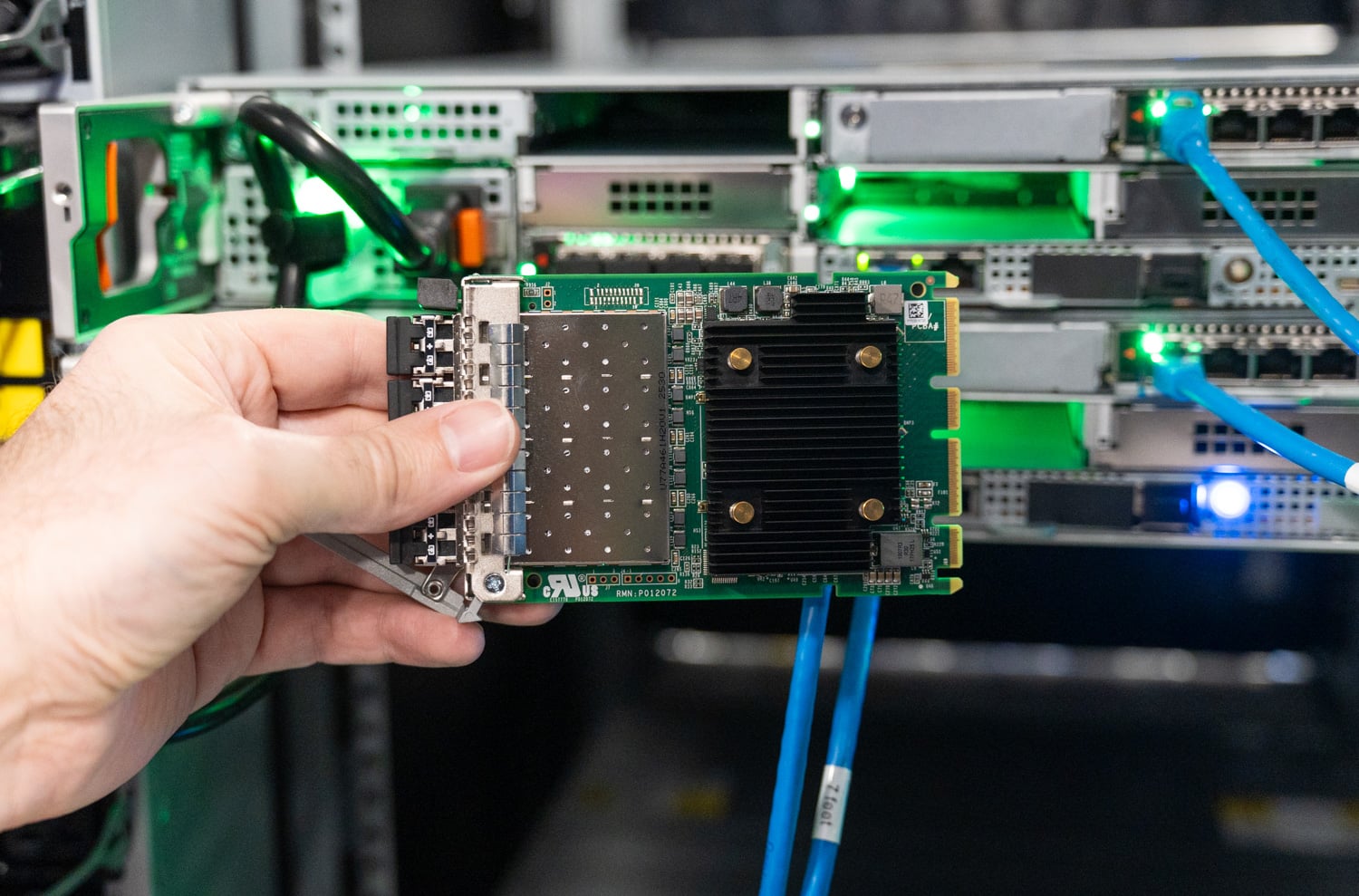
The encryption is session-based and negotiated between adapters, with AES-GCM-256 on the wire, ML-KEM-1024 key exchange, and ML-DSA-87 signed certificates for mutual authentication, the CNSA 2.0 algorithm set that FC-SP-3 standardized this year. Because the traffic is decrypted in the array’s adapter, PowerStore still sees plaintext for deduplication, compression, and Cyber Detect, which is the distinction Dell’s own storage leadership has drawn between fabric encryption and application-layer encryption. Alongside it, the Dell Post-Quantum Readiness Assessment, also due in November, inventories cryptographic exposure across IT infrastructure and devices, ranks risks by criticality, and prioritizes migration actions.
PowerProtect Reaches Into PowerScale and Identity Platforms
A deeper PowerProtect and PowerScale integration, available in December, automatically initiates, schedules, and manages retention-locked local snapshots on PowerScale for rapid recovery. PowerScale SmartSync support then synchronizes those snapshots to Dell ObjectScale for an additional recovery copy and long-term retention, which gives file customers a second copy on object storage without a separate backup job.
NOUVEAU PowerProtect identity resilience capabilities, available now, restore a clean, trusted copy of Active Directory, Microsoft Entra ID, and Okta so an organization is not rebuilding access controls by hand after an incident. Dell Managed Detection and Response for Identity, also available now, adds 24×7 monitoring and response for suspicious authentication activity, compromised accounts, and privilege misuse; when the service detects defined attack patterns, Dell’s team can initiate automated response actions to contain the threat.
AI Factory Services and the PowerProtect AI Assistant
Two services target the Usine d’IA Dell. Security Hardening for Dell AI Factory, available in October, has Dell experts assess the physical, virtual, and application layers of a deployment, identify configuration risks that could affect AI workloads, and deliver prioritized recommendations. Resilience Operations for AI, available now, starts by identifying the AI capabilities the business cannot run without, then builds the recovery policies and procedures around them and delivers a prioritized plan for what to protect and how to recover it.
The PowerProtect AI Assistant gains an expanded conversational interface for assets, tasks, restores, and reporting. Proactive daily briefs surface potential risks before they escalate, and a human-in-the-loop approval workflow lets teams review and approve actions before they are taken. Those expanded capabilities are available now.
“Organizations are trying to protect their AI environments, identity systems and infrastructure with tools and strategies that were designed for yesterday’s threats,” said Simon Jelley, vice president, Cyber Resilience, Dell Technologies. “Dell has the portfolio, the services and the operational expertise to help organizations strengthen cyber resilience and close the gaps between where threats are headed and where most strategies stand today.”


 Amazon