

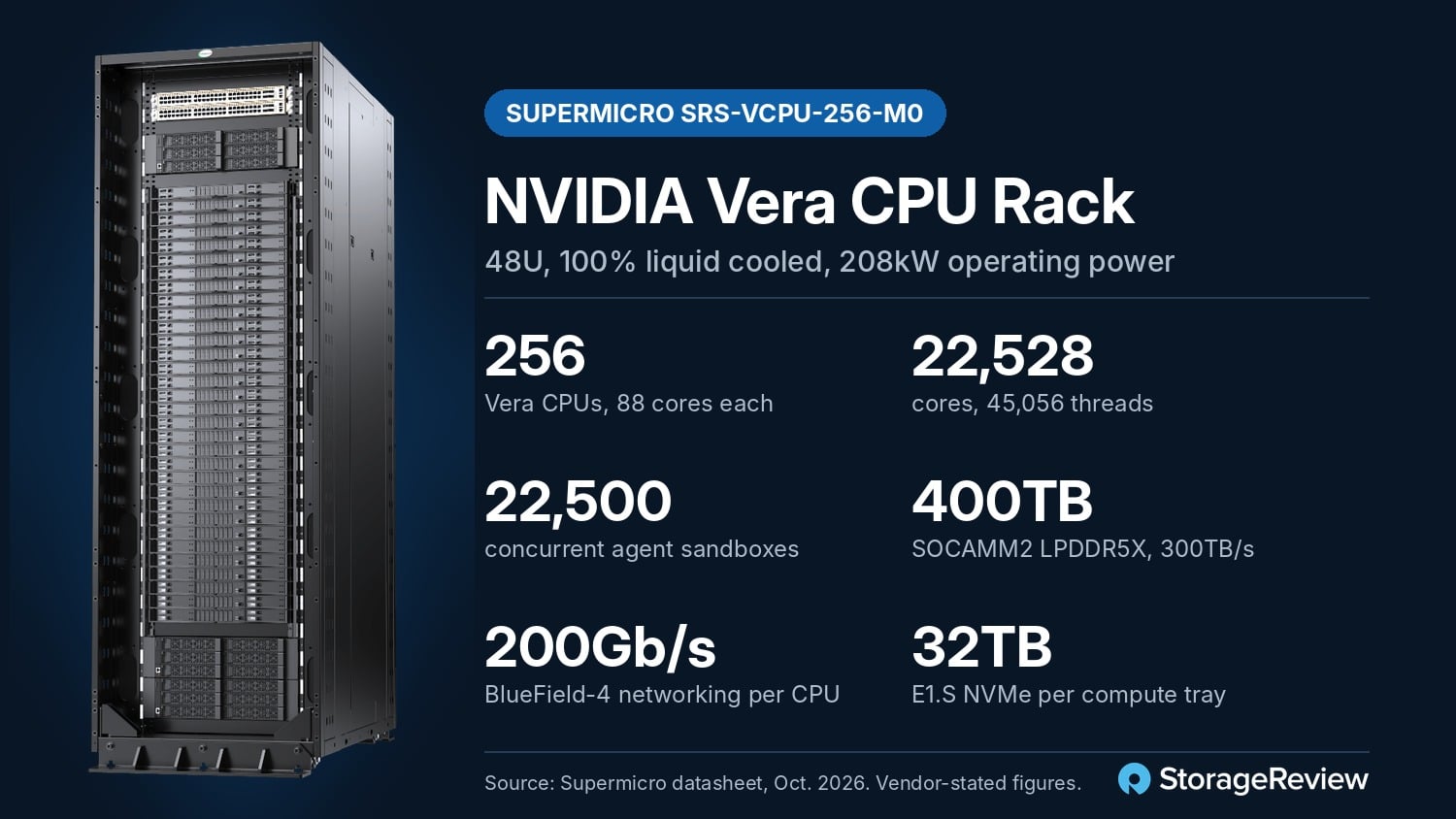
Supermicro announced the NVIDIA Vera CPU rack today, a 48U, 100 percent liquid-cooled rack that holds 256 NVIDIA Vera CPUs, 22,528 cores, and 45,056 threads and that Supermicro rates for up to 22,500 concurrent agent sandboxes. It is the newest member of the Data Center Building Block Solutions (DCBBS) portfolio, built to run beside the Supermicro Vera Rubin NVL72, which the company says is now shipping, or standalone as a dense CPU rack for agent orchestration, reinforcement learning, and data processing. The rack is available to quote now; Supermicro has not given a ship date.
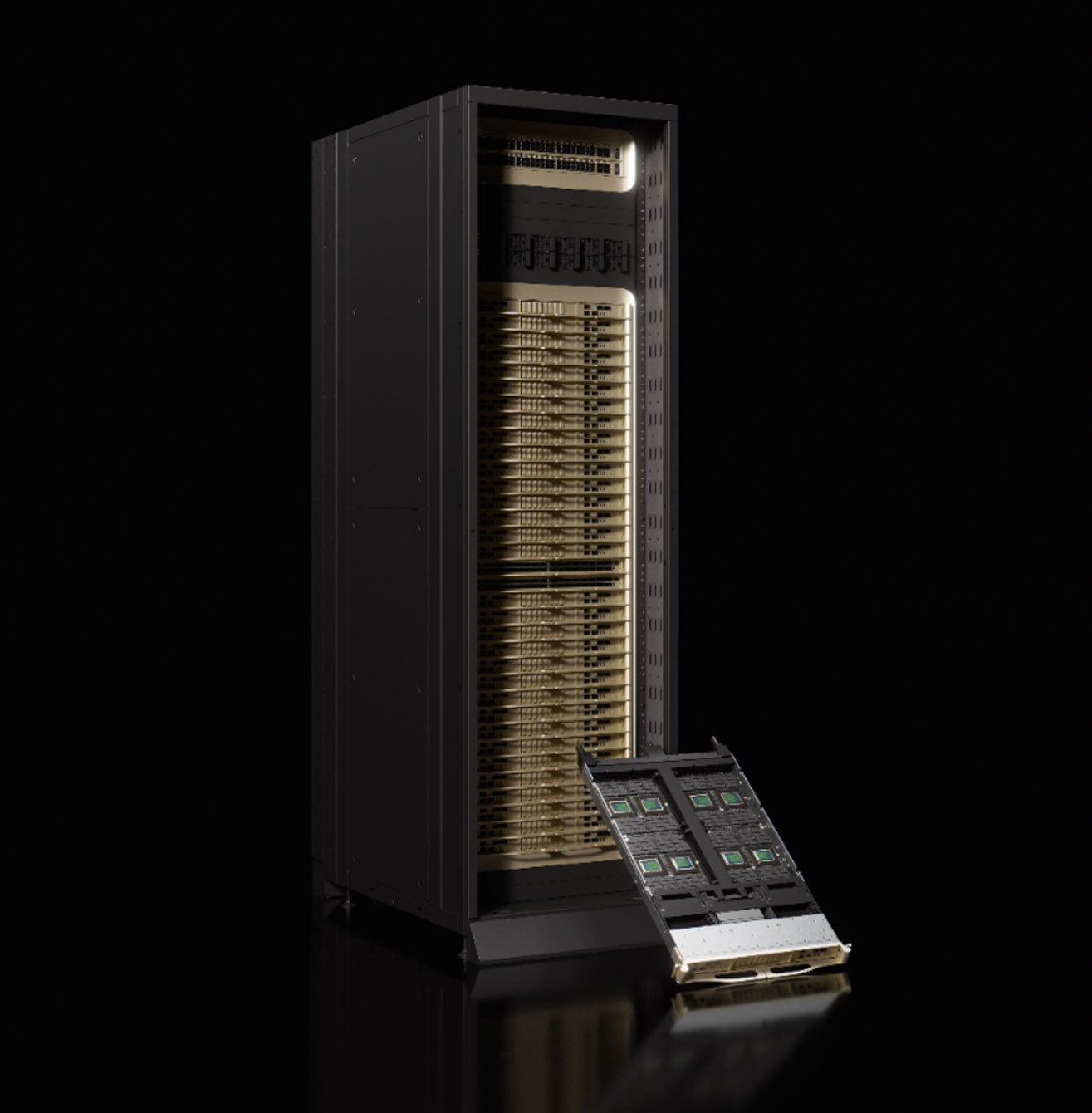
It is the second 256-CPU Vera rack announced this week, after the 戴尔 PowerEdge M9882 at GTC Berlin, and both follow NVIDIA’s Vera CPU Rack reference design with 88 cores per CPU. Dell lists the M9882 for Q1 CY27 and has not published its memory or networking configuration. Supermicro has published both, which makes this the first full set of rack-level figures for a Vera CPU rack from a system vendor.
Dedicated CPU Capacity for Agent Execution
Supermicro’s case for a CPU-only rack is that agentic AI and reinforcement learning turn linear inference chains into branched, looped execution with many intermediate steps that wait on CPU availability. GPUs generate the tokens, code, and queries; CPU-based sandboxes execute the actions, evaluate the results, run the tools, and orchestrate the workflow. At the scale of an AI factory with hundreds or thousands of GPUs, Supermicro says that means hosting thousands or millions of parallel execution environments, which is the job this rack is sized for.
Supermicro lists the rack as model SRS-VCPU-256-M0: 32 1U compute trays, each carrying four dual-CPU nodes for eight Vera CPUs per tray, up to 400TB of SOCAMM2 LPDDR5X per rack with 300TB/s of aggregate memory bandwidth (1.2TB/s per CPU, or 13.6GB/s per core), up to 1.8TB/s of NVLink-C2C bandwidth per CPU, and up to 32TB of E1.S NVMe per tray. Each tray carries four NVIDIA BlueField-4 DPUs for 200Gb/s per CPU, and the rack networks over an NVIDIA Spectrum-X Ethernet converged fabric with up to 400Gb/s north-south, two 1U top-of-rack switches, and 1G/10G management switches.
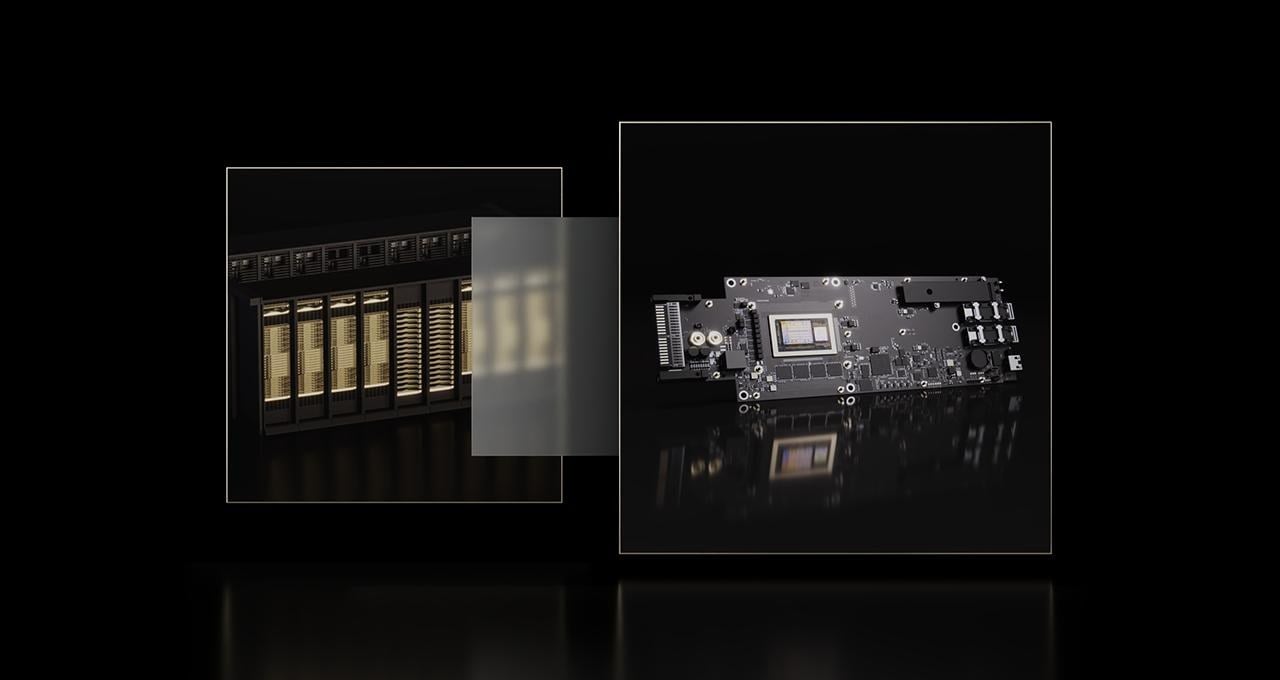
The 22,500-sandbox figure against 45,056 threads works out to two threads per sandbox. Supermicro does not say what memory allocation, workload, or software configuration that rating assumes, so treat it as a sizing ceiling for lightweight sandboxes until a reference configuration appears. As a standalone platform, Supermicro also lists database operations, cluster management, Slurm and Kubernetes scheduling, data analytics, and large-scale software build pipelines as target workloads, and the broader Supermicro Vera CPU portfolio includes air-cooled 1U and 2U systems for sites that cannot take liquid.
Third-Generation MGX Supports AC and 800 VDC Power
The rack uses the third-generation NVIDIA MGX design, part of Supermicro’s DLC-2 stack, so it shares infrastructure with the Supermicro 薇拉·鲁宾 NVL72. Supermicro puts it in a 48U MGX v1.2 busbar rack measuring 600 x 1,200 x 2,296mm with 208kW of operating power. Customers can feed it with three 3U 110kW AC power shelves (415 to 480VAC) in 2+1 redundancy, or with 800 VDC through three 90kW DC-DC shelves fed from a power sidecar rack.
The 800 VDC sidecar is what enables battery backup units in place of a conventional UPS for power-loss protection, and Supermicro says the arrangement frees data center floor space, can improve end-to-end power conversion efficiency, and lowers capital and operating cost. The announcement does not quantify any of those three claims. Cooling comes from the DLC-2 stack: an in-row coolant distribution unit rated up to 5MW with redundant pumps that can serve multiple racks, an optional rear door heat exchanger, and an optional 200kW or 500kW liquid-to-air sidecar CDU for sites without facility water.
For customers building on the Supermicro DCBBS Blueprints for Vera Rubin NVL72, Supermicro offers an optional design that pairs NVL72 racks with Vera CPU racks under a defined Spectrum-X network topology, hot-aisle containment layouts, and redundant in-row CDUs and rear door heat exchangers from the DLC-2 stack. One Supermicro team covers site survey, design, L11 and L12 integration and testing, on-site deployment, and ongoing support whether the CPU rack ships with an NVL72 or alone.
“As agentic AI transforms data center requirements, Supermicro is extending its DCBBS portfolio with fully integrated infrastructure,” said Charles Liang, president and CEO of Supermicro. “For customers seeking air-cooled deployments, Supermicro’s NVIDIA Vera CPU portfolio includes air-cooled 1U and 2U systems, in addition to rack-scale liquid cooling options. Together with NVIDIA, we help accelerate time to deployment with a common purpose-built architecture for secure, scalable agentic AI.”
OpenShell and Sentry Govern Agent Activity
The rack natively supports the NVIDIA OpenShell Reference Architecture that NVIDIA detailed at GTC Berlin this week. 开壳 runs on the Vera CPUs and applies least-privilege, policy-based controls to agents at runtime, while NVIDIA Sentry runs on the BlueField-4 DPUs as an out-of-band monitor that enforces policy, provides attested telemetry, and can quarantine an agent that moves outside its permitted boundaries in milliseconds. Because Sentry lives on the DPU, Supermicro says the monitoring keeps observability and auditability in production without consuming host CPU resources.
“As enterprises scale agentic AI and reinforcement learning, supporting thousands of concurrent agent workflows requires a new class of high-density CPU infrastructure,” said Chris Marriott, vice president of enterprise platforms at NVIDIA. “NVIDIA Vera CPUs and BlueField-4 DPUs, integrated with Supermicro’s liquid-cooled DCBBS architecture, give customers the dedicated compute and hardware-based security to scale the execution of agentic workloads across their AI factories.”
The CPU-only agent rack has turned into a category this month: AMD’s Helion blueprint packs up to 32,768 EPYC cores into an open OCP design, Dell’s M9882 arrives in Q1 CY27, and Supermicro’s version is quotable today with published specifications. What none of the three has published yet is a measured sandbox density on a named workload, which is the number that will decide how many of these racks an AI factory needs per NVL72 row.


 Amazon