

AMD has released ROCm 10, coinciding with the tenth anniversary of its open software stack, and made ROCm.AI generally available to developers. First introduced at Advancing AI 2026, ROCm.AI is an AI-native development platform intended to accelerate build, deployment, and optimization workflows on AMD hardware.
ROCm.AI combines three components, ROCm Hyperloom, AMD Skills, and the ROCm CLI, into a unified set of developer experiences. The platform is designed to bring AMD-specific expertise and agentic optimization directly into the tools developers already use.

According to AMD, a system configured with ROCm.AI delivers an average 3.3x inference performance improvement and a 2.4x training performance improvement over ROCm 7 on equivalent hardware, achieved through AI-driven optimization of kernels, memory management, and scheduling.
Autonomous Inference Optimization
ROCm Hyperloom functions as an autonomous agentic system for optimizing end-to-end inference workloads across both host code and GPU kernels. The system profiles a given workload, identifies performance bottlenecks, explores potential optimization paths, implements targeted code changes, and then benchmarks and validates the results for correctness.
With ROCm 10, Hyperloom expands its support for AMD Instinct GPUs and adds compatibility with the vLLM and SGLang inference frameworks. Developers can direct optimizations across HIP, Triton, and FlyDSL codebases, with Hyperloom generating reports that detail proposed changes alongside measured or projected performance gains. Hyperloom is accessible both as a standalone workflow and through integration with AMD Skills.
Curated Expertise for AI Coding Agents
AMD Skills delivers curated AMD technical knowledge and validated workflows directly into supported AI coding agents, including Claude Code, Cursor, and Codex. This gives developers AMD-specific guidance without leaving their existing development environment.
With ROCm 10, the AMD Skills catalog expands across three categories: client-native workflows for local AI and application integration, cross-stack workflows covering diagnostics, routing, and replay analysis, and server-native workflows for AMD Instinct GPUs and AMD EPYC processors, including serving, profiling, and performance analysis. Skills previewed at Advancing AI are now available through the Claude Code, Codex, and Cursor marketplaces, as well as an open catalog on GitHub. AMD states that each skill undergoes structural and behavioral testing prior to release.
Unified Command-Line Management
The ROCm CLI, currently a Technology Preview component of ROCm.AI, provides a stable, unified command-line interface for setting up, managing, and running AI workloads on AMD hardware. Developers can use the same command set manually, through an AI coding agent, or within continuous integration pipelines, covering system inspection, ROCm environment installation and management, model serving, diagnostics, and runtime control.
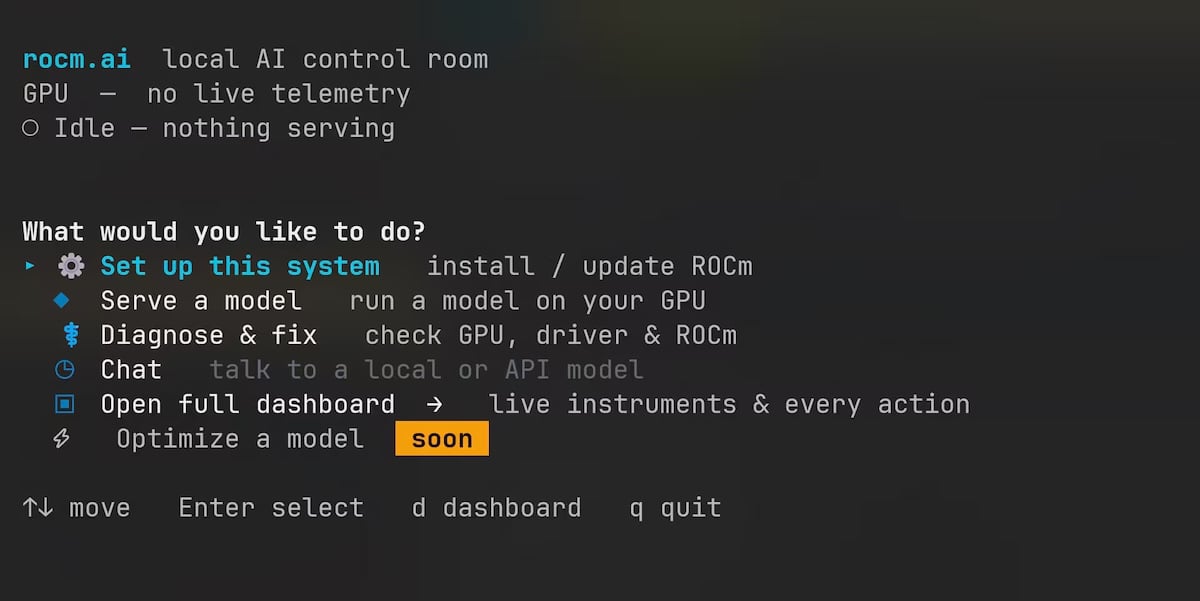
The CLI is distributed as a prebuilt binary for Windows and Linux and does not require a pre-existing ROCm installation. It supports managed ROCm environments with multiple side-by-side runtimes, including runtime activation and rollback, along with integrated model serving and engine management. Current adapters support Lemonade on select AMD client systems and vLLM for AMD Instinct GPU serving.
Bundled with the CLI is the ROCm Console, previously known internally as “dash,” which provides a real-time view of system status and workload activity. It allows developers to monitor ROCm runtime health, model serving status, GPU utilization, and benchmark telemetry, including high-bandwidth memory usage, power consumption, and tokens per watt on supported AMD Instinct systems. The ROCm CLI Technology Preview offers a version-agnostic experience starting with ROCm 7.13, with formal ROCm 10 support planned.
Broader ROCm 10 Stack Updates
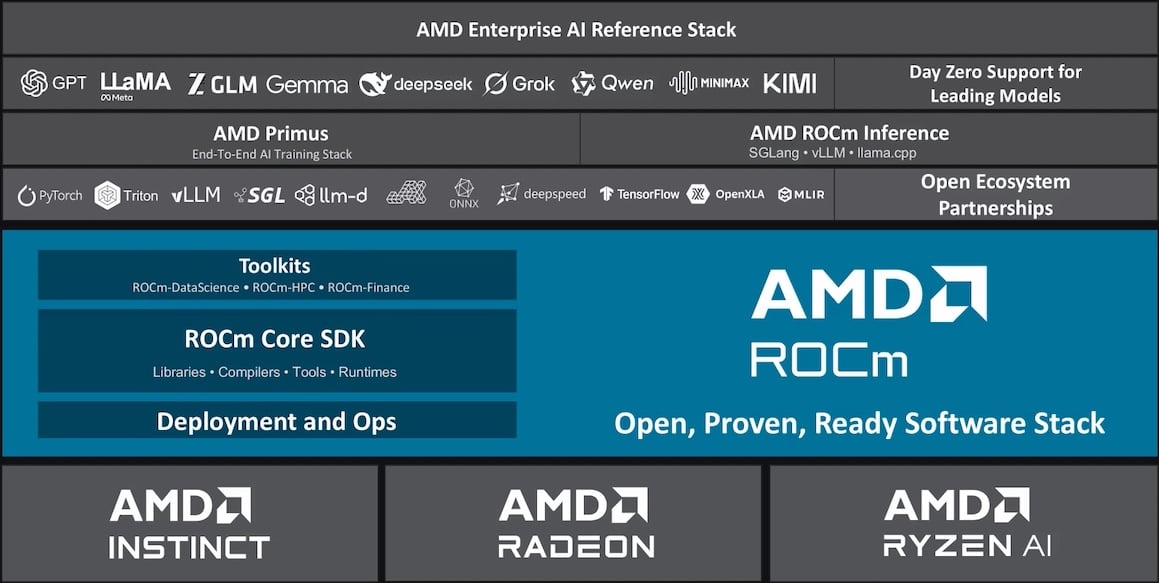
These developer-facing tools are built on top of the broader ROCm 10 software stack, which introduces a more modular ROCm Core SDK. The release also includes updates to libraries, compilers, frameworks, model support, performance tuning, and supported hardware platforms.
| Label | Value |
|---|---|
| Hardware Configuration | Supermicro AS -4126GS-NMR-LCC (board H14DSG-OD) 8x AMD Instinct MI355X BIOS AMI v1.4a (2025-04-16) GPU firmware SMC 04.86.11.02 TA RAS 27.69.00.10 TA XGMI 32.00.00.20 RLC43 MEC36 SDMA12 Ubuntu 22.04.2 LTS kernel 5.15.0-70-generic amdgpu driver 6.16.6 HOST ROCm 7.1.0 |
| Software Configuration(s) | GLM-5 ROCm Docker Image: rocm/sgl-dev:v0.5.8.post1-rocm700-mi35x-20260219, PyTorch Version 2.8.0, SGLang v0.5.8 Kimi ROCm Docker Image: vllm/vllm-openai-rocm:v0.16.0, vLLM version 0.16.0 DeepSeek-R1 Docker Image: rocm/7.0:…sgl-dev-v0.5.2-rocm7.0-mi35x-20250915, SGLang version V0.5.13 vs GLM-5 ROCm Docker Image: rocm/atom:rocm7.2.2_ubuntu24.04_py3.12_pytorch_release_2.10.0_atom0.1.2.post, ATOM v0.1.2.post Kimi ROCm Docker Image: vllm/vllm-openai-rocm:v0.22.0, vLLM version V0.22.0 |


 Amazon