

Published October 8, 2026. Ranked on our current cross-platform client suite; systems tested on earlier suite versions are noted in Also Tested.
Every mini PC ranked on this page has been through the StorageReview lab. We run the same client suite on every one: PCMark 10, Geekbench 7, Cinebench 2026, 3DMark CPU Profile, 7-Zip, y-cruncher, Blender, LuxMark, V-Ray, Blackmagic RAW, Topaz Video AI, the UL Procyon AI tests for image generation, computer vision, and local text generation, 3DMark’s gaming suite, SPECviewperf 15, SPECworkstation 4, and storage. Everything below is ranked on what we measured, and each pick links to the review holding the detailed data.
This page covers the sub-liter class: integrated graphics, an external power brick, and a chassis that fits on a VESA bracket behind a monitor. Mini workstations with discrete GPU options are a different category and are ranked on our Best Desktop Workstations page, and the GB10 and Strix Halo appliances built for local AI live on Best Desktops for Local AI.
The current field is the most interesting it has been in years: Intel’s 16-core Core Ultra X7 358H arrived in two very different boxes, AMD’s Ryzen AI 7 450 refreshed the commercial 4×4, and Qualcomm’s Snapdragon X2 Elite produced the first Arm mini PC we have tested that outruns its x86 class on the CPU.
At a Glance
| Category | System | CPU / GPU (as tested) | Memory (as tested / ceiling) | Volume | Full Review |
|---|---|---|---|---|---|
| Best Overall Mini PC | ASUS NUC 16 Pro | Core Ultra X7 358H (65W) / Arc B390 | 64GB LPDDR5X-8533, soldered | 0.71L | NUC 16 Pro Review |
| Best Business Mini PC | ASUS ExpertCenter PN55 | Ryzen AI 7 450 / Radeon 860M | 64GB DDR5-5600 SO-DIMM / 64GB | 0.57L | PN55 Review |
| Best CPU Throughput | ASUS Ascent QN10 | Snapdragon X2 Elite, 18 cores / Adreno X2-90 | 32GB LPDDR5X, soldered / 32GB | 0.7L | Ascent QN10 Review |
| Best Consumer Mini PC | Lenovo Yoga Mini | Core Ultra X7 358H / Arc B390 | 32GB LPDDR5X-8533, soldered | 0.65L | Yoga Mini Review |
The Picks
Best Overall Mini PC: ASUS NUC 16 Pro
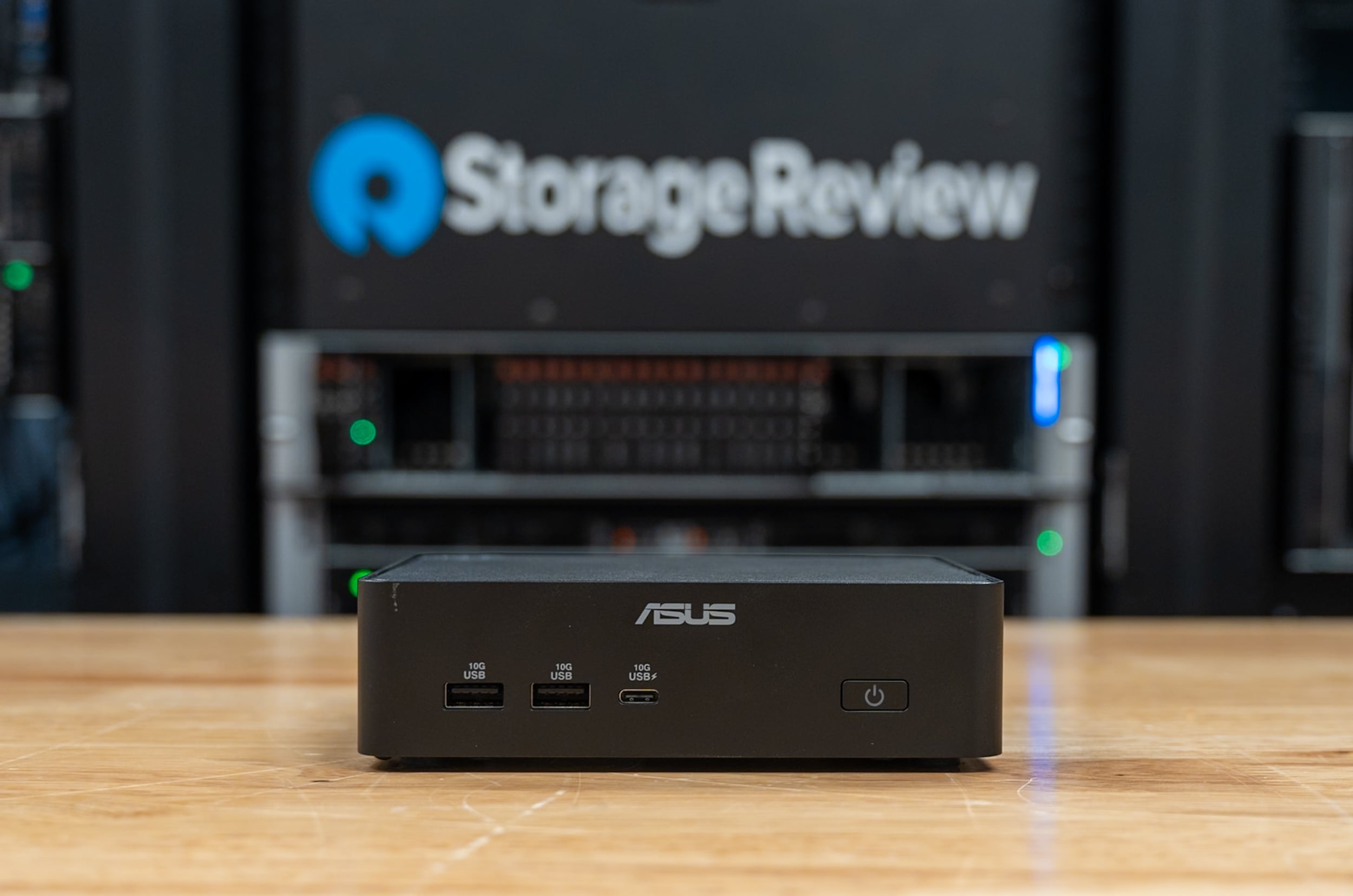
The NUC 16 Pro is the most complete mini PC we have tested, and the one that gets the most out of Intel’s Core Ultra X7 358H. ASUS moved the NUC Pro line from a 4×4 to a 5×4 footprint and spent the extra inch on a second M.2 slot, a second 2.5GbE port, and a cooling stack of two exhaust fans, a DIMM fan, and three heat pipes, which lets it run the 358H at a 65W cTDP.
That budget buys a consistent 5% to 15% over the same chip in the Lenovo Yoga Mini on the multi-core and sustained tests: Geekbench 7 multi-core of 18,388, Cinebench 2026 multi-thread of 4,741 with a 9.34x scaling ratio, and 3DMark CPU Profile 15% ahead at max threads.
The Arc B390 is the strongest integrated GPU in the class, and it shows everywhere: 55,273 in Geekbench OpenCL, 3,518 on LuxMark Hall, Blender Cycles at 5.5x to 6x the Radeon 860M in the PN55, and a first token in local LLMs that arrives in 0.3 to 0.6 seconds, while the AMD box waits six to fourteen. The 1TB Samsung PM9E1 Gen5 drive posts 9,505MB/s reads, nearly twice the Gen4 drives in the rest of the field.
Know its limits: the LPDDR5X configuration is soldered, there is no headphone jack, and the listed price is $2,699 for the 32GB and 1TB Gen4 configuration at B&H, about twice the PN55 as listed. The 64GB build we tested had no US listing at review time. For a creator or developer running models on the GPU, it earns the premium; for a managed office desk, read the next pick.
Read the full ASUS NUC 16 Pro review
Best Business Mini PC: ASUS ExpertCenter PN55
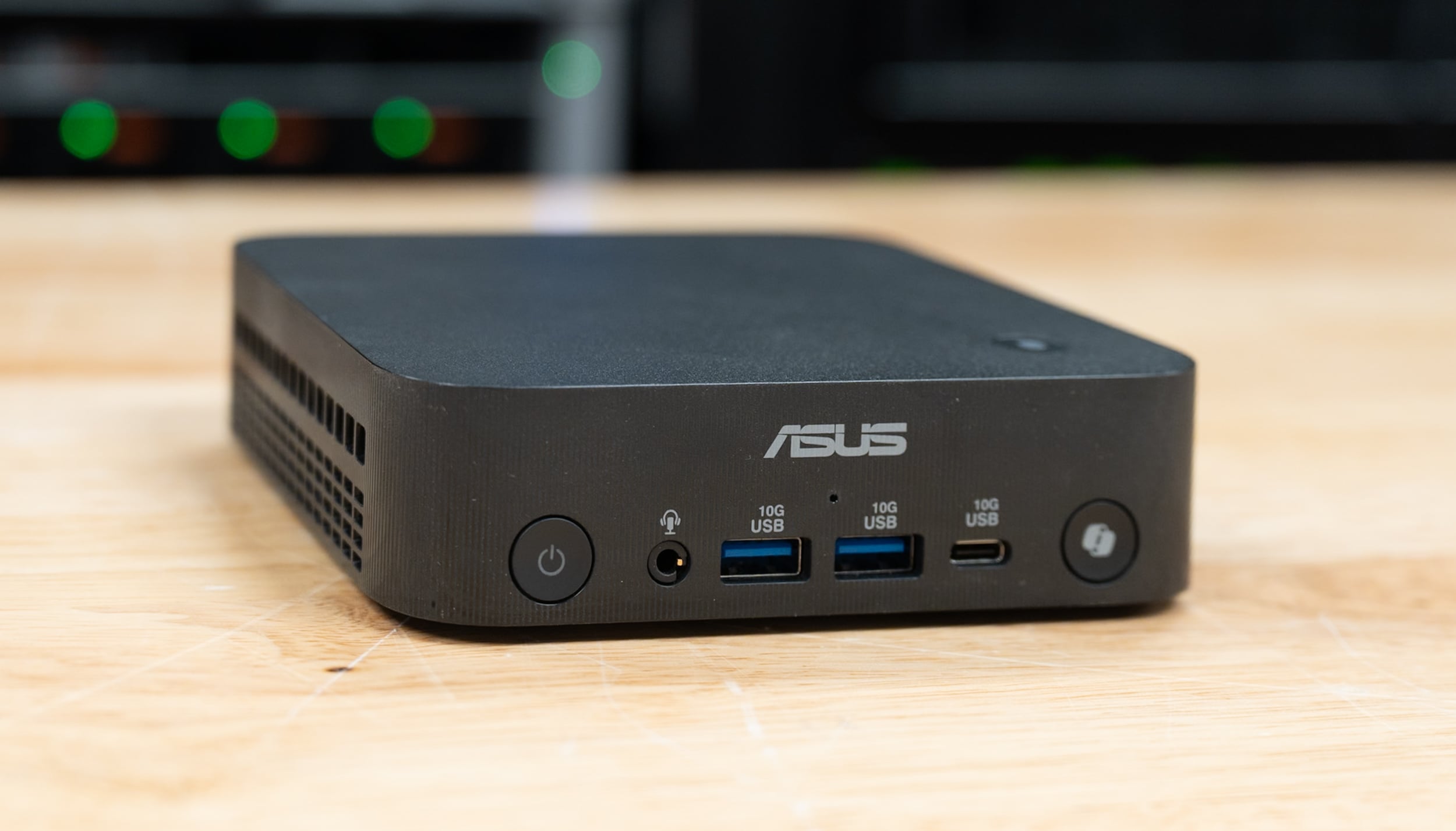
On the work most business desktops do, the PN55 keeps pace with the 65W Intel box at half the listed price, in a smaller chassis with field-upgradable memory. The Ryzen AI 7 450 leads the NUC 16 Pro on single-core Geekbench, on every 3DMark CPU Profile row from one to eight threads, on 7-Zip decompression, and on every y-cruncher Pi computation, where it computes a billion digits in 26.0 seconds, 6% faster than the NUC. Its XDNA 2 NPU posts the highest Procyon computer vision score in the group: 2,031 at integer precision.
The box itself is the better-equipped one for a managed desk: two DDR5 SO-DIMM slots with 64GB installed on our unit, two PCIe 4.0 M.2 slots, dual 2.5GbE, a USB4 port that accepts 100W of power input so a dock can run the system without the brick, a fingerprint reader, a headphone jack, and an ASUS-rated MIL-STD-810H chassis, all in 0.57 liters and 0.62kg. Against the previous-generation Ryzen AI 7 PRO 350 in the HP EliteDesk 8 Mini G1a, the 450 and its current driver stack are 11% to 32% faster in y-cruncher and 16% to 56% ahead across the SPECworkstation verticals.
The trade is the GPU and heavier threaded workloads: the Radeon 860M lands at 39% to 54% of the Arc B390 on OpenCL, LuxMark, Blackmagic RAW decode, and 3DMark graphics, Blender renders the Monster scene faster on this system’s CPU than on its GPU, and a local LLM waits six to fourteen seconds for a first token on the DirectML path. At $1,349 for the 32GB and 1TB Windows 11 Pro configuration at the ASUS eShop, it is the office pick; the GPU work is the whole difference between the two ASUS boxes.
Read the full ASUS ExpertCenter PN55 review
Best CPU Throughput: ASUS Ascent QN10
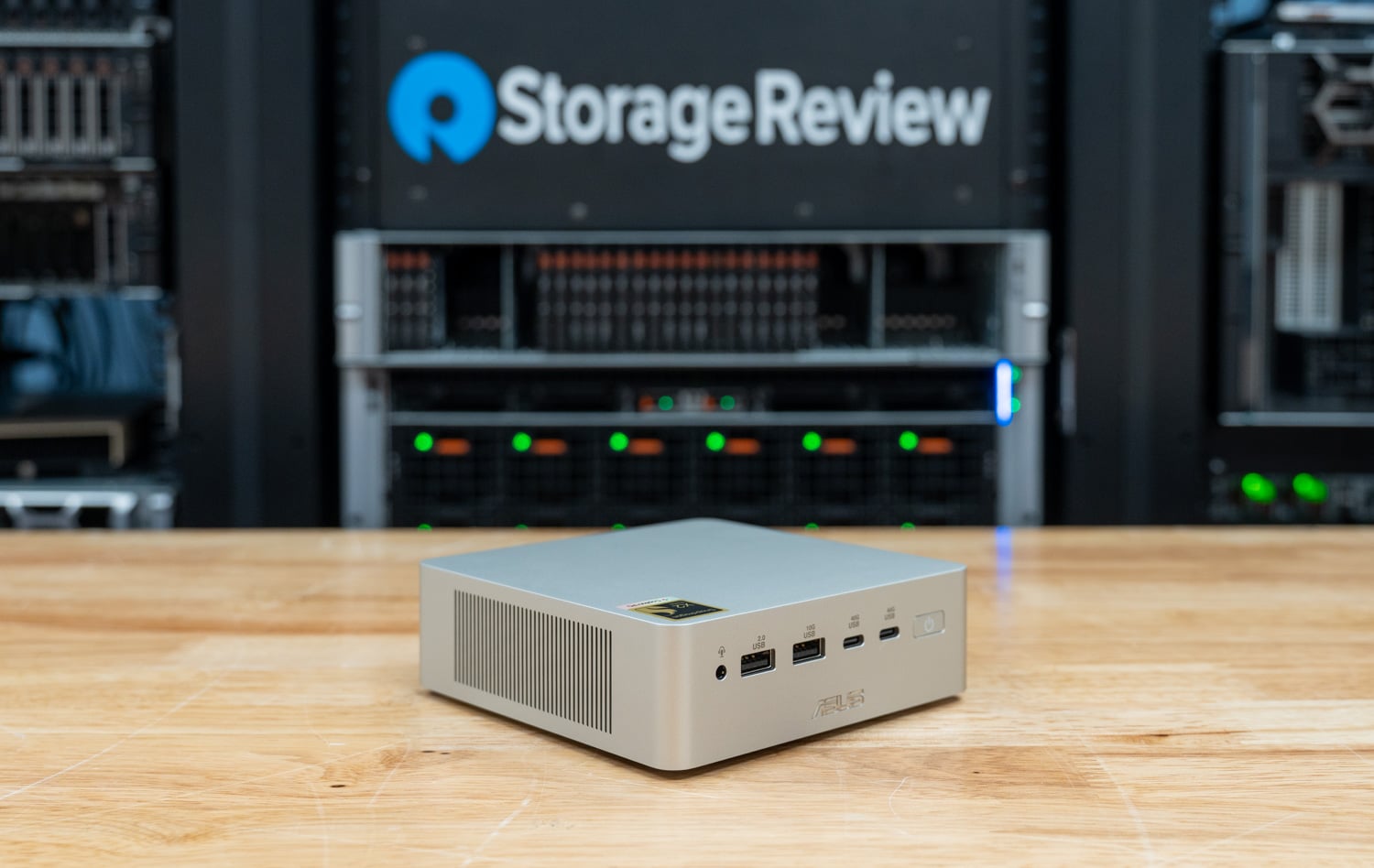
The QN10 is the first Arm mini PC we have tested that outruns its x86 class on the CPU. Qualcomm’s Snapdragon X2 Elite puts 18 Oryon cores at up to 4.7GHz in a 0.7-liter box that stays whisper quiet from idle through sustained load.
Its CPU results carry the widest margins on this page: 24,049 in Geekbench 7 multi-core, 31% ahead of the NUC 16 Pro and 57% ahead of the PN55; a Cinebench 2026 multi-thread score of 6,476 with a 10.13x scaling ratio, 7-Zip at 108.5 GIPS, and Blender CPU renders 36% to 43% ahead of the NUC and 52% to 71% ahead of the PN55.
The 80 TOPS Hexagon NPU backs its rating with measured results: 5,457 in Stable Diffusion 1.5 INT8 and 35.7 tokens per second on Phi, both on the NPU with the CPU idle, are the kind of local inference that signage, kiosks, and edge appliances benefit from.
The reservations are structural: the 32GB of LPDDR5X is soldered, and 32GB is the ceiling. The 16GB configuration lists at $1,349.99, with the 32GB build listed but out of stock at review time. The Arc B390 leads the Adreno GPU by 59% on Fire Strike graphics and 89% on Time Spy graphics, and Windows on Arm compatibility remains a per-application question any fleet buyer should settle before ordering. For work that runs on Arm and leans on the CPU or the NPU, nothing else this size is close.
Read the full ASUS Ascent QN10 review
Best Consumer Mini PC: Lenovo Yoga Mini
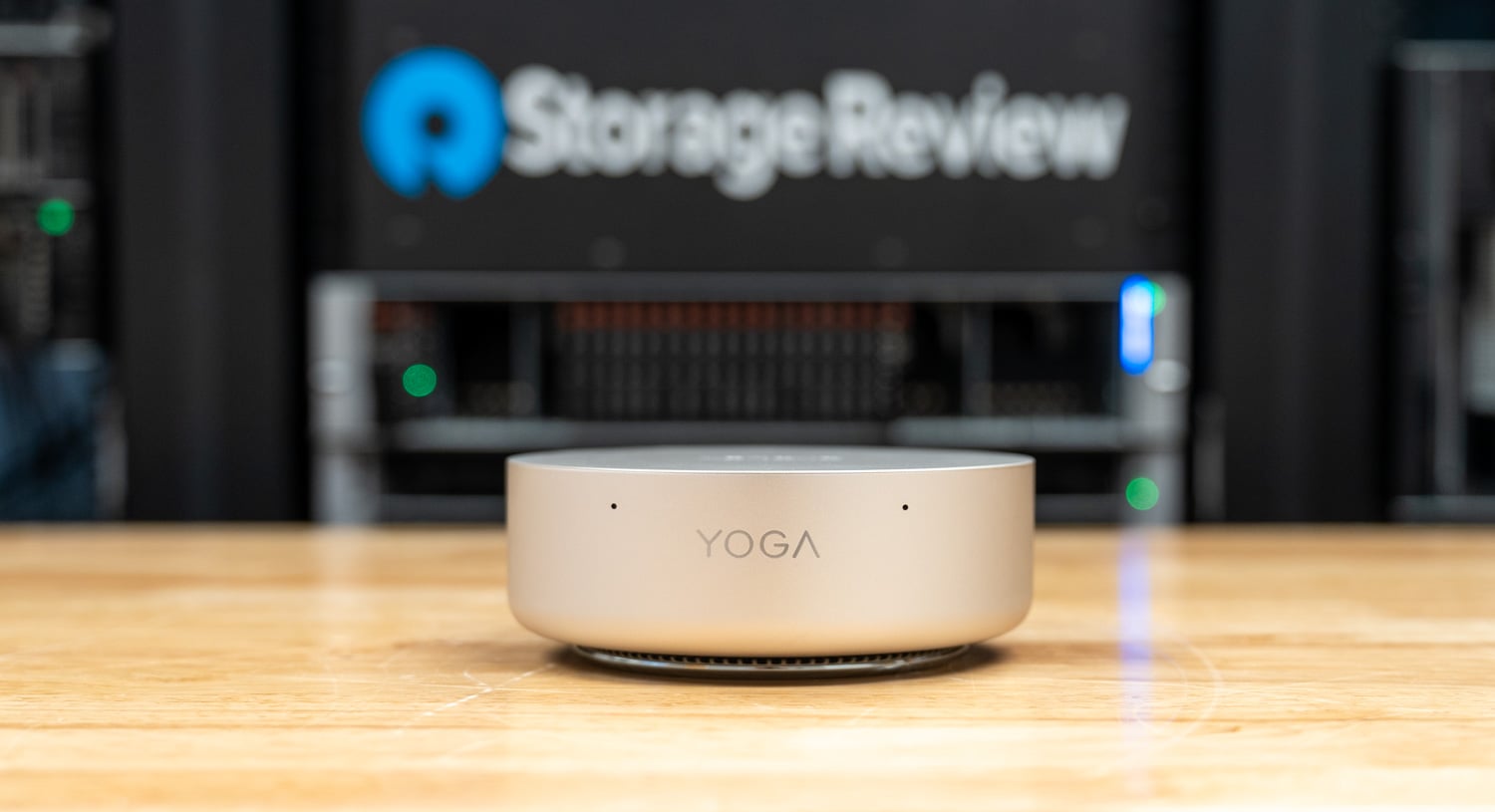
The Yoga Mini is the system that prioritizes form and still performs: a 130mm aluminum puck at 0.65 liters and about 600 grams that carries the same 16-core Core Ultra X7 358H and Arc B390 as the NUC 16 Pro. It posted the highest PCMark 10 overall score of the three x86 systems at 10,369, with a Productivity score of 20,073, 36% ahead of the NUC 16 Pro, Cinebench 2026 multi-thread of 4,473 with an 8.79x scaling ratio, and graphics within 5% of the NUC on every test, including 51,571 in Geekbench OpenCL and 7,119 in Stable Diffusion 1.5 INT8.
It is a Copilot+ PC first, with a 50 TOPS NPU that scored 1,205 in Procyon computer vision, a fingerprint reader on the power button, two Thunderbolt 4 ports, 2.5GbE, and an adaptive lighting ring on the underside that reacts to touch and notifications.
The compromises are the soldered 32GB of LPDDR5X-8533, a mid-pack Gen4 KIOXIA SSD at 5,277MB/s reads, and multi-core CPU throughput that the QN10 beats by 43% in Geekbench. Our review unit listed at $1,869.99 at Best Buy, with Lenovo’s equivalent configuration, bundled with a wireless keyboard and mouse, at $1,711.99 on sale. For a desk where the machine is on display, it is the pick, landing within 15% of the NUC 16 Pro on multi-core work and within 5% on graphics from the same chip.
Read the full Lenovo Yoga Mini review
Also Tested
These systems ran earlier versions of our suite or carry silicon that the picks above have since replaced, and each is listed with the measured gap to its successor.
HP EliteDesk 8 Mini G1a (December 2025): the previous-generation Ryzen AI 7 PRO 350 with the same Radeon 860M and 32GB of DDR5-5600. The PN55’s 450 and a year of driver work are 11% to 32% faster in y-cruncher, 23% to 31% in LuxMark, and 19% in Stable Diffusion 1.5, with a 20% to 36% shorter first-token wait; between the two Ryzen AI 7 boxes, take the 450.
Lenovo ThinkCentre Neo 50q QC (November 2025): the first-generation Snapdragon X in an ultra-compact chassis. One generation later, the QN10’s X2 Elite is 2.3x to 4.4x faster depending on the test.
ASUS NUC 14 Pro (August 2024): the 4×4 Meteor Lake NUC the 16 Pro replaces. The QN10 leads it by 43% to 76% across the CPU suites and roughly 2x in mainstream graphics, and the Yoga Mini’s Stable Diffusion 1.5 INT8 result is seven times what it managed.
What About Mini Workstations?
A second class of small desktop sits just above this page: mini workstations with a discrete GPU option, more memory, and a larger chassis. The Lenovo ThinkStation P3 Tiny Gen 2 is the reference example, and the HP Z2 Mini G1a, which ran GPT-OSS 120B on Strix Halo without a discrete GPU, holds Best Mini Workstation on Best Desktop Workstations and Best Without a Discrete GPU on our Best Desktops for Local AI page. If the workload is a model larger than 64GB of memory can hold, or a GPU-bound render, that page and Best Desktop Workstations are the next step up.
How We Rank
Three rules govern every StorageReview leaderboard, and the first is that a system appears here only after it has been through our lab on the cross-platform client suite, ranked only on results we measured. Geekbench, Cinebench, 3DMark, 7-Zip, y-cruncher, Blender, and the Procyon AI tests all run natively on Arm and x86, which is what lets a Snapdragon system sit in the same tables as Intel and AMD, and where a test has no path on a platform, we report it as missing.
Second, every entry carries its memory configuration and ceiling, because in this class memory is soldered more often than not, and it decides which local models load. Third, prices move quickly, so any dollar figure on this page is the as-listed price at the time the review was published.
The sub-liter rule is deliberate, because once a chassis grows to hold a discrete GPU, the buying decision changes, and those systems are ranked on Best Desktop Workstations.
Mini PC FAQ
What is the best mini PC for business?
The ASUS ExpertCenter PN55 for most managed desks: upgradable SO-DIMM memory, two Gen4 M.2 slots, dual 2.5GbE for a separate management network, USB4 power input from a dock, a fingerprint reader, and an ASUS-rated MIL-STD-810H chassis at $1,349 as listed. It leads every system here on the one-to-eight-thread 3DMark CPU Profile rows and on y-cruncher. If the users run GPU workloads, local models, or Blender, the ASUS NUC 16 Pro’s Arc B390 is roughly 2x to 6x faster on those paths and worth the premium.
Is an Arm mini PC worth buying?
Yes, with a compatibility check first, because the ASUS Ascent QN10’s Snapdragon X2 Elite leads every x86 mini PC we have tested in Geekbench multi-core, Cinebench multi-thread, and Blender CPU rendering, by 31% over the NUC 16 Pro in Geekbench, and its 80 TOPS NPU runs image generation and small language models with the CPU idle. The limits are a 32GB soldered memory ceiling, integrated graphics that Intel’s Arc B390 outruns by 59% to 89% in 3DMark graphics, and Windows on Arm application support that a fleet buyer should verify per application before ordering.
Can a mini PC run local AI models?
Within the memory ceiling, yes, and the platform matters more than the core count. The NUC 16 Pro’s Arc B390 delivers a first token in 0.3 to 0.6 seconds on the Procyon text generation models and 46 output tokens per second on Phi; the QN10’s NPU streams 35.7 tokens per second on Phi; the PN55’s Radeon 860M streams at a competitive rate but waits six to fourteen seconds for the first token on the DirectML path. For models larger than 32GB to 64GB of system memory can hold, the GB10 and Strix Halo appliances on Best Desktops for Local AI are the right class.
Mini PC or mini workstation?
A mini PC in the sub-liter class runs on integrated graphics and an external brick, and it is the right answer for office desks, signage, kiosks, and edge inference. A mini workstation such as the Lenovo ThinkStation P3 Tiny Gen 2 adds a discrete GPU option, more memory, and a larger chassis, and it is ranked with the workstations because that is what it competes with. The dividing line is the workload: if it needs a discrete GPU, it has outgrown this page.


 Amazon