

Chelsio Communications has introduced its seventh-generation AI Interconnect Platform, expanding its Ethernet offload portfolio with SmartNICs, storage controllers, and Data Processing Units. Built on the company’s Unified Wire architecture, the T7 platform targets AI training and inference clusters, disaggregated storage, cloud infrastructure, and high-performance networking environments.
The platform supports Ethernet speeds from 1GbE through 400GbE and combines native 400Gb Ethernet with Unified RDMA support for both iWARP and RoCEv2. Chelsio is positioning the architecture as a standards-based Ethernet fabric for AI deployments that need low-latency communication, high-bandwidth data movement, and hardware acceleration across compute and storage infrastructure.
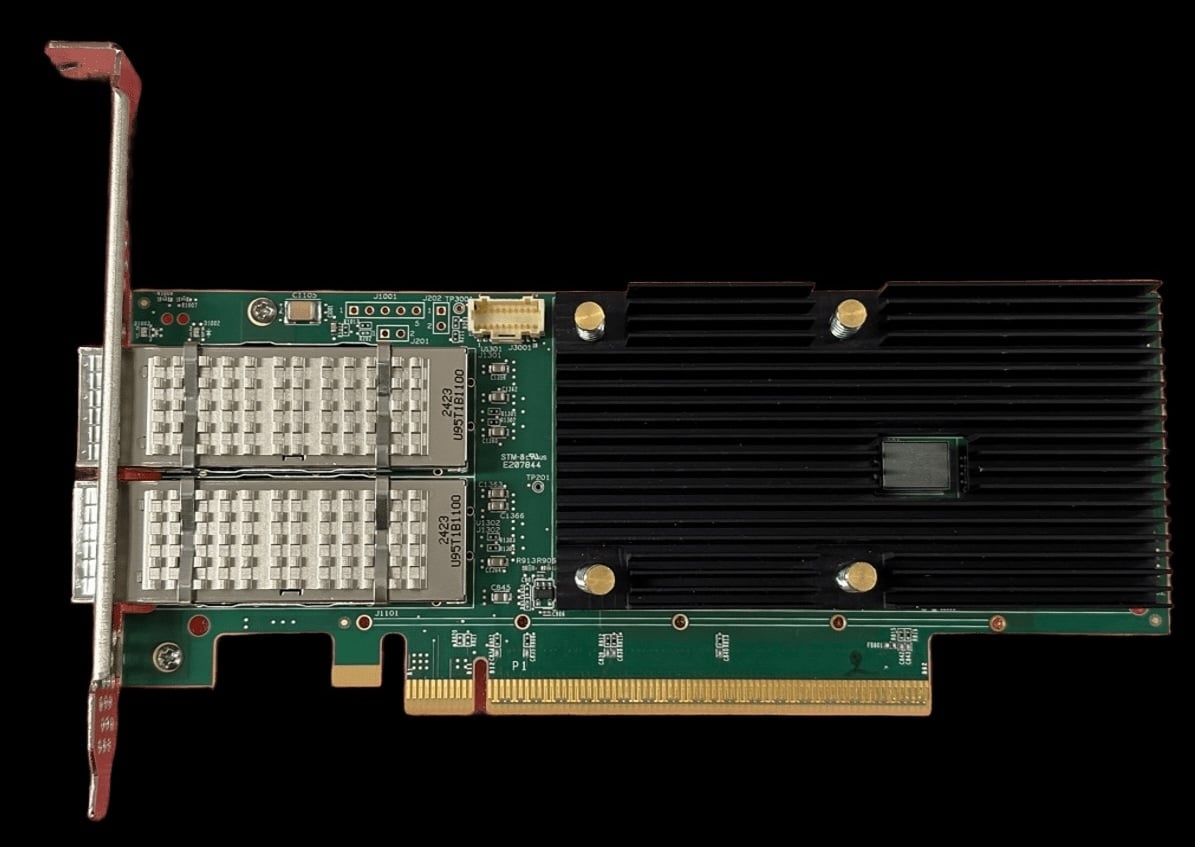
The seventh-generation platform integrates networking, storage, and compute acceleration in a common hardware and software architecture. Chelsio states that the design maintains software compatibility with its T4, T5, and T6 product families, allowing existing users to migrate to higher-speed Ethernet and PCIe Gen5 deployments without a full software transition.
For AI and HPC workloads, the T7 architecture includes lossless Ethernet support, congestion-management capabilities, GPU-oriented data paths, and RDMA acceleration. These features are intended to reduce synchronization overhead in distributed training clusters and support GPU-to-GPU and GPU-to-storage transfers. Hardware offload and CPU-bypass capabilities are also designed to reduce host CPU utilization for network and storage I/O.
Storage acceleration is a central component of the platform. Chelsio lists hardware offloads for NVMe/TCP, NVMe over Fabrics, iSCSI, RDMA, and TCP Offload Engine functions. The company is targeting JBOF deployments, enterprise storage systems, and disaggregated storage architectures where protocol processing can affect CPU efficiency and application latency.
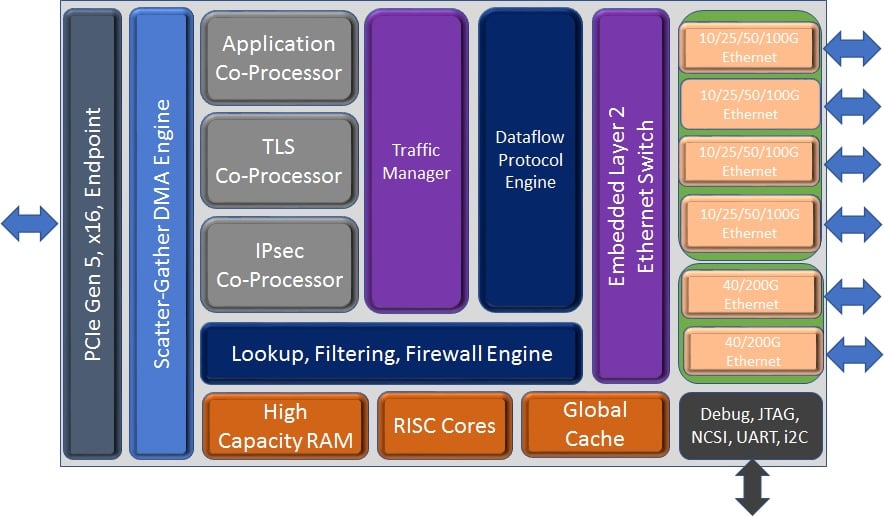
The platform also includes a programmable data path for workload-specific acceleration and inline processing. Its security feature set includes on-chip cryptographic acceleration for QUIC, TLS, kTLS, and IPsec. Virtualization and cloud features include SR-IOV, virtual-switch, and container offloads designed to help maintain multitenant isolation and network performance.
Product Families
The initial T7 product family includes SmartNICs based on Chelsio’s S7 silicon, storage controller adapters based on N7 Storage Controller silicon, and fully programmable T7 DPU adapters.
| PCIe Gen5 x16 | ||||||
|---|---|---|---|---|---|---|
| Chelsio P/N | T72200 | T72200-DPU | T72200-FH-DPU | T72200-FH | S71400 | T7-Server |
| Ports | 2×40/100/200G (QSFP56/QSFP28/QSFP+) | 1×400G or 4×100G (QSFP-DD) | 1×200G (QSFP) or 4×56 (SFP) | |||
| Type | Storage Adapters | DPU | Storage Adapters | SmartNIC | Server | |
| Form Factor | Low Profile (HHHL) | Low Profile (HHHL) | Half Size (FHHL) | Low Profile (HHHL) | Low Profile (HHHL) | — |
| Concurrent Conn. | 64K | 128K | 2K | 128K | — | — |
| On-Adapter Memory | 8GB | 8GB | 16GB | 16GB | — | 64GB |
| ARM Cores | — | 4 | 8 | — | — | 8 |
| Power (Typical) | 31W | 35W | 42W | 36W | 26W | 42W |
| Replaces | T62100-LP-CR | — | — | T62100-CR | — | — |
| PCIe Gen5 x16 | |||||||
|---|---|---|---|---|---|---|---|
| Chelsio P/N | S72200 | S72200-OCP | S7450-OCP | S7450 | T7450 | T7450-DPU | T71200-iNIC-L |
| Ports | 2×40/50/100/200G (QSFP56/QSFP28/QSFP+) | 4×1/10/25/50G (SFP56/SFP28/SFP+) | 1×40/100/200G (QSFP56) | ||||
| Type | SmartNIC | Storage Adapters | Storage Adapters | DPU | SmartNIC | ||
| Form Factor | Low Profile (HHHL) | OCP3 | OCP3 | Low Profile (HHHL) | Low Profile (HHHL) | Low Profile (HHHL) | — |
| Concurrent Conn. | 2K | 64K | — | — | |||
| On-Adapter Memory | — | 8GB | 8GB | — | |||
| ARM Cores | — | 4 | — | — | |||
| Power (Typical) | 22W | 22W | 21W | 21W | 27W | 29W | 31W |
| Replaces | T62100-LP-CR | T62100-SO-OCP3 | T6225-OCP3 | T540-LP-CR | — | — | — |
| PCIe Gen5 x8 | |||
|---|---|---|---|
| Chelsio P/N | S7250 | S7210-BT | S7410-BT-OCP |
| Ports | 2×1/10/25/50G (SFP56/SFP28/SFP+) | 2×1/10GBase-T | 4×1/10GBase-T |
| Type | SmartNIC | ||
| Form Factor | Low Profile (HHHL) | Low Profile (HHHL) | OCP3 |
| Concurrent Conn. | 2K | ||
| On-Adapter Memory | — | ||
| ARM Cores | — | ||
| Power (Typical) | 15W | 16W | 17W |
| Replaces | T6225-CR | T520-BT | — |
Available SmartNIC products include the S7250, S7450, and S7450-OCP, which provide dual- and quad-port configurations for 1/10/25/50GbE deployments. Chelsio positions these adapters for virtualization, embedded systems, edge environments, and lower-speed cloud infrastructure.
The S72200 and S72200-OCP are dual-port 40/50/100/200GbE SmartNICs for cloud, HPC, and AI infrastructure. At the top end of the SmartNIC range, the S71400 provides a single 400GbE port with configurable 4x100GbE and 2x200GbE modes for high-density fabric deployments.
Chelsio is also offering T72200 and T7450 storage controller adapters in PCIe and OCP form factors. Built on the N7 silicon, they provide hardware offloads for NVMe/TCP, NVMe-oF, iSCSI, and RDMA-based storage traffic, along with zero-copy and kernel-bypass acceleration for AI and storage workloads.
The T72200-DPU and T7450-DPU are Chelsio’s programmable DPU offerings. The adapters support stateful and stateless acceleration, direct data placement, and per-connection offload. Supported protocols include TCP/IP, UDP/IP, RoCEv2, iWARP, iSCSI, NVMe-oF, NVMe/TCP, NVGRE, VXLAN, TLS, IPsec, kTLS, QUIC, and RSA-related offloads.
Ethernet for AI Fabrics
Chelsio is positioning T7 as an Ethernet alternative to proprietary AI interconnect technologies. At 400GbE, the platform is intended to support distributed AI training and real-time inference workloads through RDMA, congestion management, protocol offloads, and GPU-optimized data movement.
The company expects these capabilities to improve GPU and storage utilization by reducing host-side protocol processing and supporting higher-throughput communication between compute nodes and storage systems. The approach also allows organizations to use Ethernet standards and existing operational practices as AI cluster requirements scale.
Availability
Chelsio SmartNICs and storage controller products are available through OEM, ODM, and distribution channels. The T7 DPU is currently offered as an evaluation platform for early testing, with production availability planned for December 2026.


 Amazon