

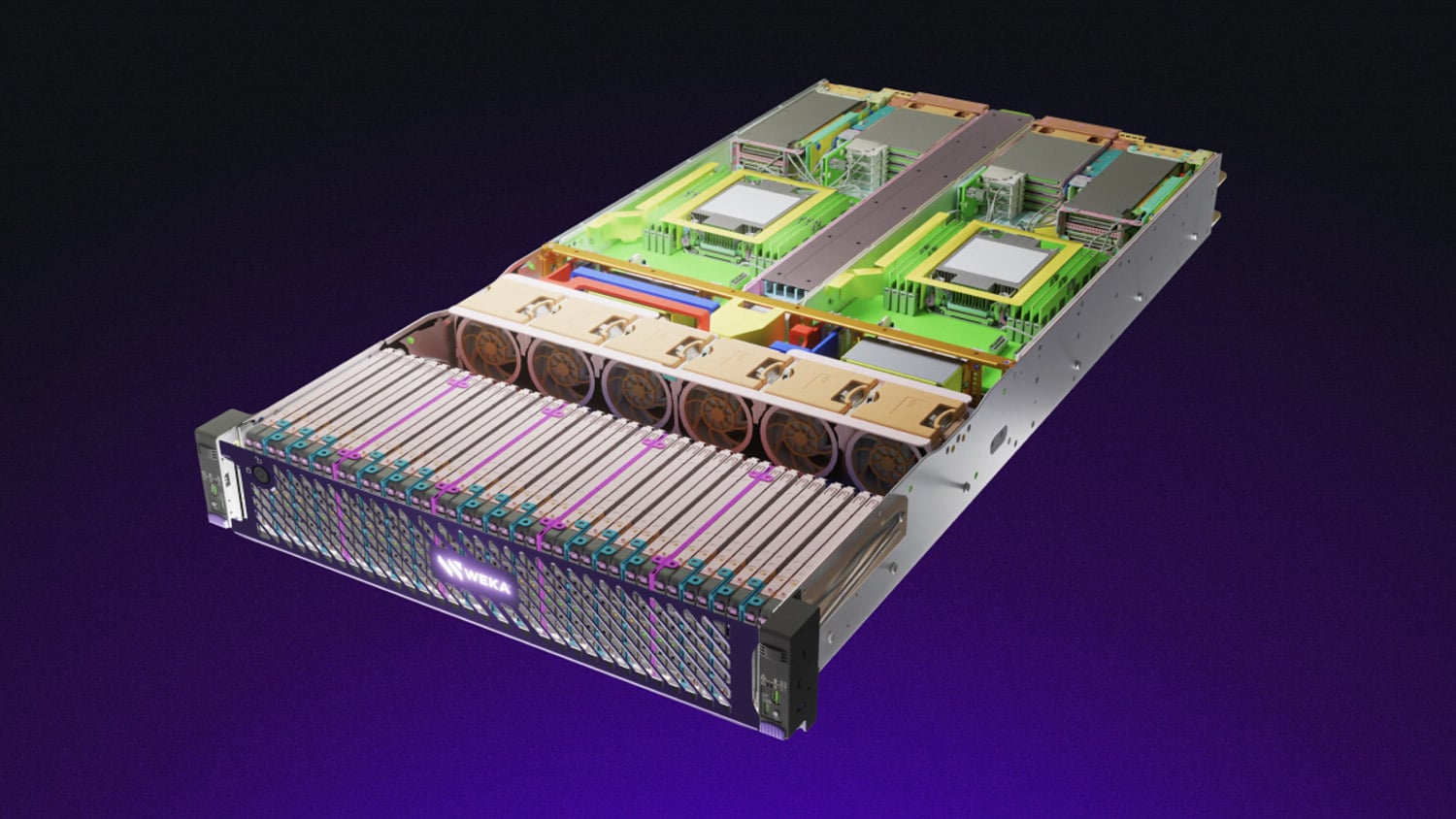
WEKA has launched two connected products: NeuralMesh 6, its most significant software release to date, and WEKApod 3, a new generation of storage appliances designed and engineered by WEKA to run it. NeuralMesh 6 remains deployable on customer-selected hardware, while WEKApod provides the turnkey path, shipping with the software preinstalled. NeuralMesh 6 introduces native multi-tenancy, a combined file-and-object protocol stack, metadata-driven data mobility, always-on data reduction with contractual guarantees, Kubernetes-native operations, and integrated observability. WEKApod 3 is custom-designed hardware built to run this software at what the company claims is the highest capacity and performance density available in a single rack, with three configurations, Nitro, Prime, and Prime Max, targeted at maximum performance, balanced capacity, and maximum density, respectively.
Both announcements frame the release around a common market shift: as AI workloads move from training toward long-context, agentic, and retrieval-driven inference at production scale, storage and memory infrastructure, not just GPU count, increasingly determine cost per token and achievable throughput.
NeuralMesh 6: Multi-Tenancy, Unified Protocols, and Data Mobility
NeuralMesh 6 combines features that WEKA claims AI infrastructure operators have traditionally needed to piece together from various vendors: multi-tenancy, a unified protocol stack for files and objects, data mobility across sites, continuous data reduction, Kubernetes-native management, and integrated observability, all integrated into a single software stack instead of assembled from separate parts.
Multi-tenancy is split into two tiers that can be combined. Composable Clusters provide hardware-level isolation, with dedicated CPU, memory, and storage drives per tenant, intended for anchor tenants that need guaranteed resources and predictable performance. Virtual Multi-Tenancy adds VPC-style network isolation through WEKA’s Virtualized RDMA Data Fabric, supporting private VLANs, overlapping IP address spaces, per-tenant quality of service and encryption with independent key management, and independent LDAP or Active Directory authentication per tenant. Virtual Multi-Tenancy scales to more than 1,000 isolated logical tenants per cluster, with new tenant provisioning in under 30 minutes. The two tiers compose, so a single WEKA hardware cluster running 50 Composable Clusters can support up to 50,000 logically isolated tenants on the same physical infrastructure, enabling growth from dozens to tens of thousands without re-architecting the system.
On the protocol side, NeuralMesh 6 implements a native S3 stack in which the same physical data blocks are addressable via S3 and POSIX simultaneously, rather than via a gateway that translates between them. A file written via NFS or POSIX is immediately readable from S3, and vice versa, eliminating duplicate full-dataset copies that typically accumulate as data moves between training, fine-tuning, and inference stages. WEKA built the S3 implementation specifically for AI access patterns, supporting 2,000 to 5,000 concurrent S3 connections per node, roughly five times the concurrency of conventional S3 architectures, with S3 over RDMA enabling zero-copy transfer directly into GPU memory.
Data mobility is handled through metadata-first replication, making a destination environment immediately browsable rather than requiring a complete data copy before a workload can start. Data hydrates on demand, reducing WAN traffic and allowing organizations to place workloads wherever GPU capacity exists rather than where the data was originally written. This release adds asynchronous replication and remote caching as a first step toward broader federation and a global namespace across sites and clouds.
That replication capability is already underpinning real deployments: Sam Tabar, CEO of WhiteFiber, said NeuralMesh’s intelligent replication lets the company make datasets visible across sites and pull exactly the data each job needs to the next GPU allocation, the same architecture behind Project Redwood, the 111.2 Tbps cross-data-center supercluster we covered earlier this month.
Data Reduction up to 6X Capacity Savings
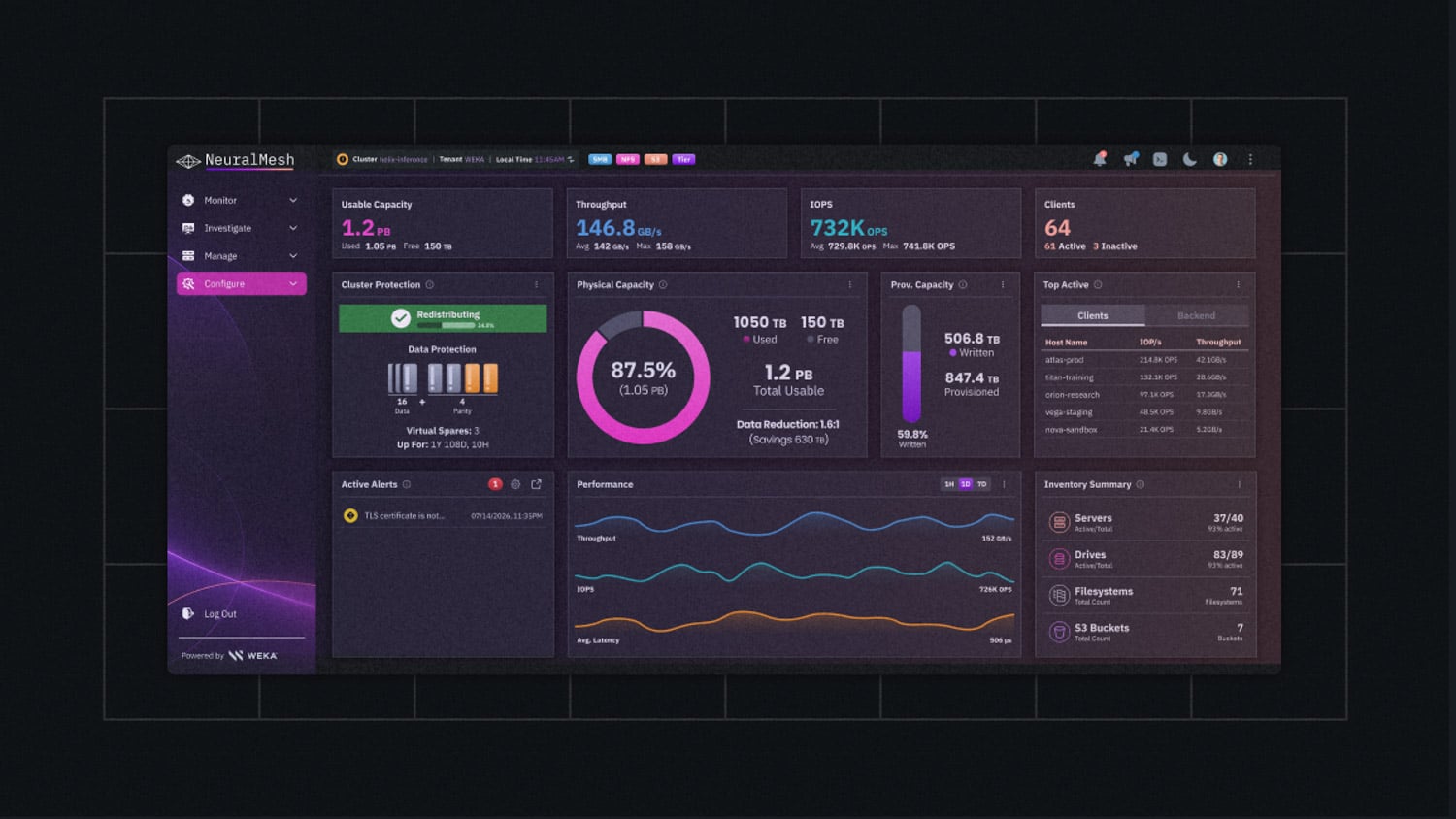
NeuralMesh 6 also enables data reduction, including fingerprinting, similarity hashing, deduplication, and compression, by default across every deployment, with a write overhead below 5%, up to 6x capacity savings on AI training data, and a contractual guarantee covering both reduction ratio and performance impact. A new Kubernetes Operator automates cluster deployment and lifecycle management for organizations running Kubernetes as their standard operating model, which WEKA says cuts deployment time from weeks to hours. NeuralMesh Observe, included at no extra cost with every deployment, provides SaaS-based multi-cluster dashboards, client-level diagnostics, and alerting routed to Slack, PagerDuty, or email.
WEKA reports using its Augmented Memory Grid feature in production, which expands GPU memory by speeding up persistent KV cache access to NeuralMesh-managed NVMe storage on Oracle Cloud Infrastructure. Benchmarks on OCI H100 infrastructure demonstrated 10x higher token throughput, 10x more concurrent users served, and 7x more tokens per GPU, which WEKA says is measured against DRAM-based alternatives. Pablo Selem, senior director of software development at OCI, characterized the approach as removing memory bottlenecks so customers can achieve higher throughput and more users from the same GPU footprint.
WEKApod 3: Custom Hardware Built Around the Software
WEKApod 3 is WEKA’s own hardware design rather than a reference architecture built on third-party OEM chassis. The company says a single WEKApod rack delivers 1.1 exabytes of effective capacity on a hardware foundation of 441.5 PB of raw capacity, making it the first single-rack system to exceed an exabyte of effective capacity. Per-rack throughput is rated at 10.2 TB/s with 210 million IOPS. WEKA reports 267% higher effective capacity density and 114% higher throughput density per rack unit than the next-best publicly available alternative in each category.
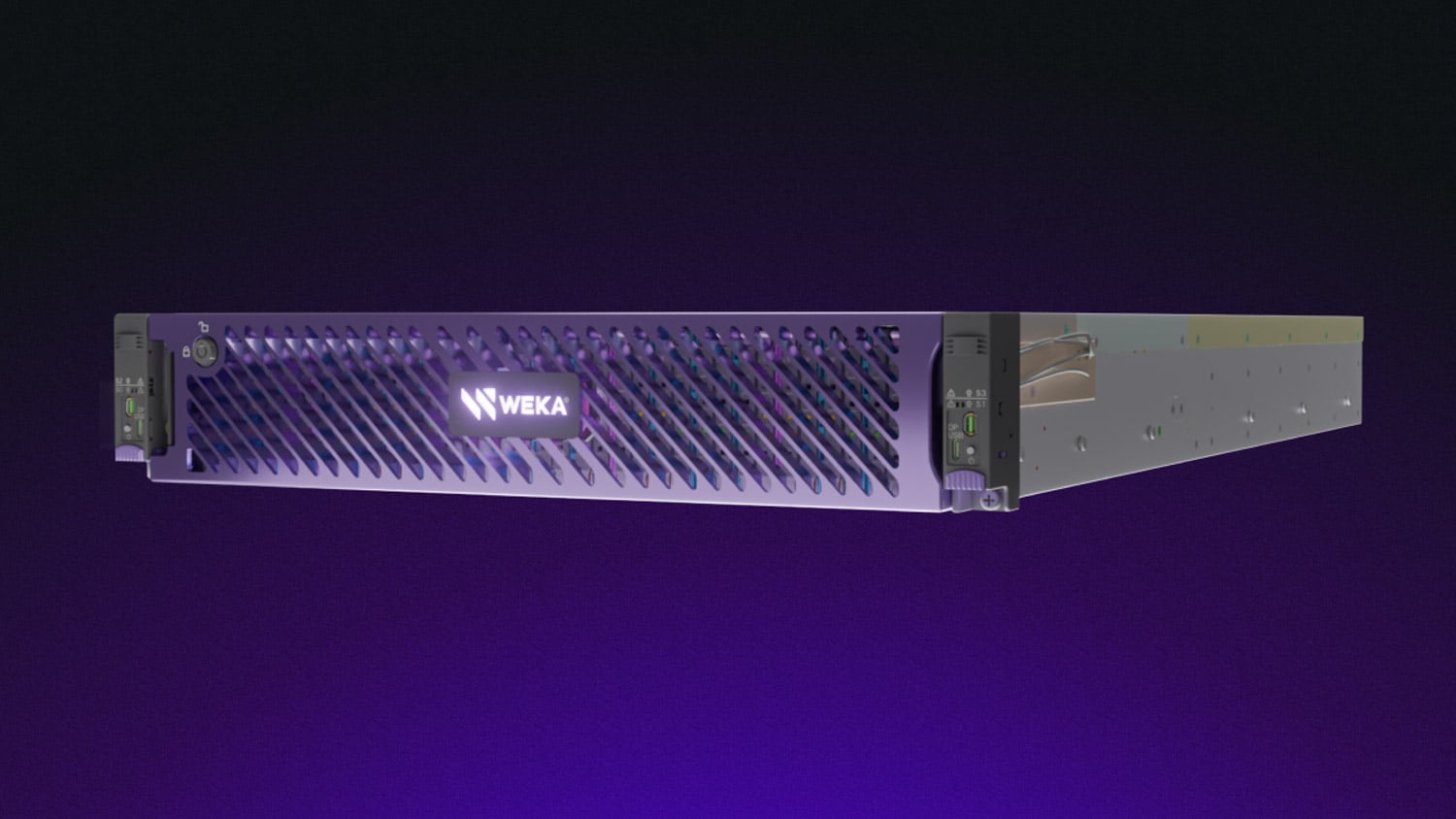
The design relies on a PCIe Gen 6 internal fabric, a cable-based drive interconnect rather than a backplane, NVIDIA ConnectX SuperNIC networking for Spectrum-X Ethernet connectivity, and a software-managed thermal architecture rated for 35°C ambient operation that throttles NVMe power under thermal stress instead of shutting down. WEKA has multiple patents pending on the chassis, drive interconnect, thermal management, and serviceability design. Serviceability features include hot-pluggable boot drives with a GUI-guided replacement process WEKA says takes about 10 minutes instead of a multi-hour maintenance window, along with headless, cloud-driven rack-scale deployment through NeuralMesh Home.
Three configurations for different workload priorities
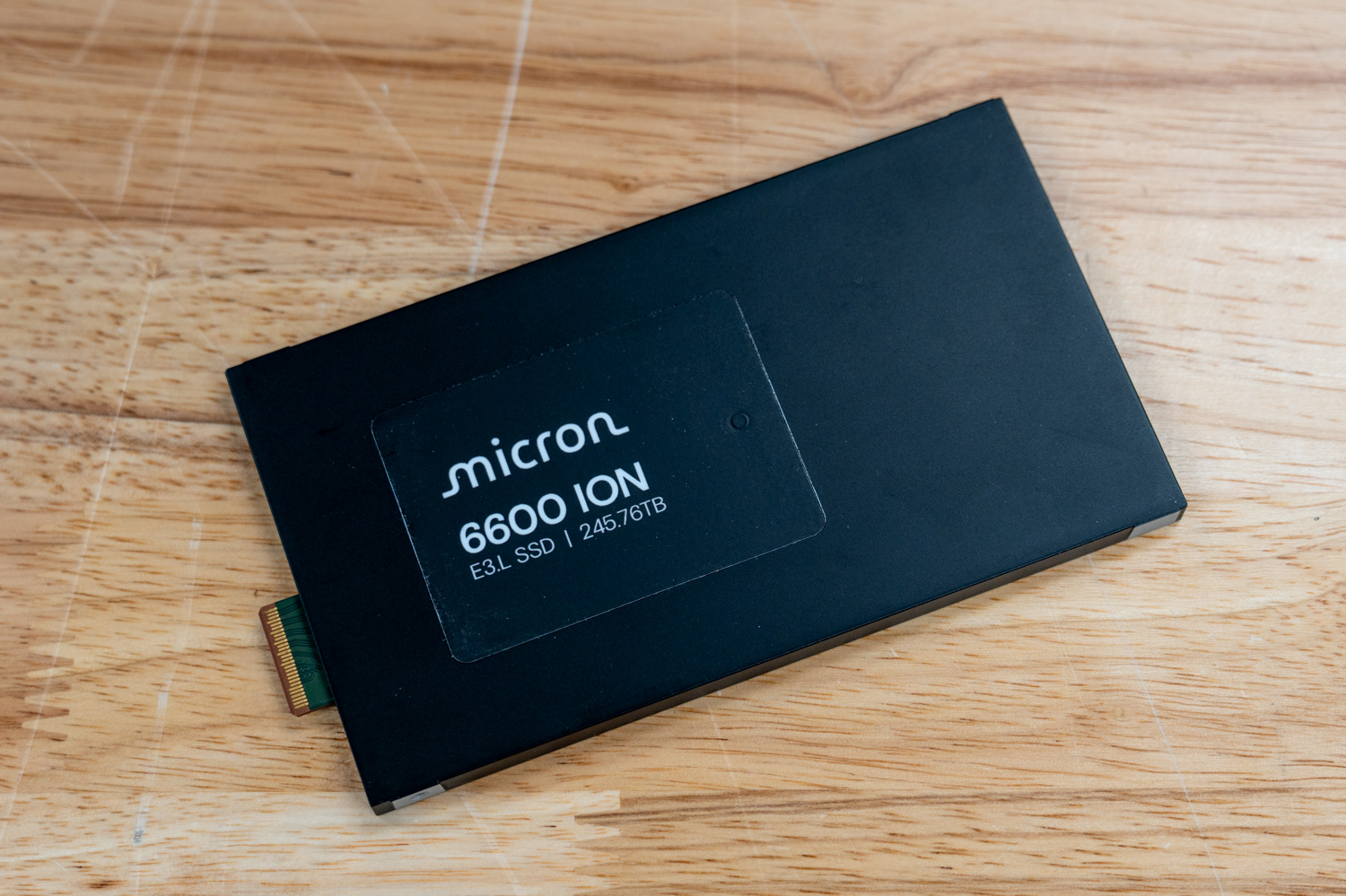
WEKApod Nitro is designed for workloads where storage bandwidth is critical, ensuring GPUs remain saturated. It features a two-rack-unit, four-node chassis with four independent failure domains and 56 TLC drives, supported by dual-port NVIDIA ConnectX networking that delivers 800 Gb/s throughput. WEKApod Prime emphasizes balanced capacity and performance with an AlloyFlash blend of TLC and QLC drives, housed in a similar four-node, two-rack-unit chassis that supports 56 drives. WEKApod Prime Max maximizes capacity in a compact form: a two-rack-unit, two-node chassis containing 70 NVMe drives, using Micron’s 245.76 TB 6600 ION SSDs, combined with NeuralMesh’s object storage and data reduction techniques, to achieve an effective capacity of 1.1 exabytes in a single 56U rack. For a sense of what that drive does to rack math, our 6600 ION power and density report works out an exabyte in six racks instead of 22.
AlloyFlash, the tiering feature that makes the Prime and Prime Max configurations viable, automatically routes latency-sensitive operations to TLC flash while directing bulk-capacity data to QLC, which runs roughly 30-40% cheaper per terabyte, without requiring customer configuration. This is the clearest point at which the NeuralMesh 6 software release and the WEKApod 3 hardware release are one product: the software’s tiering logic makes the higher-density hardware configurations usable at production performance levels, rather than just a larger capacity number on a spec sheet.
WEKA bases its hardware decision on current data center constraints: US data center construction dropped in 2025 for the first time since 2020, grid connection queues in major markets now take four to seven years, and Morgan Stanley forecasts a 49-gigawatt power shortfall in the US through 2028. This is in addition to ongoing NAND supply issues and longer OEM lead times. WEKA argues that storage that is inefficient in rack space and power directly competes with GPUs for limited physical resources. By managing its own hardware supply chain rather than relying on OEM channels, it believes it can offer more predictable pricing and lead times for customers planning large-scale infrastructure projects.
Jason Hardy, VP of Storage Technology at NVIDIA, said Spectrum-X Ethernet networking gives WEKApod 3 the high-bandwidth, low-latency fabric needed to keep the storage-to-GPU data path clear at scale. Steve McDowell, chief analyst at NAND Research, argued that inference at production scale is a different infrastructure problem than training, with tokens per rack, tokens per watt, and cost per inference at sustained load becoming the metrics that matter, a scorecard he says buyers should evaluate every vendor against. Jeremy Werner, senior vice president and general manager of Micron’s Core Data Center Business Unit, added that the new WEKApod architecture with Micron’s 245TB SSDs delivers 15.8 petabytes in a 2U footprint, preserving power and space for additional compute.
Availability
NeuralMesh 6 is expected to be generally available in the second half of 2026. Current WEKA customers can upgrade at no additional cost through standard channels. WEKApod Nitro, Prime, and Prime Max are now available for ordering through WEKA’s distributor and VAR network, with deliveries starting in fall 2026 and NeuralMesh 6 pre-installed. Additionally, WEKApod is now offered in configurable SKUs for the first time in this generation, allowing customers to choose chassis type, memory, drive capacity, and drive count, supporting systems from under 1PB up to 100PB or more in a single setup.


 Amazon