

DapuStor announced the J5101, an enterprise NVMe M.2 boot SSD for AI, HPC, virtualization, and cloud servers. The drive uses a PCIe Gen4 interface in the M.2 2280 form factor, comes in 480GB, 960GB, and 1.92TB capacities, and carries power loss protection and a 1 DWPD endurance rating. DapuStor rates it at 2W idle and as little as 4.5W active, and says it is in volume production and running in customer environments.
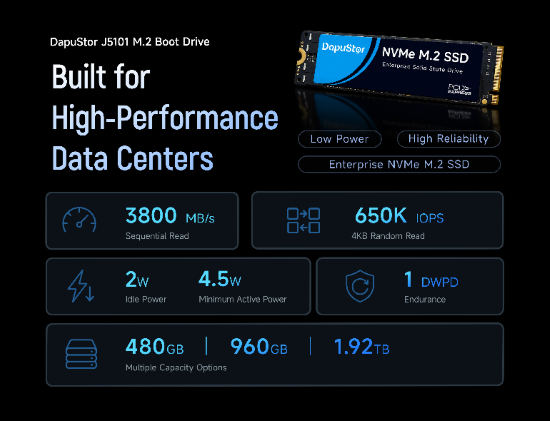
DapuStor positions the J5101 as a replacement for PXE network boot and SATA boot drives. A local NVMe boot device gives each node dedicated storage for the operating system, which the company says makes startup and recovery more dependable as the software stack on AI nodes grows. Because an M.2 2280 drive does not occupy a front-accessible bay, those bays stay available for primary data storage in dense AI servers where internal space is tight.
DapuStor J5101 Performance and Power Efficiency
DapuStor lists sequential reads of up to 3,800MB/s and 4KB random reads of up to 650,000 IOPS, with endurance rated at 1 drive write per day (DWPD). The company has not published write performance or the NAND type. It says the three capacities let customers match the drive to each system’s boot requirements without paying for capacity they will not use.
| Specification | DapuStor J5101 |
|---|---|
| Drive Type | Enterprise NVMe M.2 boot SSD |
| Capacities | 480GB 960GB 1.92TB |
| Form Factor | M.2 2280 |
| Interface | PCIe Gen4, NVMe |
| Sequential Read | Up to 3,800MB/s |
| 4KB Random Read | Up to 650,000 IOPS |
| Idle Power | 2W |
| Active Power | As low as 4.5W 5.5W at 960GB (DapuStor comparison) |
| Endurance | 1 DWPD |
| Data Protection | Power loss protection (PLP) End-to-end data protection |
| Security | Secure Boot Firmware integrity checks |
| Error Correction | 4K error correction ASIC-accelerated machine learning |
| Target Applications | AI, HPC, virtualization, cloud infrastructure |
| Availability | Volume production |
DapuStor leads with power draw: the drive idles at 2W, and its active power starts at 4.5W. In the company’s comparison of 960GB enterprise M.2 boot drives, the J5101 draws 5.5W active and 2W idle, against 8.9W and 3.5W for one unnamed competitor and 8W and 3W for another. That works out to 31% to 38% less active power and 33% to 43% less at idle. These are vendor figures, and we did not run or audit them.
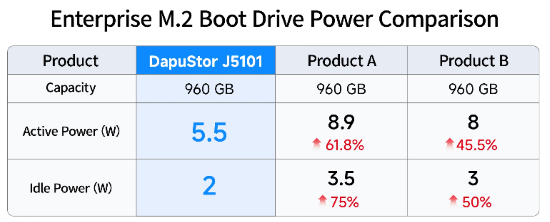
DapuStor’s pitch is that small per-drive savings add up across thousands of servers. Boot drives typically spend most of their life near idle, so the idle gap is the one that counts: 1W to 1.5W per drive in DapuStor’s comparison, which comes to 1kW to 1.5kW across 1,000 servers with one boot drive each, and twice that where boot drives are mirrored.
Data Protection
The J5101 includes power loss protection (PLP) and end-to-end data protection to guard the boot volume against unexpected power interruptions, and Secure Boot support and firmware integrity checks protect the boot process and the drive firmware. DapuStor also cites 4K error correction and ASIC-accelerated machine learning, which it says reduce NAND retries and adapt to varying NAND operating conditions. Keeping the operating system on a dedicated boot device separates it from the application data drives, which the company counts as part of the reliability case.
Deployment and Availability
The J5101 is in volume production, and DapuStor says customers are running it in production environments. It brings the J5 family, which DapuStor otherwise lists as U.2 and add-in card drives such as the J5060 QLC SSD we reviewed, to the M.2 boot slot. DapuStor’s SC26 lineup at booth 1702 in Chicago includes the J5 M.2 boot SSD alongside the 512TB R6060 QLC SSD it first demonstrated at FMS 2026.


 Amazon