

Everpure has expanded its Enterprise Data Cloud strategy by adding ActiveCluster support for file workloads. This new capability aims to provide policy-driven availability and mobility across the entire storage fleet. It ensures that data remains accessible as it moves between environments without interrupting applications.
Targeting Legacy Constraints for AI and Unstructured Data
The growth of AI has made large-scale processing of unstructured data a priority. However, many companies still use storage systems designed before flash, cloud, and AI became common. These outdated systems often lack sufficient throughput to keep modern GPUs fully utilized. This results in underutilized accelerators and longer timeframes for gaining insights.

Traditional designs also reinforce rigid data silos. Policies related to protection, placement, and availability often apply to individual arrays rather than to the datasets themselves. This complicates workflows across sites and makes it difficult when workloads need to move. Additionally, human-driven failover and migration processes can lead to errors, be slow, and be difficult to standardize, especially at scale.
Everpure positions ActiveCluster for file as a solution to these issues. The aim is to transition from array-centric configurations to data- and policy-centric operations that align with the needs of the AI era.
ActiveCluster for File: Fleet-Wide High Availability and Mobility
ActiveCluster for file is the newest feature added to the Everpure Platform, enhancing the company’s synchronous high-availability capabilities for file services. Integrated with Everpure Fusion and part of the Purity operating environment, this feature enables organizations to set availability and mobility policies once and apply them across all participating file systems.
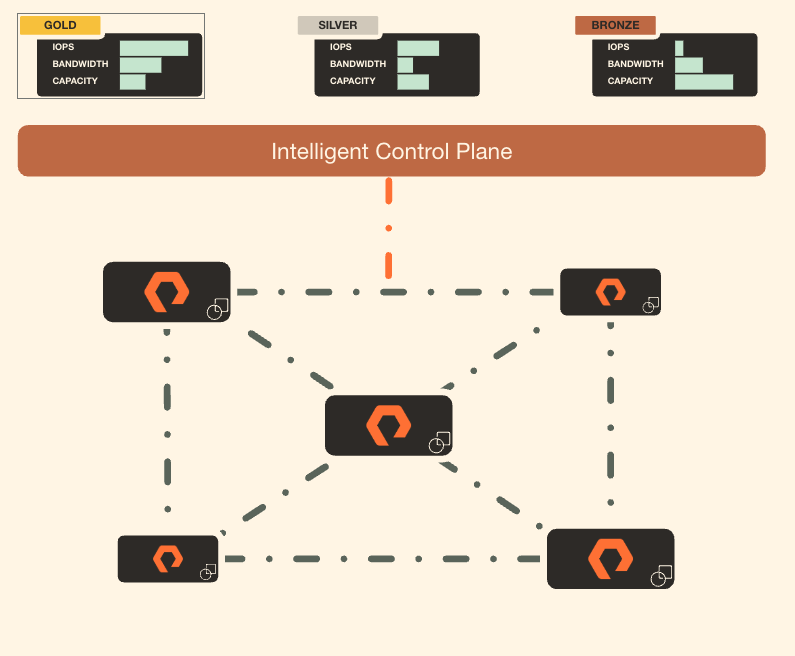
Instead of managing separate high-availability setups for each array or site, administrators can centrally define workload-level SLAs and data mobility policies. The platform automatically enforces these policies across the entire network, reducing manual configuration work and helping standardize operations as environments grow.
A key focus is on removing the need for dedicated hardware pairs or fixed-topology designs. ActiveCluster for file is built to operate across “any array, any time,” using policy and SLA definitions to determine where data should be stored and how it should fail over.
Policy-Driven Operations and Continuous Access
With ActiveCluster for files, setup and management are based on policies and standards rather than low-level replication constructs. The initial configuration is easier for administrators because they can apply consistent templates across workloads, simplifying the onboarding of new applications and sites.
Once policies are established, the system provides continuous access even during outages. Files stay online during failures, with ActiveCluster ensuring availability across participating arrays. The goal is to keep systems operational during array, site, or infrastructure events without disrupting access to application data.
Fleet-wide file mobility is another essential feature. Workloads can shift across the entire fleet in response to policy triggers, performance requirements, or SLA targets, without manual intervention for each migration. This helps operators rebalance workloads, address capacity or performance hotspots, and place data closer to compute resources that support AI and analytics.
By integrating high availability and mobility with a cloud-like model, ActiveCluster for file aims to enable autonomous operation within defined SLAs. Policies govern data location, protection, and movement, and the platform consistently enforces them.
Standardization at Scale
Standardized, policy-driven behavior is essential to the design. Workload-level SLAs are established once and automatically enforced across all relevant systems. This method simplifies scaling infrastructure, as new arrays and sites can implement existing policies rather than requiring custom configurations.
This shifts the discussion from array-specific replication features to fleet-level data services. The emphasis is on how quickly workloads can scale, how consistently SLAs are met, and how effectively the platform supports AI and unstructured-data pipelines across multiple locations.
Availability
ActiveCluster for file is expected to be generally available in Q2 2026. It will be offered as a non-disruptive upgrade within the Everpure platform’s Purity operating environment, requiring no new hardware and no expected downtime for existing deployments.


 Amazon