

IBM has launched its next-generation IBM FlashSystem portfolio, making it an autonomous storage layer powered by agentic AI. This new version builds on FlashSystem’s existing AI features. IBM is improving resilience and automating operations. It offers ongoing protection, automated threat analysis, and personalized recovery advice. IBM claims this method can cut manual storage management tasks by up to 90%. It shifts daily operations from reactive management to continuous, policy-driven improvement.
This update comes as companies accelerate AI adoption and seek to simplify IT operations across the board. An IBM Institute for Business Value (IBV) study finds that 76% of executives report their organizations are developing, executing, or scaling proofs of concept for intelligent workflows using self-sufficient AI agents. Meanwhile, storage teams face issues such as data growth, rising cyber risks, and stricter compliance requirements, driving the need for platforms that can detect, explain, and remediate problems with minimal human intervention.
IBM Storage GM Sam Werner described the new FlashSystem as a constantly available, smart layer that uses autonomous AI agents to improve performance, security, and cost. He said IBM is positioning this release as a step toward storage that serves as a strategic AI partner for IT leaders, rather than a static repository requiring ongoing manual oversight.
New FlashSystem Models: 5600, 7600, and 9600
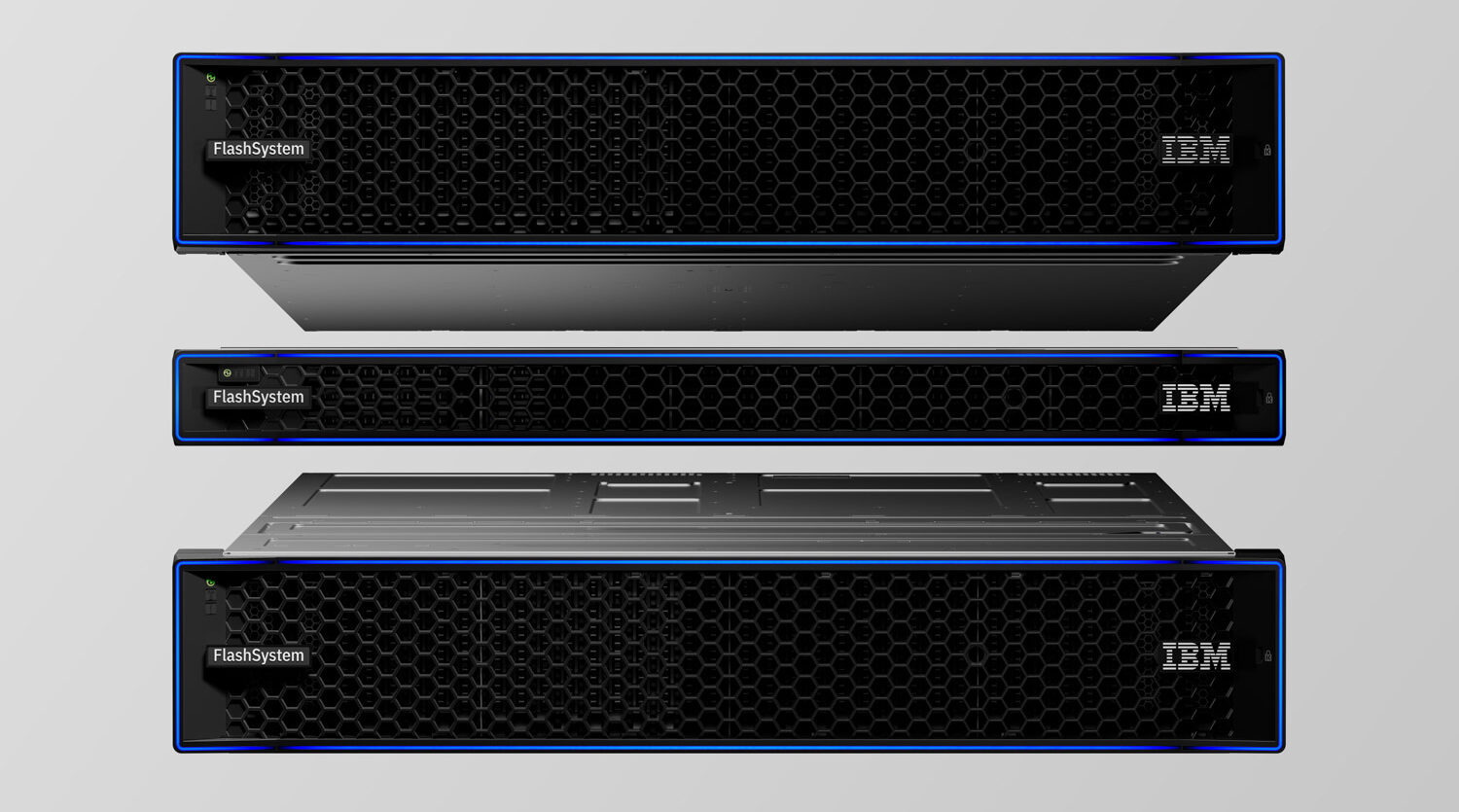
IBM is releasing three new systems at once, calling it the most significant FlashSystem update in six years. Across the portfolio, IBM claims up to 40% higher data efficiency than the previous generation, improving effective capacity, size, and performance.

IBM FlashSystem 5600
The FlashSystem 5600 targets organizations that require enterprise-class features in a compact form factor. IBM rates this system at up to 2.5 PBe of effective capacity and up to 2.6 million IOPS in a single 1U chassis. The 1U form factor is designed for deployments with space constraints, such as edge sites, remote offices, and smaller data centers, that still require modern cyber resilience and performance.
IBM FlashSystem 7600
The FlashSystem 7600 is designed for high-performance, scalable environments that support growth. IBM reports up to 7.2 PBe of effective capacity in a 2U system and up to 4.3 million IOPS. This platform is designed for large virtualized environments, analytics platforms, and consolidated application stacks that require higher throughput and faster response times as workloads and data volumes grow.
IBM FlashSystem 9600
The FlashSystem 9600 is built for mission-critical operations that need extreme performance and large-scale growth. IBM specifies up to 11.8 PBe of effective capacity in a 2U system with up to 6.3 million IOPS. IBM highlights use cases such as core banking, ERP, and AI-driven applications, where performance, availability, and security controls are crucial. The company also claims the 9600 can lower operational costs by up to 57% through AI and consolidation compared to the previous version.
IBM states that across the portfolio, FlashSystem can reduce storage space requirements by 30% to 75%, depending on the model. It cites optimized placement and consolidation compared to older systems. For the FlashSystem 7600 and 9600, IBM has added interactive LED bezels that let users view system status directly on the chassis.
Intelligent Data Services Across the Data Path
IBM is also introducing FlashSystem.ai, a new set of intelligent data services designed to manage, monitor, diagnose, and resolve issues across the full data path. The goal is to reduce dependence on manual, error-prone tasks by enabling self-service operations that automate routine management and expedite issue resolution.
IBM says the platform is trained on tens of billions of data points collected through advanced telemetry and years of operational data, allowing it to make thousands of automated decisions daily that would typically need human review. In addition to automation, IBM highlights adaptive behavior. The agentic AI features are made to understand application patterns within hours, explain its reasoning, and incorporate administrator feedback to improve suggestions over time.
On the latest FlashSystem models, IBM claims FlashSystem.ai can reduce the time spent on audit and compliance documentation by half through AI-generated, explainable operational reasoning. The systems are designed for proactive tuning and intelligent workload placement, enabling seamless data movement across storage configurations, including third-party arrays.
Hardware-Accelerated Security and Efficiency
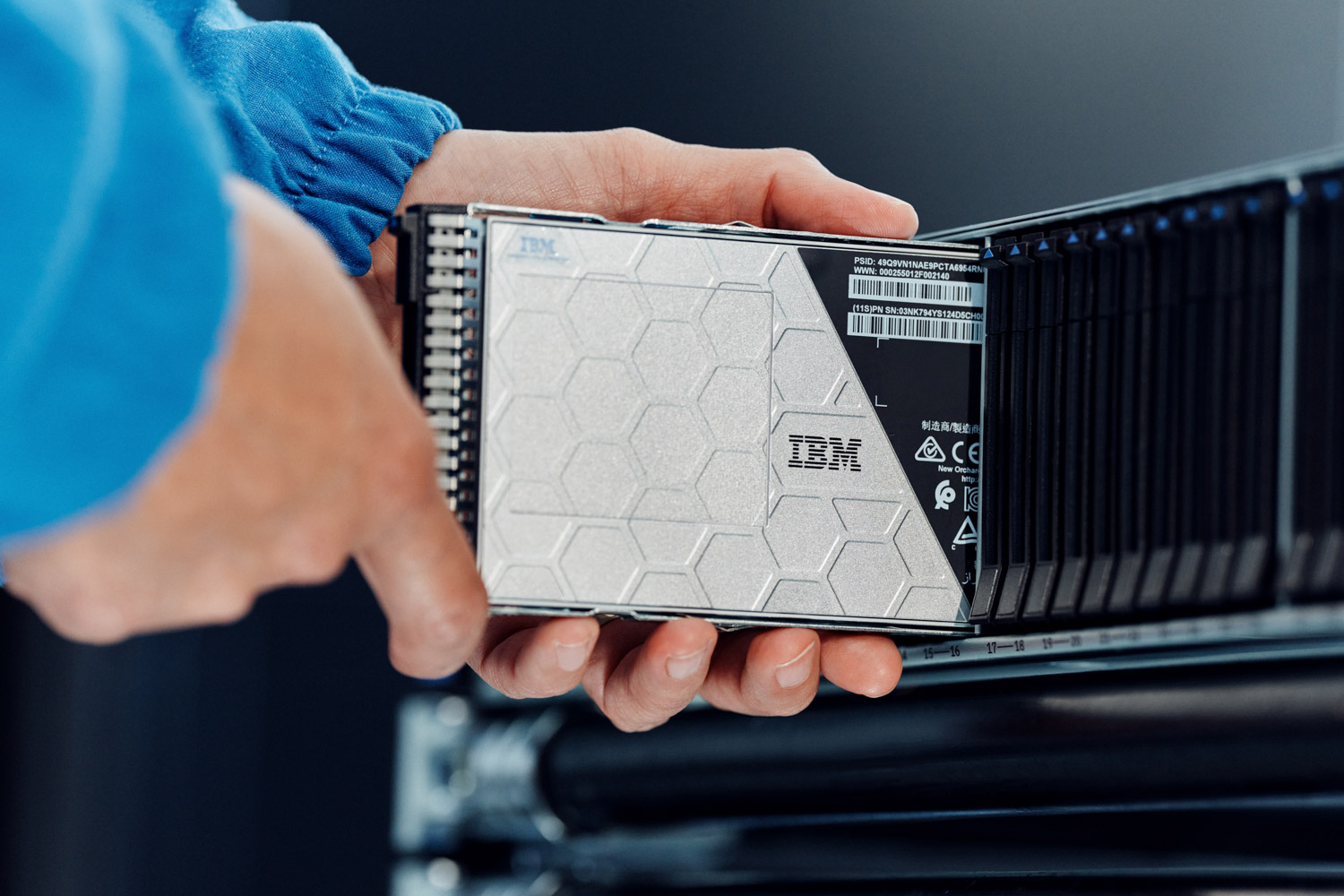
All new FlashSystem models include the fifth-generation FlashCore Module (FCM), a flash drive technology that IBM says improves both efficiency and cyber resilience. IBM lists drive capacity of up to 105 TB and highlights hardware-accelerated capabilities for real-time ransomware detection, data reduction, analytics, and operations. The module is designed to compute complex statistics on every I/O operation with hardware acceleration, enabling fast anomaly detection without impacting latency or overall system performance.
IBM claims its new threat detection method, trained on tens of billions of telemetry data points, can keep false positives under 1%. The company also states that the platform can provide AI-driven ransomware detection and alerting in under 60 seconds, as well as autonomous hardware-level recovery actions. According to IBM, this results in a storage platform designed for consistently low latency at scale while boosting detection speed and lowering operational costs for security responses.
Operations and Support
IBM also includes IBM Technology Lifecycle Services (TLS) in the operational model, leveraging AI-enabled monitoring, automated issue detection via Call Home, pre-code health checks, and priority support for critical issues. The aim is to proactively identify and manage risks before they cause downtime, aligning with IBM’s broader initiative for autonomous operations.
Availability
IBM states the new FlashSystem portfolio will be generally available on March 6, 2026. Learn more about IBM FlashSystem.ai.


 Amazon