

MinIO has introduced AIStor Memory, a storage service that provides persistent memory, workspaces, and secrets for AI agents within a single enterprise-controlled platform. The offering targets organizations moving agentic AI workloads from isolated experiments into production processes involving analysis, software development, document creation, and decision support.
AIStor Memory treats memory as a native data type alongside objects and tables. Rather than requiring teams to assemble object storage, vector databases, metadata services, secrets managers, and synchronization pipelines, the platform provides a unified persistence layer for agent state. This approach allows agents to retain context across sessions, resume interrupted work, and access governed enterprise data without rebuilding their working state.
The product breaks into three services that share the AIStor foundation but keep separate access boundaries and lifecycles. Long-term memory holds what the organization has learned, including facts, decisions, evidence, outcomes, corrections, and open questions. Workspace holds what an agent is actively working on, covering plans, attachments, intermediate artifacts, evidence indexes, checkpoints, and handoffs between agents. Vault holds the credentials an approved agent needs to act, with each secret encrypted under keys controlled by MinKMS and kept separate from both memory and active work, so an authorized task receives a narrowly scoped credential only when it needs one. All three are reachable over HTTPS or a POSIX folder mount, which is how the service drops into existing agent sandboxes without changes to the surrounding stack.
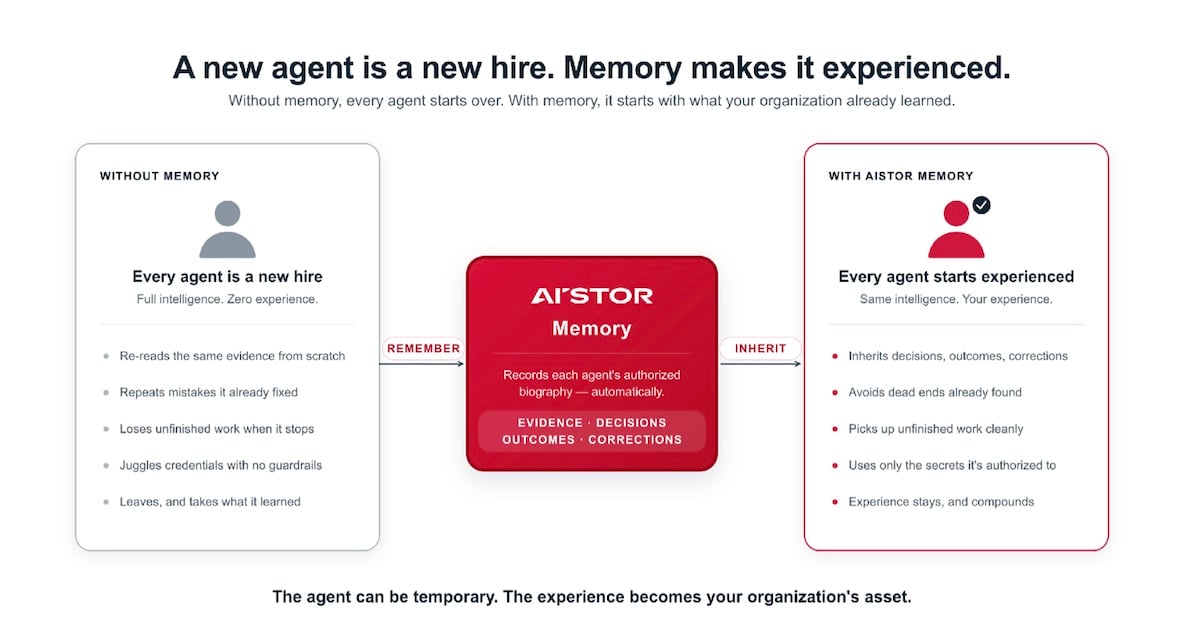
The piece MinIO is pushing hardest is Agent Biography, an authorized record of an agent’s work captured inside Memory: what each run examined, decided, produced, and left unfinished. It fills automatically as the agent works, within the boundaries of the customer’s access policy, with no memory engineering and no changes to the agents a team already runs. Agents can also write deliberately through purpose-built memory tools to create, recall, and organize what they keep. MinIO’s argument is that this turns remembering from a specialist skill into default behavior, and that one agent’s biography becomes a shared substrate other authorized agents can draw on.
A key design objective is avoiding fixed context limits associated with model prompt windows. AIStor Memory scales persistent context with underlying storage capacity, allowing agent state and associated records to be retained without truncation, eviction, or forced summarization. This is particularly relevant for workflows that span hours or days, including deep research, large codebase analysis, and human-in-the-loop processes that pause and resume.
AIStor Memory inherits the data protection capabilities of the broader AIStor platform, including erasure coding, bitrot protection, encryption, compression, and tolerance for drive, rack, and data center-level failures. MinIO’s main point is that this record is customer data, not model output. Memory can hold the reasoning behind an escalation, the judgment behind a claim decision, an operating exception, a failed strategy, or the open questions surrounding a material event, which is to say, not only what happened but also what the organization concluded about it. Data and encryption keys stay on infrastructure the enterprise owns and under keys it holds, and MinIO frames that as preserving freedom of choice: agents, models, and runtimes can change without the accumulated knowledge leaving with them.

MinIO’s operational pitch is consolidation. As agent-generated work accumulates, memory built for individual agents compounds into memory for the organization, a record agents and humans build on together. At scale, MinIO argues, one platform replaces several point systems, which means less to operate, a smaller attack surface, and no synchronization pipelines to break. That last item is the one worth watching, since sync between an object store, a vector store, and a metadata tier is where most homegrown agent memory stacks fail.
Potential use cases include software engineering agents operating across large repositories, long-running research and analysis workflows, regulated enterprise AI deployments, and operational processes requiring durable state across interruptions.
MinIO is explicit that the memory is meant to outlive the runtime around it. The blog names enterprise Kubernetes platforms alongside sandbox services, including Daytona, E2B, GitHub Codespaces, Modal, OpenSandbox, and Vercel, and argues that teams should be free to swap agents, model providers, and execution environments while the memory stays put. Daytona co-founder and CEO Ivan Burazin, quoted in the release, frames the split the same way: compute stays disposable while organizational knowledge stays durable and governed.


 Amazon