

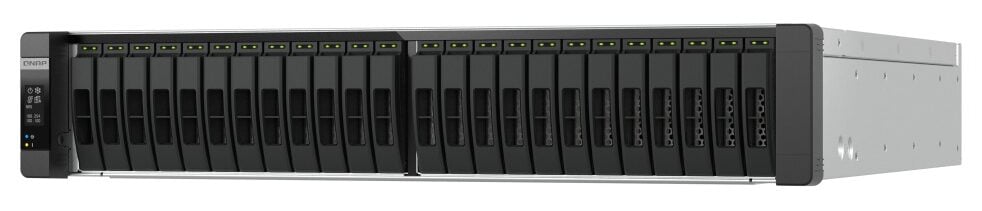
QNAP has a new flagship for its Enterprise ZFS NAS line, the ES2486AFdc, a 2U dual-controller all-flash array that swaps the SAS bays of the earlier ES2486dc for 24 dual-port U.2/U.3 NVMe slots. QNAP rates it at more than 616,000 iSCSI 4K random read IOPS and up to 15GB/s of throughput, runs it on the ZFS-based QES operating system, and aims it at virtualization, VDI, databases, and AI data pipelines where a controller failure cannot be allowed to take a volume offline. QNAP says the system, its first to pair active-active controllers with U.2/U.3 NVMe, is available now, and it has not published pricing.
Controller Architecture
The two controllers run active-active, so both serve I/O and the pair doubles the bandwidth and compute of a single-controller system. Each controller carries an Intel Xeon D-2142IT, an 8-core part at 1.9GHz base and 3.0GHz turbo, eight RDIMM slots that ship with 64GB of DDR4 ECC and top out at 512GB per controller, four 10GbE SFP+ ports, three 2.5GbE ports with one assignable to management, and two PCIe slots for 25GbE or Fibre Channel cards. If one controller fails, the other takes over every NVMe drive and network IP across a PCIe non-transparent bridge, and QNAP says front-end applications see no interruption and need no reconnect.
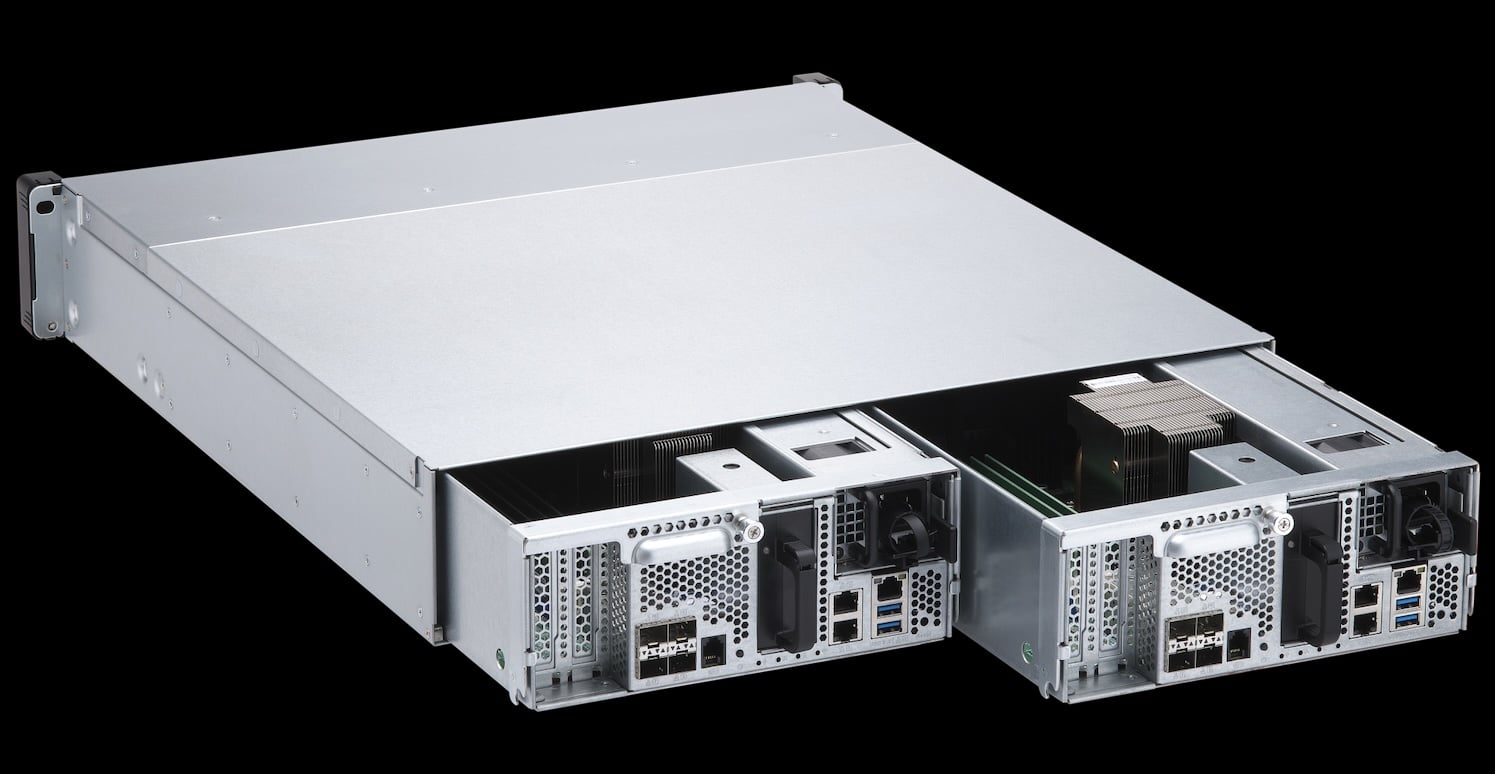
Write cache sits in DRAM and is protected by a battery backup unit paired with a 64GB M.2 SSD in each controller. On a power loss, the BBU keeps the controller alive long enough to flush the cached writes to the M.2 protection area, which is how QNAP backs its zero data loss claim. SAS expansion enclosures still attach for capacity, up to seven of them over dual-path connections, which is where QNAP’s PB-level figure comes from.
Gen4 NVMe in Every Bay
QNAP says each of the 24 bays gets a PCIe Gen4 x4 lane and accepts U.3 drives while staying backward compatible with U.2, which removes the 12Gb/s SAS ceiling of the prior model and cuts command queue latency for SQL Server and Oracle style workloads. One spec is worth confirming before you plan add-in cards: QNAP’s hardware specification lists the two expansion slots as PCIe Gen3 x8, while its product page calls them Gen4 slots, and the Xeon D-2100 series itself is a PCIe Gen3 processor.
QES Operating System
QES is QNAP’s FreeBSD and ZFS-based operating system for the dual-controller line. It brings end-to-end checksums that detect and repair silent corruption, up to 65,535 copy-on-write snapshots per LUN or shared folder, inline deduplication that QNAP says saves more than 90% of space on identical VDI images, inline compression, and a write coalescing algorithm that batches random writes into sequential ones to cut write amplification on the NVMe drives. SnapSync replicates changed blocks to a remote system in real time and integrates with VMware Site Recovery Manager for disaster recovery.
Virtualization and Workloads
QNAP lists VMware, Hyper-V, and Proxmox support with VAAI and ODX offload, iSER for iSCSI over RDMA to cut host CPU load, and Storage QoS for predictable performance out of a single pool. It pitches the system for VDI boot storms, collaborative 4K and 8K editing over 25GbE, and database work where NVMe latency shortens queries, and positions it as the tier-1 companion to the ES1686AFdc for capacity. The 616,000 IOPS and 15GB/s figures are QNAP’s, and the company has not published the test configuration behind them.
“The ES2486AFdc delivers outstanding performance and a reliable high-availability storage solution,” said Sean Teng, Product Manager of QNAP. “The ZFS-based QES operating system ensures zero data loss and maximizes storage efficiency through advanced data reduction technologies. From critical database transactions and VDI Boot Storms to 4K/8K media inline editing, the ES2486AFdc provides uncompromising stability and extreme performance to our customers.”
Specifications
| Specification | QNAP ES2486AFdc |
|---|---|
| Overview | |
| Model | ES2486AFdc-2142IT-128G |
| Number of Controllers | 2 |
| Processor | |
| CPU | Intel Xeon D-2142IT, 8 cores, 1.9GHz base, up to 3.0GHz |
| CPU Architecture | 64-bit x86 |
| Encryption Engine | Yes (AES-NI) |
| Memory | |
| System Memory | 64GB RDIMM DDR4 ECC per controller |
| Maximum Memory | 512GB (8 x 64GB) per controller 1,024GB system total |
| Memory Slots | 8 x RDIMM or LRDIMM DDR4 per controller (16 total) RDIMM and LRDIMM cannot be mixed |
| Flash Memory | 4GB (dual boot OS protection) |
| Storage | |
| Drive Bays | 24 x 2.5-inch, hot-swappable |
| Drive Compatibility | 2.5-inch dual-port U.2/U.3 NVMe PCIe SSD |
| Cache | L1 ARC read cache: RAM L2 ARC read cache: SSD ZIL write cache: NVRAM (Copy to Flash) |
| Copy to Flash Device | 1 x 64GB M.2 SSD per controller |
| Networking and I/O | |
| 2.5GbE Ports | 3 per controller (one assignable to remote management) |
| 10GbE Ports | 4 x 10GbE SFP+ per controller |
| PCIe Slots | 2 per controller, PCIe Gen3 x8 (CPU) Card size up to 215 x 68.9 x 18.76mm per slot |
| USB | 2 x USB 3.2 Gen 1 per controller (engineering use only) |
| Wake on LAN / Jumbo Frame | Yes / Yes |
| Chassis | |
| Form Factor | 2U rackmount |
| Dimensions (H x W x D) | 88.3 x 483 x 525.18mm |
| Weight | 22kg net 26.91kg gross |
| Indicators | System power and status LEDs Two-digit LCD for JBOD connection status |
| Environment and Power | |
| Operating Temperature | 0 to 40C (32 to 104F) |
| Storage Temperature | -20 to 70C (-4 to 158F) |
| Relative Humidity | 5 to 95% RH non-condensing, wet bulb 27C (80.6F) |
| Power Supply | Redundant hot-swap, 90 to 264VAC, 700W |
| Typical Power Consumption | 663.4W (drives fully populated) |
| Fans | 3 x hot-swappable 60 x 60 x 38mm modules, 16,000 RPM |
| Support | |
| Standard Warranty | 5 years |
| Max Concurrent CIFS Connections (max memory) | 10,000 |


 Amazon