

Schneider Electric used YOTTA 2026 in Las Vegas to introduce what it calls the world’s first fully software-defined medium-voltage switchgear, already running in a live colocation pilot with Equinix, along with a 38 kV extension of its SF₆-free AirSeT gas-insulated switchgear and a three-company “Generator-to-Chip” delivery model with Wärtsilä Energy and Stanley Consultants. The software-defined switchgear separates control logic from the hardware: distribution equipment is standardized and configurable, and protection schemes, telemetry, and upgrades move into software modules that deploy over the air.
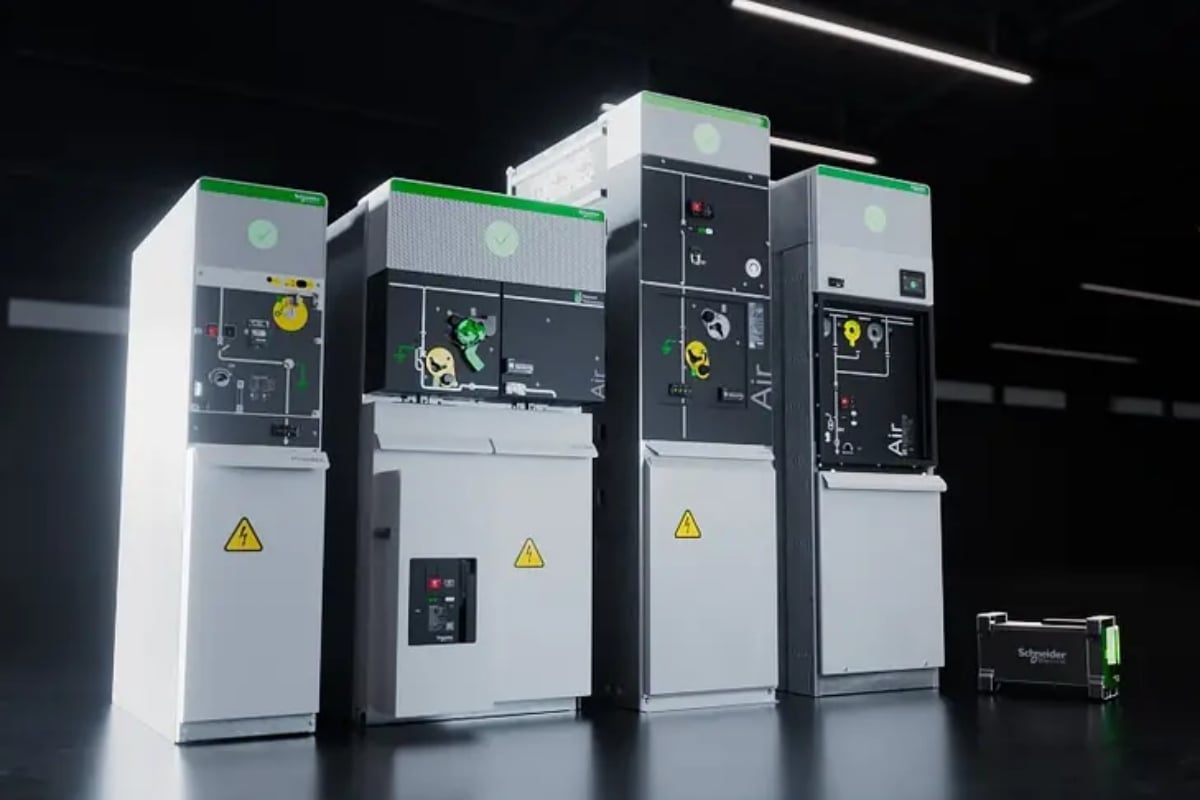
Software-Defined Medium Voltage Architecture and RM AirSeT 38
Schneider’s numbers come from its own White Paper 303, a 20-panel comparison against conventional engineered-to-order medium-voltage switchgear: the software-defined configuration used 87 percent less control wiring, 91 percent fewer terminals, and 85 percent less copper in that control wiring. On the same basis, Schneider claims up to 3x faster ordering and manufacturing and up to 2x faster commissioning and on-site acceptance testing. Its global version of the release attributes the 3x and 2x figures to “studies and estimations,” so treat them as modeled.
Over-the-air updates handle system upgrades without hardware replacement or downtime, and telemetry feeds Schneider’s EcoCare Services for predictive maintenance. The Equinix pilot is the first live deployment. Pilot programs continue through 2027, with broader availability in 2028, and Schneider says the approach will extend across its medium-voltage line and then the rest of the powertrain, including PremSet and the GM, RM, and SM AirSeT ranges.
For campuses planning 36 or 38 kV distribution, the RM AirSeT 38 Software Defined GIS extends the AirSeT platform from 24 kV to 38 kV. It uses pressurized pure air insulation and vacuum interruption instead of SF₆, other fluorinated gases, or proprietary gas mixtures, in a compact GIS form factor with digital monitoring and sensing options configurable to the customer’s cybersecurity requirements. Order intake is planned for 2027, with first deliveries in 2028.
Galaxy VXL UPS and Generator-to-Chip Delivery
Schneider also put its Galaxy VXL UPS on the stand. It’s not new; the product was announced in December 2024 and is available globally, but it’s the UPS Schneider pairs with the switchgear story for AI load steps.
A single frame supplies up to 1.25 MW in up to 70 percent less floor space than its predecessor, with a 31 percent reduction in lifecycle CO₂ emissions versus that predecessor by Schneider’s count. Live Swap, which Schneider’s product page says is TÜV verified, lets operators add, upgrade, or replace power modules without planned downtime. It supports lithium-ion and VRLA batteries under EcoStruxure monitoring.
The Generator-to-Chip model, announced on the show’s final day, is a delivery approach with no product attached. Wärtsilä supplies flexible, modular engine power plants for on-site generation; Schneider provides the electrical architecture, automation, and digital power management; and Stanley Consultants handles engineering, permitting, design coordination, construction management, commissioning oversight, and climate resilience. The three support grid-connected, islanded, and hybrid configurations, and Schneider is branding the result an “AI Energy Park.”
“For many data center projects, power has become the schedule,” said Risto Paldanius, Vice President, Americas at Wärtsilä Energy. The release claims the approach “can accelerate project schedules compared with traditional, sequential delivery models” and offers no figures, customers, or dates behind that. Schneider’s YOTTA booth also ran a full IT pod on its Smart Spatial digital twin, including iLine busway, Motivair in-rack CDUs, and an 800 VDC sidecar.


 Amazon