

Silicon Motion has introduced the SM2524XT, a PCIe Gen5 DRAM-less SSD controller targeting AI PCs, edge AI systems, and workloads centered on local AI inference. The controller is engineered to meet the storage demands of KV cache-intensive workloads, where sustained random I/O performance and low-latency access are increasingly critical for continuous inference.
Silicon Motion says that the SM2524XT can deliver sequential read speeds of up to 14GB/s, sequential write speeds of up to 12GB/s, and random performance reaching up to 2.5 million IOPS. The controller was built to maintain stable throughput under fragmented, latency-sensitive access patterns commonly associated with AI inference workloads.
| Specification | Silicon Motion SM2524XT |
|---|---|
| Overview | |
| Product Type | PCIe Gen5 DRAM-less SSD controller |
| Target Workloads | AI PCs, edge AI, AI inference, and KV Cache-intensive workloads |
| Primary Focus | Sustained random I/O performance and low-latency AI inference workloads |
| Interface and Architecture | |
| PCIe Interface | PCIe Gen5 x4 |
| NVMe Support | NVMe 2.1 |
| CPU Architecture | Quad-core Arm Cortex-R8 |
| NAND Channels | 4 NAND channels |
| NAND Interface Speed | Up to 4,800 MT/s |
| Performance and Power | |
| Sequential Read Speed | Up to 14 GB/s |
| Sequential Write Speed | Up to 12 GB/s |
| Random Performance | Up to 2.5 million IOPS |
| Power Consumption | Below 5W SSD power |
| Performance-Per-Watt Improvement | Up to 25% over the previous generation |
| Process and Technologies | |
| Manufacturing Process | TSMC 6nm |
| Key Technologies | SCA (Separated Command Address), advanced FTL scheduling, NANDXtend LDPC ECC |
| Error Correction | 4KB LDPC ECC capability with NANDXtend technology |
| Voltage Optimization | PI-LTT low-voltage NAND I/O optimization |
KV Cache Workloads Drive Higher Storage Demands
AI inference workloads exhibit different storage behavior than that of more traditional consumer SSDs. Instead of relying mainly on burst-oriented sequential transfers, KV Cache operations create continuous streams of fragmented random reads and writes that depend heavily on sustained IOPS throughput and low-latency access.
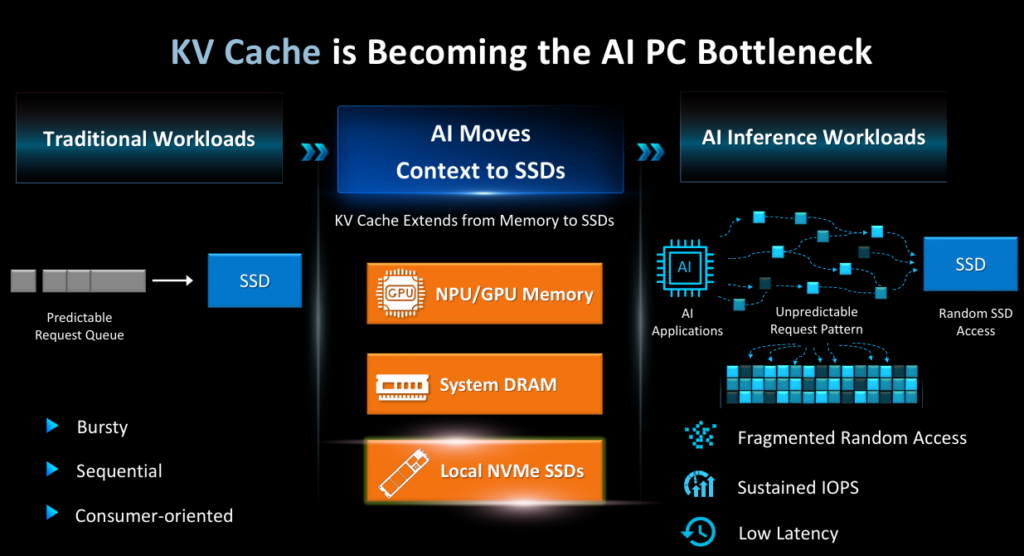
Silicon Motion describes KV Cache as one of the growing storage bottlenecks in AI PCs, particularly as larger local language models and AI agents move more context data from memory into local NVMe SSD storage. The SM2524XT was designed to maintain consistent random I/O performance during sustained inference sessions where storage responsiveness becomes critical.
PCIe Gen5 Interface And Four-Core Architecture
The SM2524XT uses a PCIe Gen5 x4 interface with NVMe 2.1 support and includes a quad-core Arm Cortex-R8 processor architecture. The controller supports four NAND channels with interface speeds up to 4,800MT/s and is manufactured using TSMC’s 6nm process technology.
The architecture also incorporates Silicon Motion’s Separated Command Address technology, or SCA, which separates command and address handling to improve NAND access efficiency. This design should help improve the efficiency of parallel data processing and reduce latency interruptions during sustained AI workloads.
Additional technologies integrated into the controller include advanced FTL scheduling and NANDXtend LDPC ECC error correction. Silicon Motion says these features will maintain more consistent performance and improve reliability during continuous inference.
Power Efficiency
Power efficiency is also important in the overall SM2524XT design, as Silicon Motion states that the controller delivers up to 25% higher performance-per-watt than the previous generation while keeping SSD power consumption below 5W.

The controller combines the 6nm manufacturing process with Silicon Motion’s PI-LTT voltage optimization technology, which lowers NAND I/O voltage to reduce power usage during sustained workloads. Silicon Motion also compares the SM2524XT against the earlier SM2504XT controller and reports higher sequential read throughput at similar active power levels.
Positioned Around Edge AI And Local Inference
Silicon Motion says the SM2524XT targets AI PCs and edge AI systems, where inference workloads increasingly run locally rather than relying entirely on cloud infrastructure. Workloads tied to enterprise AI agents, robotics, manufacturing systems, science applications, and AI coding environments are also relevant use cases for the SM2524XT.


 Amazon