

Simplyblock is building business continuity and storage-level disaster recovery into its software-defined storage platform for Red Hat OpenShift Virtualization and OpenShift Container Platform, with no separately licensed DR product on top. The platform now ships with synchronous stretch-cluster replication for zero-RPO metro deployments, asynchronous replication with RPOs as low as one minute, automated failback, live movement of running volumes between clusters, and backup to any S3-compatible object store. Simplyblock’s pitch is aimed squarely at VMware shops mid-migration, where vSAN, vMotion, Storage vMotion, and Site Recovery Manager used to handle replication, failover, and workload mobility as part of the stack, and where storage-level DR for OpenShift has typically meant a premium add-on licensed on every worker node at both the primary and recovery sites.
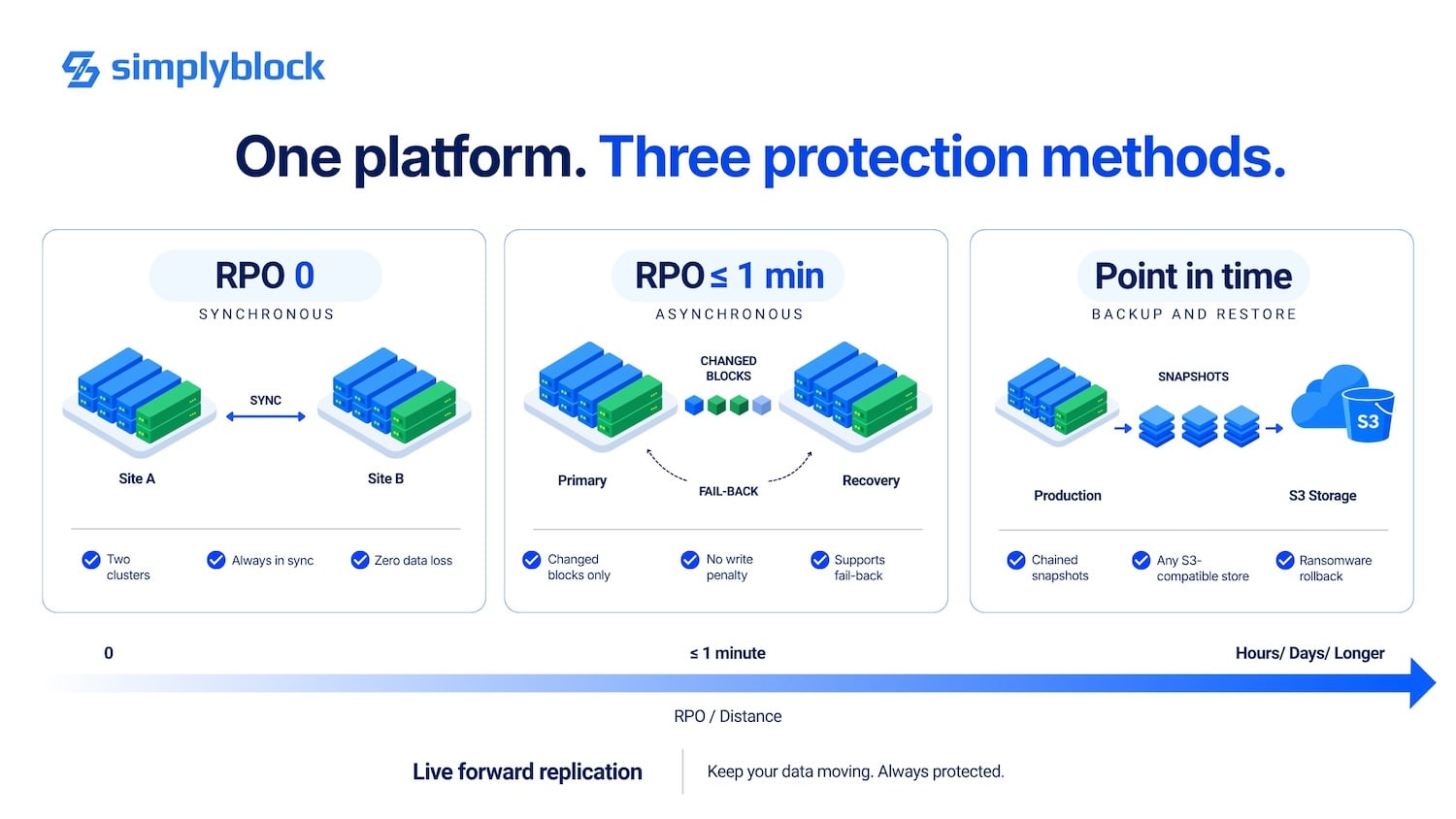
Synchronous Metro and One-Minute Async Replication
For sites close enough for synchronous writes, Simplyblock uses distributed erasure coding across a stretch cluster, so a write lands on both sites before it’s acknowledged and the RPO is zero. Simplyblock’s documentation puts the practical limit for that mode at sub-10ms round-trip latency between sites. Beyond that distance, the platform continuously replicates volumes between independent clusters using delta-based replication, with RPOs as low as one minute, automated failback, active monitoring of the replication backlog, and application-consistent recovery across related volumes, so a multi-volume VM or application comes back as a set.
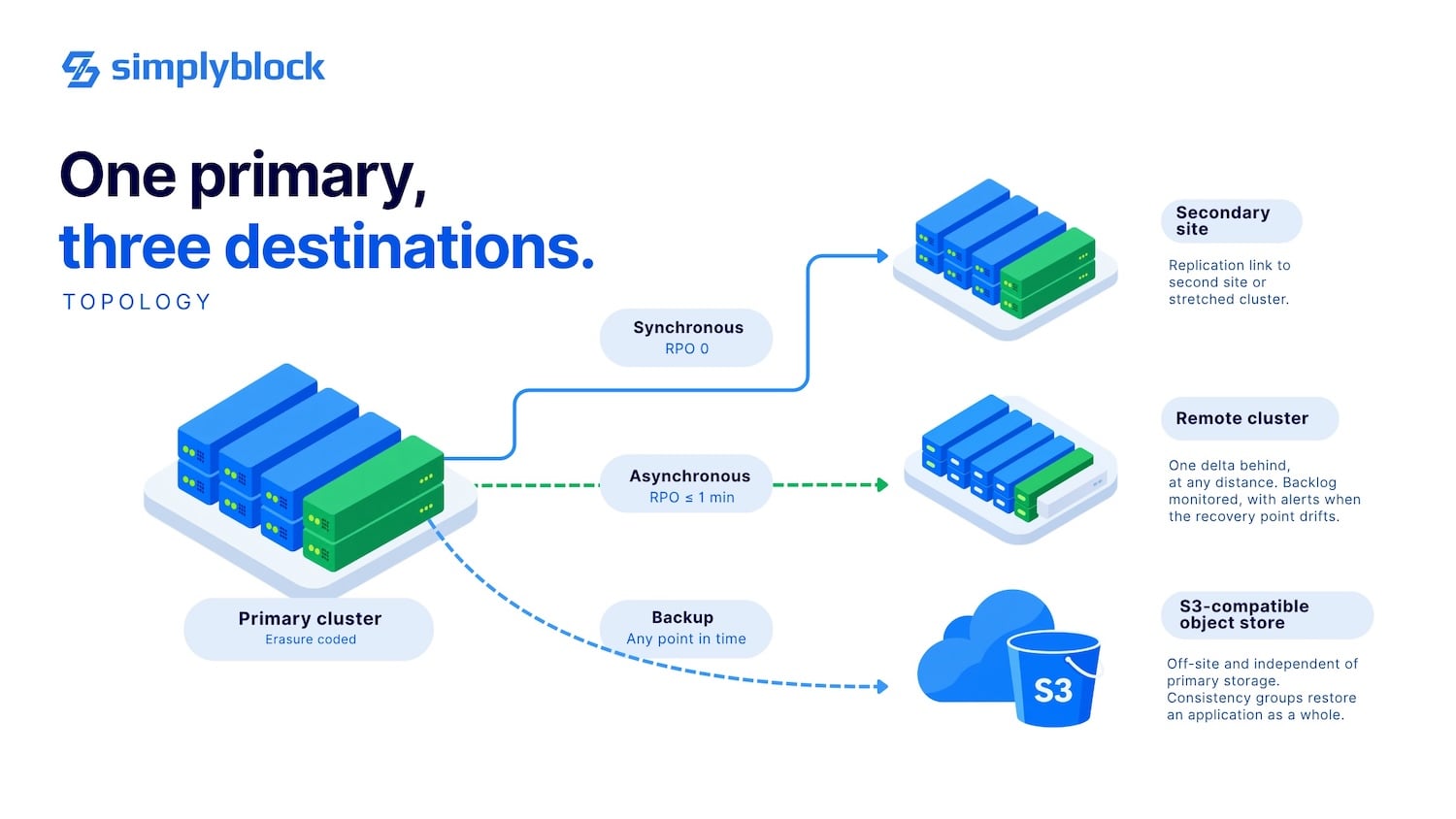
The third mode is live forward replication of a running volume from one cluster to another with no disruption to the workload, a vMotion-like capability for maintenance windows, hardware refreshes, planned infrastructure changes, and cluster relocation. For off-site protection independent of the primary storage environment, volumes can be backed up to any S3-compatible object store and restored from it.
Storage-Layer DR Under OpenShift Multi-Cluster Tooling
Simplyblock positions all of this at the storage layer, providing the replication and protection foundation that broader cluster-level DR workflows, including OpenShift multi-cluster management and orchestration, can build on. That’s the gap Simplyblock is pointing at with the analyst quote in its announcement. “Kubernetes and OpenShift are becoming increasingly popular. However, the lack of built-in business continuity and disaster recovery has made it difficult for many organizations to make the transition from hypervisors or hyperconverged infrastructure,” said Marc Staimer, CEO of Dragon Slayer Consulting. “CSI shared storage lacks the granularity, business continuity, and low-cost users are looking for. Simplyblock is the first to solve this problem.”

“OpenShift Virtualization gives enterprises a compelling path to modernize their VM infrastructure without abandoning the workloads they depend on,” said Rob Pankow, CEO of Simplyblock. “However, running VMs in this new production environment requires resilient storage and a credible recovery strategy to succeed. By building DR and business continuity directly into Simplyblock, we are providing a fully integrated storage platform that offers customers replication, recovery and off-site protection without them having to assemble a separate collection of products or purchase a separately licensed DR layer.”
The DR and business continuity capabilities ship as part of the Simplyblock platform for OpenShift Virtualization and OpenShift Container Platform. Simplyblock’s platform runs NVMe over TCP and NVMe over RDMA with SPDK acceleration, supports hyperconverged and disaggregated deployments, and includes copy-on-write snapshots, erasure coding, thin provisioning, multi-tenant QoS, and a Kubernetes CSI driver.


 Amazon