

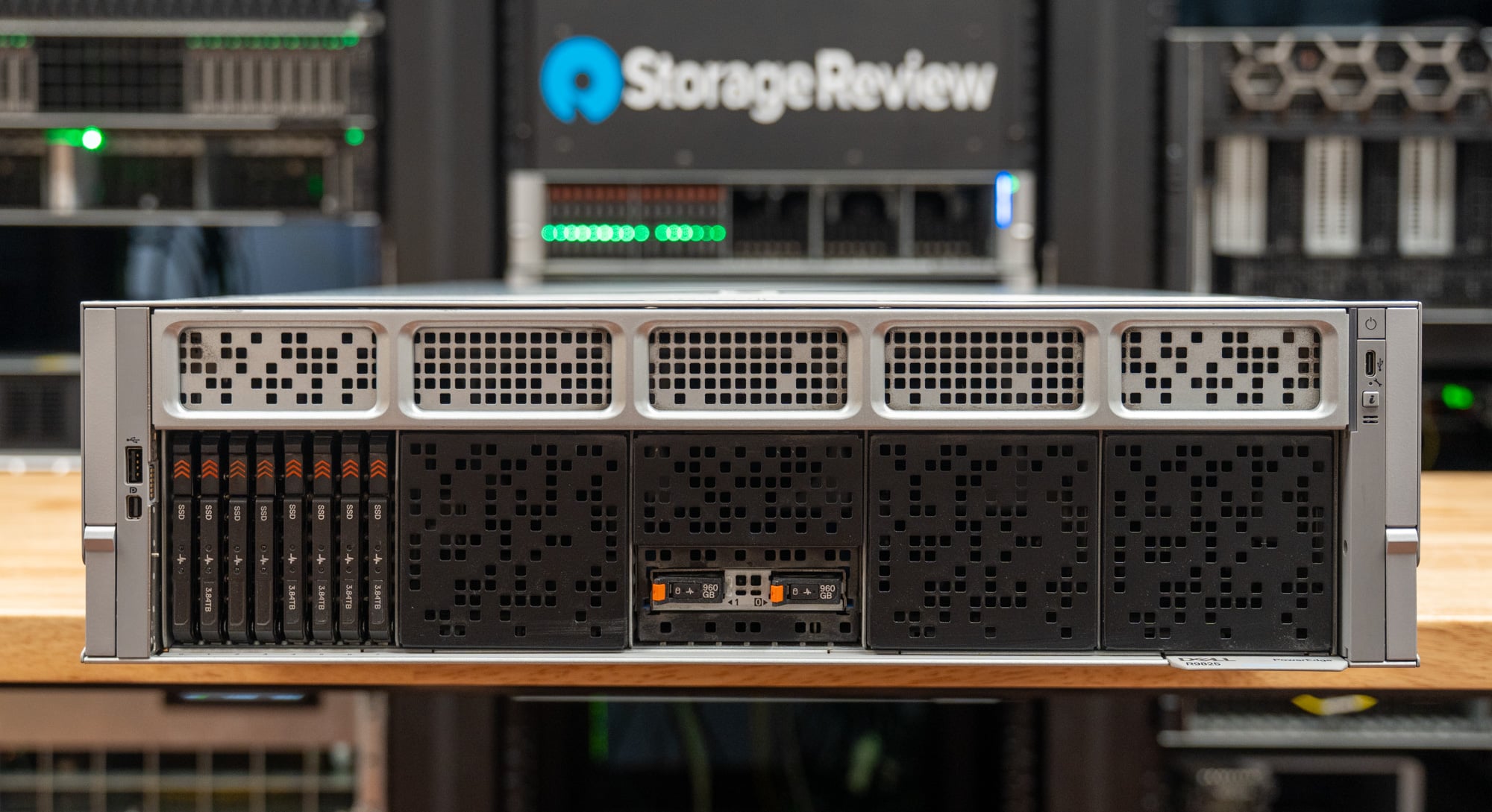
The Dell PowerEdge R9825 is the first server built on AMD’s 6th Gen EPYC to reach our lab, and it is the dual-socket flagship of Dell’s 18th generation PowerEdge line. Two EPYC 9996 processors give it 512 Zen 6c cores and 1,024 threads, 32 DDR5 slots take it to 8TB of memory, and the front panel holds up to 32 E3.S Gen6 x4 NVMe drives. Dell describes it as a high-density dual-socket server engineered for existing air-cooled data center environments, and the design choices that follow from that one sentence are what make the R9825 interesting beyond its core count.
The most visible of those choices is the height. Dell’s dual-socket mainstream platforms have been 2U for a decade, and the R7725 that this server replaces at the top of the AMD line is a 2U box. The R9825 is 3U, and the extra rack unit buys the airflow room needed to cool two 600W processors with fans alone, so that a customer with a conventional data center can deploy 512-core nodes without a liquid loop.
Our review unit shipped with two EPYC 9996 and 2TB of DDR5 running at 8,000MT/s, which we paired with Solidigm Gen5 E3.S drives, and its processor results are in our AMD EPYC Venice SP7 review; this review is about the server around them.
Key Takeaways
- 512 cores, air-cooled, in a standard rack. Two 600W EPYC 9996 run on five hot-swap fans in a 3U chassis, and the R9825 ran GROMACS benchPEP at 9.72 ns/day, 1.8x the 2U PowerEdge R7725 with two 192-core EPYC 9965, and encrypted at 6.8TB/s with AES-256-GCM.
- The extra rack unit is an airflow decision. Dell moved the dual-socket flagship from 2U to 3U, stacked the two processor boards, and shaped the front intake so air reaches both sockets, so the platform fits existing air-cooled data centers with liquid cooling optional.
- Memory is the configuration choice that matters. The R9825 takes 32 RDIMMs at 8,000MT/s up to 8TB or 32 MRDIMMs at 12,800MT/s up to 4TB, with 2TB the MRDIMM ceiling at launch; our unit, with memory running at 8,000MT/s, sustained 1,201GB/s on STREAM Triad, and the same processors on MRDIMMs reached 1,901GB/s in our testing on AMD’s reference platform.
- Gen6 everywhere. Up to eight PCIe Gen6 x16 slots, optional Gen6 OCP 3.0, and 16 or 32 E3.S Gen6 bays for up to 1.96PB of flash make this the first PowerEdge where the I/O generation moves with the CPU.
- Against NVIDIA Vera, the x86 side leads most of the board. The R9825 beat the two-socket Vera reference system on GROMACS, OpenFOAM, Valkey throughput, 7-Zip, and OpenSSL, while Vera kept raw memory bandwidth, ClickBench’s hot sum, PostgreSQL and MariaDB throughput on one socket, and a few latency-bound single-thread tests.
Build and Design
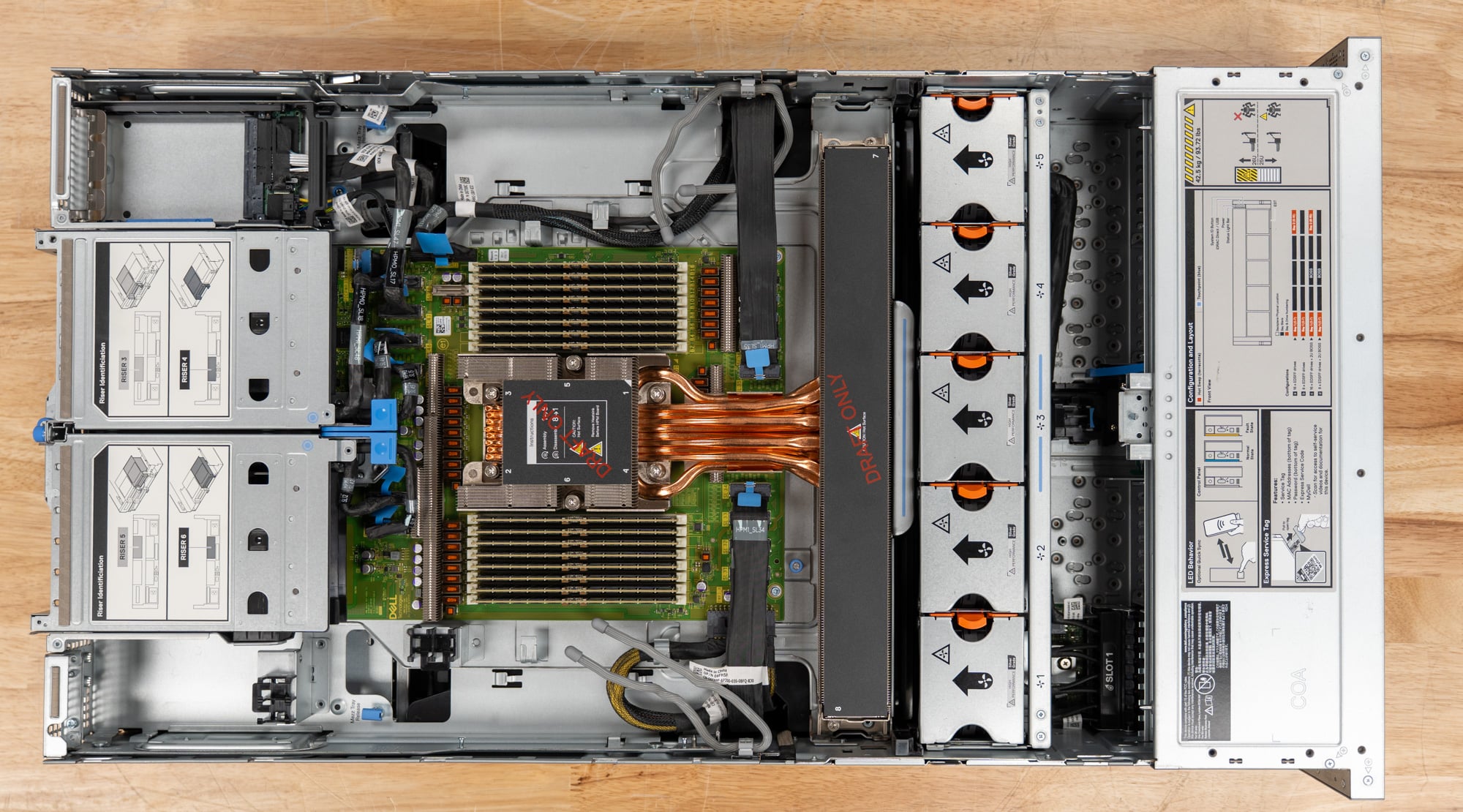
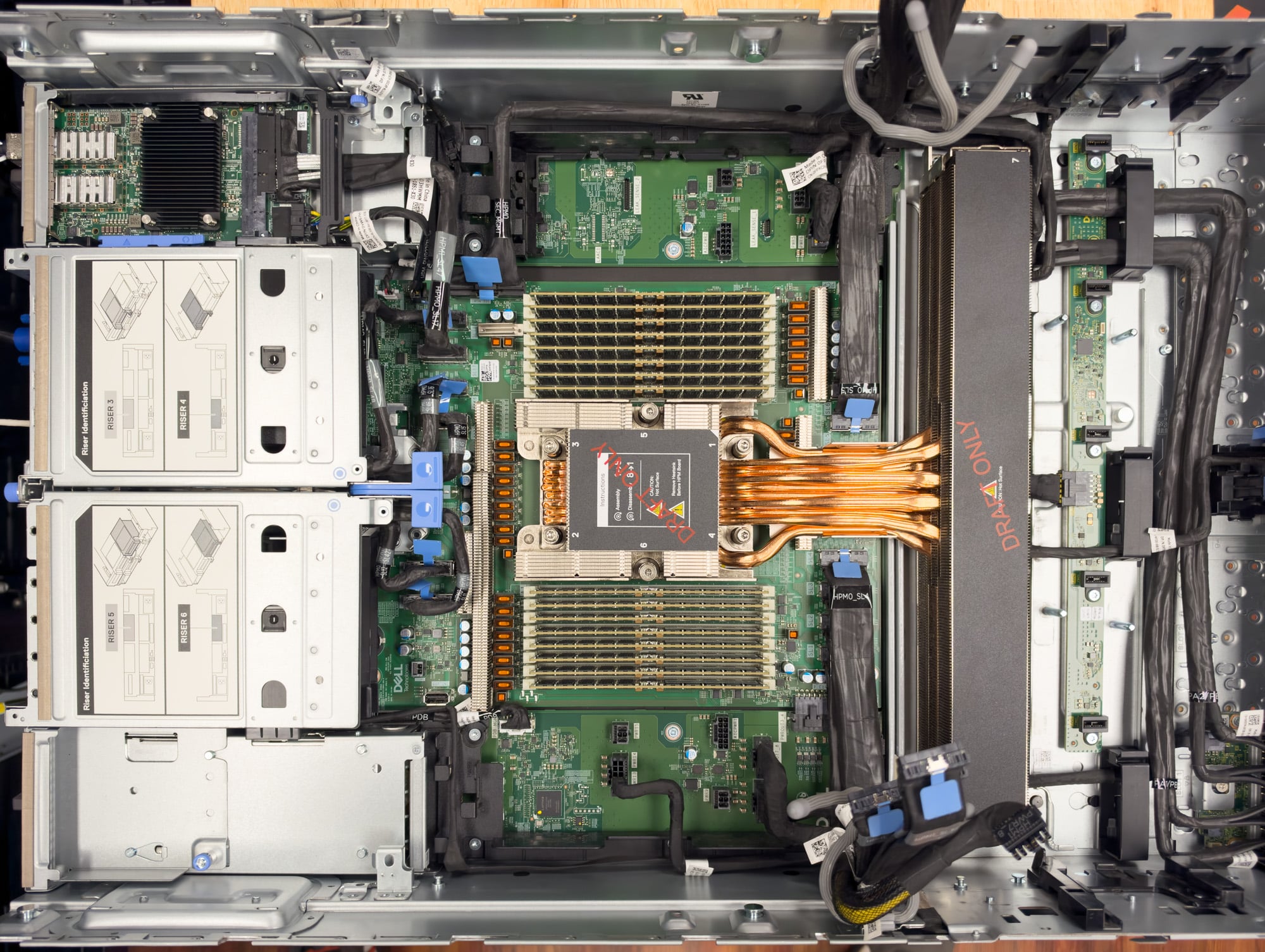
Dell lists the R9825 at 5.17 inches tall, 17.09 inches wide, and 34.44 inches deep with the bezel, at 94 pounds configured. The depth and weight are in line with a loaded 2U two-socket server; the height is the departure. Inside, Dell has stacked the two processor boards one above the other, where a 2U design lays both sockets side by side across a single board, and that is how the 3U volume turns into cooling headroom.
The height follows from AMD’s socket as much as from Dell’s design. Venice ships on two platforms, and the R9825 uses SP7, the larger one: a 76mm by 80mm socket rated to 600W with sixteen memory channels at one DIMM per channel, which is where the 256-core parts and the 1.6TB/s MRDIMM ceiling live. SP8, due in the first half of 2027, is the smaller enterprise socket, capped at 400W, 128 cores, and eight channels, with more PCIe lanes per socket. That makes the R9825 the top of Dell’s Venice line, and it leaves the volume 2U two-socket role to the PowerEdge R7825, a two-socket EPYC 9006 server Dell lists as coming soon.
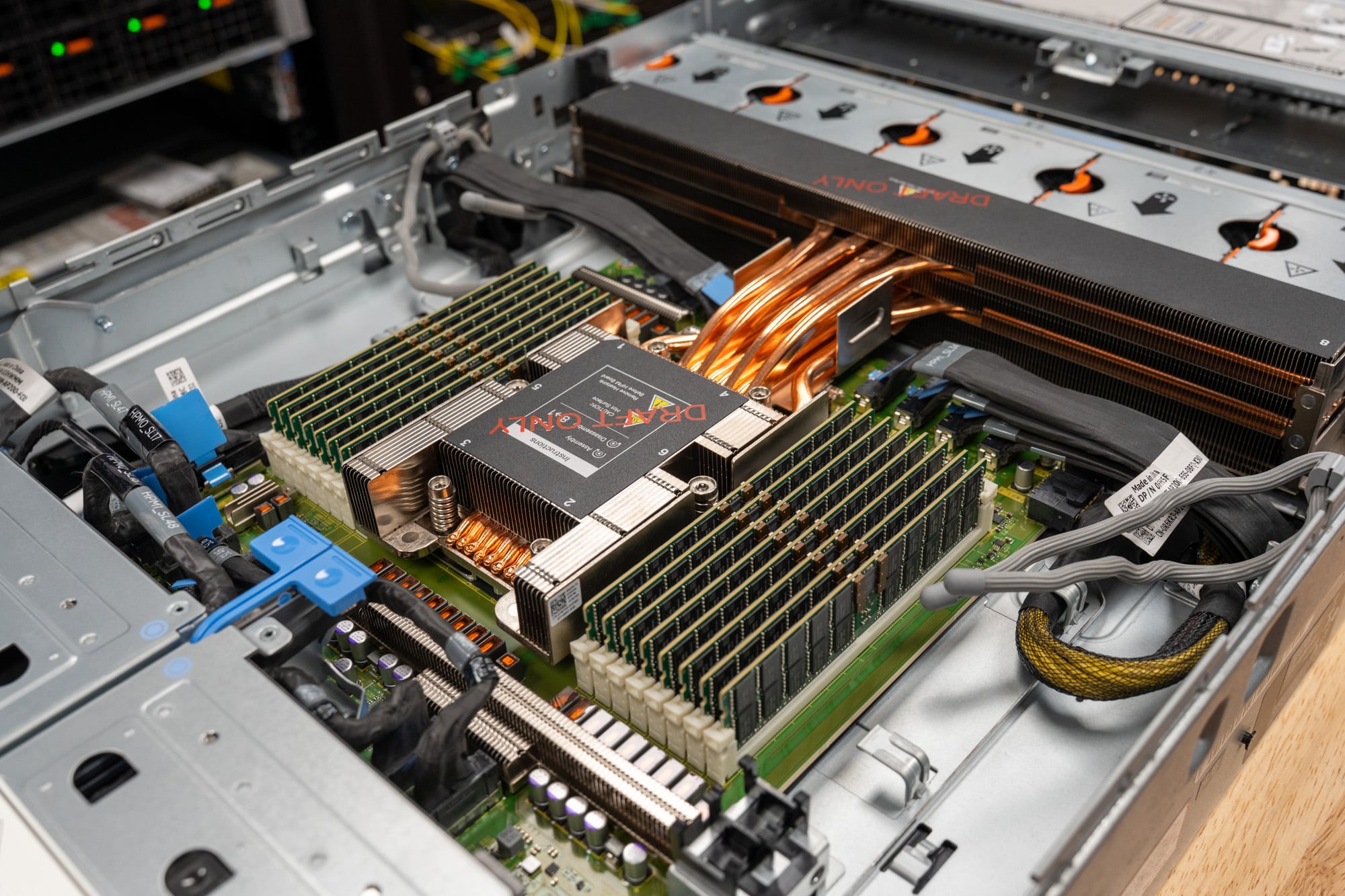
Each processor gets a dedicated path for intake air and a full-height heatsink on its tier, and the fan wall behind the drive bays pushes through both tiers.
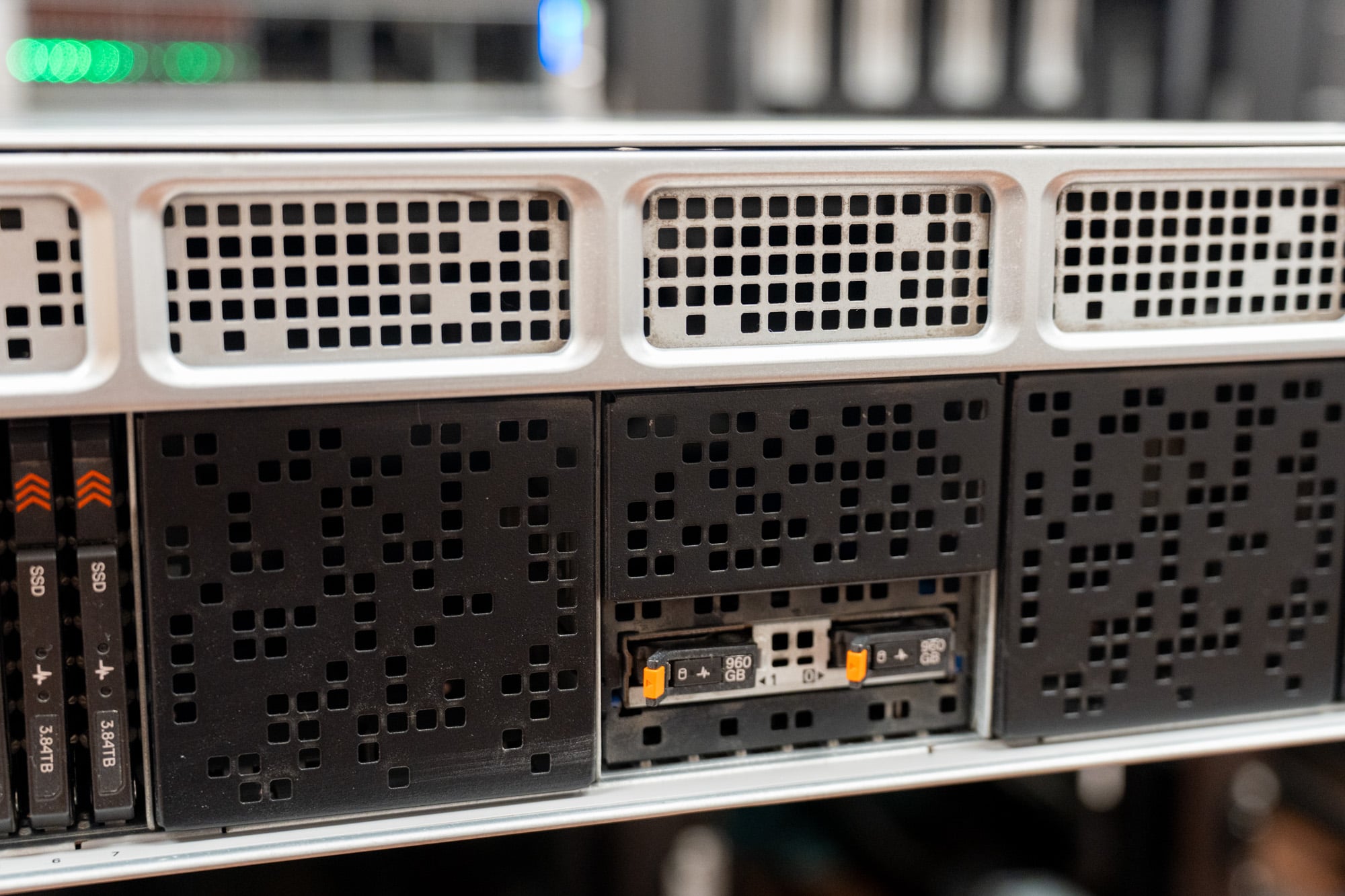
The front of the chassis is where the airflow design shows. The perforations across the front panel look irregular at first glance, as if Dell had cut a pattern for appearance. They’re actually a purpose-built intake map: the openings line up with the two processor boards, and the density of the pattern is tuned to equalize pressure between the upper and lower tiers so each board receives the same volume of air. Dell’s engineers walked us through the pattern on a site visit, and every part of it is there for thermal reasons.
The lower motherboard follows much of the same layout, with the power supplies and distribution boards flanking it on each side. Those additional components raised the measured temperature of the lower CPU by more than 10C over the upper CPU under our heaviest sustained workloads. The gap narrowed under moderate loads, but it is a wider spread than we have seen on conventional server designs with the two CPUs side by side.
Storage occupies the rest of the front panel. Dell offers the R9825 with 8 or 16 E3.S Gen6 NVMe bays at launch, for a maximum of 983TB, and lists a 32-bay configuration for 1.96PB that is not available at product launch. Every configuration is PCIe Gen6 end to end from the drive to the processor.
Boot comes from a BOSS-N1 or N2 module with two M.2 NVMe SSDs in hardware RAID 1, and PERC H975i and H965i controllers are available for customers who want hardware RAID over the front bays. Our unit used Solidigm 12.8TB Gen5 E3.S drives, which link at Gen5 x4 in Gen6 slots. An upcoming review will look at Gen6 storage performance via Micron SSDs.
Around back, the R9825 offers up to eight PCIe Gen6 x16 slots alongside a Gen4 x4 OCP 3.0 slot, with an option for two Gen6 x8 OCP slots in its place. Accelerator support is modest by design: up to six 75W single-wide, half-length cards, or up to two 675W double-wide full-length cards, which Dell supports only when the server is configured with a single CPU. That positions the R9825 as a CPU-first platform with room for NICs, DPUs, and inference cards, and leaves the heavy GPU work to Dell’s XE line.
Rear ports are a dedicated 1GbE BMC port, two USB 3.1 Type A, and VGA, with a USB Type C, optional USB 2.0 Type A, and mini DisplayPort on the front.
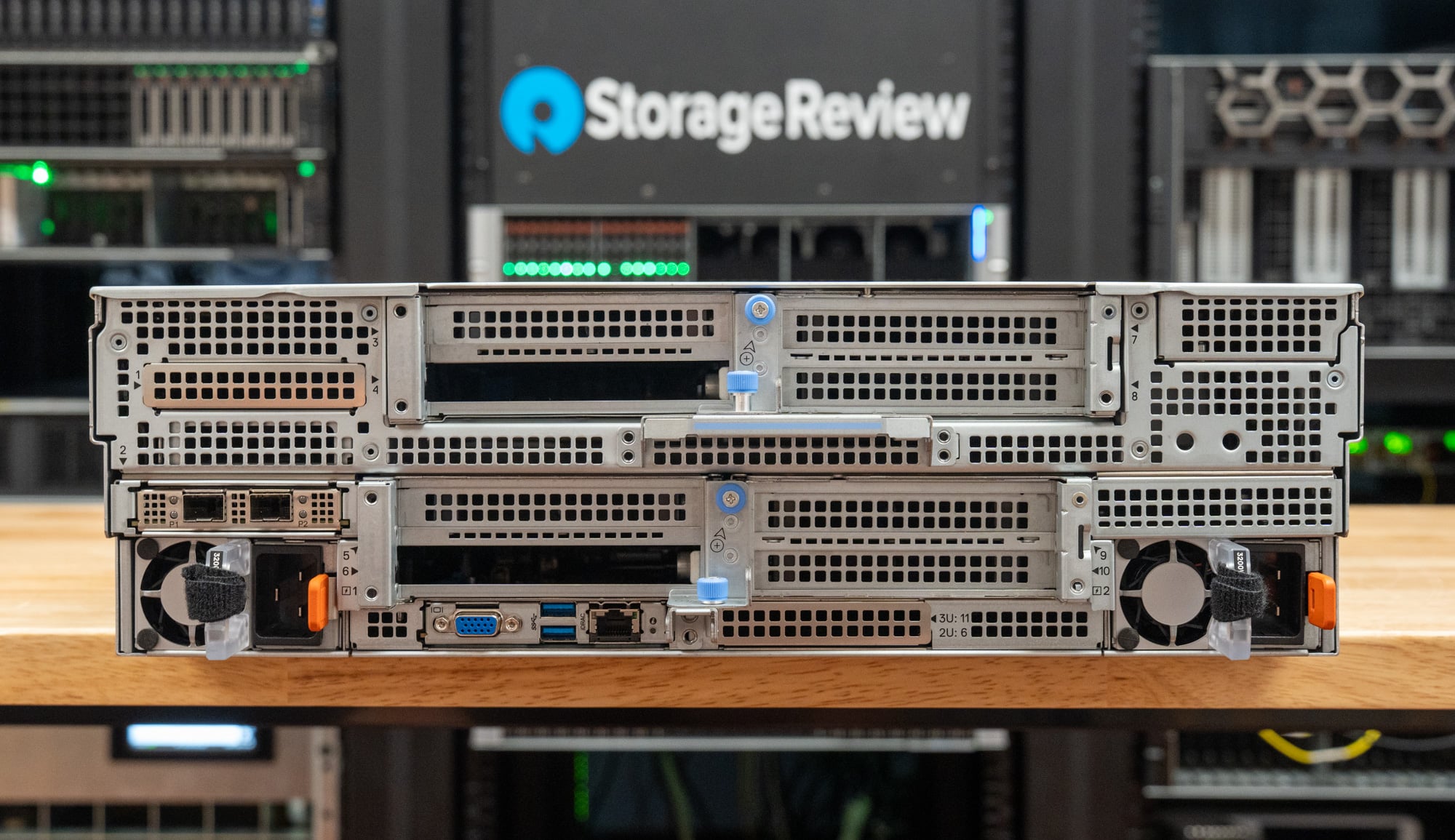
Power supplies run from 1,500W to 3,200W in hot-swap redundant pairs, all Titanium rated, in 100 to 240VAC, 200 to 240VAC, and 277VAC / 336V HVDC variants, plus a 1,400W negative 48V DC option. Two 600W processors, 32 DIMMs, and 32 NVMe drives make the 3,200W units the realistic choice for a full build. Cooling is up to five hot-swappable fans, with direct liquid cooling available as an option.
Dell’s published thermal limits back the air-cooling claim: every processor Dell lists for the chassis, from the 300W, 64-core EPYC 9556 to the 600W EPYC 9996 and 9686F, is supported on air at inlet temperatures up to 35°C with the high-performance fans, across every riser layout and the 8- and 16-bay drive configurations. At 40°C, Dell lists no processor restriction, but MRDIMMs, RDIMMs of 96GB or larger, and GPUs are no longer supported.
At 45°C, processors of 300W or more are not supported on air, which rules out every part on Dell’s list, and that is where the direct liquid cooling option comes in, since it carries no processor restriction at that temperature. The same list confirms the alternatives to the 256-core flagship in this chassis: 192-core, 168-core, and 128-core parts, plus 96-core and 64-core parts in both standard and 5GHz F-series form.
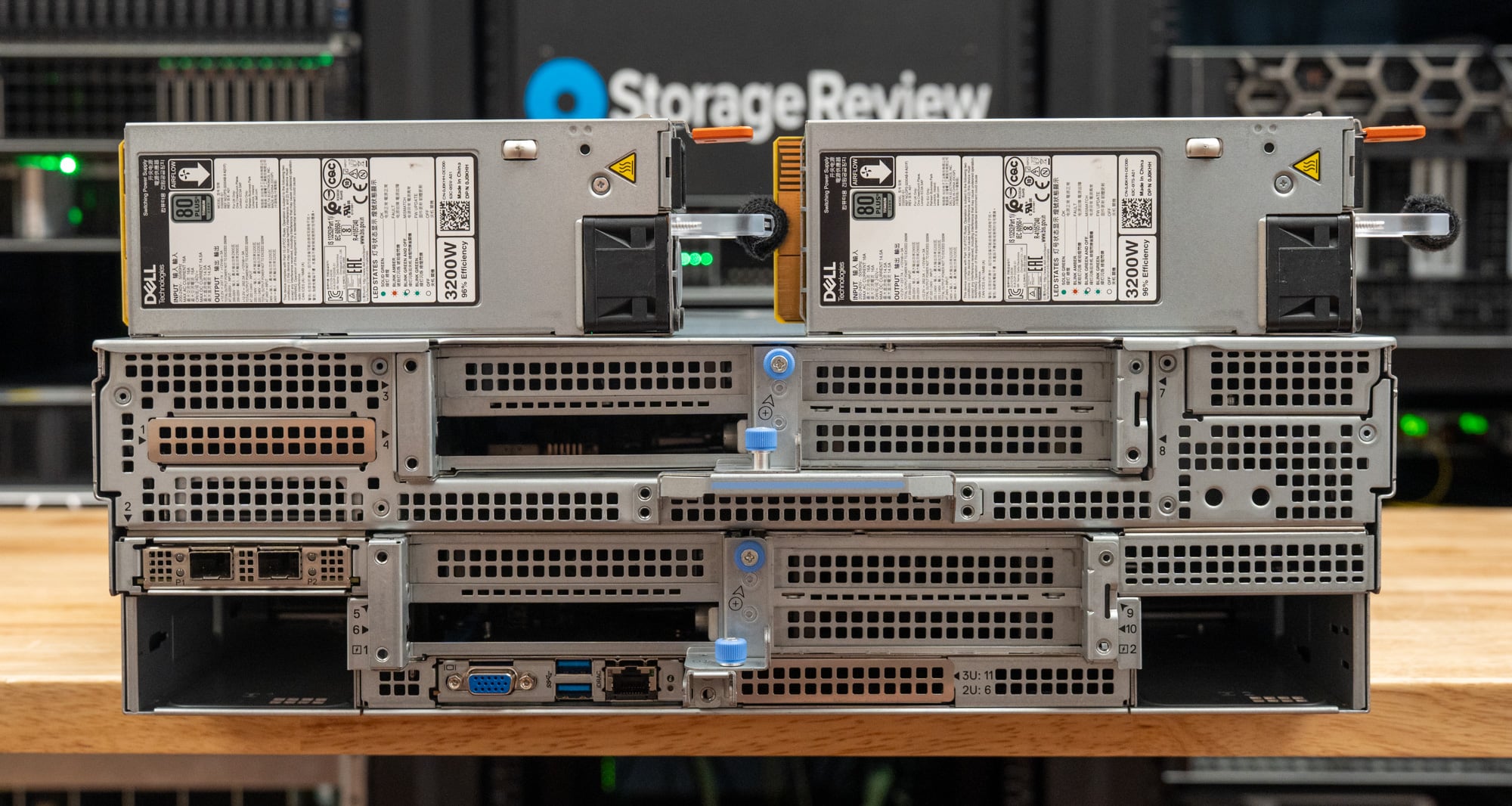
Venice also brings three platform power controls, which we describe in the processor review: a unified SoC and DIMM power budget that AMD models at 16 two-socket 9996 servers per 35kW rack at the default 830W per socket and nearly 19 with the limit set 15% lower, utilization-based power scaling that lets socket power follow the active core count, and a per-core-group frequency floor that turns one physical part into several performance tiers.
Dell PowerEdge R9825 Specifications
| Specification | Dell PowerEdge R9825 |
|---|---|
| Platform Overview | |
| Form factor | 3U rack server, 5.17 x 17.09 x 34.44 in (131.3 x 434.0 x 874.9 mm) with bezel, 94.01 lb (42.64 kg) |
| Processors | Two 6th Gen AMD EPYC 9006 (SP7), up to 256 cores per processor |
| Chipset | AMD |
| Memory | |
| DIMM slots | 32 DDR5 |
| RDIMM | Up to 8TB at up to 8,000MT/s |
| MRDIMM | Up to 4TB at up to 12,800MT/s (128GB modules not available at launch) |
| Storage | |
| Front bays | Up to 16x E3.S Gen6 NVMe (983.04TB max) Up to 32x E3.S Gen6 NVMe (1.96PB max, not available at launch) |
| Controllers | PERC H975i, PERC H965i |
| Boot | BOSS-N1 / BOSS-N2, hardware RAID 1, 2x M.2 NVMe |
| I/O and Accelerators | |
| PCIe slots | Up to 8x PCIe Gen6 x16 |
| OCP | 1x OCP 3.0 Gen4 x4; optional 2x OCP Gen6 x8 |
| Accelerators | Up to 2x 675W double-wide FHFL (single-CPU configurations only) Up to 6x 75W single-wide FHHL |
| Front ports | 1x USB 2.0 Type A (optional), 1x USB 2.0 Type C, 1x mini DisplayPort |
| Rear ports | 1x 1GbE BMC, 2x USB 3.1 Type A, 1x VGA |
| Power and Cooling | |
| Power supplies | 1,500W 100-240VAC / 240HVDC 1,500W 277VAC / 336HVDC 1,800W 200-240VAC / 240HVDC 2,400W 100-240VAC / 240HVDC 3,200W 200-240VAC / 240HVDC 3,200W 277VAC / 336HVDC 1,400W -48V DC All hot-swap redundant, Titanium (AC) |
| Cooling | Air cooled, up to 5 hot-swappable fans Optional direct liquid cooling |
| Management and Security | |
| Management | iDRAC, iDRAC Direct, iDRAC RESTful API with Redfish, RACADM CLI, iDRAC Service Module, Dell Repository Manager, Dell System Update, Enterprise Catalogs, Server Update Utility |
| Security | Cryptographically signed firmware, data-at-rest encryption (SEDs), Secure Boot, Secured Component Verification, Secure Enterprise Key Manager, post-quantum cryptography ready |
| Software | |
| Operating systems | Ubuntu Server LTS, RHEL, SLES, VMware ESXi, Windows Server |
| Rails | ReadyRails II sliding with optional CMA / SRB, combo rails, ReadyRails static |
Management and Security
Management is iDRAC10 with iDRAC Direct on the front USB port, the Redfish-based RESTful API, RACADM, the iDRAC Service Module, and Dell’s update tooling from Repository Manager through the Server Update Utility. The security list carries signed firmware, self-encrypting drive support, Secure Boot, Secured Component Verification for supply-chain attestation, and Secure Enterprise Key Manager, and Dell describes the platform as post-quantum cryptography ready.
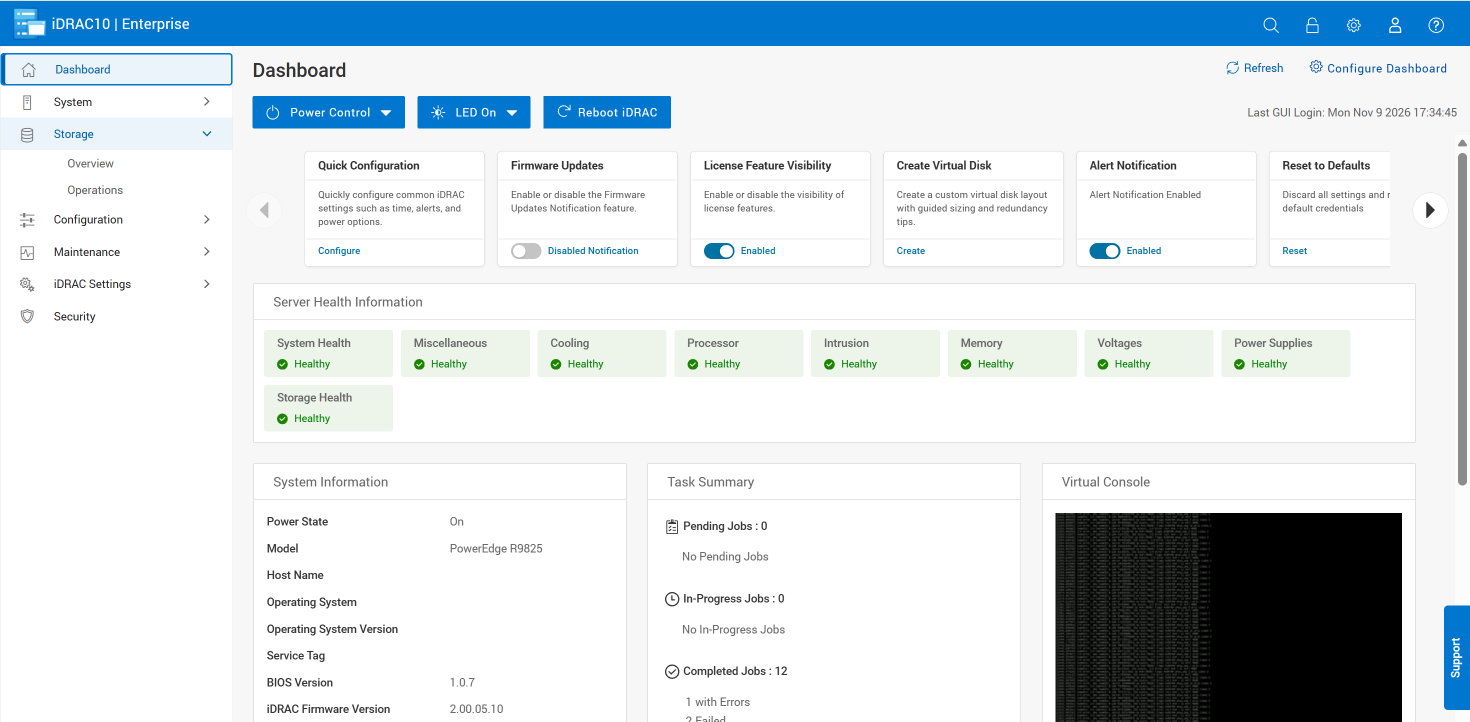
Our unit shipped with iDRAC10 Enterprise at firmware 2.00.05.10, and the feature set matches the PowerEdge R7725 that precedes it. Pages load faster than they did on iDRAC9, but some of the character of earlier versions is gone: server visualizations such as the storage backplane view have become generic dropdown lists, and we hope they return, because those touches set PowerEdge apart from white-box servers.
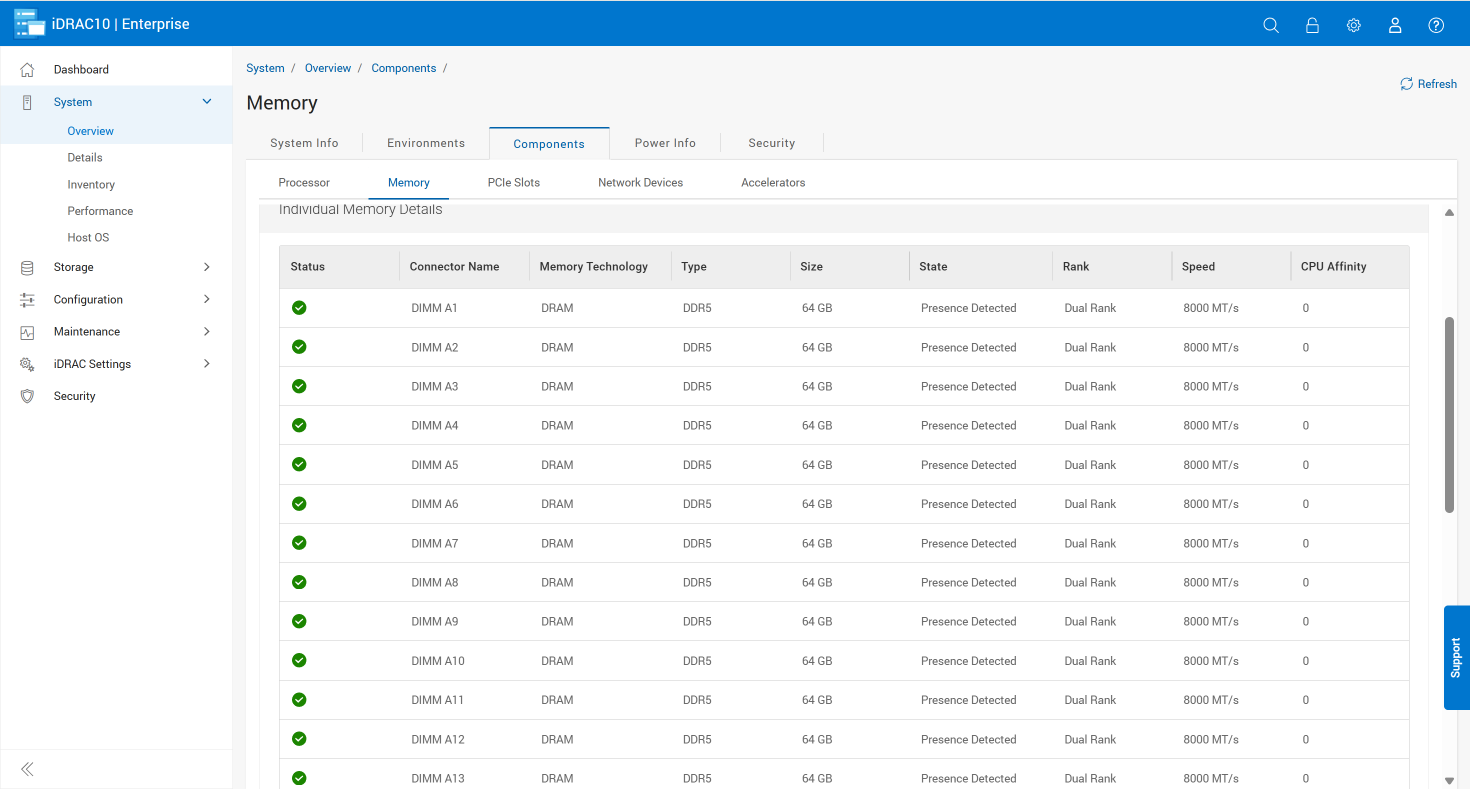
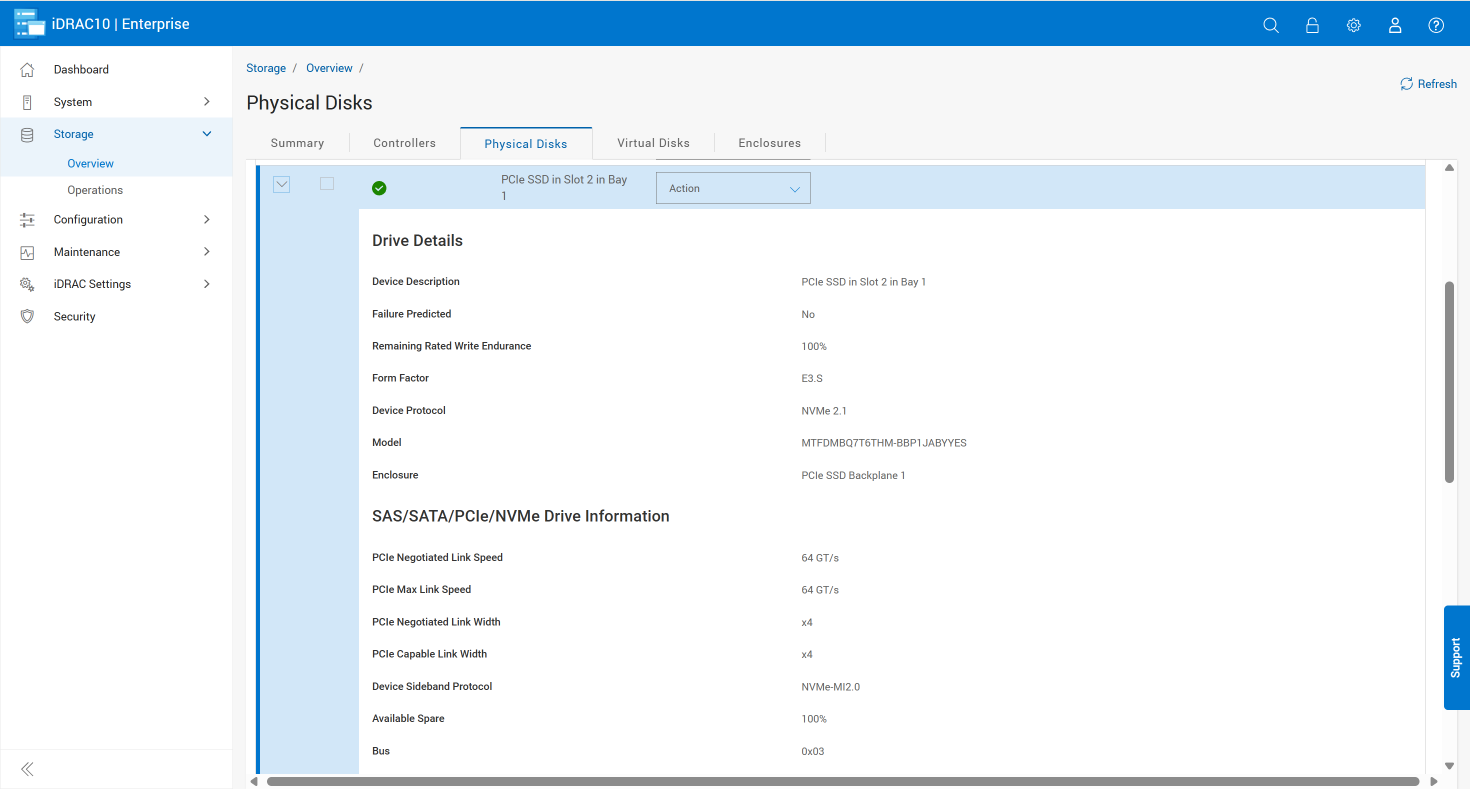
The component views line up with what the suite recorded: both EPYC 9996 report as Model 81, Stepping 0, with 256 cores each, every DIMM shows as 64GB dual-rank DDR5 at 8,000MT/s and the Micron 9650 E3.S drive in bay 1 reports a negotiated PCIe link of 64GT/s at x4 with NVMe 2.1 and NVMe-MI 2.0 sideband management, confirming Gen6 capabilities.
Performance
The full processor evaluation is in the AMD EPYC Venice SP7 review. Here we pull the results that speak to the R9825 as a server, against three systems from our lab. The 2U PowerEdge R7725 is the server it succeeds, with two 192-core EPYC 9965 and 3TB of DDR5-6400 on twelve memory channels per socket to the R9825’s sixteen. The two-socket NVIDIA Vera reference system, with 176 cores and 1.5TB of LPDDR5X-9600, is its direct competitor in the air-cooled two-socket class, and the PowerEdge R770AP with two 120-core Xeon 6978P is Intel’s current top part in our lab.
The other two configurations in the charts ran remotely. AMD gave us SSH access to Nigeria, an AMD-built two-socket SP7 reference server in AMD’s lab, which we ran once with the same pair of EPYC 9996 on MRDIMM-12800 and once with two 96-core, 5.0GHz EPYC 9686F on the same memory. The 9996 run is the closest look available at the R9825’s MRDIMM option, because the processors match and the memory moves from 8,000MT/s to 12,800MT/s. Those runs are the only data here not collected in our lab, and the platform differs from the Dell in chassis, firmware, and data drive, so we present them as a guide to the memory option.
Results come from our sr-suite and sr-harness methodology. The R9825, the AMD reference platform, and Vera ran Ubuntu 26.04 with GCC 15.2, with the Venice systems in NPS2 and SMT on and off; the R7725 and R770AP were tested earlier on Ubuntu 24.04 with GCC 13.3, which leaves them a small compiler handicap against the newer systems.
| Configuration | Detail |
|---|---|
| Review Unit | |
| System | Dell PowerEdge R9825, 3U, BIOS 1.0.4 |
| Processors | 2x AMD EPYC 9996 (256 cores, 512 threads each), 600W |
| Memory | 32x 64GB DDR5-8000 RDIMM (2TB), NPS2 |
| Data drive | Solidigm 12.8TB PCIe Gen5 x4 E3.S (SB5PHA7E128T) |
| OS and toolchain | Ubuntu 26.04, GCC 15.2.0, glibc 2.43, Open MPI 5.0.10, OpenJDK 11.0.32, Python 3.14.4 |
| AMD Reference Platform (remote) | |
| System | AMD Nigeria two-socket SP7 reference server, BIOS RNIV1001H, tested over SSH in AMD’s lab |
| Processors | 2x AMD EPYC 9996 (256 cores each) and, separately, 2x AMD EPYC 9686F (96 cores each, 5.0GHz boost) |
| Memory | 32x 64GB SK hynix MRDIMM-12800 (2TB), NPS2 |
| Data drive | Micron 9650 PRO 7.68TB PCIe Gen6 x4 NVMe |
| OS and toolchain | Ubuntu 26.04, GCC 15.2.0; AMD-provided pre-release Linux 7.2.0-rc5 kernel on the 9686F runs |
| Comparison Systems | |
| Dell PowerEdge R7725 | 2x AMD EPYC 9965 (192 cores each), 24x 128GB DDR5-6400 (3TB), Solidigm Gen5 NVMe at x2; Ubuntu 24.04, GCC 13.3.0 |
| NVIDIA MGX Vera C2 | 2x NVIDIA Vera (88 cores each), 16x 96GB LPDDR5X-9600 SOCAMM2 (1.5TB), Solidigm D7-PS1010 7.68TB E1.S; Ubuntu 26.04, GCC 15.2.0 |
| Dell PowerEdge R770AP | 2x Intel Xeon 6978P (120 cores each), 24x 64GB DDR5-6400 (1.5TB), Solidigm Gen5 NVMe; Ubuntu 24.04, GCC 13.3.0 |
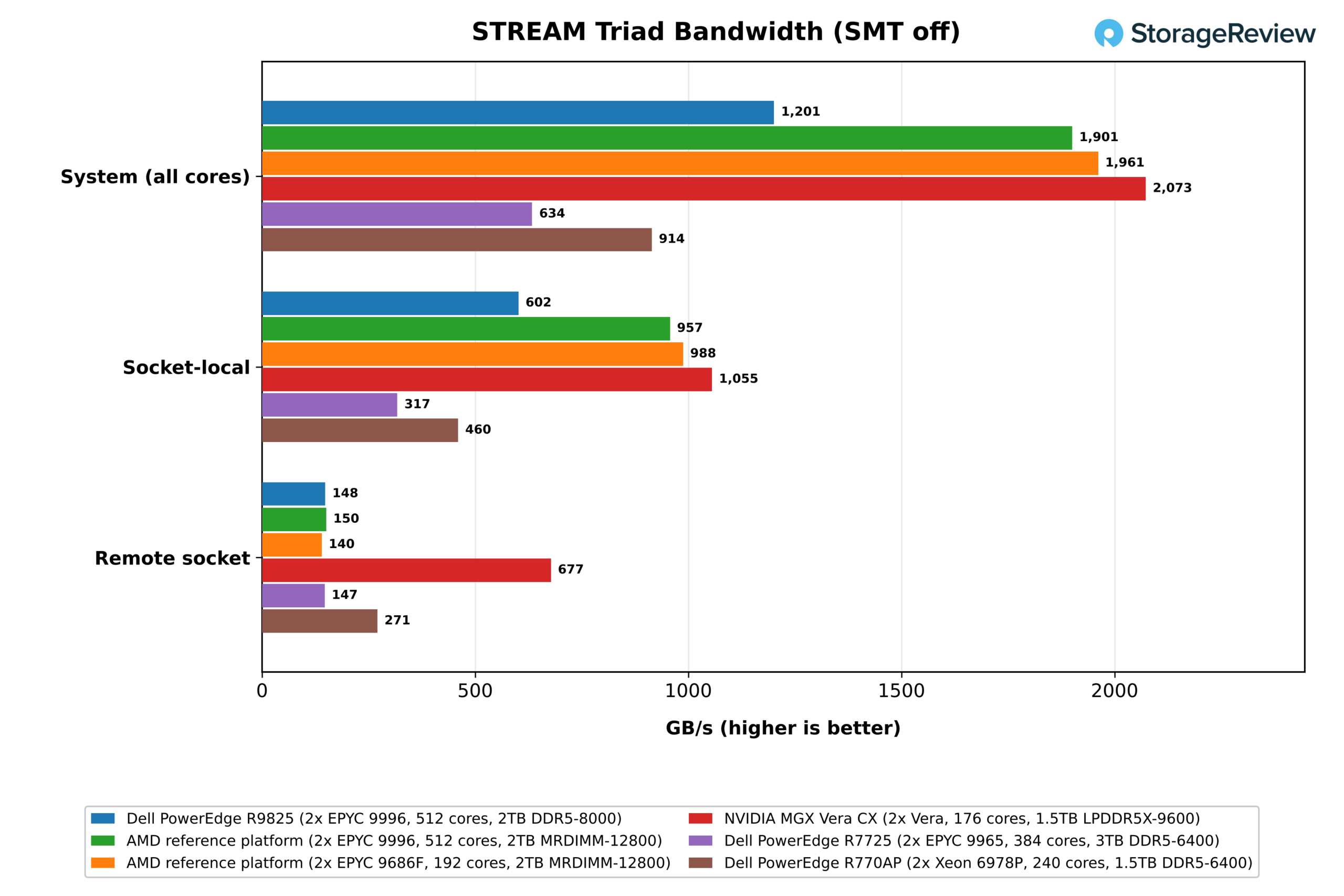
Memory bandwidth is the figure that defines what the R9825 can and can’t do at 512 cores. With its 32 DDR5 modules running at 8,000MT/s, the system sustained 1,201GB/s on STREAM Triad with SMT off, 1.9x the R7725’s 634GB/s on 24 channels of DDR5-6400, with one socket reading its local memory at 602GB/s and the remote socket at 148GB/s over xGMI. That generational multiple leans on a low R7725 result, because the suite’s STREAM build doesn’t count the extra read AMD’s Zen cores make on every store; the harness STREAM Copy test, which avoids it, puts the gap at 1,158GB/s against 832GB/s.
Vera’s LPDDR5X system reached 2,073GB/s, and the same two EPYC 9996 on MRDIMM-12800 in AMD’s reference platform reached 1,901GB/s, which is the configuration a bandwidth-bound buyer should spec from Dell. Local latency of 87.6ns at 2MB pages is the best in the group.
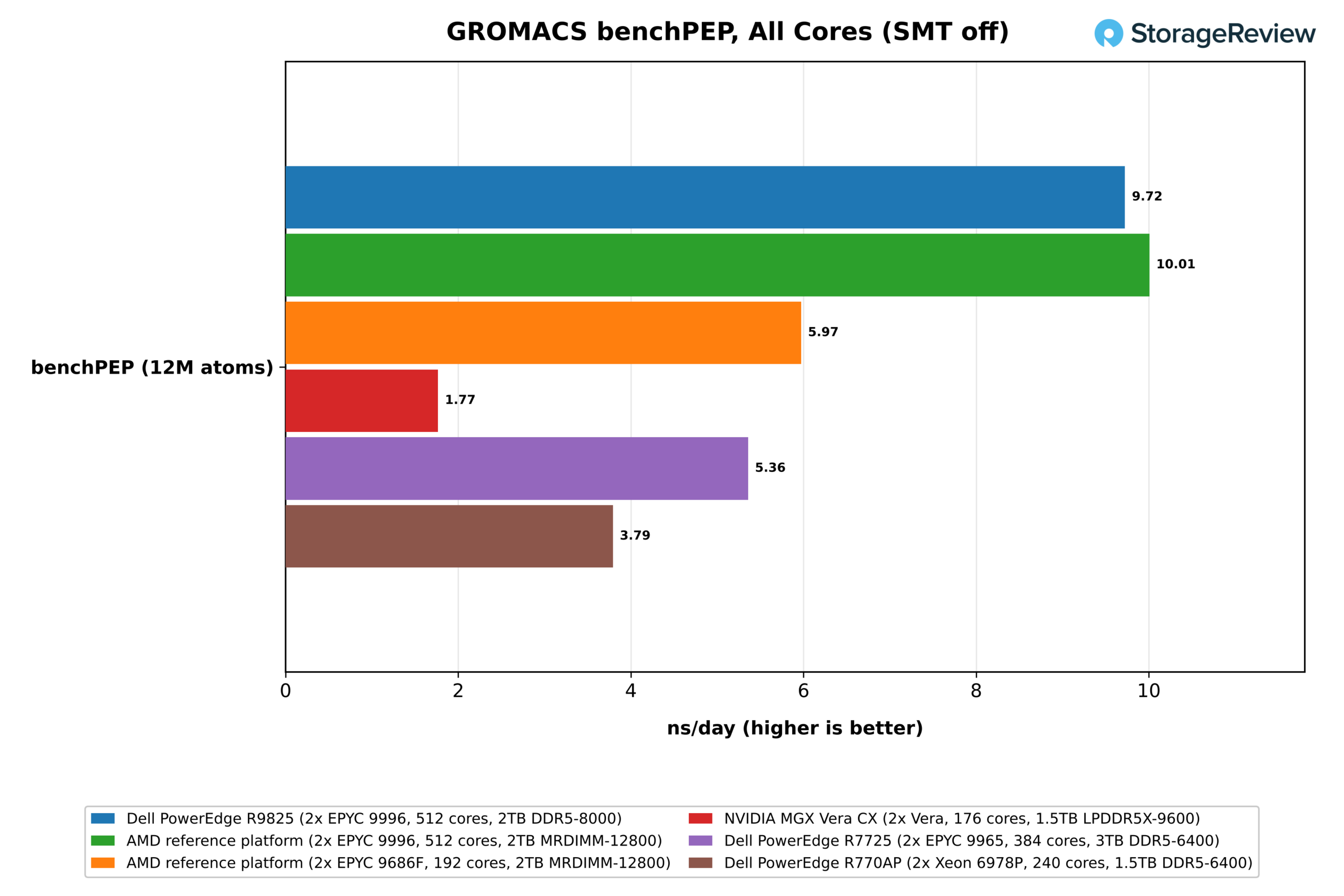
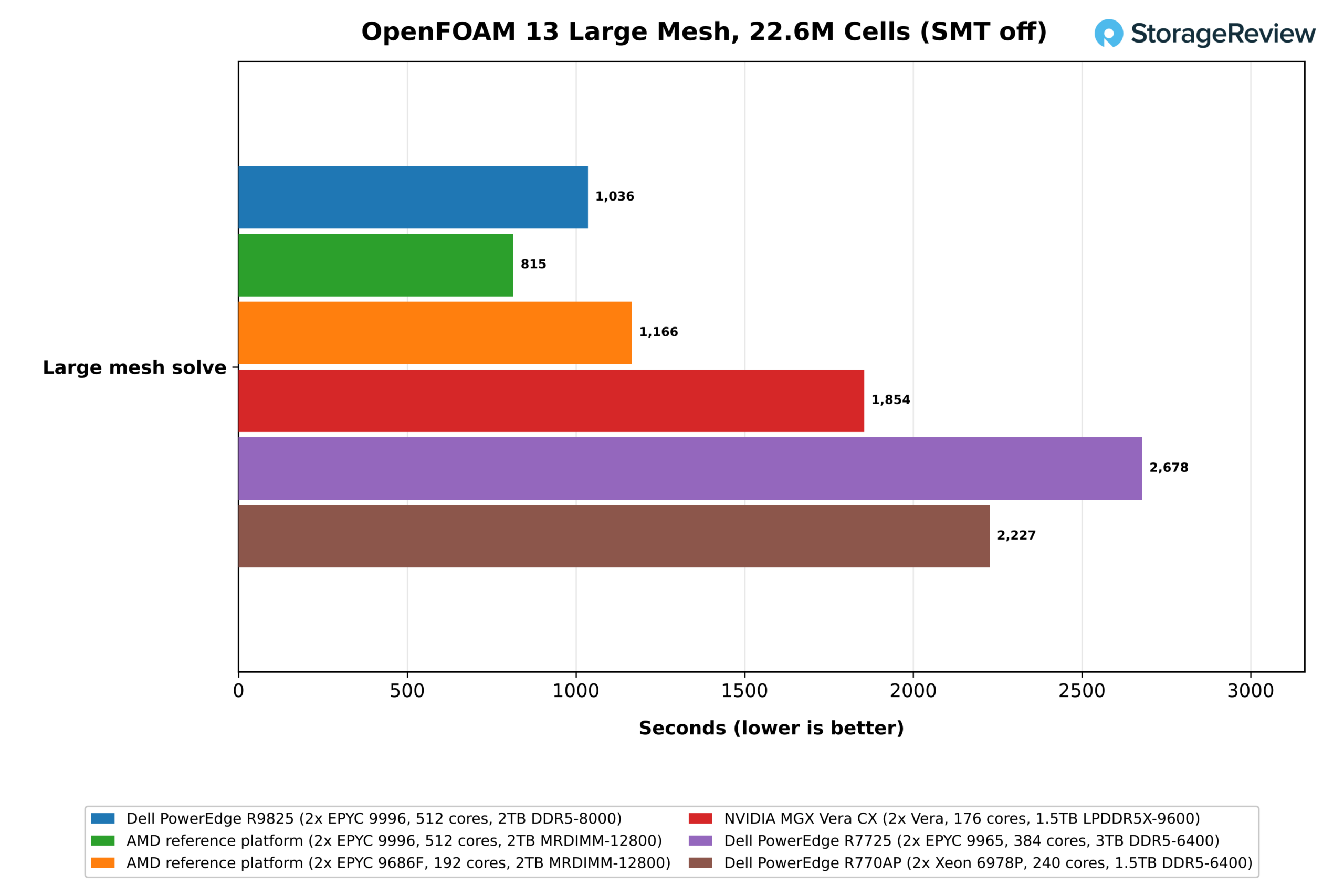
HPC is where 512 cores and sixteen channels per socket show up together. GROMACS benchPEP, the 12-million-atom molecular dynamics case run across every physical core, finished at 9.72 ns/day on the R9825 against 5.36 for the R7725 and 2.07 for Vera with SMT on, a 1.8x generational gain for Dell’s AMD flagship and 4.7x the Arm system. The large OpenFOAM mesh, a 22.6-million-cell CFD solve that outruns every cache, took 1,036 seconds on the R9825 against 2,678 on the R7725 and 1,854 on Vera; on MRDIMMs the same processors finished in 815 seconds, a 21% cut that is the clearest argument for the faster memory option.
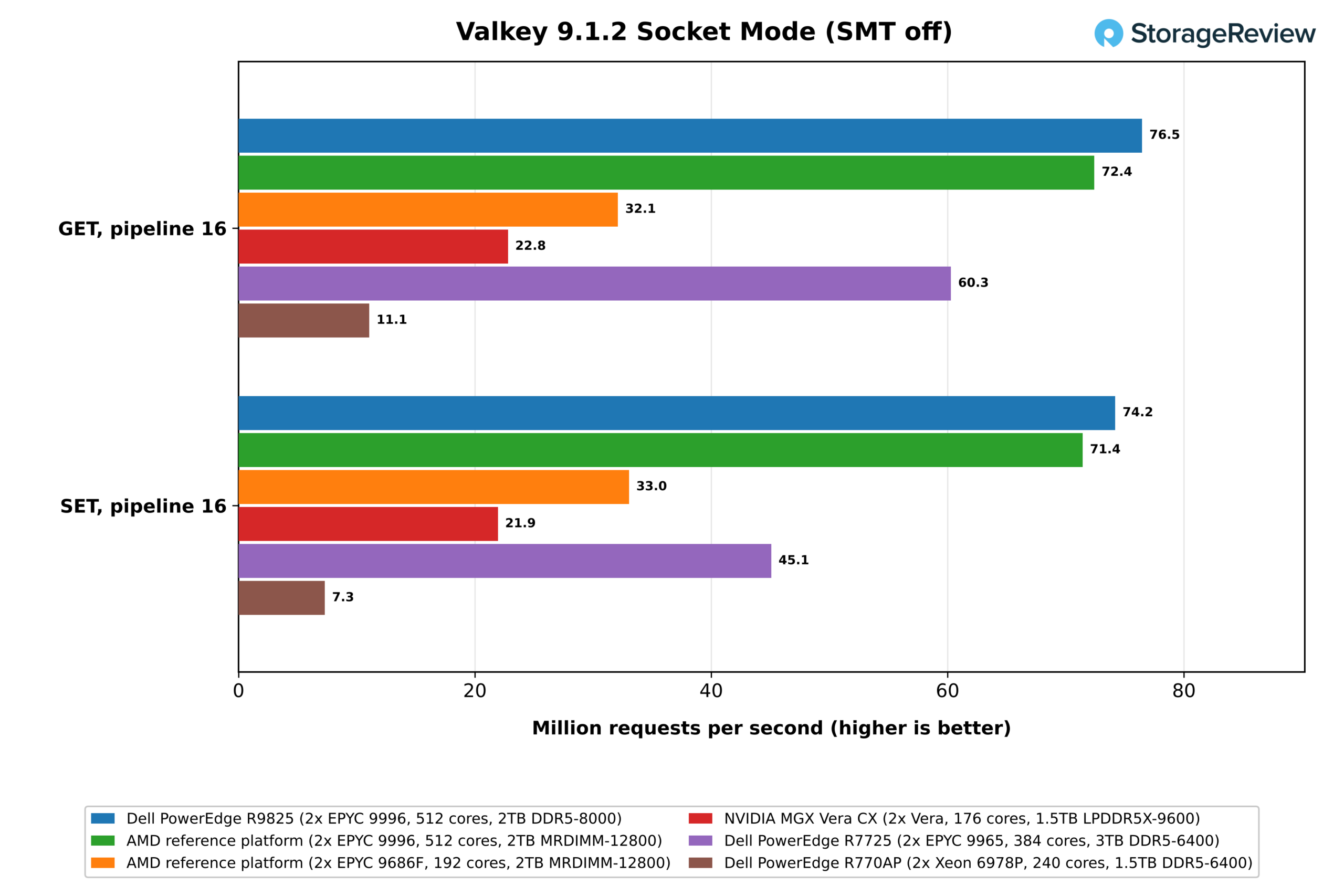
Scale-out data work follows the core count, and one 256-core socket moved 76.5M Valkey GET and 74.2M SET requests per second at a pipeline depth of 16, 27% and 65% more than one 192-core EPYC 9965 socket and 3.4x Vera’s 88-core socket. ClickBench’s hot sum on ClickHouse, which does not scale past 192 cores, was a tie at 2.69 seconds against 2.70 for the R7725, with Vera at 2.09; the cold sum of 5.75 seconds matched Vera’s 5.70 and beat the R7725’s 9.61, where the older system’s drive sits on a Gen5 x2 link.
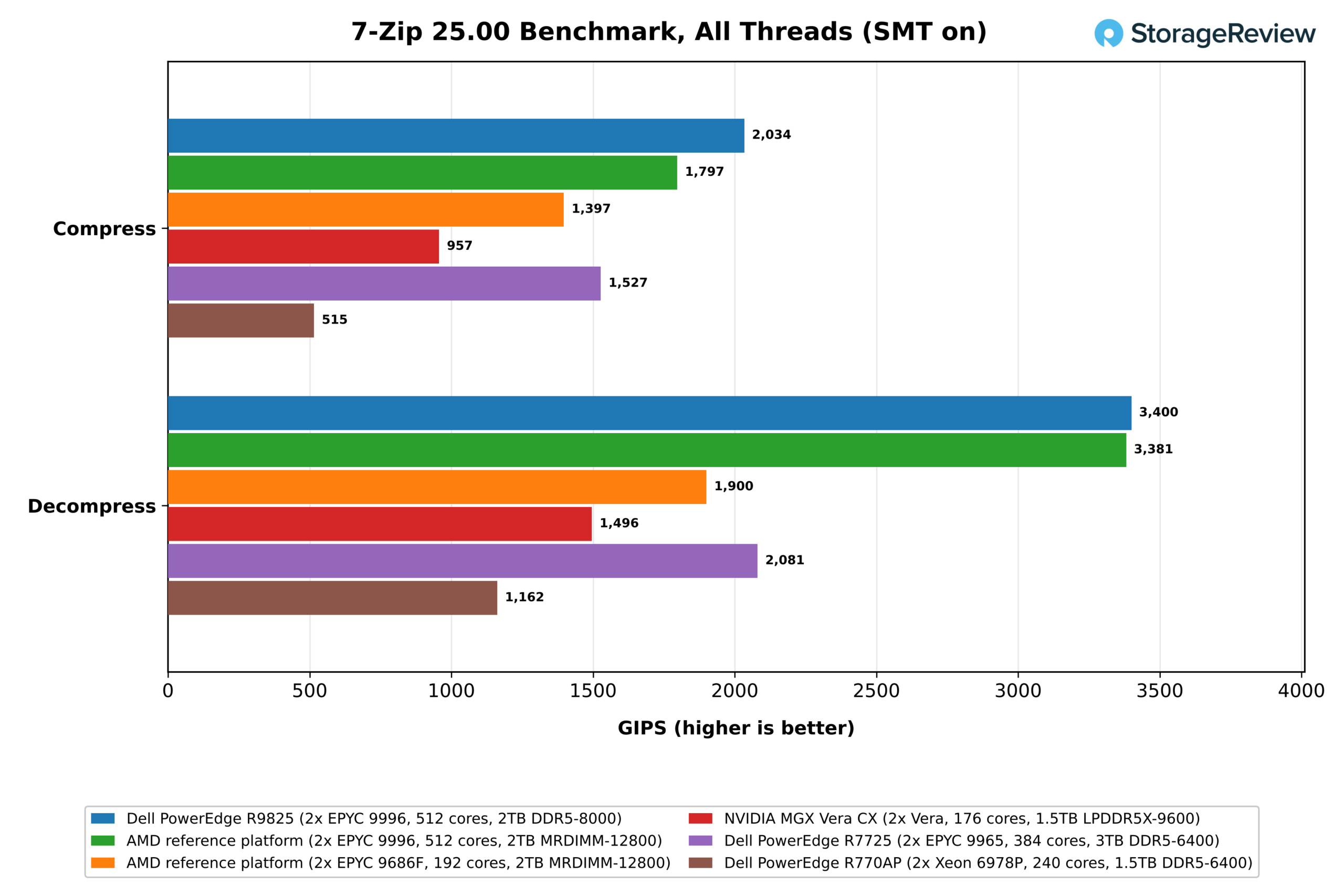
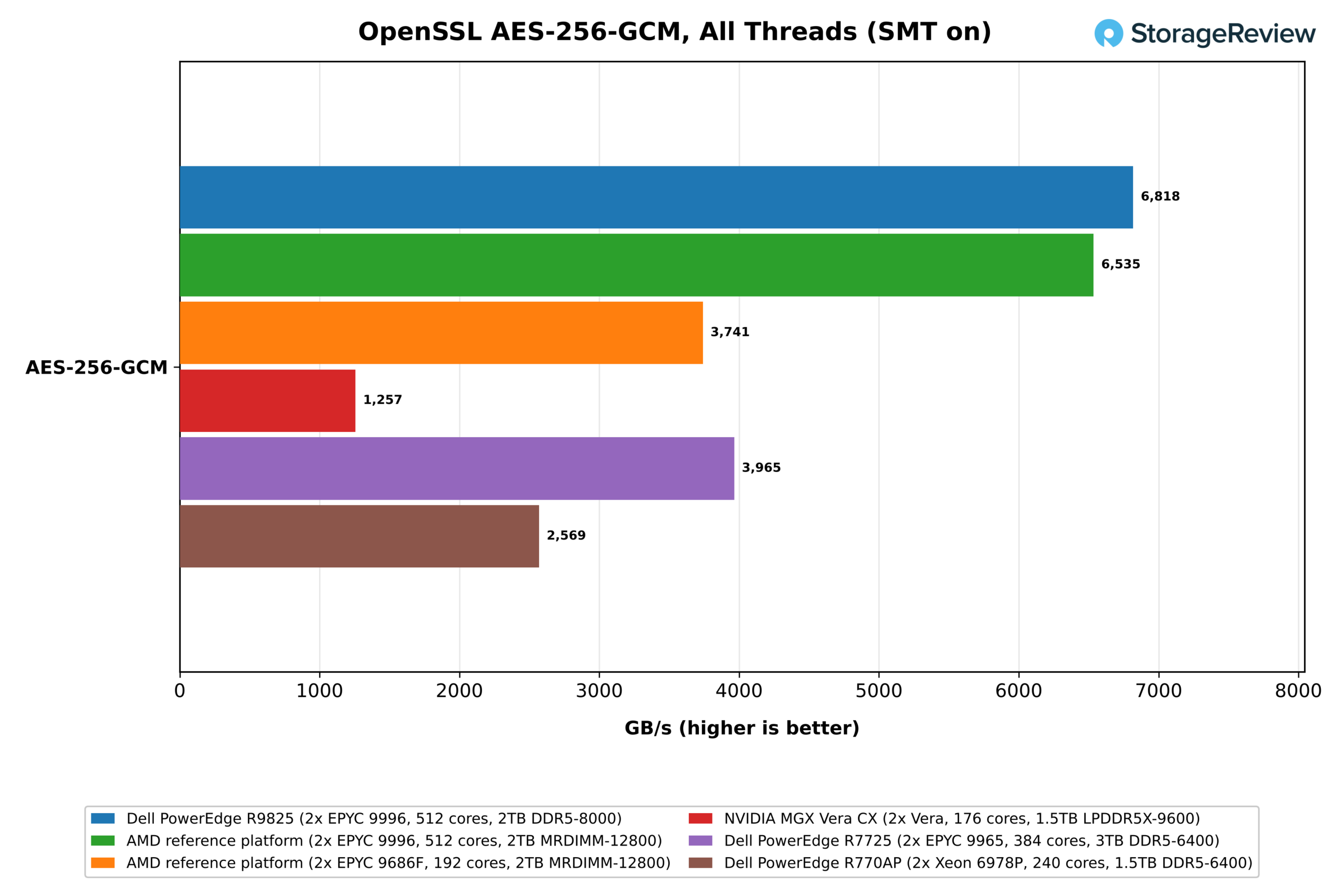
The harness throughput tests with SMT on put a number on 1,024 threads. The R9825 compressed at 2,034 GIPS and decompressed at 3,400 GIPS in 7-Zip, 33% and 63% ahead of the R7725 and 2.1x and 2.3x Vera, and OpenSSL AES-256-GCM across all threads reached 6.8TB/s against 3.96TB/s on the R7725 and 1.26TB/s on Vera. On a single pinned thread, a Zen 6c core at 4.1GHz compressed at 11,068 MIPS against 7,077 for Zen 5c and 9,537 for Olympus, and the Linux kernel allmodconfig build finished in 99.4 seconds with SMT off against 146.2 on the R7725.
Two results go the other way, and both are thread-count effects. The Renaissance JVM suite and schbench penalize a 1,024-thread system because the JVM and the scheduler benchmark spread work across every logical CPU they see, so the R9825 trails smaller systems there, and Vera’s remote-socket bandwidth of 677GB/s over NVLink-C2C is 4.6x the 148GB/s the R9825’s xGMI links deliver, which makes NPS2 placement and NUMA-aware software more important on this server than on the Arm one. Full tables for both are in the processor review.
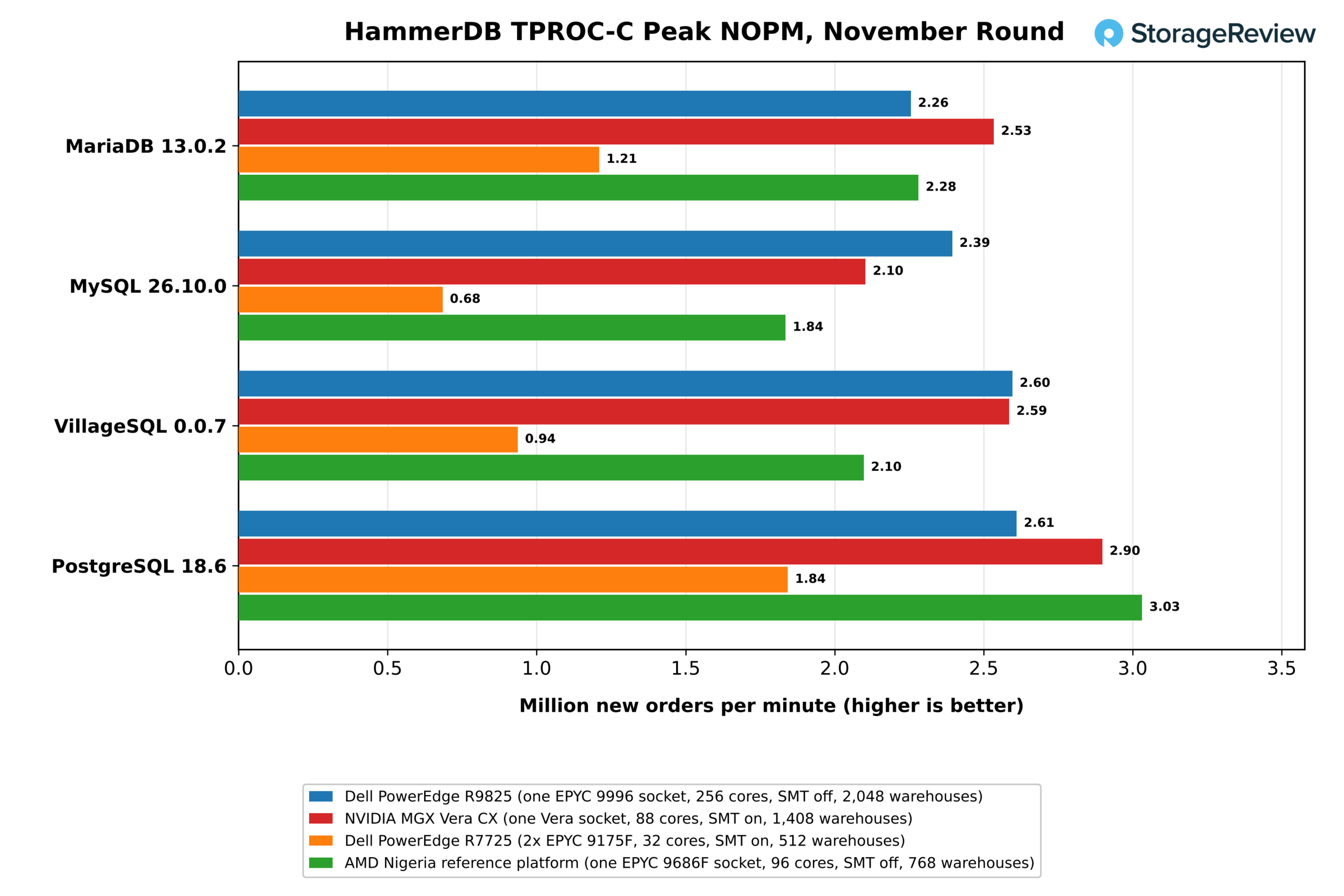
For databases, Steve Shaw of HammerDB ran TPROC-C on HammerDB 6.1.1 against a single EPYC 9996 socket in the R9825, 256 cores with SMT off, at 2,048 warehouses, alongside Vera’s 88-core socket at 1,408, a two-socket EPYC 9175F system at 512, and one 96-core EPYC 9686F socket on AMD’s reference platform at 768.
The R9825 socket peaked at 2.39M new orders per minute on MySQL 26.10, 2.60M on VillageSQL, 2.26M on MariaDB 13.0.2, and 2.61M on PostgreSQL 18.6, winning MySQL by 14% over Vera, tying VillageSQL, and trailing by 11% to 12% on the other two. The PostgreSQL peak arrived with the socket 18% busy, so the database set the ceiling and the server had headroom to spare; the full analysis is in the Venice review.
The 96-core EPYC 9686F, the fourth system in the chart, posted the round’s highest PostgreSQL result at 3.03M NOPM, ahead of Vera’s 2.90M, and reached 2.28M on MariaDB, 2.10M on VillageSQL, and 1.84M on MySQL.
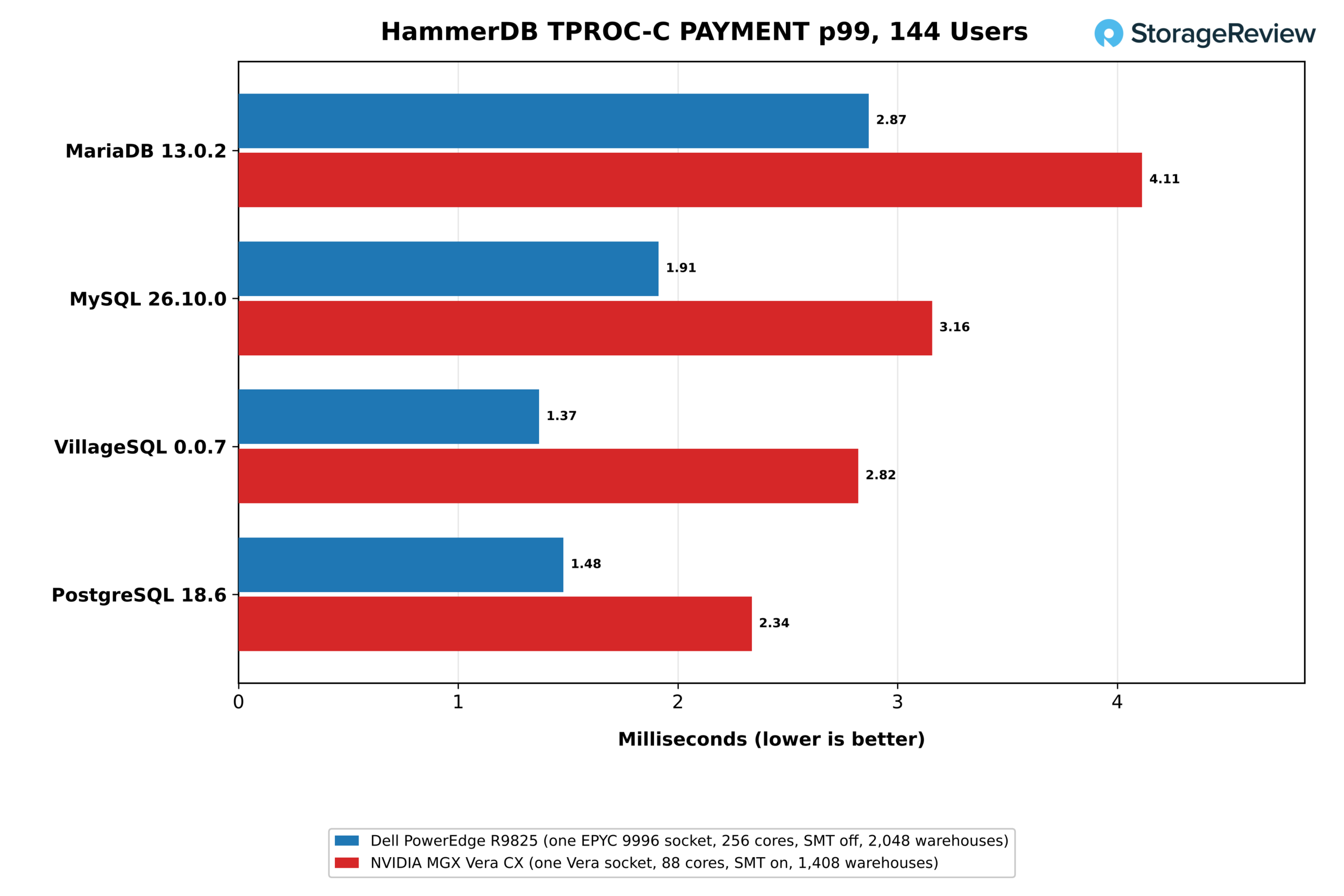
Tail latency at a matched load of 144 virtual users went to the R9825 on every engine. PAYMENT p99 ran 2.87ms on MariaDB, 1.91ms on MySQL, 1.37ms on VillageSQL, and 1.48ms on PostgreSQL, against 4.11ms, 3.16ms, 2.82ms, and 2.34ms on Vera, which puts the R9825’s tails 30% to 51% lower. The chart shows only these two systems because they are the only ones Shaw ran to 144 users; the 96-core EPYC 9686F profile topped out at 104 users and the two-socket EPYC 9175F system at 68, loads sized to their core counts.
Conclusion
The PowerEdge R9825 is the server AMD’s 256-core Venice needed: a mainstream, air-cooled two-socket box that an enterprise can rack next to the R7725 and R770 without changing to a liquid loop. Dell took the dual-socket flagship to 3U, stacked the processor boards, and shaped the intake around them so two 600W processors run on five fans, and the payoff is 512 cores in a chassis that doubles the R7725’s HPC throughput, beats it by 27% to 65% on compression and key-value work, and ships with PCIe Gen6 from the slots to the drive bays.
The configuration decision that matters most is memory. Our review unit ran its memory at 8,000MT/s and sustained 1,201GB/s on STREAM Triad; RDIMMs at that speed are the capacity choice at up to 8TB, while the MRDIMM-12800 option halves the capacity ceiling and lifts bandwidth toward 1.9TB/s, and for CFD, analytics, and anything else that waits on memory it is worth more than the step from 96 to 256 cores. Buyers whose workloads synchronize across every thread, as JVM services and some scheduler-bound code do, should look at the 96-core and 128-core Venice parts in the same chassis.
The third rack unit has a cost in density on core-bound work. At 512 cores in 3U, the R9825 holds 171 cores per rack unit against 192 for an R7725 with two EPYC 9965, and it delivers about 11% less 7-Zip compression throughput per rack unit even as it wins by 33% per server. On memory-bound and vector work, the extra height pays off, with GROMACS 21% higher and the large OpenFOAM mesh about 1.7x per rack unit, so the case for the R9825 is strongest where memory bandwidth and air cooling set the limit.
Against NVIDIA’s Vera, the first serious Arm competitor in this class, the R9825 wins most of the board on raw performance and loses on memory bandwidth, ClickBench’s hot sum, PostgreSQL and MariaDB throughput, and a few latency-bound single-thread tests, which is the processor story told in full in the Venice review. On HammerDB, a single EPYC 9996 socket kept pace with a full Vera socket on OLTP throughput and beat it on tail latency by 30% to 51%, with the database engines setting the ceiling.
For delivering 512 Zen 6c cores, up to 8TB of memory, and PCIe Gen6 from the slots to the drive bays in an air-cooled 3U chassis that any existing data center can deploy, the Dell PowerEdge R9825 earns our Best Overall Server award.

Leaderboard: The Dell PowerEdge R9825 holds Best Overall Server on our Best Servers leaderboard.



 Amazon