

The HighPoint Rocket 1604L is a $399 PCIe Gen5 x16 add-in card that carries four M.2 NVMe SSDs, each on a dedicated Gen5 x4 connection. In our testing with four Samsung 9100 PRO 4TB drives installed, the card sustained 55.6GB/s of 128K sequential read bandwidth and 10.1 million 4K random write IOPS, numbers that are within a few percent of what the four drives are rated to deliver on native motherboard slots. That is the entire pitch of this card: it adds drive bays without subtracting performance.
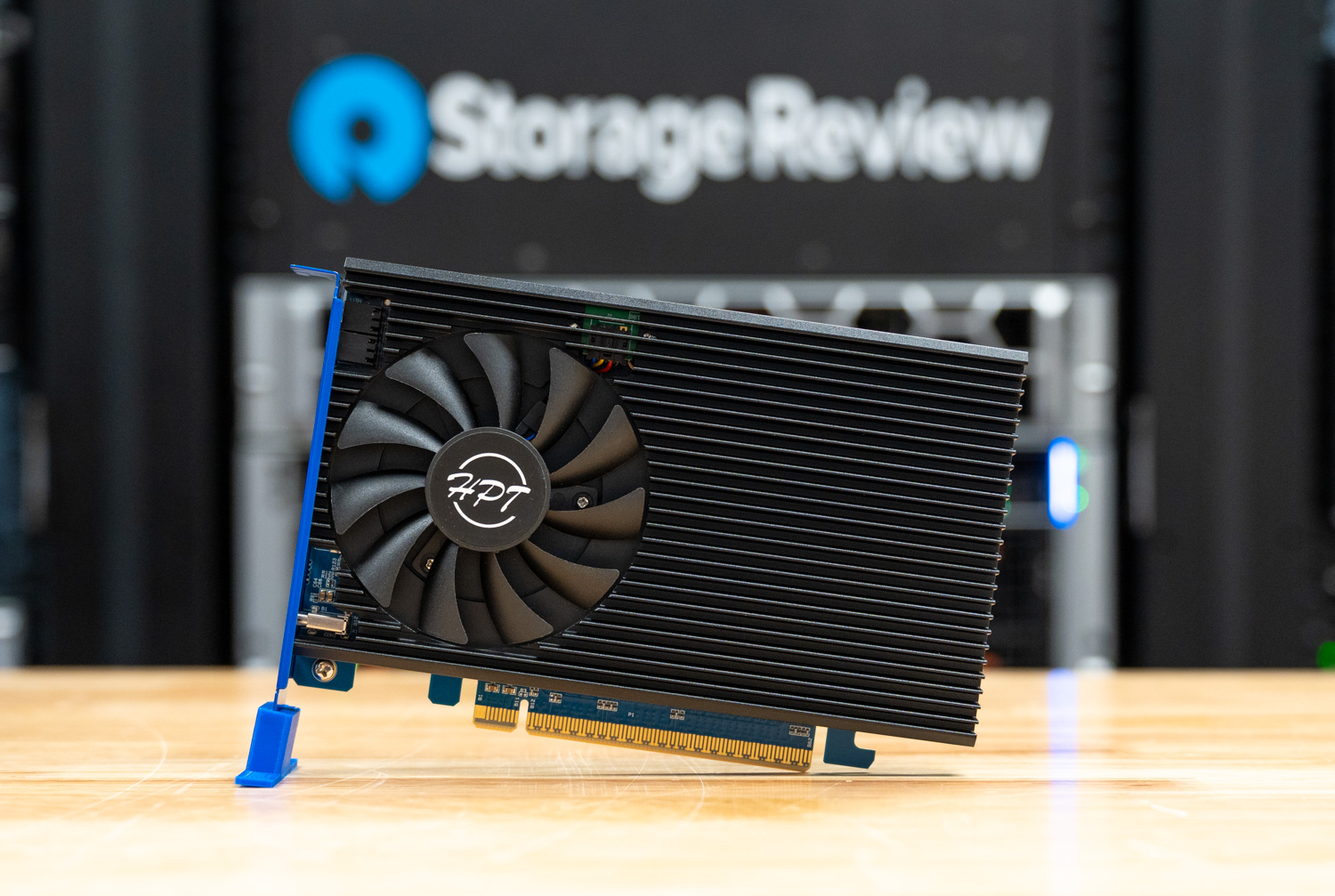
The 1604L takes a different architectural path than most quad-M.2 cards we have looked at. It is not a passive bifurcation riser, nor is it a PCIe switch card. Instead, it is built around an Astera Labs PT5161LRS retimer, which sits in the data path at the physical layer, re-clocking and regenerating the Gen5 signal between the host slot and each M.2 connector. At Gen4 speeds, passive cards that simply route traces from the slot to the connectors are usually fine. At Gen5’s 32GT/s signaling rate, trace length and connector transitions start eating into the signal budget, and marginal links train down to Gen4 or throw correctable errors under load. The retimer approach addresses that without the cost, power, and latency of a full PCIe switch. The trade-off is that the host platform must support x4/x4/x4/x4 bifurcation on the slot, since the retimer does not perform any lane virtualization of its own.
This card joins a HighPoint Gen5 family we have covered previously, which includes the switch-based Rocket 1604A, which works in any x16 slot regardless of bifurcation support, and the Rocket 7604A, which adds bootable RAID on top. The 1604L is the leanest of the three. There is no RAID stack and no driver; the operating system simply enumerates four native NVMe devices, and anything beyond that (mdadm, Storage Spaces, ZFS) is up to the user. HighPoint positions the card heavily toward servers hosting M.2 accelerator modules like the Hailo-8 series, but for our purposes, the storage use case is the more universal one. The card is a full-height, half-length design that HighPoint claims is roughly 40% shorter than typical four-bay M.2 cards, with a full-length anodized aluminum heatsink, thermal padding for the drives, an integrated low-decibel fan, and a ventilated bracket. Firmware-level monitoring exposes per-port lane allocation, power draw, and board health, with present and activity LEDs for each SSD.
The bifurcation requirement is the caveat to settle before buying. Most mainstream consumer boards either cannot split a x16 slot four ways or steal those lanes from the primary GPU slot. Where the 1604L makes immediate sense is on platforms with PCIe lanes to spare: Threadripper TRX50 and WRX90, Xeon W, and EPYC or Xeon server boards, where x4/x4/x4/x4 is a BIOS toggle and a spare x16 slot is not a sacrifice. That describes our test rig, so the fit was natural.
HighPoint Rocket 1604L Specifications
| Specification | Rocket 1604L (R1604L) |
|---|---|
| Bus Interface | PCIe 5.0 x16 |
| Chipset | Astera Labs PT5161LRS retimer |
| Working Mode | 4 x 4-lane (host bifurcation x4/x4/x4/x4 required) |
| Ports | 4x M.2 NVMe (dedicated PCIe 5.0 x4 per port) |
| Device Support | M.2 NVMe SSDs or M.2 PCIe accelerator modules |
| SSD Form Factors | M.2 2242, 2260, 2280 |
| Data Transfer Rate | Up to 64GB/s |
| RAID Support | None (OS-level software RAID optional) |
| Form Factor | Full-height, half-length |
| Cooling | Full-length aluminum heatsink, integrated fan, thermal pads, ventilated bracket |
| Monitoring | Per-port lane allocation, power, and health via smart firmware; present and activity LEDs |
| OS Support | Native NVMe support in mainstream operating systems, x86 Intel/AMD and ARM |
| Price | $399 (HighPoint eStore) |
Build and Design
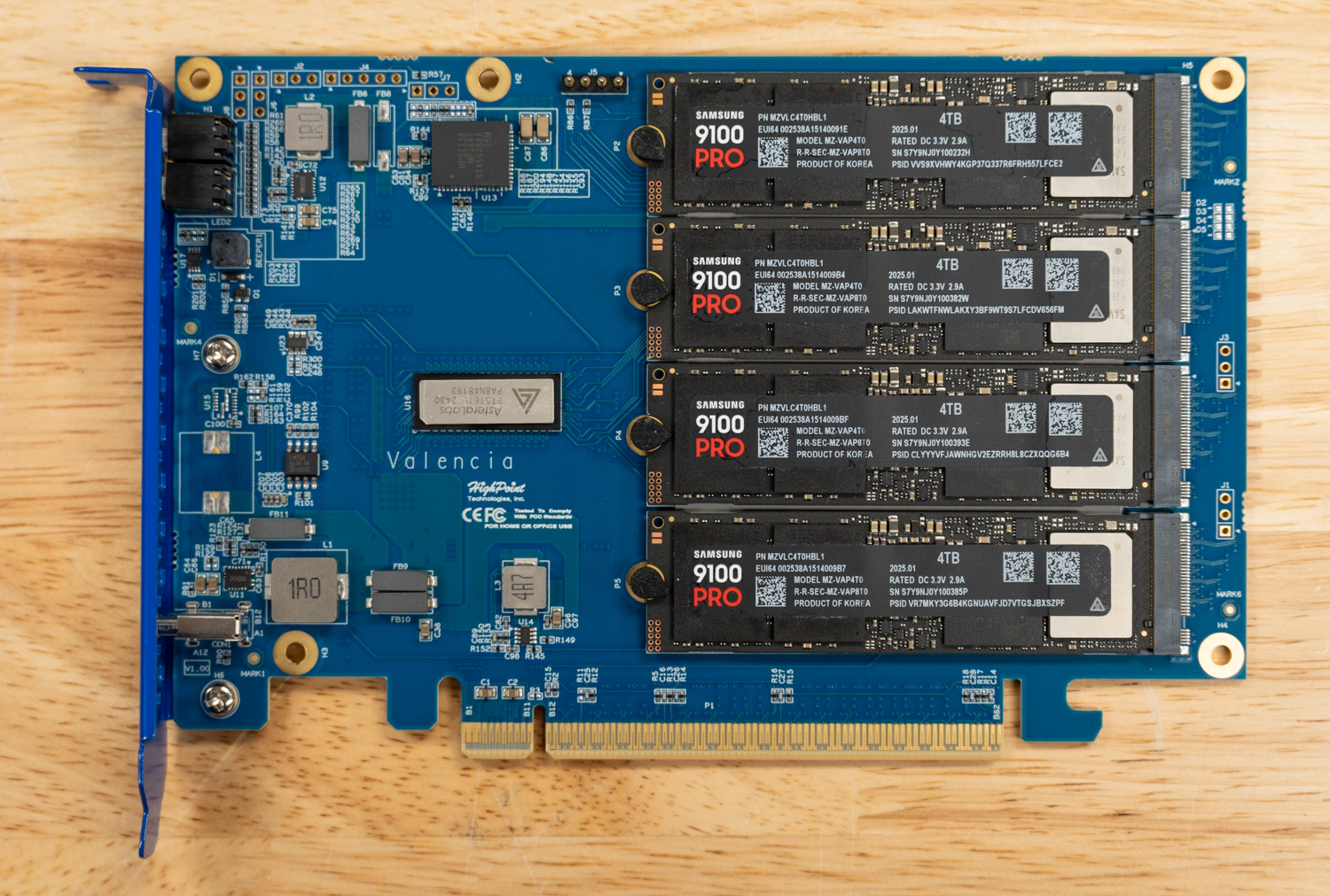
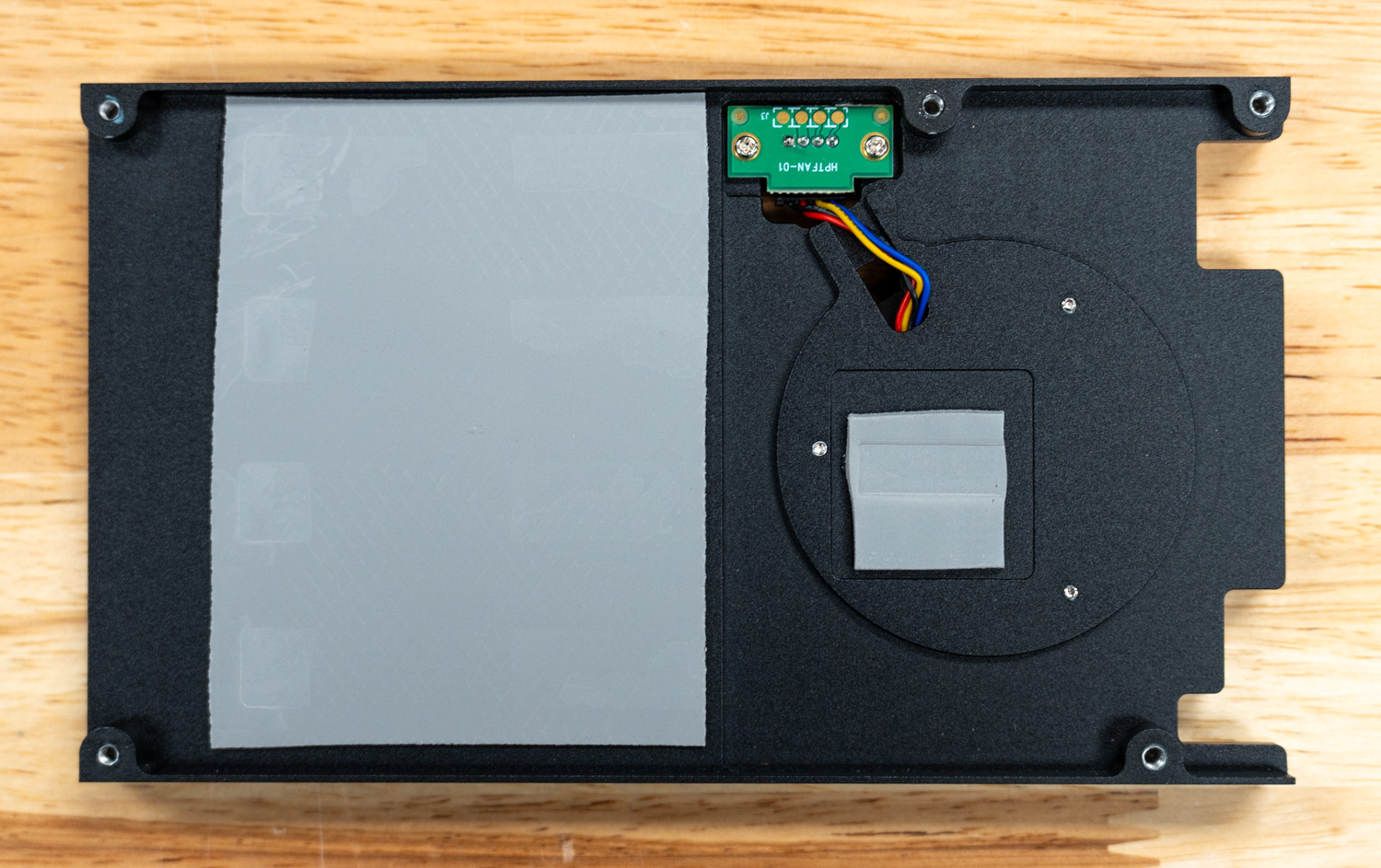
The 1604L’s compact footprint is the visible difference from the sprawling four-bay cards of the Gen4 era. Drive installation is conventional: heatsink off, drives into the four sockets, thermal pads aligned, heatsink back on. The single fan exhausts through the ventilated bracket, which matters in workstation towers where slot airflow is unpredictable. We did not observe thermal throttling from any of the four drives during sustained 60-second test runs.
Testing Setup
We tested the Rocket 1604L in our consumer Threadripper platform, the same water-cooled rig that has handled our recent high-end GPU and HEDT CPU reviews. The card was installed in a Gen5 x16 slot configured for x4/x4/x4/x4 bifurcation.
StorageReview Threadripper Test Platform
- CPU: AMD Ryzen Threadripper 7980X (64C/128T)
- Motherboard: ASUS Pro WS TRX50-SAGE WIFI
- RAM: 128GB DDR5-6400
- Storage: 1TB Gen4 Boot SSD, 4x Samsung 9100 PRO 4TB (FW 0B2QNXH7) on the Rocket 1604L
- OS: Ubuntu Server 24.04
The four Samsung 9100 PRO drives are each rated at 14,800MB/s sequential read, 13,400MB/s sequential write, 2,200K random read IOPS, and 2,600K random write IOPS, which puts the theoretical aggregate at 59.2GB/s read and 8.8 million random read IOPS. Since a Gen5 x16 slot tops out at roughly 63GB/s of usable bandwidth, the drives, not the slot, are the ceiling in this configuration. That is the right way around; a card like this should never be the bottleneck.
All workloads were run with FIO 3.36 using the io_uring engine against the raw block devices, with a 5% LBA span per drive, 60-second runtimes with a 5-second ramp, and one job per drive at QD64 for sequential transfers or 16 jobs per drive at QD32 (64 total) for 4K random. These are burst-oriented consumer test parameters rather than enterprise steady-state methodology, consistent with how we evaluate client platform accessories.
HighPoint Rocket 1604L Performance
Sequential Bandwidth
| Workload (4 drives aggregate) | IOPS | Bandwidth | Avg Latency | 99th % Latency |
|---|---|---|---|---|
| 128K Sequential Read, QD64 | 424K | 55.6GB/s | 604µs | 906µs |
| 128K Sequential Write, QD64 | 279K | 36.5GB/s | 918µs | 1,303µs |
| 64K Sequential Read, QD64 | 668K | 43.8GB/s | 383µs | 570µs |
| 64K Sequential Write, QD64 | 462K | 30.3GB/s | 553µs | 914µs |
The headline number is the 128K sequential read result of 55.6GB/s, which works out to 13.9GB/s per drive, or about 94% of Samsung’s 14,800MB/s rating for the 9100 PRO. Getting four Gen5 drives to within striking distance of their individual spec sheets, simultaneously, through a single add-in card is the result that validates the retimer architecture. Average latency held at 604µs with the 99th percentile at 906µs, and per-drive utilization stayed pinned above 99% for the duration of the run. The 64K read result of 43.8GB/s trails the 128K figure as expected, since larger transfers amortize protocol overhead more efficiently.
Sequential writes landed at 36.5GB/s at 128K and 30.3GB/s at 64K. That is below the four drives’ combined 53.6GB/s write rating, which is a drive behavior rather than a card limitation: vendor write specs reflect short bursts into pSLC cache, while our 60-second sustained runs push past that window. The write latency profile stayed orderly, with the 128K test averaging 918µs and holding 1,303µs at the 99th percentile.
4K Random Performance
| Workload (4 drives aggregate) | IOPS | Bandwidth | Avg Latency | 99th % Latency |
|---|---|---|---|---|
| 4K Random Read, QD32 x 64 jobs | 8.83M | 36.2GB/s | 231µs | 553µs |
| 4K Random Write, QD32 x 64 jobs | 10.1M | 41.5GB/s | 202µs | 461µs |
The random results are the cleanest evidence that the 1604L’s data path is transparent. Samsung rates the 9100 PRO 4TB at 2,200K random read IOPS, and four of them behind the 1604L produced 8.83 million, which is the rated aggregate almost to the decimal. Random write reached 10.1 million IOPS against a theoretical ceiling of 10.4 million, about 97% of spec. Writes-outrunning-reads looks odd at first glance but matches the drives’ own ratings, helped along by the 5% working set, which keeps the controllers operating in their happiest caching range.
Latency under these loads stayed tight, averaging 231µs for reads and 202µs for writes, with 99th percentile figures of 553µs and 461µs, respectively. The other observation worth passing along is host cost: driving nearly 10 million IOPS through 64 FIO jobs consumed roughly 60% of the system CPU time over the run. The card will hand a workstation more storage performance than most applications can absorb, and feeding it is a workload in its own right.
Conclusion
The Rocket 1604L does one job, and our test data shows it doing that job with effectively no overhead. Four Samsung 9100 PRO 4TB drives delivered 55.6GB/s of sequential read bandwidth, 8.83 million random read IOPS, and 10.1 million random write IOPS through the card, figures that sit at 94 to 100% of the drives’ combined ratings. For a device whose value proposition is invisibility, that is a clean sweep.
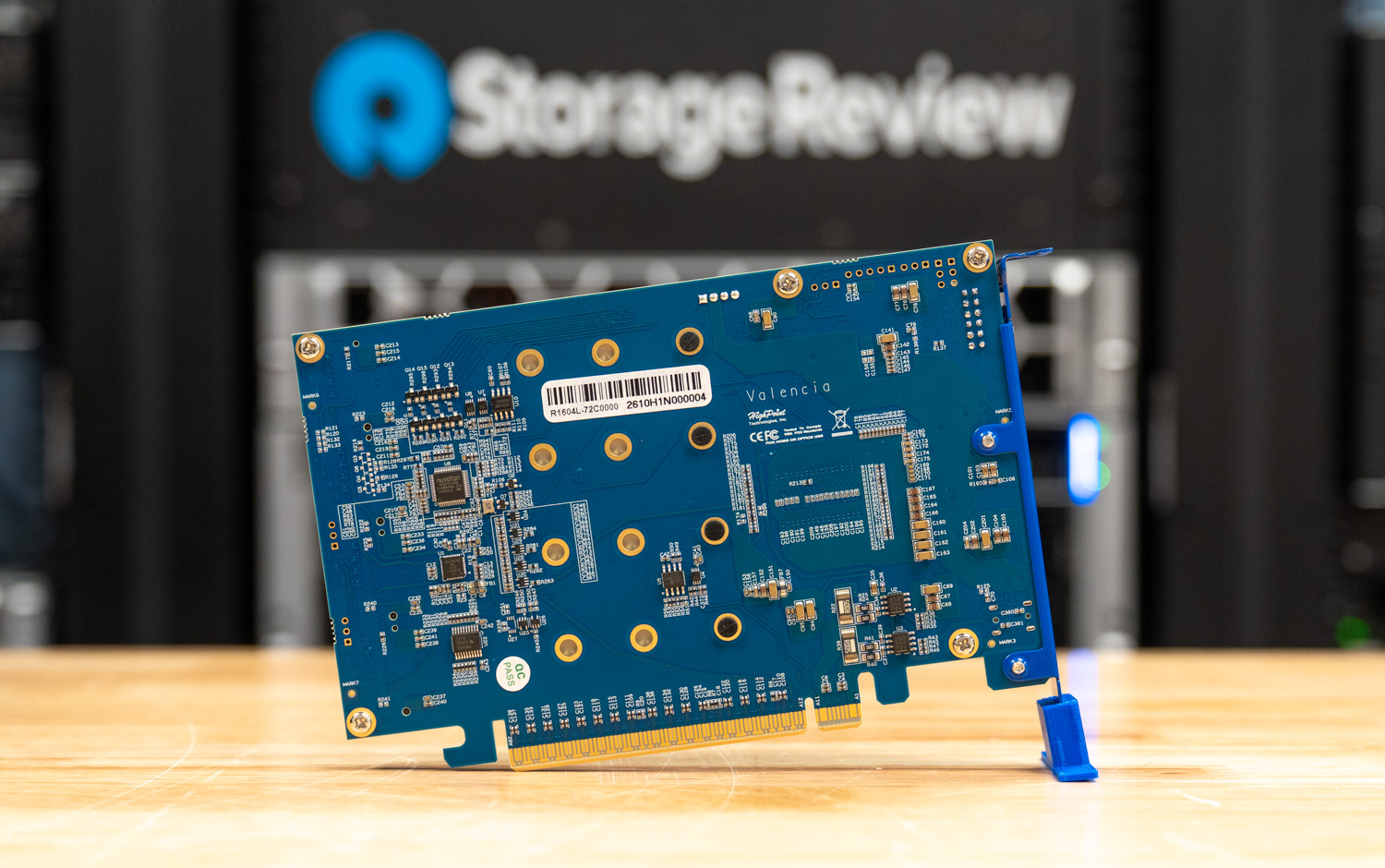
The buyer’s question is whether the $399 ask is justified, given that passive bifurcation cards sell for a fraction of that price. At Gen4 and below, it often is not. At Gen5, the signal integrity margin is thin enough that the retimer earns its keep, particularly for users planning to load the card with drives that each move 14GB/s. Worked out per bay, $100 per Gen5 M.2 slot with cooling and monitoring included is reasonable against the alternative of unstable link training on a passive card, and it undercuts switch-based options while preserving the full bandwidth of every port.
Who should buy it: TRX50, WRX90, Xeon W, and server platform owners who want 16TB or more of Gen5 flash in a single slot for media work, AI dataset staging, or scratch space, and who are comfortable with OS-level RAID or none at all. Who should not: anyone on a platform without x4/x4/x4/x4 bifurcation support, who should look at the switch-based Rocket 1604A instead, and anyone needing bootable hardware RAID, which is the Rocket 7604A’s territory. Buyers running Gen4 drives can also save money with simpler cards, since the retimer’s advantages are largely wasted below 32GT/s.



 Amazon