

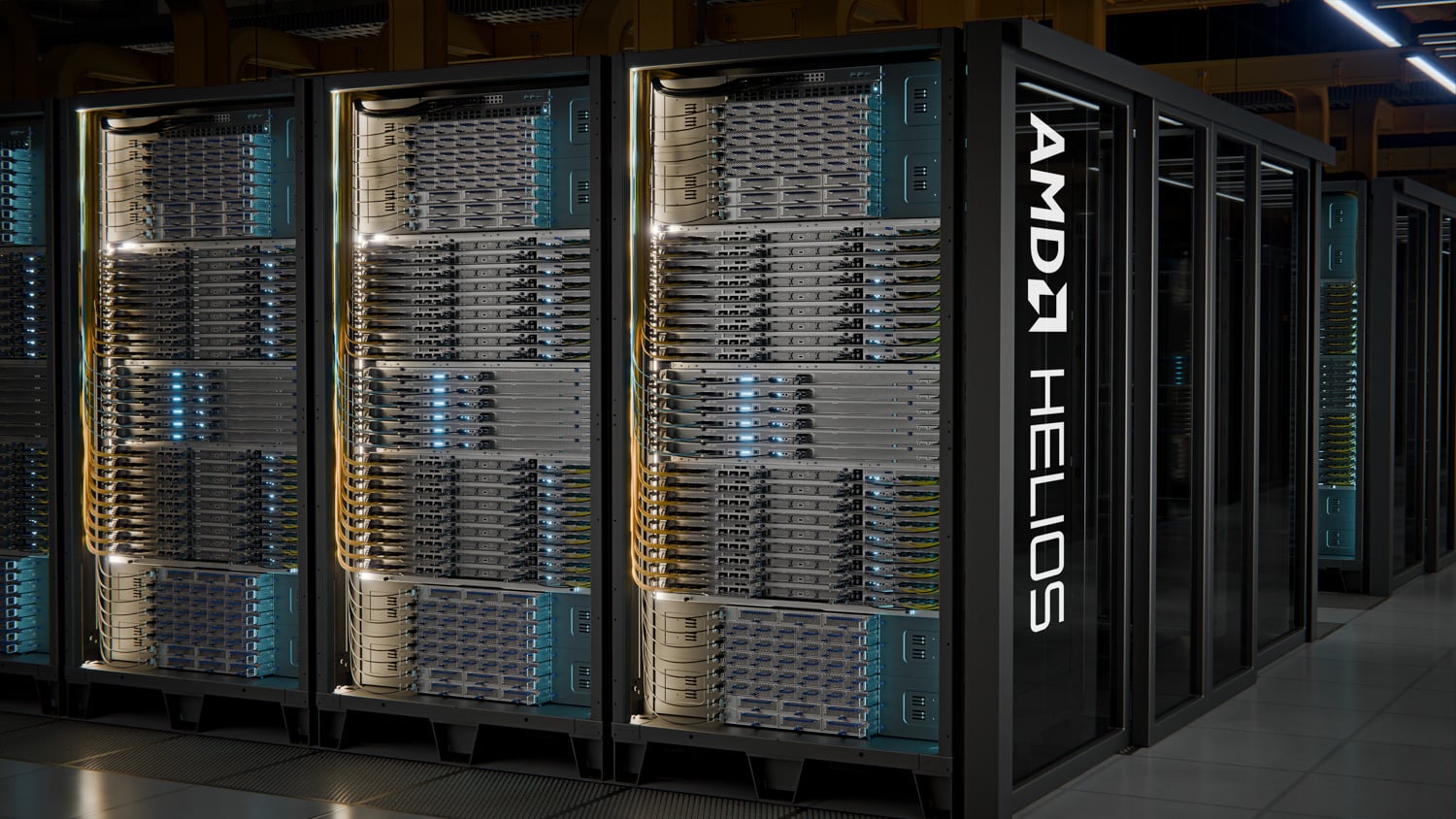
AMD says the first AMD Helios rackscale systems are installed and under test at Meta, with a broader deployment to follow, and that the two companies have aligned product roadmaps around Meta’s workloads across EPYC CPUs, Instinct GPUs, Pensando networking, and ROCm. The same announcement puts EPYC behind Meta’s Muse personal AI agent, adds Day-0 AMD support for the Muse Spark Open and Muse Glimmer models, and commits AMD to a $1 billion investment in Meta’s equity offering.
“AMD has been a key partner in building out the compute that’s running our frontier models,” said Mark Zuckerberg, founder and CEO, Meta. “We’re making big investments in the computing power that will enable us to bring personal superintelligence to everyone, and AMD plays an important role in that.” Lisa Su, Chair and CEO, AMD, said: “With Helios now running at Meta, we are taking that partnership to a new scale in the superintelligence era.”
Rackscale Helios Architecture and Enterprise CPU Rollout
AMD gives no rack count or site for the Helios installation and no date for the broader deployment beyond “the near future.” On the CPU side, Meta has deployed millions of EPYC processors across multiple generations and is a lead customer for 6th Gen EPYC, which supports the dedicated computing environments behind Muse. The companies are also collaborating on future EPYC generations, including the part AMD calls “Verano.”
Custom Instinct Accelerators and Software Optimization
Meta runs AMD Instinct GPUs in production for training, ranking, and recommendation engines. The custom silicon is what separates this from a volume purchase: Meta was an early definition customer for the Instinct MI450 architecture and will deploy a custom Instinct GPU optimized for its workloads. AMD says the collaboration is informing future platforms, including the Instinct MI500 series and next-generation rack-scale systems.
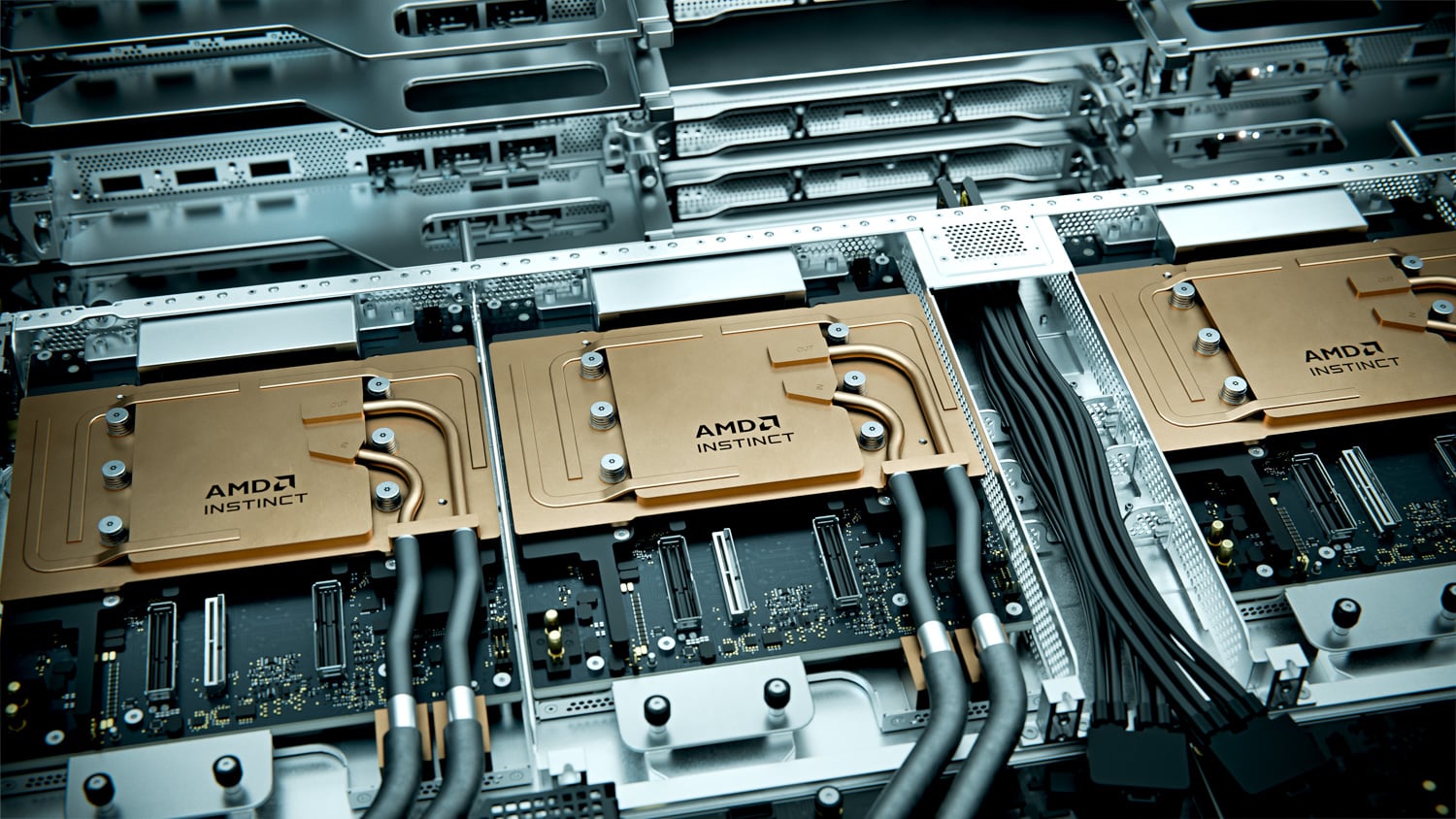
The software work runs through PyTorch so that ROCm support is in place when a developer pulls the framework. AMD and Meta have optimized recommendation model training on Instinct MI350X GPUs and are contributing the improvements back to PyTorch, Triton, and ROCm. On the model side, AMD delivered Day-0 support for Muse Spark Open on Instinct GPUs, and for Muse Glimmer on Ryzen AI PCs and Radeon GPUs, which puts that model on client hardware from the start.


 Amazon