

CTERA has announced a new integration with n8n, the agentic workflow automation platform, to connect enterprise file data with AI services, applications, and business processes. The integration extends the CTERA Intelligent Data Platform into the rapidly growing ecosystem of agentic AI and workflow automation tools while maintaining enterprise governance and security controls.
The integration introduces native CTERA community nodes for n8n, enabling organizations to build workflows to securely search, access, and manage data stored within a CTERA enterprise data fabric. The platform spans edge locations, corporate sites, and cloud environments, providing a centralized framework for accessing distributed file data.
Bringing Enterprise File Data into AI Workflows
A key objective of the integration is to make unstructured enterprise content more accessible to AI-powered automation. Organizations can securely connect file data managed by CTERA to hundreds of applications, AI services, databases, and business systems within the n8n ecosystem.
CTERA’s platform classifies file data and adds contextual understanding, turning traditional file repositories into data sources that AI agents and automated workflows can act on. Rather than relying solely on file events or basic triggers, workflows can draw on content’s meaning, classification, metadata, and compliance status.
Content-Aware Automation
The integration enables n8n workflows to incorporate CTERA Search, CTERA Classify, and CTERA Experts capabilities. This allows workflows to make decisions based on file content, metadata, compliance classifications, and business context.
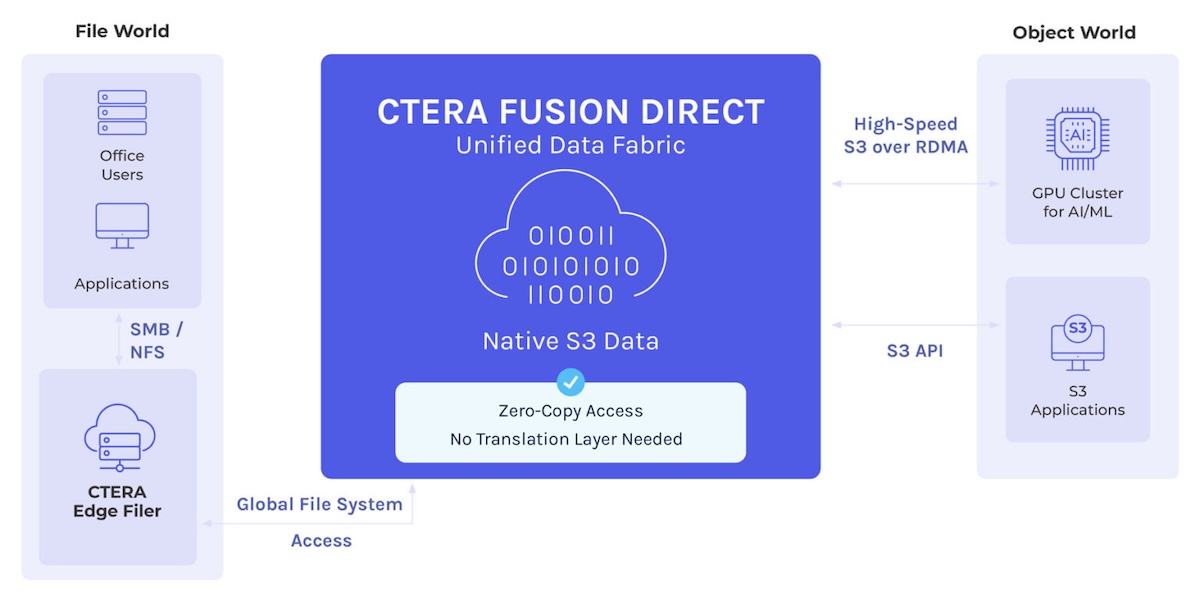
By incorporating content-aware decision-making into automation pipelines, organizations can create workflows that go beyond basic task orchestration. Automated processes can evaluate compliance requirements, understand document context, and act on enterprise content with greater accuracy.
Simplifying Workflow Development
CTERA also highlights the ability to accelerate automation projects using n8n’s visual workflow designer. Organizations can create integrations and business processes without extensive custom development, reducing implementation complexity while leveraging governed enterprise data sources.
An early adopter, Bezeq Group, one of Israel’s largest telecommunications providers, is exploring the integration across its hundreds of terabytes of CTERA-managed file data. “Bezeq differentiates itself with customer service, and we believe that AI and automation will play a key role in supporting our customers and helping improve and streamline internal workflows across all departments,” said Igal Muginstein, Storage Team Manager in Bezeq’s Engineering & Network Division, citing the company’s interest in pairing n8n with CTERA’s data classification.
The combined platform is intended to support a range of enterprise use cases, including compliance-driven document routing, AI-assisted knowledge management, file lifecycle automation, secure collaboration workflows, and integration with broader business processes.
Focus on Production AI Deployments
CTERA CEO Oded Nagel said organizations are increasingly moving from AI experimentation to production deployments, creating a greater need for trusted enterprise data sources. He noted that the n8n integration allows organizations to connect automation and AI initiatives directly to governed enterprise content while maintaining security and operational controls.
According to CTERA, the integration is designed to help organizations transform enterprise storage from a passive repository into a platform that actively supports automation, AI-driven workflows, and business decision-making.


 Amazon