

FS has organized its AI optics into a two-part portfolio: Scale-Out transceivers at 400G, 800G, and 1.6T for the links inside a GPU cluster, and Scale-Across coherent modules at 400G and 800G for stitching clusters together across sites at distances up to 500 km. The Scale-Out side covers Ethernet, RoCE, and InfiniBand fabrics between GPU servers, NICs, switches, and racks; the Scale-Across side ships in OSFP and QSFP-DD for data center interconnect. Alongside both, FS is positioning the BOX 5 Ultra, a handheld toolkit for configuring, validating, and monitoring transceivers from 100M to 1.6T without a switch in the loop. The announcement is a packaging of parts FS has released one at a time since December, so the useful view is how they line up.
1.6T at the Top of the Scale-Out Stack
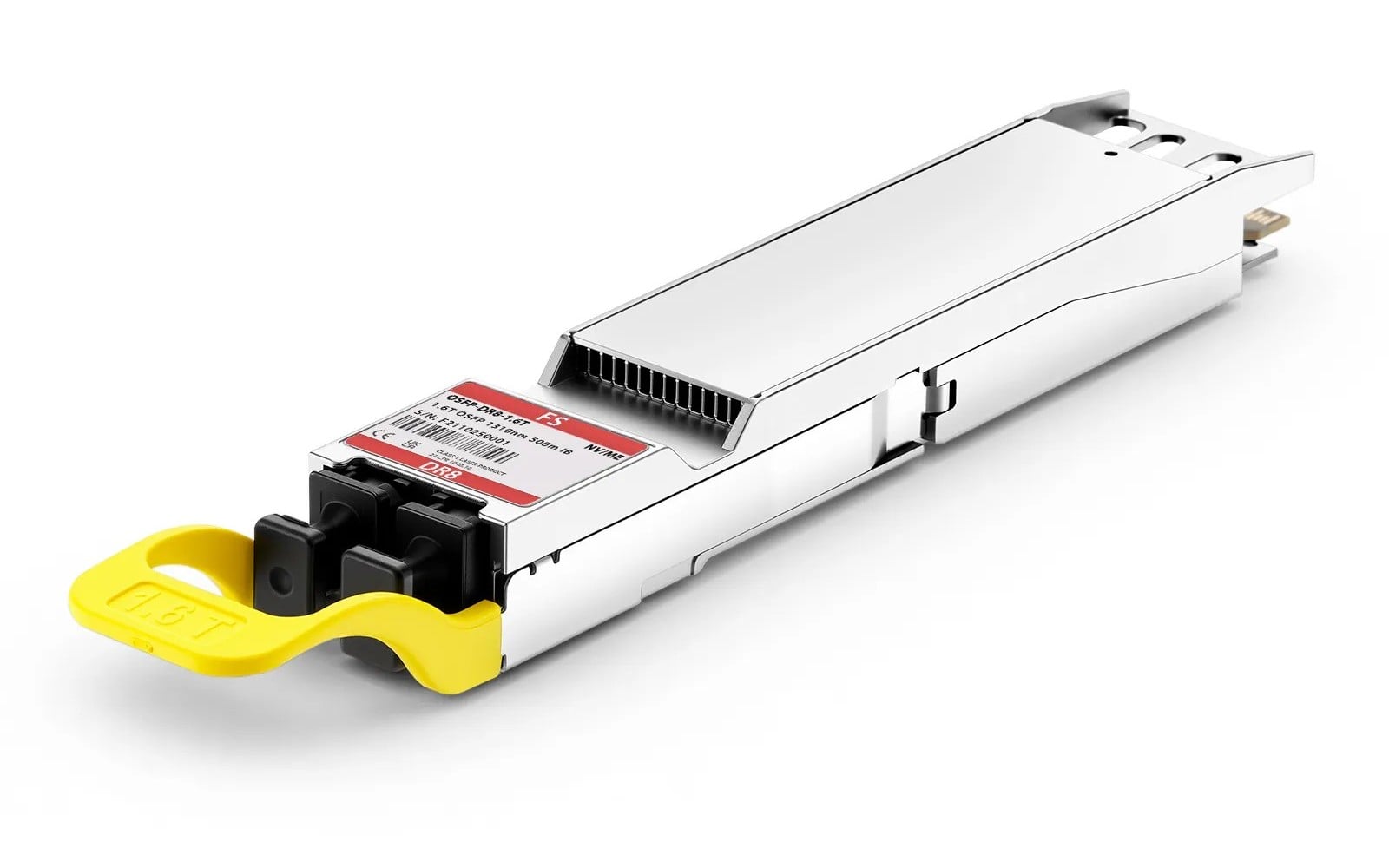
The 1.6T parts are the OSFP-DR8-1.6T and OSFP-2FR4-1.6T, twin-port OSFP modules with a closed finned top that FS introduced for InfiniBand XDR networks. Both take 8x 200G PAM4 on the electrical side and run a Broadcom 3nm DSP. The DR8 uses silicon photonics with a CW laser, drives dual 4x 200G optical lanes at 1310nm over dual MTP/MPO-12 connectors, reaches 500 meters, and tops out at 25W; the 2FR4 uses EML transmitters and CWDM4 wavelengths over dual duplex LC, reaches 2 km, and draws up to 26W. FS says the modules are 100% verified on NVIDIA Quantum-X800 switches and lists NVIDIA part numbers (MMS4A00 and MMS4A50-XM) they’re built to match, with the DR8 aimed at 1.6T switch-to-switch links and 1.6T-to-two-800G breakouts into DGX B300 systems. That puts FS in the same 200G-per-lane generation the hyperscalers are buying into, whether through Qualcomm’s 1.6T interconnect deal with Amazon or the startup optics Lumilens is already shipping, at the compatible-module end of the market where FS competes on price and availability.
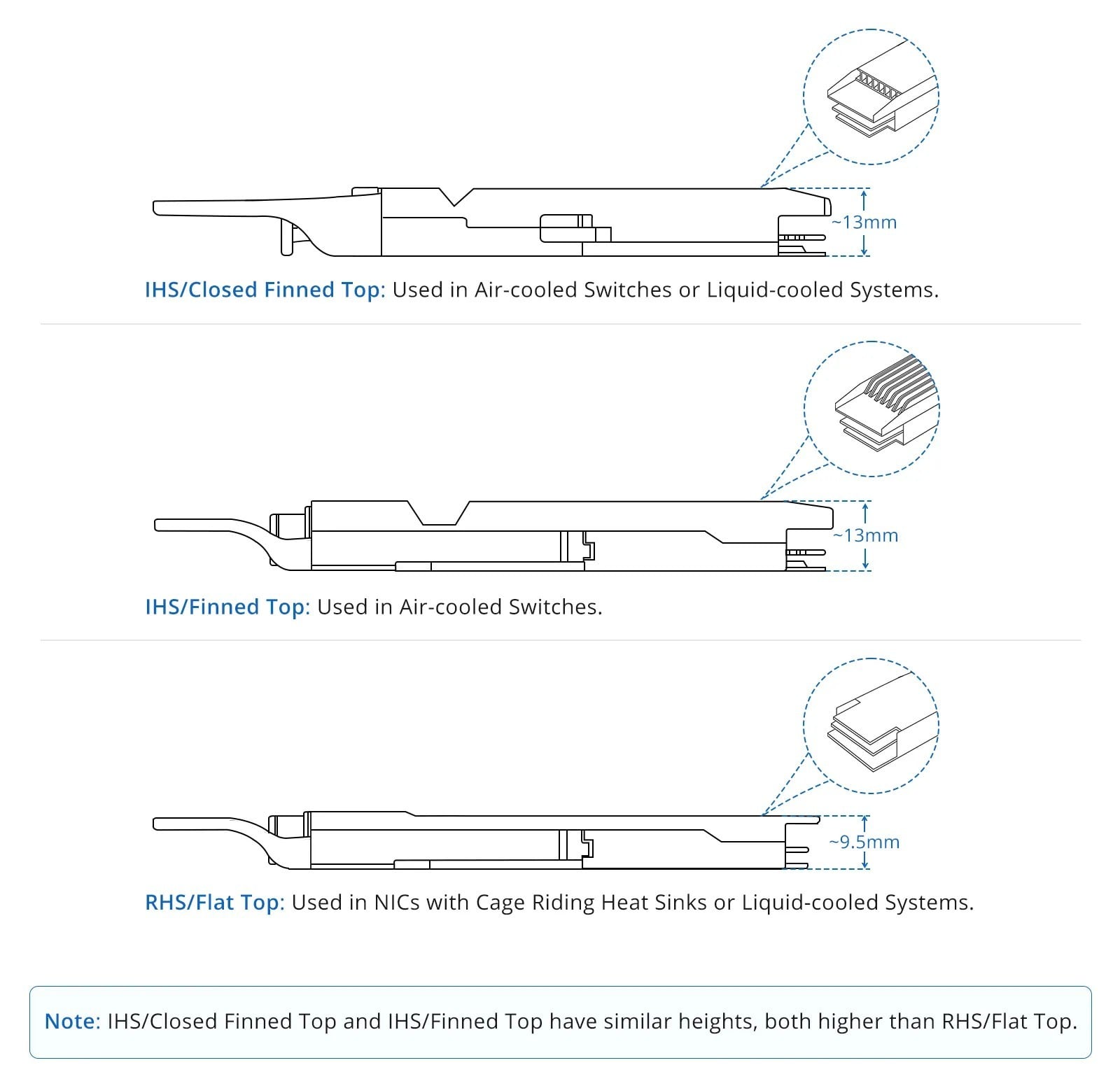
The form factor detail matters more at 1.6T than it did at 400G. FS’s diagram shows the three OSFP tops it sells: the closed-finned top and the open-finned top both stand about 13mm and are meant for air-cooled switch cages (the closed version also works in liquid-cooled systems), while the flat top at roughly 9.5mm is for NICs with cage-riding heatsinks or liquid-cooled gear. The release says the 400G-to-1.6T lineup spans multiple form factors to match specific accelerator platforms, and that’s the choice it’s referring to: the same optics in the shape a given switch or NIC can cool.
800G Coherent for Scale-Across, and the Muxponder Behind It
The Scale-Across modules are the 800G ZR/ZR+ coherent optics FS launched in July, in OSFP and QSFP-DD, built on a Marvell 5nm DSP. FS rates them for 120 km and 500 km over single-mode fiber depending on the line, supports C-band and L-band operation to get more out of a fiber pair, and lists compliance with the OSFP and QSFP-DD MSAs plus 800ZR, OpenZR+, and OIF specifications, with Open FEC and CMIS/C-CMIS management. The 500 km figure in this week’s announcement is that July spec, restated with the caveat that reach depends on network configuration and optical line conditions.
For sites that aggregate client traffic before it reaches the line side, FS added the D7070 Series muxponder in August: a 1U box that takes 100GbE and 400GbE client services on QSFP28 and QSFP112 and puts them onto four 800G coherent wavelengths through CFP2-DCO line pluggables, for 3.2 Tb/s per platform, with WebGUI and CLI management for third-party NMS integration. “As AI and cloud workloads accelerate inter-site traffic growth, customers need DCI networks that can scale with demand while maximizing existing infrastructure,” said Bener Peng, product R&D manager at FS, when the D7070 launched.
BOX 5 Ultra: Provisioning Optics Without a Switch
The FS BOX 5 Ultra is the operations piece. It’s a portable transceiver toolkit that handles data rates from 100M to 1.6T across 15 form factors, OSFP, QSFP-DD, QSFP112, SFP-DD, and SFP among them, and FS says it works with modules from more than 200 brands. The functions are transceiver configuration, compatibility validation, module information reading, DDM monitoring, batch management, and wavelength tuning for tunable DWDM modules; the product page adds cloud batch coding, database access for easy config, and a 3,200mAh battery FS rates at up to 8 hours. The pitch is that a field tech can code, verify, and tune a tray of optics on a bench before any of them touch a production cage, which is the kind of work that otherwise eats switch ports and change windows.
FS hasn’t published module-level power or reach for every SKU in the 400G and 800G Scale-Out range in this announcement, and the 1.6T figures above come from the December launch of those specific parts. “The evolution from 800G to 1.6T is not only about higher speed but also about reshaping the optical interconnect architecture for AI,” said Kyrie Zhang, senior product manager at FS, at that launch, and the September portfolio is the company drawing the map around it.


 Amazon