

Fujitsu is bringing its 2nm FUJITSU-MONAKA processor to AI infrastructure with a new server family designed to run AI inference in air-cooled data centers without requiring specialized liquid cooling. The MONAKA Server is designed, developed, and manufactured in Japan, with component and manufacturing traceability for sovereign AI deployments.
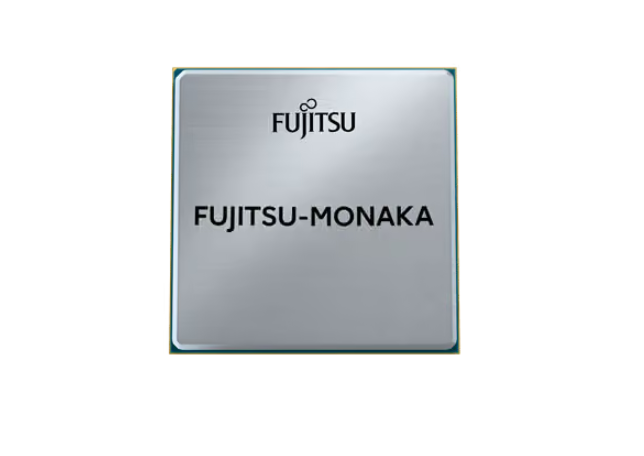
The first MONAKA Servers will come in 1U and 2U configurations for AI inference and AI agents, with a separate 2U multi-node system planned for academic and HPC environments. Fujitsu is also making the MONAKA processor available separately for cloud and data center operators and other server vendors.
MONAKA runs at up to 3.8GHz and supports memory transfer speeds up to 8800MT/s, with dedicated matrix instructions and SVE2 vector processing accelerating AI inference directly on the CPU. Fujitsu rates MONAKA at twice the AI inference throughput of other CPUs, although it hasn’t identified the processors used for that comparison or provided benchmark results.
MONAKA Brings AI Inference to Air-Cooled Servers
The 1U MONAKA Server supports air cooling at ambient temperatures up to 40 degrees Celsius, while its liquid-cooled configuration supports water temperatures up to 45 degrees Celsius.
Fujitsu rates its server cooling technology for up to an 80% reduction in cooling power consumption, although specific system configurations and test conditions weren’t provided. The air-cooled configuration is particularly interesting for data centers that want to add AI inference capacity without changing their existing cooling infrastructure.
The processor itself uses a 3D-stacked design that combines CPU cores manufactured on a 2nm process with cache and I/O produced at 5nm. Fujitsu pairs the design with its ultra-low-voltage operation technology, which is where it says the power efficiency comes from.
Confidential computing is implemented at the hardware level through Arm CCA, encrypting applications and data while they are running in memory, including workloads operating in multi-tenant cloud environments.
MONAKA is also being developed for integration with accelerated platforms through Fujitsu’s work with NVIDIA to connect MONAKA CPUs and NVIDIA GPUs through NVLink Fusion.
MONAKA Server Keeps Development and Manufacturing in Japan
Sovereign infrastructure is the other major focus for MONAKA Server, with Fujitsu keeping the design, development, and manufacturing of the systems in Japan. Production will take place at the company’s Kasashima Plant, where component origins and manufacturing histories can be tracked through the production process.
That traceability takes the sovereign AI pitch down to the physical hardware, past the usual question of where data is stored or processed. Fujitsu is pairing the domestically produced hardware with its own AI software and management technologies for organizations that need greater control over their infrastructure, data, and supply chain.
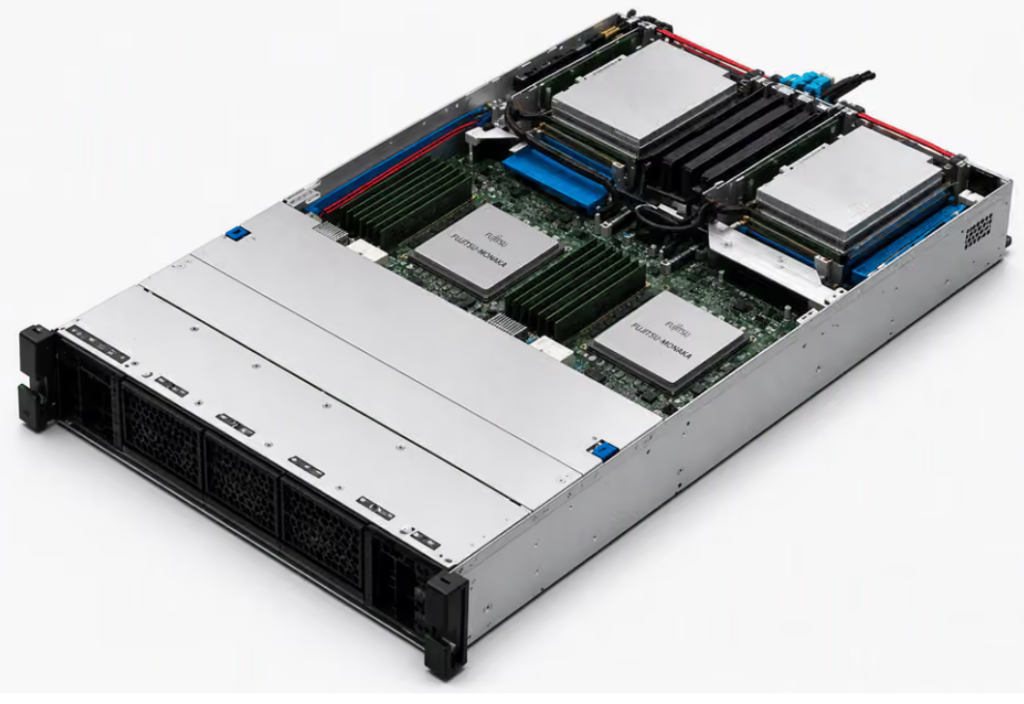
The initial server lineup includes a 2U system with two MONAKA processors and 1U configurations with either one or two CPUs. Both air- and water-cooled deployments are supported, with the systems targeting AI inference and AI agent workloads.
| Specification | 2U Rackmount Model | 1U Rackmount Model | |
|---|---|---|---|
| Features | All-in-one CPU/GPU/NW model optimized for existing DC/Edge environments | Scalable model with flexible configuration and expansion according to environmental changes | |
| Applications | Digital Twin, Physical AI, Agentic AI, AI Inference | Optimized for facility environments; flexible expansion from small to large scale | |
| CPU | Type / Quantity | FUJITSU-MONAKA 2 CPUs |
FUJITSU-MONAKA 1 to 2 CPUs |
| Base Frequency / Cores | 2.1GHz × 144 cores | 2.1GHz × 144 cores (air-cooled) 2.9GHz × 144 cores (liquid-cooled) |
|
| Memory Type / Slots | RDIMM 24 |
RDIMM 12 (1-CPU configuration) / 24 (2-CPU configuration) |
|
| Storage Type / Slots | E3.S SSD × 4 M.2 SSD × 2 |
E3.S SSD × 8 M.2 SSD × 2 |
|
| Expansion Slots | PCIe Gen6 (GPU support available) | PCIe Gen6 | |
| Chassis Size | 2U height | 1U height | |
| Cooling Method | Air-cooled | Air-cooled / Liquid-cooled | |
The 1U MONAKA Server also uses CDI/CXL technology to pool memory and accelerators, allowing those resources to be allocated across systems.
For academic and HPC environments, Fujitsu is preparing a 2U multi-node MONAKA Server with four nodes and two CPUs per node. The configuration is intended for computational workloads including surrogate models and fluid analysis.
| Specification | 2U Multi-node Model (4 nodes per chassis) | |
|---|---|---|
| Features | Multi-node model maximizing processing power within limited power and space | |
| Applications | AI data centers, large-scale simulations | |
| CPU | Type / Quantity | FUJITSU-MONAKA 2 CPUs per node / 8 CPUs per chassis |
| Base Frequency / Cores | 2.9GHz × 144 cores | |
| Memory Type / Slots | RDIMM 24 per node / 96 per chassis |
|
| Storage Type / Slots | E1.S SSD × 2 per node M.2 SSD × 2 per node |
|
| Expansion Slots | PCIe Gen6 | |
| Chassis Size | 2U height | |
| Cooling Method | Liquid-cooled | |
Fujitsu Connects MONAKA With Its AI Software
Fujitsu is extending the sovereign infrastructure approach into software through the Fujitsu Kozuchi AI platform, Takane enterprise generative AI, and industry-specific AI models. The combination brings together the processor, server hardware, AI platform, and generative AI software while supporting domestic data management, governance, traceability, security, and operational autonomy.
Future MONAKA hardware will include higher-density systems for AI data centers and rack-scale servers with autonomous operation features. Fujitsu is also developing robotic maintenance technology for future rack-scale systems, extending automation into physical server operations and maintenance.
Fujitsu’s math on the twice-the-throughput claim is that customers need half the servers and half the power for the same inference load, which is the figure the air-cooled pitch rests on. With no named comparison CPU or published benchmarks behind it, that’s the number to test when systems ship.
FUJITSU-MONAKA Availability
Standalone FUJITSU-MONAKA processors are scheduled to go on sale in November 2026, with availability planned for cloud and data center operators and server vendors in Japan, the US, APAC, and other markets during the fourth quarter of Fujitsu’s fiscal 2026.
Fujitsu also plans to begin sales of its 1U and 2U MONAKA Servers in Japan and Europe in November 2026 to data center operators, enterprises, academic and HPC buyers, and the defense sector. Select customers in the financial, telecommunications, and manufacturing sectors are expected to receive systems during the second half of fiscal 2026, with broader shipments in Japan and Europe scheduled to begin sequentially in April 2027.


 Amazon