

IBM has announced the IBM Storage DS8000 Release 10.2, an update to its flagship enterprise storage platform tailored for IBM Z, IBM LinuxONE, and high-performance, mission-critical environments. The release targets large-scale enterprise demands by focusing on increased drive density, deeper operational telemetry, and automated cyber resilience.
Fifth-Generation FlashCore Module (FCM5)
Release 10.2 introduces the fifth-generation IBM FlashCore Module (FCM5), housed in the redesigned High-Performance Flash Enclosure (HPFE) Gen 3 E3. The architecture transitions the physical medium to the Enterprise and Datacenter Standard Form Factor (EDSFF), providing improved airflow, lower thermal overhead, and integration with Active Energy Management (AEM) for real-time power and cooling observability.
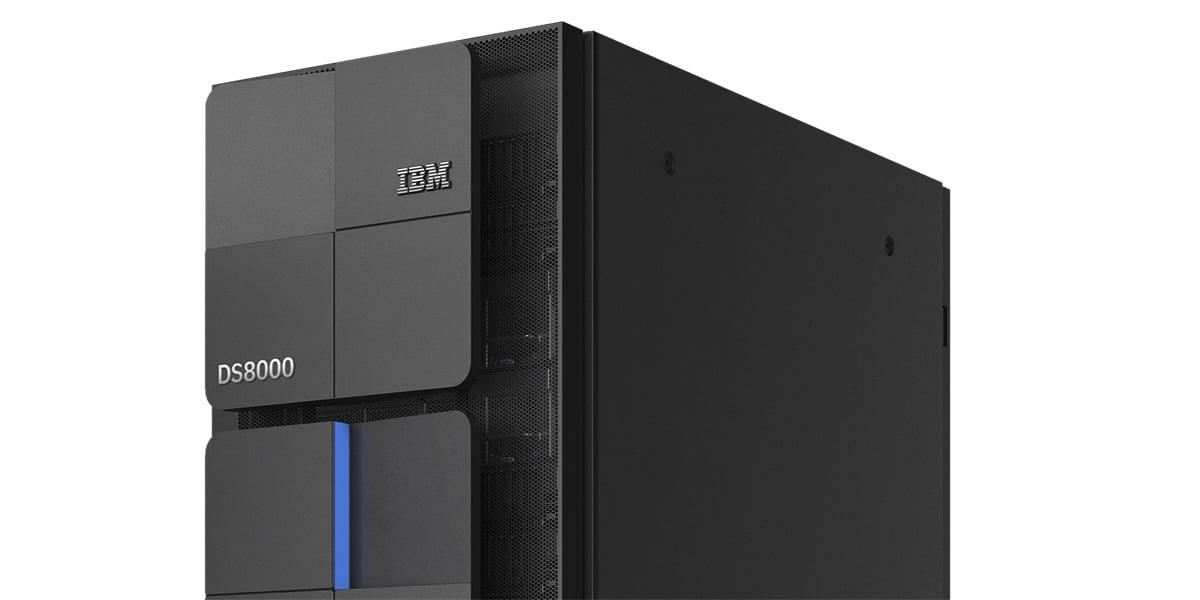
IBM says back-end storage fabric throughput and IOPS are doubled using NVMe over PCIe Gen 4 connectivity. This interface enhancement specifically benefits read-heavy, cache-unfriendly enterprise transaction workloads and large dataset processing.
FCM4 vs. FCM5
The shift from FCM4 to FCM5 represents significant architectural and density advancements across the FlashCore lineup.
| Attribute | FCM4 | FCM5 |
|---|---|---|
| Introduced | 2024 | 2026 |
| Form factor | 2.5-inch U.2 NVMe | EDSFF (Enterprise and Datacenter Standard Form Factor) |
| Enclosure | HPFE Gen 3 (prior design) | HPFE Gen 3 E3 (redesigned) |
| Interface | NVMe over PCIe Gen 4 | NVMe over PCIe Gen 4 |
| Max raw capacity | 38.4 TB | Up to 76.8 TB |
| Max provisionable/effective capacity | Up to 115.2 TB (at 3:1 compression) | Up to 134 TB provisionable per drive |
| NAND technology | Charge Trap QLC NAND | Charge Trap QLC NAND (high-density) |
| Airflow/thermal design | Standard U.2 thermal profile | Improved airflow via EDSFF design |
| Power/thermal observability | Not a defined feature | Active Energy Management (AEM) with real-time power and thermal telemetry |
| Cyber resilience | Introduced in-drive AI ransomware threat detection | Extends in-drive AI threat detection to CKD data with near real-time alerting and automated CSM containment |
| Back-end throughput/IOPS | Baseline for prior generation | Doubled versus baseline, per DS8000 Release 10.2 |
Operational Visibility and Mainframe Integration
Release 10.2 integrates native IBM Storage Insights telemetry directly into DS8000 environments, consolidating health monitoring and performance metrics across both storage systems and SAN fabrics into a unified interface.
For mainframe deployments, the platform incorporates advanced zHyperLink performance statistics. These metrics provide storage administrators with granular monitoring of low-latency channel programs to maintain strict service-level agreements for core transactional systems.
Automated Cyber Resilience and Recovery
Expanding on the threat detection capabilities of Release 10.1, Release 10.2 pairs inline hardware AI with automated remediation workflows. The onboard module intelligence monitors continuous I/O streams for anomalous signatures and ransomware behavior on Count Key Data (CKD) volumes, issuing immediate alerts to operational teams and support channels.
Automated containment is driven via native Copy Services Manager (CSM) integration. When anomalous activity is detected, CSM triggers automated policy actions to isolate affected environments and reduce exposure windows. Furthermore, CSM introduces automated Type 1 infrastructure validation to verify that system environments restart cleanly from immutable Safeguarded Copies. Organizations requiring deep structural validation can extend these protections through IBM Z Cyber Vault and IBM Expert Labs Cyber Vault services.


 Amazon