

IBM and three research partners, the University of Chicago, Algorithmiq, and Qedma, have published separate quantum-computing studies focused on a common barrier to quantum advantage claims: establishing confidence in results that classical systems cannot directly reproduce.
The work spans encoded logical circuits, quantum-material simulations, and error-mitigated many-body physics. In each case, IBM Quantum Heron processors were used to run workloads that the participating teams reported exceeded the practical capabilities of leading classical simulation approaches. The studies and underlying results have been released through IBM’s Quantum Advantage Tracker for continued benchmarking.
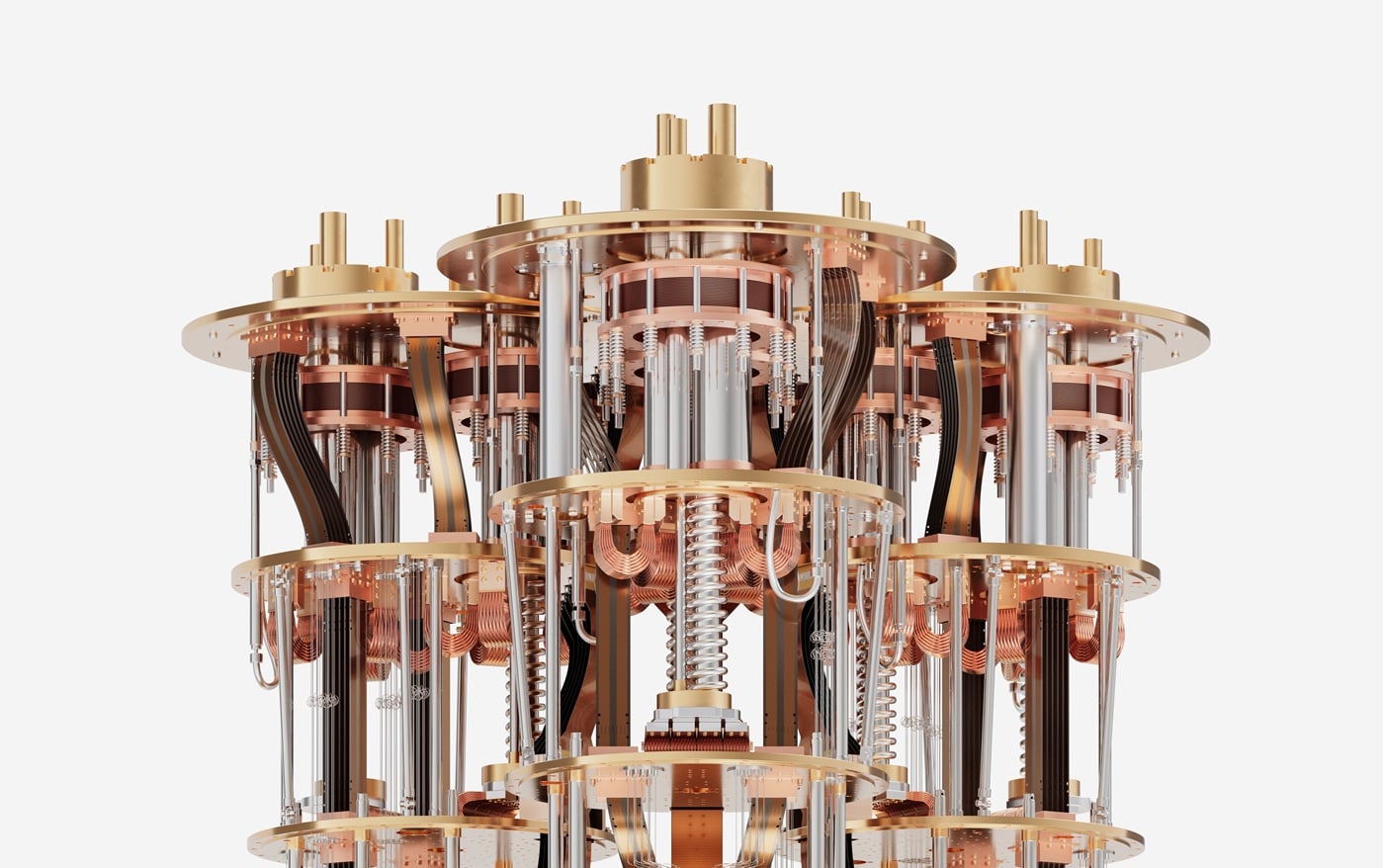
The University of Chicago collaboration demonstrated a structured alternative to random circuit sampling, a common quantum-advantage benchmark that becomes difficult to validate as circuit complexity increases. The technique, which IBM calls doped Clifford sampling, embeds a Clifford circuit in a spacetime code and then strategically adds non-Clifford T gates, making the computation classically hard while preserving the syndrome checks needed to detect errors mid-execution. The paper is titled “Sampling hard circuits with verifiably high fidelity.”
The experiment executed 70 logical qubits, running 2,415 logical two-qubit operations and 468 logical T gates, both of which are measures of circuit complexity. IBM and the university report effective logical error rates roughly ten times lower than the underlying physical error rates, which is what allowed high circuit fidelity at those gate counts. The quantum computation finished in approximately 15 minutes, while the researchers said leading classical simulation approaches faced prohibitive runtimes. IBM describes it as one of the world’s largest known error correction demonstrations, and the result matters because it pairs a beyond-classical workload with a statistical lower bound on execution fidelity.
“We are now firmly in the quantum advantage era,” said Jay Gambetta, Director of IBM Research and IBM Fellow. “We have demonstrated a quantum computation beyond the practical reach of classical computers that establishes, with statistical confidence, a lower bound on how faithfully it was executed. This milestone gives scientists, developers, and businesses a new foundation for trusting quantum computers as they scale to problems far beyond what we can achieve classically.”
Algorithmiq’s study used an IBM Quantum Heron processor to simulate a heterogeneous quantum material, a model built to represent systems with irregular local properties, interfaces, and tunable microscopic couplings. Those effects matter for materials such as catalysts and battery electrolytes, where local disorder alters the movement of energy, particles, and information. The team developed a quantum algorithm to estimate the operator Loschmidt echo, a quantity that tracks how information spreads through such systems, and ran it on 56 qubits.
The workload was first published through the Quantum Advantage Tracker eight months ago, and IBM and Algorithmiq say no classical method has reliably reproduced results across the full problem regime since. Methods from at least three leading classical simulation groups produced predictions that conflicted with each other and with the quantum result. Rather than relying on an unavailable exact answer, the team applied controlled noise injection, modified gate calibrations, and device-noise modeling, and executed across what IBM describes as effectively five quantum computers with different noise profiles, testing whether the quantum result remained stable as noise conditions changed.
Algorithmiq also released monoprop, a benchmark package based on its classical molecular-ground-state simulation methods. The software is intended to allow external researchers to test future quantum-advantage claims against available classical techniques.
“This collaboration with IBM has realized an idea first proposed by Richard Feynman in 1982,” said Matteo Rossi, co-founder and CTO of Algorithmiq. “By simulating quantum matter using a digital quantum processor built from the same physics, we’re able to give researchers a tunable, physically interesting model open to anyone who wants to try to disprove it classically. It is a demanding test case, and it has withstood open challenge for eight months and counting.”
Qedma, IBM, RIKEN, and BlueQubit reported a third study using Qedma’s Quantum Error Suppression and Error Mitigation (QESEM) software on IBM Quantum Heron hardware to model long-lived quantum dynamics in a two-dimensional Floquet Ising system, which physicists use to study how a material’s magnetic properties evolve under rhythmic external driving. Qedma claims this is the first time quantum advantage has been achieved using commercially available hardware and software, with both the Heron system and QESEM available on the cloud. The companies point toward applications in ultrafast optoelectronics and light-induced superconductors.
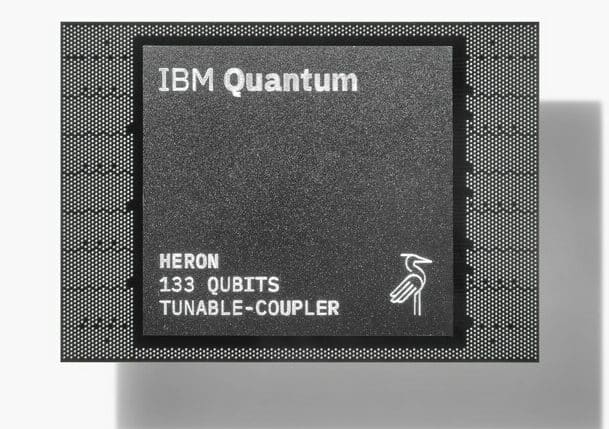
IBM Quantum 133 Qubit HERON
The team reported simulations involving up to 74 qubits. It compared quantum results with several classical methods, including runs on RIKEN’s Fugaku supercomputer and simulations from BlueQubit. At the largest scale tested, the classical approaches did not consistently agree, while the error-mitigated quantum results showed persistent oscillatory behavior.
Qedma’s validation process first compared an unbiased error-mitigation method with classical calculations, in which the latter remained reliable. The researchers then benchmarked a more scalable mitigation method against the validated results before scaling up the workload to larger systems and longer execution times. The study also evaluated behavior on separate quantum hardware, including Quantinuum trapped-ion systems, to help distinguish simulated physics from device-specific artifacts.
Taken together, the three studies move the discussion of quantum advantage beyond runtime comparisons alone. They focus on reproducibility, error characterization, cross-platform validation, and open benchmarking, all of which will be required before quantum systems can be treated as reliable instruments for scientific computing workloads that exceed classical simulation limits.


 Amazon