

Proxmox rolled out version 9.2 of its virtualization platform at the start of this month, which adds official support for 64-bit ARM (arm64/aarch64). Previously, Proxmox VE was available only for x86-64 (amd64). With this release, arm64 builds share the same code base, package repositories, and release lifecycle as x86-64.
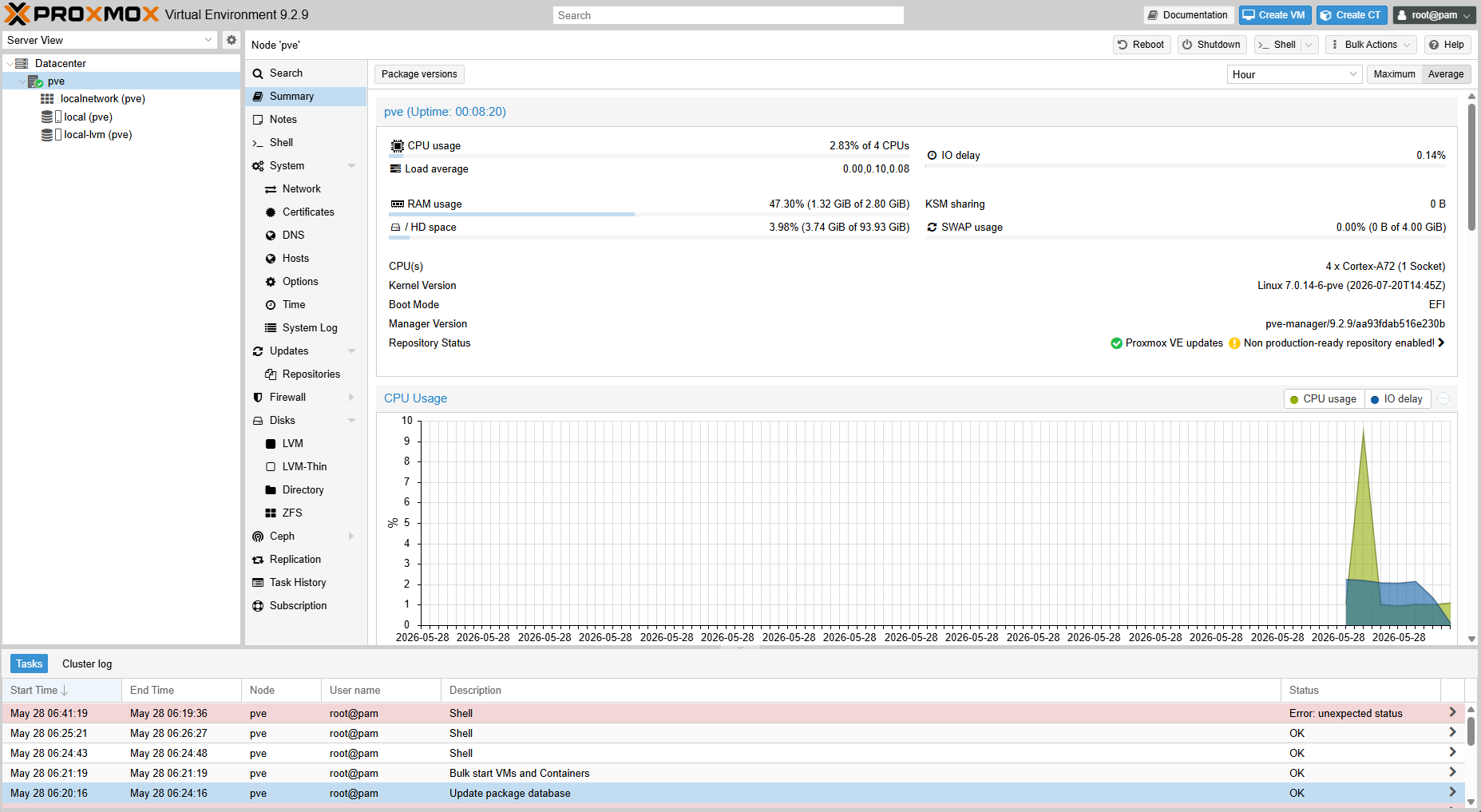
This screenshot is of Proxmox VE 9.2 running on a Raspberry Pi 4, an unofficial configuration that falls outside Proxmox’s supported hardware list.
Proxmox VE 9.2 for arm64 is built on Debian 13.5 “Trixie” with Linux kernel 7.0 as the stable default. It ships the same underlying technologies as x86-64, including QEMU 11.0, LXC 7.0, and ZFS 2.4. Configuration, tooling, and documentation are identical across both architectures aside from a short list of architecture-specific differences.
Platform Support
Full support is limited to the NVIDIA Grace Hopper and NVIDIA Vera platforms. Other UEFI-based ARMv9-A or newer server hardware gets best-effort support, and ARMv8-A hardware generally works as well under the same best-effort terms. The host must boot through UEFI and describe its hardware through ACPI, which rules out device-tree-only devices.
What About Raspberry Pi and ARM Single-Board Computers?
Proxmox has confirmed that the Raspberry Pi and similar single-board computers are not officially supported. The arm64 ISO installer requires a host that boots via UEFI and describes its hardware via ACPI; device-tree-only boards and legacy boot methods fall outside that requirement. Raspberry Pi boards rely on the device tree rather than ACPI by default, so the standard ISO installation path is not available.
That said, Proxmox VE can still be made to run on a Raspberry Pi. Rather than installing from the ISO, it can be installed manually on top of a fresh Raspberry Pi OS Trixie installation, or the Pi can be switched to UEFI boot to align with what the installer expects. Either approach is unofficial and falls outside Proxmox’s supported hardware list, but both have been demonstrated to work.
Architecture-Specific Differences
Virtual machines on arm64 boot through the ARM build of OVMF (AAVMF); SeaBIOS is not available. AMD SEV memory encryption and Intel GVT-g mediated vGPUs remain x86-only features. There is no OS-level CPU microcode package on arm64, unlike intel-microcode and amd64-microcode on x86. Guests run only on nodes matching their architecture, and live migration is limited to nodes of the same architecture. Mixed x86-64/arm64 clusters are not officially supported, and moving a guest between architectures requires offline migration, backup and restore, or shared storage, along with a reinstall or reconfiguration on the target node.
Enterprise Support
Proxmox says arm64 support is not a technology preview. It carries the same release lifecycle and support windows as x86-64. The pve-enterprise repository is available for arm64, and hosts with an active subscription get enterprise support at the same service levels as x86-64. Subscriptions for arm64 are handled separately from x86-64 and are currently available on request through Proxmox’s sales team.

Proxmox credited NVIDIA for its collaboration on the arm64 port, noting the platform is already deployed in production on supported hardware, and said it validated systems with Supermicro as well. The company claims ZFS and Ceph reach feature and performance parity with existing x86 deployments, which matters more than the CPU architecture for anyone running Proxmox as a storage platform.
“Developing directly on NVIDIA Grace Hopper systems let us validate that on production-class hardware from day one,” said Thomas Lamprecht, CTO at Proxmox.
The company said it is working with additional enterprise server vendors and expects to expand its list of officially supported ARM platforms over time. This follows Proxmox VE joining NVIDIA Mission Control as the HA layer for AI factories.
Internal test builds for other Proxmox products, including Proxmox Backup Server, are also in progress, with prioritization based on enterprise customer demand.


 Amazon